Changing Seas
1803 Engineering the Power of Waves | Changing Seas | Preview
Preview: Season 18 | 2m 39sVideo has Closed Captions
Scientists and engineers test ways to both mitigate and harness the power of waves.
At the O.H. Hinsdale Wave Research Laboratory at Oregon State University, scientists and engineers recreate ocean waves to test artificial breakwaters and underwater energy converters. This increased understanding allows engineers to better help protect coastal communities and advance renewable power.
Problems playing video? | Closed Captioning Feedback
Problems playing video? | Closed Captioning Feedback
Changing Seas is presented by your local public television station.
Major funding for this program was provided by The Batchelor Foundation, encouraging people to preserve and protect America’s underwater resources. Additional Funding was provided by The Parrot Family Endowment for Environmental Education. Distributed by American Public Television.
Changing Seas
1803 Engineering the Power of Waves | Changing Seas | Preview
Preview: Season 18 | 2m 39sVideo has Closed Captions
At the O.H. Hinsdale Wave Research Laboratory at Oregon State University, scientists and engineers recreate ocean waves to test artificial breakwaters and underwater energy converters. This increased understanding allows engineers to better help protect coastal communities and advance renewable power.
Problems playing video? | Closed Captioning Feedback
Where to Watch Changing Seas
Changing Seas is available to stream on pbs.org and the PBS app.
Providing Support for PBS.org
Learn Moreabout PBS online sponsorship(waves crashing) (airy pensive music) (waves crashing) - [Dan] It's almost phenomenal just to think about the power that the waves have.
And sometimes you just go out to the coast, you just see the surf is just pounding, pounding, pounding.
(waves crashing) - [Daniel] There's just so much energy.
Everything is changing.
The beach changes, the waves change, the ecosystem changes.
From seconds to minutes to hours to years, everything is changing - [Narrator] Along the Oregon Coast, powerful waves have reshaped the shoreline for centuries.
Winds, astronomical forces, and seismic events transfer their energy into the water and the waves carry this energy thousands of miles across the Pacific before finally breaking along the shoreline.
(waves crashing) Just 60 miles inland, engineers at Oregon State University have brought these ocean waves into the lab.
(bright music) Since 1972, researchers have used the O.H.
Hinsdale Wave Research Laboratory to study everything from tsunamis and storm surge to capturing wave energy.
- [Meagan] We have researchers from all over the world come to do projects here.
(chain rattling) (water splashes) - [Pedro] It's exciting because every single project is different.
There is absolutely nothing that has been done identically two times.
- [Person 1] Whoa!
- [Person 2] Yeah!
(wistful pensive music) - [Narrator] Today, engineers come to the Hinsdale Lab driven by two pressing questions: How can we protect coastal communities from the destructive force of waves?
And how can we harness that same energy to help power the future?
(bright dramatic music) (bright dramatic music continues) (airy haunting music) - [Announcer] Major funding for this program was provided by The Batchelor Foundation, encouraging people to preserve and protect America's underwater resources.
Additional funding was provided by The Parrot Family Endowment for Environmental Education.
(soft bright music) - [Narrator] In Corvallis, Oregon, engineers at Oregon State's O.H.
Hinsdale Wave Lab recreate some of the ocean's most powerful conditions.
Inside the lab's 342-foot-long flume and 14,000-square-foot directional basin, waves generated at scale provide an ideal testing ground.
(waves lapping) (soft bright music continues) - The value of having a wave lab is that you can ask really specific questions that you can't really ask in the field because you can isolate the process and do the test again and again, where in the field you kind of just get all the variability all at once.
So sometimes it's hard to tell if what you're seeing is from this process or from something else.
- So we can just isolate one particular aspect and try to understand that.
There's things that you give up, you know?
Like the real world, you know, we don't have tides, we don't have certain things, but on the other hand, we have control.
That's kind of the hallmark.
We can reproduce the exact same wave time after time.
So some of the guesswork is gone because we can repeat, repeat, repeat.
- This is pure engineering.
It's something that's, you're playing in a sandbox, testing different things out.
You're iterating, you're trying new things, seeing what works, fixing it, and it's all happening in real time and you're doing it physically.
That's not something you often get to do as a coastal engineer.
- So a really good engineer can develop a simulation that's going to show what they want.
It doesn't mean that it's going to work in the real world.
[Geoff] Ready?
- [Engineer] Yeah!
- [Geoff] One, two, three!
(water splashes) But if something works in Hinsdale, you've tested it in real dynamics with real waves on real systems, you have way better chance, much higher chance of it being successful than if you had just tested it in simulation.
(lively music) - [Narrator] At the heart of the lab is the wave machine itself, a computer-controlled system designed to recreate ocean waves at scale.
- We call it a wave machine because behind it there is a muscle, there is a system that drives the motion of that wall that is guided.
The more precision we have, and the more control we have on that motion, the better the quality of the waves we are going to generate.
(water splashing) - [Narrator] In the wave flume, a single paddle generates one wave at a time in the same direction.
In the directional wave basin, 29 interconnected paddles shift position and timing to recreate more complex wave patterns.
- When they move together like this and the wall is like that, the waves goes in that direction.
When I move a little bit faster one than the other, when I do this, the wall adapts itself to the orientation and produces waves in different directions.
- [Narrator] Every experiment begins in the control computer where engineers program wave conditions based on real ocean data.
Instruments throughout the basin then measure the resulting waves in real time.
(waves lapping) - We always are concerned on making sure that that motion replicates exactly what we say.
So what we do is we control the motion of the wave machine and at the same time we make sure that the instruments are running so we are collecting the data of those waves that are happening.
- So we don't know if- So if they're going to start the low water level, we would stop soon?
- I don't know yet.
- I guess we could just drain down to the low water level if the- - It's not that much.
- Okay.
- Like five centimeters or something.
- Yeah!
That takes about a half hour.
- Thanks!
- And we're going to be unidirectional wave plus multidirectional.
One of our jobs is to ensure that the waves we generate have the same shape as the waves that you see in the ocean.
The success comes from there is that we can rely that those waves are going to produce the same effect as another wave with a different scale in the ocean with whatever we are testing.
(pensive bright music) - [Narrator] By recreating realistic ocean conditions, engineers can study how waves shape the coastlines where people are increasingly living and building.
At the ocean's edge, coastal engineering is not simply about construction, it is the science of managing risk.
(waves crashing) - Future coastal engineering, I think, one of the most important things is: How do we manage our risks on the coast?
Personal risk, but also risk as a community, as a society.
We have to make those decisions based on best available information.
- [Narrator] Historically, coastal engineers have learned about wave damage by studying the aftermath of storms long after the waves have passed.
- [Dan] When I do disaster reconnaissance, so oftentimes about four to six weeks after the event, like a hurricane, when Hurricane Ian hit Fort Myers Beach, teams of us go in to document the damage and just that is when it really hits home.
Like, that's the power of water when it runs into something that was never prepared for water.
That's where you really see the destructive power in the waves.
You can just see the extent of that damage, block after block after block, and so that really hits home.
The energy is there, you know?
It's just really strong.
(soft haunting music) - [Narrator] When Hurricane Ian struck Fort Myers, Florida, coastal engineers were offered a rare opportunity to examine storm surge impacts as they occurred.
- A storm chaser put a video camera in the street and documented the damage and failure of a wood frame structure.
It's one of the first videos that I've ever seen where you can see that happening.
(waves lapping) (bright pensive music) - [Narrator] This new perspective inspired Dan and his team to recreate this structural failure scenario in the Hinsdale basin.
(waves crashing) There they could generate waves from multiple directions to simulate realistic storm conditions.
They built two model homes at 1/3 scale to test how varying heights influence wave damage outcomes.
- The height difference in the laboratory was one foot, which equates to about three feet in the real world, and that's roughly the difference between what we call the “hundred-year storm” and the “500-year storm.” So what we wanted to see was, you know, the cumulative effect of this wave energy hitting a building, how it starts to unravel and then ultimately fail.
- [Scientists] Whoa!
- [Dan] We just don't have that type of information, that type of data, from the disasters when we go out to the field.
You know, we have records of before and after, but nothing that's really getting at the mechanics behind how the damage happened and then what led to the unraveling and eventually the failure of the building.
- [Narrator] The results from this experiment and others like it help shape practical standards and codes used to build along vulnerable coastlines.
(slow-paced upbeat music) - [Dan] Engineers come up with their recommended design, but ultimately society's going to say, "Yep, we'll accept that for our code for our city."
There's a little bit of back and forth, and the laboratory is a great place to document that and show people, like, "Well, here's why we're choosing these numbers."
(pensive piano music) (waves crashing) - [Narrator] Along the Southern California Coast, engineers are working not only to mitigate destructive waves, but to reshape how they interact with the shoreline.
In Oceanside, decades of erosion have steadily narrowed the beach, threatening surfing conditions central to the town's identity.
Now, community advocates and engineers are testing a new approach to restoring both the beach and its renowned surf break.
- Oceanside has been suffering from what's called structural erosion for very long time now, going on 60 years, for a couple different reasons.
Really, you just get sand pulled away year after year after year until you have the current condition, which is no beach, and that's not a unique problem to Oceanside.
A lot of Southern California's beaches are facing this same problem, and the reason why this project is so important is it gives another tool in the toolbox of all these coastal communities to hopefully bring back their beach and preserve their surfing resources.
(waves crashing) (soft pensive music) - [Narrator] To help restore the beach, engineers developed a new kind of offshore breakwater reef designed to dissipate and redirect wave energy before it reaches shore.
(waves lapping) This 1-to-35 scale model represents the current reef design shaped through years of computer modeling and refinement.
It will now be tested under a wide range of ocean conditions before the project advances toward construction.
- Physical model testing is, it's not something that happens with every coastal engineering project, although it really is the closest you can get to reality in your design, right?
It really gives us the opportunity to test a lot of the things that our computer models just can't do.
- Wave maker start!
- [Narrator] In the first phase of testing, engineers look at distinct features of the reef that directly impact waves and currents, including the reef's crest height.
To understand variability throughout a typical year, they run a range of conditions: From high to low tides, and from winter to summer, wave patterns that shift direction.
As scaled waves pass over the reef, researchers observe how resulting currents may influence sand retention and surfability.
(waves lapping) - The second phase is what's called stability testing.
So we want to make sure that when we put this reef in the ocean, because it's made out of these large rocks, we want to make sure those rocks are able to withstand the forces that are breaking on it from waves.
- [Narrator] The model reef is constructed from scaled rock materials, matching those planned for the full-scale structure, including a protective armor layer built from rocks weighing up to 15 tons.
(inspirational music) Painted sections allow cameras to track how individual rocks shift as waves strike the structure.
(waves lapping) - So we're tracking with cameras where individual rocks are moving on the structure, places we know that are most vulnerable to movement, and we're going to track those and see: Is that an acceptable level of movement?
Do we see any progressive damage?
So once you get kind of core exposure, damage can progress really quickly and lead to a failure.
And so that's what we want to know is when does that happen, and where on the reef?
- [Narrator] Waves representing increasingly powerful storms are sent toward the structure, including a simulated hundred-year storm equivalent to 18 foot waves in the real ocean, or six inches inside the lab.
- [Daniel] So it's really, really large waves, and so we're going to throw those at our reef and see how our reef does.
Do the rocks survive?
Do they move?
Where do they move?
And how much movement do we see?
- [Narrator] In the final phase, engineers will test sediment transport around the reef, a key measure of the design suitability.
Only then will the project advance, as some questions can only be answered in the ocean itself.
- Until we actually build this reef and put it in Oceanside, everything else is an approximation.
And you can only go so far, right?
There's kind of a fall off point at which the more work you do, you don't really answer any more design questions.
I could stay here forever and test this reef forever because I really enjoy doing it, but at some point you don't really answer more questions.
And the real test is just putting it in the water, and that is the beauty of this project is that it's Oceanside saying, "Look, we need something different and we want to try something new."
And they're really leading the way for California and the entire West Coast.
(waves crashing) (bright wistful music) - [Narrator] In addition to man-made structures, coastal engineers are also studying nature-based solutions like the dune ecosystems along the Oregon Coast, which absorb wave energy and reduce coastal flooding.
- Coastal engineering with nature is focused on how we can use the natural environment as an engineering solution.
We are realizing as communities that we value the natural setting.
And in Oregon we have this phrase, "Keep Oregon Wild," and we value that as a community, and so these nature-based solutions promote that value.
(lively wistful music) - [Narrator] At the Hinsdale Lab, Meagan is using the large wave flume to study how dunes respond to powerful waves, including how different sand conditions and vegetation influence erosion.
- In laboratory experiments, it's really tricky to scale the size of the waves with the sediment because it starts getting cohesive, meaning that it sticks together like mud or clay.
In the flume, we can generate waves that are nearly full scale, so we don't need to reduce the size of the sediment down too much.
- [Narrator] As the largest structure of its kind in North America, the Hinsdale wave flume provides unique opportunities for testing coastal resilience.
- The benefits of the flume are you can do this experiment at a really large scale that's nearly mimicking what we see in the field, and then you can try it again and stop the waves, and try it again and stop the waves.
- [Narrator] This research helps scientists and state agencies better understand how dunes may protect coastal communities during major flooding events.
- The modeling that we're doing now is focused on supporting the Oregon state agencies and understanding the influence of tsunami inundation on the coast.
The dunes and the beaches will change with a big wave like that, so our modeling work is focused on understanding how much change we'll have and how well the dunes can buffer a tsunami or not, depending on the size of the event, and how they might change inundation into the communities.
(pensive music) (waves crashing) (pensive music continues) (waves crashing) - [Narrator] While some engineers work to reduce the destructive impact of waves, others are working to harness the vast amount of energy they carry.
- What we know is that the amount of energy that we have there available is incredible, but we are still studying the way of how to get some little portion of that energy that we can use instead of just letting it dissipate and disappear.
- [Narrator] Around the world, engineers are developing wave energy converters, or WECs, designed to generate electricity from ocean waves in environments ranging from coastal waters to the open ocean.
- Wave energy converters are devices that take the energy that's in that heaving wave, in that up and down motion, or back and forth, or side to side, or rocking or pitching motion, and take that motion and use some configuration of electric generators or gear boxes or hydraulic pumps, many different approaches, to produce electricity.
- [Narrator] At Hinsdale, researchers test wave energy devices of many different shapes and sizes, recreating ocean conditions in both the flume and basin.
- There are many engineering challenges to wave energy converters.
The technology itself, the idea itself, is not that complicated, right?
There's energy that exists in these heaving ocean waves, and we want to try and convert it to electrical energy.
That's not that difficult of an engineering idea.
The challenge is in doing it in a way that's economical and robust.
(bright pensive music) - [Narrator] At Oregon State's Wallace Energy Systems and Renewables Facility, Ted and his team focus on the systems that convert wave motion into usable electricity.
- This is a dry lab, meaning we don't have large scale water systems, so we focus on testing the mechanical operation of the wave energy converter, right?
So when it's articulated, when it's moved, when it's pushed and pulled on, and what type of systems are operating to take that mechanical motion and convert it to electrical energy.
We have the test systems in this lab to focus on those parts, those subsystems.
(bright bouncy music) - [Narrator] One emerging application for WECs is powering autonomous underwater vehicles used for offshore operations, like ocean monitoring and surveying marine structures.
At Oregon State, robotics engineers are using the Hinsdale Lab to help develop systems that will allow these vehicles to dock autonomously in the open ocean.
(bright bouncy music continues) - The docking project is about recharging from the waves, from the marine energy, and if a vehicle can recharge from the waves, it can stay out there forever, indefinitely.
- [Narrator] Over several years, engineers have used the Hinsdale Lab to train and test machine learning systems, or artificial intelligence, that will enable vehicles to dock autonomously with WECs in a wide variety of ocean conditions.
(robotic whirring) - That autonomous docking, you have an underwater vehicle, you have a dock, and the underwater vehicle has a camera, it has a sonar.
And using the camera and the sonar, it needs to localize itself relative to that dock, and needs to do that well enough and effectively enough that it can use controlled algorithms, called model predictive control, in order to go into the dock and get close enough that it can wirelessly recharge from the waves, or from whatever energy source is connected to that dock.
In Hinsdale, we can say, "All right, well, we're not able to do this.
It's too difficult."
We can dial the waves down until we can and then improve and keep stepping up.
If it's too easy, just make it harder.
If it's too hard, we make it easier.
And eventually we increase the capability and we improve the ability to dock to the point where we can do it in conditions that would be reflective of off the shore in Newport or in the ocean, or wherever it is that we want to eventually deploy these vehicles.
- I think it's one of the most advanced and cool things we have done because it is top-notch technology and artificial intelligence and technology that is applied to the experiments that we do.
(fast-paced pensive music) (waves crashing) - [Narrator] Even as computer models and artificial intelligence continue to advance, engineers at the O.H.
Hinsdale Wave Lab believe physical testing remains essential for understanding the complexity of real waves and how they interact with coastlines and engineered structures.
- Physical modeling, so these type of laboratories are going to exist as long as the numerical models needs to be validated, which is all the time.
There are also processes that still the numerical models can't reproduce, particularly random waves, irregular waves, and long duration experiments, sediment transport.
There is no way yet that the models are going to get this.
Maybe one day in the future, but not in the near future, so we are going to still be around for a while.
(waves crashing) (airy bright music) ♪ Ah ♪ ♪ Ah ♪ ♪ Oh, oh, oh, oh, oh, oh ♪ (airy bright music continues) (waves crashing softly) - [Announcer] Major funding for this program was provided by The Batchelor Foundation, encouraging people to preserve and protect America's underwater resources.
Additional funding was provided by The Parrot Family Endowment for Environmental Education.
(upbeat music)
1804 Getting Sharked: Search for Solutions | Changing Seas | Preview
Video has Closed Captions
Preview: S18 | 2m 37s | Scientists test repellents to stop sharks from taking fish from anglers’ lines. (2m 37s)
 Now Playing
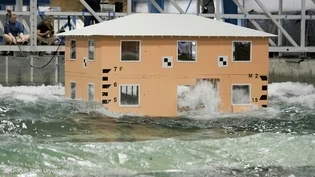
1803 Engineering the Power of Waves | Changing Seas | Preview
Video has Closed Captions
Preview: S18 | 2m 39s | Scientists and engineers test ways to both mitigate and harness the power of waves. (2m 39s)
1802 The Seals of Sable Island | Changing Seas | Preview
Video has Closed Captions
Preview: S18 | 2m 46s | Researchers study gray seals on Sable Island, the world’s largest breeding colony. (2m 46s)
1801 Puerto Rico: Resilience in Action | Changing Seas | Preview
Video has Closed Captions
Preview: S18 | 2m 51s | Puerto Rico’s fishers transform their communities after Hurricanes Irma and Maria. (2m 51s)
Providing Support for PBS.org
Learn Moreabout PBS online sponsorship New Episode
- Science and Nature

Explore scientific discoveries on television's most acclaimed science documentary series.












Support for PBS provided by:
Changing Seas is presented by your local public television station.
Major funding for this program was provided by The Batchelor Foundation, encouraging people to preserve and protect America’s underwater resources. Additional Funding was provided by The Parrot Family Endowment for Environmental Education. Distributed by American Public Television.