
Bisa Butler's first artistic influences
Clip: Season 17 | 3m 48sVideo has Closed Captions
Bisa Butler's first artistic influences
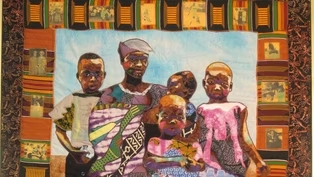
Bisa Butler's first artistic influences from the Children of the Rainbow School to Howard University to the Smithsonian. Bonus video from the EAST episode
Problems playing video? | Closed Captioning Feedback
Problems playing video? | Closed Captioning Feedback
Bisa Butler's first artistic influences
Clip: Season 17 | 3m 48sVideo has Closed Captions
Bisa Butler's first artistic influences from the Children of the Rainbow School to Howard University to the Smithsonian. Bonus video from the EAST episode
Problems playing video? | Closed Captioning Feedback
How to Watch Craft in America
Craft in America is available to stream on pbs.org and the free PBS App, available on iPhone, Apple TV, Android TV, Android smartphones, Amazon Fire TV, Amazon Fire Tablet, Roku, Samsung Smart TV, and Vizio.
Education Guides
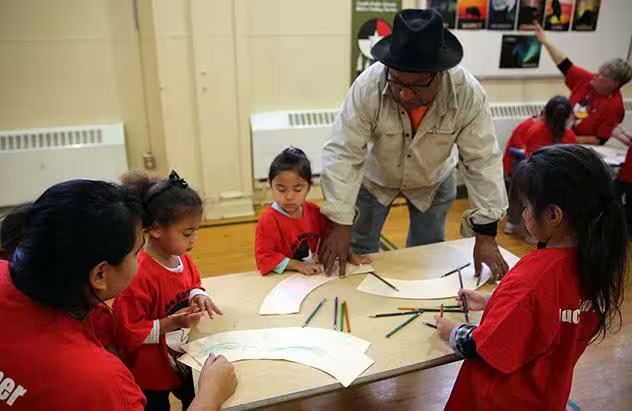
Download Craft in America education guides that educate, involve, and inform students about how craft plays a role in their lives, with connections to American history and culture, philosophies and science, social causes and social action.Providing Support for PBS.org
Learn Moreabout PBS online sponsorshipI was a child of the 70s and this was a time#when music, dance, art, creative thought, all these things were exploding onto the scene.
And my mother was very much a person who sought new and interesting ways to expand her mind.
And we as little kids benefited from that.
We went to the school in a big Victorian house.
It#was called the Rainbow School.
The school was, I guess, an experiment.
There were classrooms,# a reading room, math room, art room, music room, and the children could wander at will to#the rooms that they felt like being in.
If it rained that day, the lesson of the day might be going outside to splash in the mud.
And so I spent all my days in the#art room and it's incredible how much Rainbow School has influenced me later in my life.
My mother was from New Orleans, grew up in#Morocco, so she was into fashion completely.
I haven't seen this one either.
This is based off of# a Gordon.
But my father was a Catholic school boy from Ghana who was a college administrator and was#very much like school is not a fashion show.
Did I know she was an artist?
I really didn't.
And most# of her work she used to hide them under her bed.
I had no clue.
And I really didn't know she was into# until she was a sophomore in college.
And then she called me, you know, dad, I'm switching from# architecture to art.
And I said, "Oh my god, that poor girl is going to starve to death."
At Howard# University, I thought, "I want to be an artist, so I should paint."
But it didn't mean that# painting really spoke to me.
But my professors talked to us a lot about using color to express#emotion.
The dean of fine arts was Jeff Donaldson, who is very well known as the founder in the#60s of an artistic movement called AfriCOBRA.
Their idea was, how can we create an#African-American aesthetic for the arts?
So, they came up with a color palette based on what# people were wearing and fashions on the streets, the pattern bell bottoms and the dashikis and the Kool-Aid colors.
And so, a lot of times when you look at my artwork, you'll see#those Kool-Aid colors still.
And those are also the colors that are in African fabric itself.# They tend to be very bright and very intense.
When she finished college, she became an art#teacher.
And then when she told me she wanted to be a full-time artist, I said, "You're#going to give up a secure job."
And she said, "I got to do it now.
I just feel it#in my spirit and I got to do it."
So we felt that there was a real resonance between sort of the South Carolina family portrait and then... This survey at Smithsonian# American Art Museum will be the first time that even I am seeing works from my#earliest pieces from 2001 until now.
Just goes to show you sometimes, you know, as parents, you know, we have certain ideas and dreams for our kids, but at the end of#the day, they have to follow their dreams.
Video has Closed Captions
Clip: S17 | 6m 50s | Fiber artist L'Merchie Frazier uses her art to tell the untold African American stories (6m 50s)
Video has Closed Captions
Clip: S17 | 9m 42s | Silversmith Ubaldo Vitali makes original work and restores historical silver (9m 42s)
Video has Closed Captions
Clip: S17 | 1m 39s | Three generations at the Institute of American Indian Arts (1m 39s)
Video has Closed Captions
Clip: S17 | 6m 28s | Meet engravers and silversmiths at the silversmithing traditional cowboy arts symposium (6m 28s)
Roberto Lugo's poetry & Orange and Black vessels
Video has Closed Captions
Clip: S17 | 4m 2s | Roberto Lugo is a potter, poet, activist and educator (4m 2s)
Video has Closed Captions
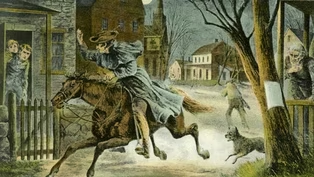
Clip: S17 | 4m 27s | Nina Zannieri, Executive Director of the Paul Revere House on Paul Revere's Midnight Ride. (4m 27s)

Milliner working with custom fabric flowers
Video has Closed Captions
Clip: S17 | 1m 27s | Milliner Gigi Burris on working with M&S Schmalberg flowers (1m 27s)
Video has Closed Captions
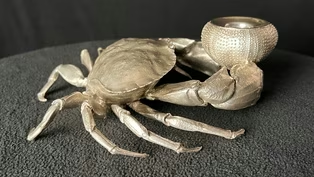
Clip: S17 | 1m 30s | Lost wax casting silver horses and crab candleholders at Ubaldo Vitali's studio (1m 30s)
Video has Closed Captions
Clip: S17 | 2m 20s | Institute of American Indian Arts student on her work and exhibition (2m 20s)
Video has Closed Captions
Clip: S17 | 1m 34s | Institute of American Indian Arts Museum of Contemporary Native Arts (1m 34s)
Video has Closed Captions
Clip: S17 | 2m 13s | IAIA student Whisper Crow Dog & IAIA alumni on Terran Last Gun on ledger art (2m 13s)
Video has Closed Captions
Clip: S17 | 59s | Institute of American Indian Art landscape and environment (59s)
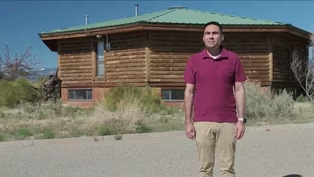
Video has Closed Captions
Clip: S17 | 1m 43s | The hogan on the Institute of American Indian Art campus (1m 43s)

Video has Closed Captions
Clip: S17 | 3m 40s | Community at the Institute of American Indian Arts (3m 40s)
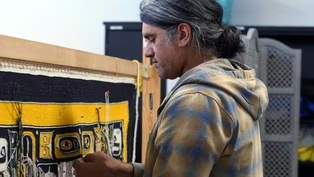
Video has Closed Captions
Clip: S17 | 2m 24s | Institute of American Indian Arts Artist-in-Residence program (2m 24s)
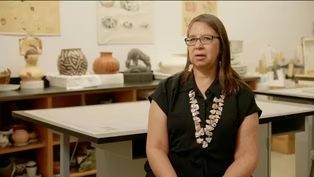
Video has Closed Captions
Clip: S17 | 1m 22s | The Institute of American Indian Arts archives consists of works/records from faculty, alumni (1m 22s)
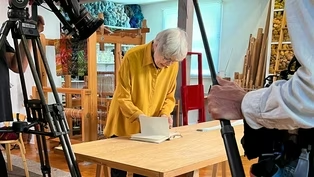
Helena Hernmarck's weaving documentation
Video has Closed Captions
Clip: S17 | 2m 24s | Tapestry artist Helena Hernmarck's weaving documentation (2m 24s)
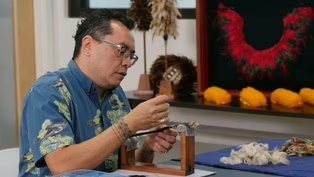
Hawaiian fiber practices and feather work
Video has Closed Captions
Clip: S17 | 2m 59s | Hawaiian cordage and knotting and feather standards in 'Iolani Palace (2m 59s)
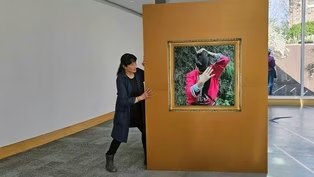
Colette Fu - tattooed lady & Terraced Rice Fields
Video has Closed Captions
Clip: S17 | 2m 36s | Pop-up book artist Colette Fu on her books based on her travels to China (2m 36s)
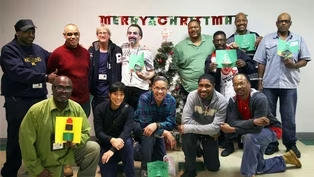
Colette Fu - social practice lab
Video has Closed Captions
Clip: S17 | 1m 29s | Pop-up book artist Colette Fu on working in her community (1m 29s)
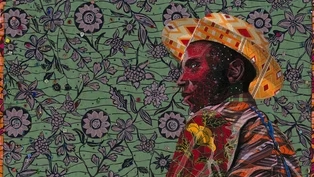
Bisa Butler's quilts based on Gordon Parks photographs
Video has Closed Captions
Clip: S17 | 3m 28s | Artist Bisa Butler's quilt portraits based on Gordon Parks' photographs (3m 28s)
 Now Playing
Bisa Butler's first artistic influences
Video has Closed Captions
Clip: S17 | 3m 48s | Bisa Butler's first artistic influences (3m 48s)
Video has Closed Captions
Preview: S17 Ep2 | 1m | Watch a preview of WEST, celebrating the continuum of heritage and handmade in the American west. (1m)
Video has Closed Captions
Preview: S17 Ep1 | 1m | Watch a preview of EAST highlighting diverse expressions behind modern craft in the eastern region (1m)
Providing Support for PBS.org
Learn Moreabout PBS online sponsorship
- Arts and Music
The Best of the Joy of Painting with Bob Ross
A pop icon, Bob Ross offers soothing words of wisdom as he paints captivating landscapes.











Support for PBS provided by: