
Ubaldo Vitali & Paul Revere
Clip: Season 17 | 9m 42sVideo has Closed Captions
Silversmith Ubaldo Vitali makes original work and restores historical silver
Ubaldo Vitali is a silversmith and conservator, hailing from a four-generation Italian lineage of metalworkers. Having honed his craft from childhood in family workshops and through formal studies at prestigious Italian art academies, Vitali creates original pieces and serves as a highly sought-after conservator for historical silver, restoring invaluable artifacts, including Paul Revere's teapots
Problems playing video? | Closed Captioning Feedback
Problems playing video? | Closed Captioning Feedback
Ubaldo Vitali & Paul Revere
Clip: Season 17 | 9m 42sVideo has Closed Captions
Ubaldo Vitali is a silversmith and conservator, hailing from a four-generation Italian lineage of metalworkers. Having honed his craft from childhood in family workshops and through formal studies at prestigious Italian art academies, Vitali creates original pieces and serves as a highly sought-after conservator for historical silver, restoring invaluable artifacts, including Paul Revere's teapots
Problems playing video? | Closed Captioning Feedback
Where to Watch Craft in America
Craft in America is available to stream on pbs.org and the PBS app.
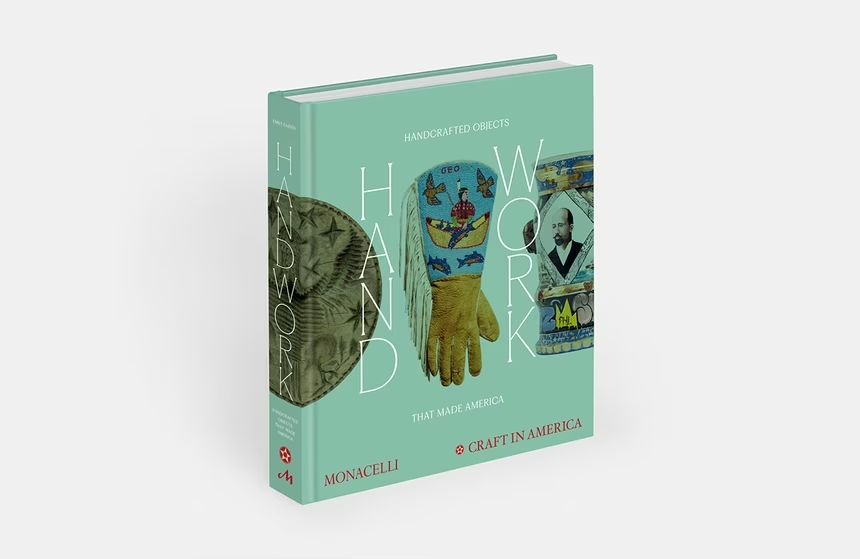
The Handwork Book
Celebrate America’s spirit with Handwork: Handcrafted Objects That Made America, a visually stunning, deeply inspiring new book that brings together unexpected, overlooked, iconic, and everyday handmade objects spanning more than 250 years.Providing Support for PBS.org
Learn Moreabout PBS online sponsorship[Music] I am a silversmith and goldsmith, a#metal worker, an alchemist, art historian.
All these things put together because I like life and I like to explore things.
So maybe I can say I'm an explorer.
Silver has been an# extremely important metal since antiquity.
And I consider silver the most beautiful metal, much more beautiful than gold.
I find gold a little vulgar.
[Music] But silver is beautiful because it reflects#light.
As you walk around an object, you see the, all the reflection#change.
So in my work, I try to control those reflections to make silver dance with lights.
The soup tureen with the fish and#everything was created with the reflections in mind.
But all the#movement are the movement of a boat.
It's just a undulating calm sea.
That is the one the fisherman prefers.
[Music] [cars honking] My family in Rome we're four generation silversmiths and goldsmiths.
My great-grandfather, his name was Ubaldo like me.
He opened his# shop and then my grandfather had his shop and then my father had his own workshop by#the time he was 24.
The family concept was that the moment you reach a certain#age, you will go on your own and opening your own workshop.
Yeah, that's fine.# That's it.
This is good.
This is good.
[Hammering] But to be a silversmith, the training is no you#don't just to work the metal.
The training is to study art, art history and design.
So I was sent#to the Academy of Fine Art and Sculpture in Rome.
[Music] I was a great admirer of Pope John the 23rd and#I create for him in my father worship a gold ink stand and the pen.
It was given to him as a#gift.
I was 17.
[Music] There was this American girl that I met at the academy and that was the# reason why I came to America.
September 27, 1967.
Few months later, we got married.
I worked#in New York for 9 months.
Then I opened my own place and I got commission from# Tiffany and then Steuben Glass and Cartier.
I was very fortunate.
[Music] Most silversmith use the repousse method that means been chased from both sides.
This is actually an impression from a 17th#century German basin.
Once I make the drawings, these drawings will be put on a piece#of metal that is embedded in pitch and we trace the drawings down into the#metal.
Then we start sinking the masses.
Once you have totally sunk the figure from the back, then we remove from the pitch and we turn it around.
And that's what# we have, the relief.
From this on, now you have to finish the front.
You're putting all the# details on and the sharpness of the figure.
For the goldsmith, silversmith, metalworker, the hammers are the most important tool.
And to use my favorite line#from Michelangelo poem, no hammer can be made without a hammer.
So we have the forge.
We can make our own.
They each one of them has their own use.
And you can see they're all different.
This is a planishing hammer.
You#do not strike it.
You just caress it so that you are smoothing# down the silver.
This is my favorite.
I've used this probably 10#time more than any other.
Mwah.
[Music] My family constantly restore objects both for museums and private collections.
Sometime there were religious objects like#Judaica.
I restored several Torah crowns.
They were in terrible condition.
You can#imagine they were buried during the war.
We restore the original beauty, but I will not# touch it until I research the history of the object.
You want to transpose yourself into#the person that created it.
It's almost like the artist that made it is telling you that's what I#meant.
Make sure you respect me.
When I was a teenager, maybe 18, I went to see an#exhibition on the American Revolution.
One of the things that caught my eye as a silversmith# was the Liberty Bowl.
It was made by Paul Revere.
A lot of Paul Revere silver is fairly regular and#some is quite spectacular.
After the Revolutionary War, he's doing fluted teapots which are#really the hallmark of his ability.
They're really quite remarkable.
His father Apollos Rivoire was#French.
He came to Boston at the age of 13, learned a trade.
He opened a shop, brought#his son, Paul into the shop to apprentice.
Paul does eventually take on his father's#shop.
Paul Revere carves out his niche as being a silversmith that can make whatever you#need.
Paul Revere is not only doing this himself, he has a team of apprentices and journeymen who are working in his shop.
So he's already starting to think pretty#early about how he can expand his business.
The Paul Revere House, which was built#around 1680, is the oldest surviving building in original Boston.
By the time the Revere family moves#in 1770, it's a little bit of a fixer upper, but his silversmith shop is going to be located a few blocks away, so location's perfect.
The buildup to the revolution is not military#action.
It's community activists.
The Liberty Bowl is actually commissioned by the Sons of Liberty.
This rebellious group that's stirring up troubles here in the colony.
Their ideas are that we are#being taxed without representation.
The idea that we will separate from the United Kingdom.
On this#bowl, Paul has engraved the names of those Sons of Liberty members.
This is a kind of revolutionary#act that he is doing to be affiliated with this act of rebellion.
Next to it in the exhibition# was Paul Revere's engraving of the Boston Massacre with the name of the patriots that died.
It moved#me tremendously that the silversmith made these objects.
So he's the person who's chosen for the Midnight#Ride.
One if by land and two if by sea.
It turns out the British troops are going by water.
And so#Revere is rowed by two friends across to Charles Town.
He borrows a horse and rides off.
He gets#to Lexington.
He has alerted people along the way.
The British troops are coming.
And so he becomes# our favorite patriot and silversmith, Paul Revere.
[Music] After I moved to America, I restored#more than 12 objects of Paul Revere.
I remember the first one was a simple teapot.
And I say, it probably like looking at an old friend like say, you know, I met you in Rome.
You#don't remember me, but here I am.
Video has Closed Captions
Clip: S17 | 6m 50s | Fiber artist L'Merchie Frazier uses her art to tell the untold African American stories (6m 50s)
 Now Playing
Video has Closed Captions
Clip: S17 | 9m 42s | Silversmith Ubaldo Vitali makes original work and restores historical silver (9m 42s)
Video has Closed Captions
Clip: S17 | 1m 39s | Three generations at the Institute of American Indian Arts (1m 39s)
Video has Closed Captions
Clip: S17 | 6m 28s | Meet engravers and silversmiths at the silversmithing traditional cowboy arts symposium (6m 28s)
Roberto Lugo's poetry & Orange and Black vessels
Video has Closed Captions
Clip: S17 | 4m 2s | Roberto Lugo is a potter, poet, activist and educator (4m 2s)
Video has Closed Captions
Clip: S17 | 4m 27s | Nina Zannieri, Executive Director of the Paul Revere House on Paul Revere's Midnight Ride. (4m 27s)

Milliner working with custom fabric flowers
Video has Closed Captions
Clip: S17 | 1m 27s | Milliner Gigi Burris on working with M&S Schmalberg flowers (1m 27s)
Video has Closed Captions
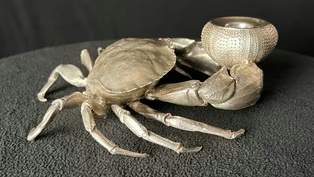
Clip: S17 | 1m 30s | Lost wax casting silver horses and crab candleholders at Ubaldo Vitali's studio (1m 30s)
Video has Closed Captions
Clip: S17 | 2m 20s | Institute of American Indian Arts student on her work and exhibition (2m 20s)
Video has Closed Captions
Clip: S17 | 1m 34s | Institute of American Indian Arts Museum of Contemporary Native Arts (1m 34s)
Video has Closed Captions
Clip: S17 | 2m 13s | IAIA student Whisper Crow Dog & IAIA alumni on Terran Last Gun on ledger art (2m 13s)
Video has Closed Captions
Clip: S17 | 59s | Institute of American Indian Art landscape and environment (59s)
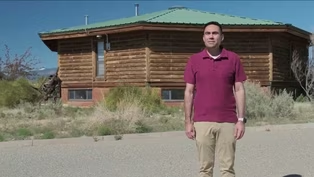
Video has Closed Captions
Clip: S17 | 1m 43s | The hogan on the Institute of American Indian Art campus (1m 43s)

Video has Closed Captions
Clip: S17 | 3m 40s | Community at the Institute of American Indian Arts (3m 40s)
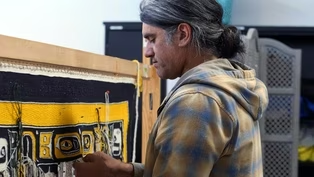
Video has Closed Captions
Clip: S17 | 2m 24s | Institute of American Indian Arts Artist-in-Residence program (2m 24s)
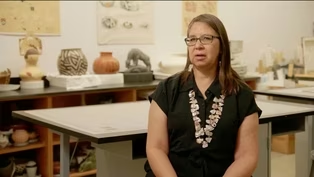
Video has Closed Captions
Clip: S17 | 1m 22s | The Institute of American Indian Arts archives consists of works/records from faculty, alumni (1m 22s)
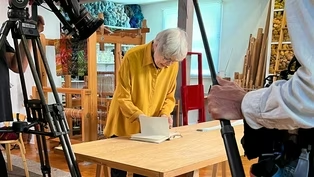
Helena Hernmarck's weaving documentation
Video has Closed Captions
Clip: S17 | 2m 24s | Tapestry artist Helena Hernmarck's weaving documentation (2m 24s)
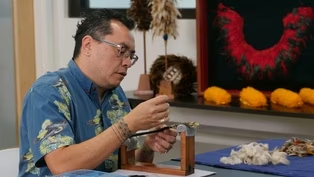
Hawaiian fiber practices and feather work
Video has Closed Captions
Clip: S17 | 2m 59s | Hawaiian cordage and knotting and feather standards in 'Iolani Palace (2m 59s)
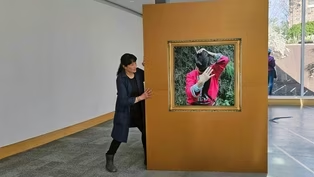
Colette Fu - tattooed lady & Terraced Rice Fields
Video has Closed Captions
Clip: S17 | 2m 36s | Pop-up book artist Colette Fu on her books based on her travels to China (2m 36s)
Colette Fu - social practice lab
Video has Closed Captions
Clip: S17 | 1m 29s | Pop-up book artist Colette Fu on working in her community (1m 29s)
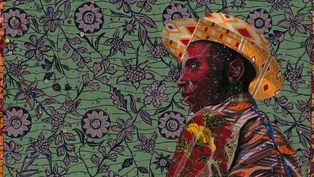
Bisa Butler's quilts based on Gordon Parks photographs
Video has Closed Captions
Clip: S17 | 3m 28s | Artist Bisa Butler's quilt portraits based on Gordon Parks' photographs (3m 28s)
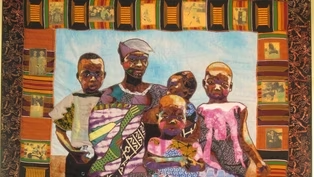
Bisa Butler's first artistic influences
Video has Closed Captions
Clip: S17 | 3m 48s | Bisa Butler's first artistic influences (3m 48s)
Video has Closed Captions
Preview: S17 Ep2 | 1m | Watch a preview of WEST, celebrating the continuum of heritage and handmade in the American west. (1m)
Video has Closed Captions
Preview: S17 Ep1 | 1m | Watch a preview of EAST highlighting diverse expressions behind modern craft in the eastern region (1m)
Providing Support for PBS.org
Learn Moreabout PBS online sponsorship New Episode
- Arts and Music

Innovative musicians from every genre perform live in the longest-running music series.









 New Episode
 New Episode

Support for PBS provided by: