Mossback's Northwest
Extended Cut: Angeline, Portrait of Seattle’s “Princess”
Clip: Season 11 | 39m 37sVideo has Closed Captions
Co-hosts Knute Berger and Stephen Hegg explore the story of Seattle’s Princess Angeline.
Chief Seattle’s daughter, Kikisoblu, dubbed “Princess Angeline” by white settlers, could be considered one of Seattle’s first celebrities. Mossback co-hosts discuss her enduring legacy – how, for instance, she stayed near her birthplace, even after indigenous people were banned by Seattle ordinance, and how her determination, generosity and resilience impacted those who knew her.
Problems playing video? | Closed Captioning Feedback
Problems playing video? | Closed Captioning Feedback
Mossback's Northwest is a local public television program presented by Cascade PBS
Mossback's Northwest
Extended Cut: Angeline, Portrait of Seattle’s “Princess”
Clip: Season 11 | 39m 37sVideo has Closed Captions
Chief Seattle’s daughter, Kikisoblu, dubbed “Princess Angeline” by white settlers, could be considered one of Seattle’s first celebrities. Mossback co-hosts discuss her enduring legacy – how, for instance, she stayed near her birthplace, even after indigenous people were banned by Seattle ordinance, and how her determination, generosity and resilience impacted those who knew her.
Problems playing video? | Closed Captioning Feedback
How to Watch Mossback's Northwest
Mossback's Northwest is available to stream on pbs.org and the free PBS App, available on iPhone, Apple TV, Android TV, Android smartphones, Amazon Fire TV, Amazon Fire Tablet, Roku, Samsung Smart TV, and Vizio.
Providing Support for PBS.org
Learn Moreabout PBS online sponsorship- Hey, everybody.
Welcome to "Mossback," the official podcast of the Mossback's Northwest video series from Cascade PBS.
I'm Stephen Hegg.
- And I'm Knute Berger.
- And today, we're exploring the legacy of one of Seattle's first celebrities, Chief Seattle's daughter, Kikisoblu, otherwise known as Princess Angeline.
She was a fixture of the pioneer city.
Her determination, generosity, and resilience impacted those who knew her.
And toward the end of her life, her portrait appeared on so many postcards and tchotchkes that she became, in many ways, the symbol of Seattle.
If you haven't already seen the video, take a few moments to watch it.
It's full of many powerful images and stories of Angeline.
You can find the video in the show notes, but for now, stick around for a journey back in time to Seattle's earliest days.
(quirky music) Knute, when did you first hear the story of Princess Angeline, or Kikisoblu?
- Well, I've been curious about her for some time.
There's a street in Seattle named after her.
- Yes, it's down by my house.
- Right.
Yeah, exactly, south end of the city, which is where she was born, in fact.
And, you know, I was curious about who she was, but I didn't really pursue it.
And it really was only a short while ago that I was looking through a book by a guy named Tim Greyhavens, who did an in-depth study of Washington's very first photographers, and it's a lavishly illustrated book with their images.
And he devoted, like, multiple pages to just images of Princess Angeline.
- Of photographs?
- Photographs.
And in some cases, he was showing the tchotchkes.
There was one, like, two-page spread.
This is a coffee table book, full of these images, and they're almost all portraits.
And when I saw them collectively, I was just fascinated by the fact that, you know, how did she become such a figure of visual interest to the people of Seattle?
And it made me wonder what her life was like here.
And I had seen stories over the years.
Paul Dorpat, for example, had done a lot of research trying to figure out exactly where her cabin was.
And it was where the Pike Place Market is.
And it was actually in two different locations, and he did a lot of photo analysis to show, like, here it was in this place here, and then it moved over here.
And so, I remember, yeah, going down there to see the place where her cabin stood.
And so I was just curious, but those pictures really kind of blew my mind.
I had never seen so many pictures of her all put in one place.
- I love situating these stories.
Where exactly was her cabin, or one of the locations?
- Yeah, well- - Pike Place Market, but where?
- Yeah, so before the Pike Place Market was built, there was kind of a shanty community on the hillside that goes down toward Western Avenue.
And so, if you come up the hill climb to Western and then you cross the street and you go up the stairs into the market, but right next to that, between that and another building, there's kind of a vacant lot on the hillside.
There's nothing there.
And that's roughly where her cabin stood.
- [Stephen] Is there a marker there?
- No, not that I know of.
- What struck you about her story?
- Well, it's interesting.
You know, I mean, Chief Seattle himself, her father, became a kind of Seattle icon somewhat involuntarily.
In other words, the city was named after him without having sought his permission, and he was upset about it.
And there was a lot of back and forth.
They were trying to honor him.
He didn't see it that way.
But they ended up sort of negotiating and paying him some money and whatnot to placate him.
And I think the story of the pioneer settlement of Seattle is one where you can see this desire to, you know, colonize Elliott Bay and the surrounding areas and turn it into New York Alki, the aspirations of the settlers' manifest destiny, we're gonna build the city of the future right here.
Chief Seattle, in fact, had invited white settlers to come to Elliott Bay in hopes of trading with them.
The area, the Alki Beach, was a seasonal gathering place for Indigenous peoples from around the area, and there was a lot of commerce.
Coll Thrush does a great job of talking about the Indigenous community here prior to the Denny Party coming in the 1850s.
And in David Buerge's biography of Chief Seattle, he does a really good job of explaining that Chief Seattle hoped that this could be a community of Indigenous people and white settlers that could kind of live happily ever after.
I mean, they would forge a community that wasn't at war with itself.
- He had an idealistic view of what this side by side living could be.
- I think he did in the beginning.
And I think that probably, you know, dissipated.
(laughs) I don't think it took too long for him to see that that wasn't gonna happen, that the influx of settlers and the transformation of the land and the waters and the shorelines and the hostility to Indigenous people was such that that didn't develop.
But he maintained very good relations with the settlers, the pioneers.
And so, it's believed that she was born in the early 19th century.
Nobody can really pin down the exact- - 1820 or something- - Yeah, sometime in the aughts or the early 1820s.
She was born on a island off of Rainier Beach.
So, in terms of what Seattle is today, she was literally born in Seattle.
And of course, I mean, she had familial connections throughout the region.
And like her father, she converted to Catholicism.
- Interesting.
- Yeah.
And she was a very devout Catholic.
And then Catherine Maynard, who was the wife of Doc Maynard, who was one of the settlers who settled and, you know, filed the papers for Seattle becoming a city and that kind of thing, it was his wife who thought that Kikisoblu should have a name of dignity, that she was a very special person.
And, you know, partly because of her father and the connections there, and so she came up with Princess Angeline.
I also think, I've read that she found Kikisoblu too hard to pronounce.
I mean, the settlers had a real difficult time with Lushootseed and its variations.
And the main method of communication well into the early 20th century, in many respects, was with Chinook Jargon.
And that was the language she communicated in the most with her fellow Seattleites.
- Do we have any idea what she thought of the name Princess Angeline?
- You know, I didn't come across that, so I don't know.
People had a lot of different opinions about it as time went on.
It was a name some people found very respectful, other people found absurd.
- What was her early life like?
Her young adulthood?
- So, at one point, she was married to a member of a different tribe.
And, of course, this was typical, and alliances that were made through people marrying into different groups.
Apparently, she didn't like her husband.
And she sort of did something that was, I guess at the time, considered not done.
She just left him, and she ended up coming back to Seattle to live.
And I think that upset some of her relatives.
She said that he was abusive and she wasn't gonna put up with that.
And, you know, that was, I mean, through modern perspective, it's easy to see why she left.
- There are no photographs, obviously, but are there any renderings or drawings of her as a young woman?
- Yeah, not that I'm aware of.
There could be.
You know, the photographs don't start until the 1880s, so she's fairly well on in life at that point.
And then toward the end of her life, it just accelerated with both the number of photographers and the fascination with her as that grew.
- Do we know how she was regarded by pioneers in her early adulthood?
- Yeah, she had a reputation for being very beautiful.
She did housework for a number of the early pioneer families and forged, you know, some pretty significant bonds with the Yeslers and the Maynards, obviously, and others.
And you know, I guess you get to know people when you're doing their laundry.
But I think she was seen as spirited and vivacious, and they're very positive feelings about her in general.
Of course, that wasn't true of Indigenous people in general.
You know, I mean, early Seattle passed an ordinance banning Indigenous people from living in the city limits.
And of course, many of the early employees at Yesler's mill were native people, and there were some pioneers who were friendlier and refused to cast out their workforce, their friends, their servants, people that they respected.
And there were a lot of people who, you know, literally just did not want Indigenous people setting foot here despite the fact that they lived here, they were born here.
But there were people who were able to defy that ban, usually, sort of, in very small numbers, living in the margins of what wasn't quite Seattle yet.
So Lake Union or Salmon Bay or Rainier Beach, you know, those weren't part of Seattle proper in the beginning.
But she stayed.
She traveled, you know, she would travel around the region, she'd go to Olympia, she'd go to places where the Duwamish and others had relations, and that kind of thing.
But this was her home.
- How do we know these facts about her early life?
Did she write things down or do we know them from the writings of pioneers?
- Yeah, we know them from the writings of people who observed her, who talked to her.
I mean, there were people who knew her very well and knew her story.
And, you know, I think the city changed a lot while she was here.
And up until the end, there were still people who knew her.
Catherine Maynard died, I don't know what, maybe 10 years after Princess Angeline died.
So there's somebody who firsthand- - Did she know- - Knowledge.
- Earlier in the series, we talked about Henry and Sarah Yesler and how their ties to natives were not typical.
Did they know Princess Angeline and she them?
- Yes.
And Henry Yesler talked about her.
He is quoted in newspaper accounts and whatnot, talking about her.
And there was one anecdote that comes in many different forms where she was said to have played a kind of heroic role in saving Seattle.
And this is part of a story around her.
And when you dig into the various accounts, it's clear that- Well, the story is unclear in that.
It probably didn't happen, but there was some germ of truth in it.
But the most commonly verbalized or written-about version was that she was over on the Suquamish Reservation, she got a tip that Seattle was about to be attacked, and the so-called Battle of Seattle, it took place in the 1850s when the community was attacked by native people, and that she then got in a canoe, and sometimes she's with Catherine Maynard in this canoe, or sometimes she's hidden in the canoe, it's not really clear, but paddles back to Seattle and warns the people here that an attack is coming and to be ready.
- Paddle to Seattle before the Battle of Seattle.
- Exactly.
And of course, the US Navy already had a ship here to protect the city, so they were aware that something might happen.
And they said this story is hooey, we didn't need warning.
There's some belief that there was another incident that had to do with a raid in the south of the city earlier, where she might have helped foil an Indigenous raid of parties on each other.
So I don't know actually what the truth of that is, except that the version of the Battle of Seattle tale seems to have been, you know, pretty refuted in its detail.
- How did she get along with the ordinary white settlers in Seattle?
What were those relationships like throughout her life?
- Well, I think with those early settlers, she maintained those bonds literally right up to the day she died.
And those relations, she considered those people friends.
Of course, as the city grew and changed, that group, that circle of original settlers was smaller and smaller.
But there are people who knew her since she was young.
She lived in their homes or she had worked for their families.
So I think there was a bond there, and they could speak a common language, or jargon, they could communicate.
And she sought, I think, some degree of, I don't think she wanted charity, and I think it was Henry Yesler who said, you know, if you gave her a hundred dollars in the morning, she would've given it all away by nightfall.
And she did not like to be, if somebody tried to give her something, she would resist that if she felt it was charity, but if it was part of some sort of exchange or almost familial kind of relationship, that was okay.
You know, of course, by the 1880s and 90s in particular, that band of settlers that she had these close relationships with was dwindling.
She was, you know, religiously devout, and she went to Mass.
- [Stephen] Where?
- She went to Mass, let me get the name of the church.
It's Seattle's first- - So there was a Catholic church there?
- There was a Catholic church opened in 1869.
There were missionaries in other places outside Seattle, but Seattle didn't have it.
So the first Catholic church, as I understand it, is the Church of Our Lady of the Good Help.
And that was located at Third and Prefontaine, and Father Francis Xavier Prefontaine was the first Catholic priest here.
And I think it only, there were only, like, six Catholics in town when it first opened up.
But that was her parish, that was her church.
She was also seen later by nuns and others who commented that they often saw her sitting in the street and working her rosary, a rosary, by the way, that went to the people at St.
James, who have given it to the Duwamish.
So that rosary exists as a artifact of her religious faith.
- Well, there was an ordinance that prohibited native people from living in the city of Seattle, so there must have been some animosity.
She wasn't treated like royalty by everybody, was she?
- No, I mean, she was housed but barely.
You know, she had a modest cabin that she lived in, but she was a figure that was seen by most people on the streets sitting on the streets.
She might have been making baskets.
She walked around the city, often barefoot.
And, you know, she was a character.
And I think the generation following the original settlers largely saw her that way.
They knew of her connection to Chief Seattle.
And you know, that was interesting to people.
And one thing we do know about her from that later period is that she spoke her mind.
She wasn't just a quiet presence.
If she was taunted, as she was, by boys on the street who would throw pebbles at her or make fun of her or chase her, you know, just behaving as very awful boys will, she would throw clamshells or rocks back at them, she would track down their parents and- - [Stephen] Have a word.
- Have a word.
Yeah, there's one, kind of, infamous case where she tracked down the boy's father.
He happened to be a prominent Seattleite, and that boy got a real whipping.
So there are also cases, I think, where she stood up for her father's legacy.
And that's seen in stories.
There's a particular story about, she's at a meeting with a bunch of church ladies and there's a map of Seattle and the region, and she gets up in front of the group and, you know, begins telling them very forcefully, you know, "This is," you know, naming places in her language and, you know, saying, "Don't you forget whose place this is."
You know, she's putting a marker down.
"I'm not gonna let you forget who my father was.
I'm not gonna let you forget whose home this is and whose home this was before you got here."
She really gave him quite a talking to in Chinook.
I think as the Chinook Jargon language ceased to be common, that shrank her circle of people she was comfortable communicating with.
- Explain what the Chinook Jargon language was.
- Right.
- So, settlers sometimes spoke it or understood it?
- Yeah, it was a trade language that predated settlement.
And it's kind of credited to, it's called Chinook partly because a lot of it had to do with trade that was taking place along Indigenous trade routes along the Columbia River.
But there's language that comes down from First Nations people, Lushootseed, various Salish speaking groups.
It also has, from the fur trading back East to coming West, it has French, it has English.
So it's a melange that was used to create very simple words that could convey, you know, where do I go this way, what do you want for this, do you have food?
- Like, settlers would learn this from natives?
- Yes, exactly.
So early settlers basically had to learn it.
I mean, if you think about the Denny Party arriving in Seattle on that cold winter day in 1851, they were kept alive that winter by the Indigenous people who lived here because they didn't have any crops, they didn't have, you know, whatever.
And so, Indigenous people would go out and hunt for them and then bring them, you know, waterfowl or whatever, and kept them going.
And that was all part of survival, was learning to speak, at least in rudimentary ways.
But I think people who spoke Chinook could speak pretty fluently in it and really make themselves known, heard.
- It would be an interesting language to hear today.
- Yeah, I mean, and you can find Chinook Jargon dictionaries.
There are words from it we still use that have stayed in the Lashkukam, you know, the words that have stuck in the Alki.
Apparently, we have the only state motto, which is Alki, which means "by and by" or "someday."
That's not in a language, but it's in a jargon, a trade language.
There were people speaking in it, you know, into the very first decades of the 20th century, but pretty much it died out.
- You wrote that Princess Angeline is considered by some to be the city's first protestor.
And I find that very interesting, because obviously, we have the reputation for protest.
What is meant by that?
- Well, I think it's a reference to the spirited way she stood up for herself.
She stood up for herself in insisting on staying in Seattle, where she was from and everybody else wasn't.
She stood up against the exclusion, she defied it.
And eventually, those laws went away.
I think the incident where she's lecturing these church ladies on the legacy of the land, the meaning of it for her people, and she's doing this in, you know, a nonsense way.
And so I think she was vocal, she was visible, she was here, and she lets you know when she was mad.
She tried to insist anyway on respectful treatment.
She didn't always get it, but she has a long history.
You can look at the newspaper coverage and the stories told about her and whatnot, and you can see someone who has dignity is not gonna tolerate disrespect.
So I think that's what that term suggests.
She certainly wasn't the first indigenous person to protest white people, you know, and settlers.
You know that.
But I think in terms of standing her ground here, against the odds.
- You mentioned she did laundry for people and that she wove baskets.
Was she able to eke out any kind of a living, or was that able to tide her for her life?
- Yeah, I mean she didn't require a lot for a subsistence living.
But it got harder as time went on, both the physical wear and tear.
And then she fell and broke her wrist, and I don't think it healed properly, so her basket-making activity was ended.
And she really, in her latter years, was not able to do housework and that kind of thing.
That was more when she was younger and more vigorous.
Interestingly, as she became this visible figure and as time went on as Seattle became more urban and as photography proliferated, she became a popular photo subject, and she would ask or people would offer to pay her for her picture.
That became a way that she could make some money.
- I first read about her many years ago when I was researching a documentary on Edward Curtis and his brother Asahel Curtis.
And Edward said that he would take a photograph of Princess Angeline and give her a dollar.
And of course, the photographs are very interesting.
So she became an icon that way.
- She did, and partly because those photographs were the first photographs he took for his North American, Native American series of photographs.
- That's where his obsession began.
- Yes.
And, you know, these are very artistic portraits and images and, you know, sort of driven by the vanishing race theme.
And yeah, so he took three pictures of her.
He took a studio portrait, which is very famous.
And then he took a picture of her on the beach with a clam basket and another one, I think, where she's harvesting mussels.
So he actually went out with her to locations and got another couple of photos.
So I don't know how many he took in all, but it's three is what we know about.
But he wasn't the first guy to take her picture, and he certainly wasn't the last.
- Where did these images go then?
Where did they travel in terms of popularity?
- So, they just kind of exploded.
And, you know, people are buying photographs.
Frederick & Nelson is putting her image on china.
And then, of course, as you get to the few years after she died, postcards become a thing, and so she's on hundreds of postcards.
You know, if you want a postcard from the city of Seattle, it's Princess Angeline in a hand-colored portrait.
Other cities started to kind of semi-adopt her as theirs.
Like at the 1904, was it 1904, 1906, Lewis and Clark Exposition in Portland, I found postcards with Princess Angeline's picture on them, and below it is, you know, "Portland's Angeline."
I read an article in one of the Tacoma newspapers saying, "Angeline is tired of Seattle.
We oughta get her to move here.
Yeah, we'd be much nicer to her down here."
- Oh, interesting.
- And this is right in the heart of the whole Seattle-Tacoma rivalry over the railroads and which is gonna be the biggest city on the Sound.
So she's like, they're fighting.
That's while she's alive.
They're sort of this, somebody is trying to create a debate around which city will treat her better.
So she dies in 1896.
- So the AYP is 15 years later or so.
- Right.
1909.
- Does she make- Is she represented there?
- She's big time.
- Big time?
- Big time.
Yeah.
So there are these blue china plates, souvenir plates from the exposition.
Her picture is included on the rim of the plates.
- What role do you think Princess Angeline plays in the history of Seattle, in the story of Seattle?
- Yeah, well- - [Stephen] I have to say that watching the video is very, very moving.
- [Knute] Oh, thank you.
I hope so.
- Well, you've portrayed Angeline with dignity, but you know her life was hard but very multifaceted, and that she had relationships with white settlers and she stood up for herself and for Chief Seattle, and she did it against all odds.
So it's very, very moving.
What has this story left you with?
- Well, a couple of things.
One is that spending a lot of time going through newspaper accounts in particular, where you're getting letters to the editor, you're getting poems, you're getting interviews, articles, man-on-the-street impressions.
I think the level of- There's this dissonance between the kind of, as I put it, almost canonization of Princess Angeline in her time with this contempt for this old woman, who many see as just a street person, not worthy of dignity or attention.
And that's a pretty prevalent view.
And it's certainly even if somebody is writing about her in a somewhat positive manner, the language that they're using is so dismissive.
She never claimed to be a princess, but people take her to task for that sometimes, like, well, you know, she's not really a princess.
Then you have other people writing letters just saying, "No, I'm English and I regard princess very highly, and I revere Princess Angeline more than any princess I know about."
So there's this kind of interesting debate just about her this legitimacy in an arena that she never really asked to be involved in.
So there's this, you know, the racism and the beauty, the tragedy and the resilience, these things are all simultaneous there.
And I think they're captured in the images, the complexity of her life, I think the beauty of her life.
And there's a great quote I came across by Tim Egan, who wrote his biography of Edward Curtis.
And he basically says, "To not see the humanity in her face is to be inhuman.
You can't be a human and not see that."
But there are plenty of people who didn't see that.
And so, that gives this kind of rough, emotional edge to it for me.
- Where is she buried?
- Well, this is also interesting, 'cause it goes also to your question.
It says something about some of those bonds that Chief Seattle hoped to forge with settlers, and some of those bonds took and lasted.
And they may have been imperfect bonds, but they were there nonetheless.
I thought I could just read a clipping.
She's buried in Lake View Cemetery, which is- - [Stephen] Up on Capitol Hill.
- Up on Capitol Hill.
It's, you know, the major, it's where most of the most famous settlers are buried, Yeslers, Maynards, others.
And, you know, she was buried in what for white Seattle in particular was, you know, the primo place.
And here's an article from the Portland Oregonian from June 6th, 1896.
So she's died a couple days before this.
The headline: For the Happy Hunting Ground.
Princess Angeline set out in an Indian canoe.
Seattle, June 5th, the funeral of Princess Angeline, daughter of Chief Seattle, who died a few days ago at the advanced age of 80 years, took place this morning, and the pallbearers were six of the most prominent pioneers of the Sound.
Not in the history of the state has a native, dead or alive, been treated with a dignified, solemn consideration accorded the departed Indian princess.
The procession was a long one.
The coffin was an Indian canoe made from one piece of a tree trunk hollowed out.
The funeral services took place from the Church of Our Lady of the Good Help and the rites were performed by the Reverend Father Prefontaine, assisted by Father Schmidt and Father Franken.
Angeline was the last of her line.
Only one mourner rode in a carriage, and that was Joe Foster, the half-breed grandson of the dead princess.
You know, Father Prefontaine was considered a pioneer of Seattle.
I mean, he opened this Catholic church right when Seattle was just beginning and built a real community around it.
It's built pretty much right there in Pioneer Square, right in the heart of the settlement.
You know, I think this article, despite some of the language, you know, I think this article was really trying to indicate they didn't want to ignore the importance of her and her father and the fact that everything you see in Seattle of today, meaning, well, you can see it today, but you can also see this in the 1890s, this was a fundamental part of our collective narrative, and that those bonds with the early settlers lasted.
There were fewer of them alive when she died, obviously, but many of them were still there and remembering how important this relationship with the Indigenous people of this area was.
(gentle music)
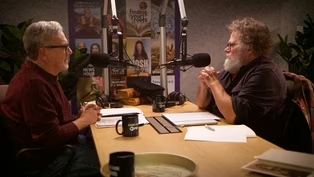 Now Playing
Extended Cut: Angeline, Portrait of Seattle’s “Princess”
Video has Closed Captions
Co-hosts Knute Berger and Stephen Hegg explore the story of Seattle’s Princess Angeline. (39m 37s)
Extended Cut: Upon Further Review: Seattle's Food Evolution
Video has Closed Captions
Co-hosts Knute Berger and Stephen Hegg explore Seattle food history with special guest Rachel Belle. (47m 6s)
Extended Cut: How Skid Road Birthed a Literary City
Video has Closed Captions
Co-hosts Knute Berger and Stephen Hegg explore the origin story of Seattle’s libraries. (48m 58s)
Extended Cut: The Case of the Treasonous Doll Spy
Video has Closed Captions
Co-hosts Knute Berger and Stephen Hegg explore the story of WWII’s “Doll Spy.” (39m 18s)
Extended Cut: In the Name of Cod
Video has Closed Captions
Co-hosts Knute Berger and Stephen Hegg explore the Alaska Purchase. (44m 11s)
Extended Cut: The Potlatch Riot of 1913
Video has Closed Captions
Co-hosts Knute Berger and Stephen Hegg explore Seattle’s Potlatch Riot. (53m 26s)
Extended Cut: The Mystery of the Mima Mounds
Video has Closed Captions
Co-hosts Knute Berger and Stephen Hegg explore the Mima Mounds. (44m 20s)

Video has Closed Captions
Season 11 of Mossback's Northwest premieres Thursday, October 9th, at 8:50pm on Cascade PBS. (30s)
Providing Support for PBS.org
Learn Moreabout PBS online sponsorship












Support for PBS provided by:
Mossback's Northwest is a local public television program presented by Cascade PBS