Mossback's Northwest
Extended Cut: How Skid Road Birthed a Literary City
Clip: Season 11 | 48m 58sVideo has Closed Captions
Co-hosts Knute Berger and Stephen Hegg explore the origin story of Seattle’s libraries.
Seattle is a UNESCO City of Literature – and it's been a literary city since its founding. The first library was created even before the city was officially incorporated! Mossback hosts discuss their own love of libraries, the earliest books on Seattle’s shelves, the lasting literary impact of early pioneers Sarah and Henry Yesler & the unconventional couple’s remarkable connection to Jack London.
Problems playing video? | Closed Captioning Feedback
Problems playing video? | Closed Captioning Feedback
Mossback's Northwest is a local public television program presented by Cascade PBS
Mossback's Northwest
Extended Cut: How Skid Road Birthed a Literary City
Clip: Season 11 | 48m 58sVideo has Closed Captions
Seattle is a UNESCO City of Literature – and it's been a literary city since its founding. The first library was created even before the city was officially incorporated! Mossback hosts discuss their own love of libraries, the earliest books on Seattle’s shelves, the lasting literary impact of early pioneers Sarah and Henry Yesler & the unconventional couple’s remarkable connection to Jack London.
Problems playing video? | Closed Captioning Feedback
How to Watch Mossback's Northwest
Mossback's Northwest is available to stream on pbs.org and the free PBS App, available on iPhone, Apple TV, Android TV, Android smartphones, Amazon Fire TV, Amazon Fire Tablet, Roku, Samsung Smart TV, and Vizio.
Providing Support for PBS.org
Learn Moreabout PBS online sponsorship(bright music) - Hey, everybody.
Welcome to "Mossback," the official podcast of the Mossback's Northwest video series from Cascade PBS.
I'm Stephen Hegg.
- And I'm Knute Berger.
- And today, we're going to explore the origins of Seattle's literary scene.
The first library here was built in 1868, even before the city was officially incorporated.
And this was largely thanks to influential pioneers, Henry and Sarah Yesler, who were, as it turns out, not only unconventional for their time in many ways, but also instrumental in the creation of one of the world's great novelists.
If you haven't already seen the video, take a few moments to watch it.
It will put this conversation in context.
Plus, you'll see some of the first books on Seattle library shelves.
You can find the video in the show notes, but for now, let's turn the page.
(playful music) Knute, as a young person, as a young student, the library was a wonderland to me, and I'm pretty sure the same was true for you, right?
- Yes.
I mean, I was lucky enough to grow up in a household that had lots of books.
And I was looking at books in magazines, you know, all the way along.
But I had a hard time learning to read in school.
I just, Dick and Jane readers and things like that were just so boring.
- [Stephen] You were ahead of your time.
- Well, I was one of those kids that every report card said, "Disturbs others, needs improvement."
(Stephen laughs) - That's the same thing on my report cards.
"Needs more of his share of attention."
- And look at us now.
So, but you know, one kind of major library experience was our neighborhood library was a Carnegie Library in Columbia City, which is still there.
Beautifully preserved.
It's even been expanded.
But it has the feel as it did when I was a kid.
You know, my mother would take us there and we would check out books.
But just, the smell of the place, the smell of the books, the smell of the oak furniture, the heavy oak desks and chairs.
- The card catalogs.
- The quietness of it.
And the light coming through, you know, it was a wonderful experience.
I loved going to the library.
And then I had a really great experience in sixth grade.
I went to John Muir Elementary School and there was a school library, and it wasn't a big thing.
It was like classroom sized, full of books.
Our librarian was a amazing educator woman, Roberta Byrd.
Roberta Byrd Barr.
She became very well known.
- [Stephen] Oh yes, very.
- And she was on television and all kinds of stuff.
Well, she was our school librarian.
And when I was in fifth and sixth grade, I sort of discovered the school library.
She was wonderful and welcoming.
And something triggered, especially when I was in sixth grade, I stumbled across a series of these, you know, biographies for young people.
And so it was, you know, Thomas Edison, Jim Thorpe, you know, various figures from history, sports, Babe Ruth, Wyatt Earp, you know, this kind of thing.
And I just could not stop reading these.
I just ran through them so much so that in a very unlikely situation, I was invited to make a book report presentation to the PTA talking about my favorite figures in history and my favorite biography.
'Cause I had turned out, I had read like the most biographies of any kid at John Muir that year.
And from then on, you know, I was just a very, very avid reader.
And I don't know what it was developmentally, whether I was just bored or my mother had took me in to see if I was dyslexic or had something.
They said, "No, he's fine."
- Well, it's amazing to think about someone how Roberta Byrd Barr could have inspired many, many other students like you.
That's why she's so revered in our city's history.
I had the same experience.
We were a family of readers.
We were encouraged to read, you know, and devoured the World Book encyclopedia set almost as soon as it got there from, you know, every single volume.
But I do remember going to the Bellingham Library, especially on Saturday mornings, because I wanted to find the latest issue of Aviation Week and space technology, because after my Tom Swift days, I was really into planes and aviation and space travel.
And that was a very expensive magazine.
You couldn't take it out of the room, but it was just one of the wonders of the library.
So I love to read, I love to read fiction, but later on, just, you know, years ago, I spent a lot of time in Vancouver going up there and taping for Cascade PBS.
And when I discovered the library that Vancouver had built, I think probably in 1995 around there, I just thought this place is not only spectacular looking, it's a coliseum style wrapped around building beautiful, graceful, but it was a magnet.
All sorts of young people were in this library.
It was busy.
It was obviously a community center.
And I remember thinking about the library, the main library that we had on Fourth Avenue, isn't it?
Fourth and Madison, and being so disappointed in it.
And of course, the library is more than the main branch.
The library is a system.
It's a whole thing.
But I thought, "I wish we could have a spectacular library that was a magnet for people."
And lo and behold.
- Yeah, I remember.
So I remember the library that they tore down to build the mid-century modern library that you didn't like.
- [Stephen] Wow.
And that was an impressive building.
- Yeah, it was sort of, you know, a library, it was a Carnegie-funded library.
It was the first permanent home of a Seattle public library, Maine branch.
And, you know, it had big columns out front,.
- [Stephen] The big Beaux-Arts building.
- Yeah.
And I didn't know.
I mean, I'm talking, I don't, kindergarten, first grade, I just remember walking down Fourth Avenue with my mother and looking up and seeing this grand impressive building that was the library.
And, you know, and then right around the time, shortly before the World's Fair was when that was torn down and they built this, you know, modern library there, which I visited many times, but it wasn't a go-to place.
The one in Columbia City was still, you know, library life circulated around the neighborhood library.
And so when they tore that one down and built the Koolhaas library, the current main branch, you know, it's the what?
You know, the third library on that location.
And I was skeptical about, oh, they're gonna build another modern library.
You know, it's not gonna have the smell of oak.
(laughs) You know, it's not gonna have that character, the smell of the books.
And it doesn't in the same way, but it has something else, which is spectacular light.
And I knew people, when it first opened up, there were a lot of people who loved it, but there were also people who were critical of it.
I had a friend who said it looked like an airport terminal mall or something in a kind of too suburban.
But I think you and I agree that it's a wonderful space to work in, to browse in.
And the light that comes in is truly amazing.
And I think a real, you know, if people think of libraries as being sort of dark and dingy and whatnot, this is the opposite.
- Rem Koolhaas being Dutch, I think had, and in the Netherlands, the weather is much like ours, had this great idea is to capture the opalescent, the pearlescent light that the northwest is famous for.
It's heavily filtered, but he has this net of girders and windows from the very top floor, and it goes all the way down to the ground floor.
So wherever you are in that library, you just are bathed in this very, very soft light.
And the one thing that I have noticed having shot there, the one thing that I didn't expect is the human form inside that library has a beautiful effect.
Because of all of the angles and the colors and everything.
The thing that stands out is the human forms, skin tone.
It's really magical.
- You would think that those geometric forms of the windows or something would be busy or create distraction, but it doesn't.
And in that way, when you're in there, it's not a distracting place.
You're kind of, you know, held in this space.
And so I think, you know, I mean, there's a lot of debate about the future of libraries and what are they for?
Are they social service agencies?
Are they literary oriented?
They are gathering places.
And I think one of the successful aspects of that library is it's a fun place to go.
It's a fun place to go to a lecture.
It's the Seattle room, which is usually where I'm headed when I go down there.
Well, this is the archives, you know, this is where they have the books that aren't, the rare books or newspapers, photographs, materials that historians get access to.
And you know, usually those, you know, at the University of Washington Special Collections is in a basement, basically.
And but not here.
You know, and I just love that.
It has that openness.
When we were filming in the stacks there of the special collections, you're still getting that light coming in, you're still getting that spaciousness, yet you're also getting the sort of intimacy of being, you know, on an aisle of tall shelves full of, you know, leather-bound books and stuff.
And it's just a great mix of experiences that works.
- And I just like the design of the building.
There's a lot of energy in that space in the building, in that part of town.
It livens it up.
So it's a success as far as I'm concerned.
Well, Seattle is known as a literary city.
We read a lot of books.
We have a lot of bookstores as well as a great library system.
It's a UNESCO city of literature, but I wasn't aware that the city's literary history started so soon after it was founded.
Was that a surprise to you when you started leafing through the pages of history?
- Yeah, well, it was.
So I got interested in it as a specific topic, when David Brewster, man I used to work for at Seattle Weekly in Eastside Week and Sasquatch Publishing.
He started, or was one of the catalysts for starting this Seattle Athenian, you know, which is a private library and lots of cities, Boston and Philadelphia.
Ever since the time of Ben Franklin, you know, libraries used to be a private thing, so wealthy people would kick in dues, they would collect books, they would have a place they could go to.
For some people, it was kind of like a club.
There's a fabulous one in San Francisco.
And so I was sort of interested in like, he's starting this library.
It was in the downtown YMCA when it started.
Now it's at the Pike Place market.
And so I thought, well, you know, what was the history, our history of libraries?
And this trace is back to what you mentioned, you know, which is in the 1860s.
So this is, you know, about 10 years or so after the settlement came to Elliot Bay, the locals decided to start an Athenian, basically a private library, because this growing budding rough hewn community needed some civilizing influences, I think is the best way to put it.
And there were small group of people who began to, you know, pay money so that they could acquire books.
And, you know, the idea wasn't just they would have books to read and loan out, but they would be putting on, or they would have authors come and talk, or other speakers come.
And the Yeslers were sort of central to that, in that one of the first gathering places in Seattle was the Yesler's Cook House, which was attached to the sawmill that was built at the bottom of what we call Yesler Way then called Mill Street.
So Henry Yesler came to Seattle in the early 1850s, not long after the Denny's got here.
He brought with him a steam sawmill, which they put together, and it was really the first industry here, but it became a kind of gathering place for the community.
And people would come to the Cook House and they would have they Sunday services there, or they would have public talks or, you know, it became a place people were.
And then, so it took a while, Yesler was here on his own, he married an Indigenous Duwamish woman and married, I guess is sort of a question, but they had a partner and had a daughter.
- [Stephen] They had a partnership.
- By this woman.
And his wife, Sarah, was still back in Massillon, Ohio, which is where Henry Yesler had come from.
And she didn't come out for another six or seven years, but when she came out, she added to this sort of growing number of white women who were settling in Seattle.
And she, because she was a key figure, she cooked at the Cook House, you know, she worked in the business with Henry, and this was the main industry in town.
She became sort of a center of promoting civic affairs.
- Did Sarah promote the library then?
Did she become the sort of head librarian and?
- She was one of the main organizers of the library.
And so they established this library.
And as you mentioned, you know, prior to official corporation of the city of Seattle, it was also prior to the first plumbed bathroom in town.
So you could see what the civilizing priorities were.
Books over- - Book's more important.
- Yeah.
And, you know, so the Yeslers became this very important civic influence.
And one of the intriguing things about that is both their civic contribution to sort of the growing growth of Seattle, the civilizing of the city, but also their unconventionality.
These were really, you know, different drummer people in terms of what their beliefs were, how they went about life.
So the civic involvement was very important in certain areas and other areas.
They tended to kind of ignore it.
- How do we know about that?
- Well, we know about it because, yeah, it's been discussed by historians.
People had to sign up for the library, so some of those signup sheets and how much people paid, we know what the first book order was.
They had to send away to San Francisco for books at that time, Seattle didn't have a bookstore.
So Bancroft Bookstore or Stationers in San Francisco, they would get books from back east and they could ship them up to Puget Sound.
So we have some general idea, and the first library lasted some time, but eventually, it kind of faded out.
It was the kind of thing where there wasn't professional librarian.
It was difficult to keep organized.
And so there were a number of iterations of the library before we actually got to the point of having a public library.
- Do we know who else was part of this literary society?
Any of Seattle's other founders pop up here?
- Oh, well, that's a good question.
Yeah, I mean, there were some of the main folks that were supporting growth.
And, you know, I have to remember, the city was a very rough and tumble place.
You know, the workforce was largely male.
It was itinerant.
You had bordellos, you had saloons, you had, you know, these were loggers, these were fishermen, these were mill workers.
But you also had growing prosperity.
And other people coming in and developing the city.
And I think there was a yearning, you know, fairly early on that we want this to be a big city.
Remember New York Alki, New York someday, aspirations to be a big city, a sense of competition with Tacoma, with San Francisco, Victoria.
You know, we wanna be this big major player.
And I think there was an awareness that to get there and to make money, you had to tame the city somewhat.
And that happened in different stages.
But certainly having a means of uplifting people morally and intellectually was part of that.
The interesting thing to me, or there are many interesting parts of it, but first of all, Yeslers were free thinkers, which meant they didn't go to church, they didn't buy into Christian dogma.
And this was looked askance by other people who were, you know, wanting to civilize the city with churches.
And that kind, Seattle's not a particularly big church going town.
It never has been.
It was not founded by missionaries.
And I think the Yeslers, you could say were tolerant of other people's Christianity, but they were given a pass for not attending church or engaging in that.
And so they were... I think the library provided a kind of broader intellectual field of engagement than simply reading the Bible, attending church on Sunday, and having your thoughts in a very kind of narrow channel by comparison.
- Did the first books in the library, whether they're donated or bought with quote "library dues," reflect that broadness?
What were the first books?
- Well, the video goes into more detail, and I won't go into a lot of it here, but I think it's safe to say that.
So I came across a ledger at the Seattle Public Library in their special collections.
And it was one of the later versions of the first library, so that it went through a number of iterations and locations.
But we have a ledger from 1889 handwritten that lists the books in that version of, which was still a private library at that point.
And the first 10 books, which I look at in the episode are all books, almost all of them anyway, are books that were in print at the time of the original order.
So I suspect they were in that first library.
And they're all aimed at either giving advice, especially to young people about how to grow up to be gentlemen and gentle ladies.
They are books of kind of wisdom and books on moral character and books on homemaking.
Harriet Beecher Stowe wrote a whole series of books about the modern housewife, the modern home, you know, she was kind of one of the foremost writers on that topic in that Victorian period.
And so the books all have, for the most part, have this sort of moral uplift, Oliver Wendell Holmes, autocrat at the breakfast table and books like that, where they're full of aphorisms and wisdom.
- What I'm trying to understand is, was this Sarah Yesler's prescription for good society?
Did she determine what the library would contain at first?
- Well, as she played a role, absolutely played a role in selecting the books.
And there's one book that's on that list that speaks to the Yeslers' unconventionality.
So you're reading about these books by Edward Eggleston, Oliver Wendell Holmes, Harriet Beecher Stowe, I guess you had to have three names back in the day.
And then you come to this book called "The Gates Ajar."
This is the ninth or 10th book on the list.
And this was actually a very controversial book at the time.
It was published in the late 1860s, and it did become a bestseller.
It sold like 80,000 copies, but was also a very controversial book.
And it has a root in promoting a kind of view of the afterlife that is both a kind of idealized view of Victorian middle classness.
But at the same time, the book was considered blasphemous.
- And was it in the spiritualist realm?
- Yeah, very much so.
So, you know, we know Henry Yesler and Sarah Yesler were so-called free thinkers.
They didn't belong to a church.
They didn't go to church.
And, but they were also into spiritualism.
And they were into other things too.
I mean, Sarah was a suffragist.
She promoted women's suffrage and women's rights from the day she arrived.
We know they had some unconventional aspects to their personal relationship.
We know from correspondence that Sarah Yesler wrote that she had a, a very intimate relationship with another woman and possibly two women.
And, you know, and then Henry had, you know, this connection with the indigenous wife and daughter.
And they zagged in other ways too.
You know, I mean, Henry Yesler was very protective and Sarah, very protective during the uprising against Chinese.
The exclusion of Chinese in Seattle in the 1880s.
Was very much against that exclusion, which put them at odds with a lot of powerful forces in town.
And this gets us to this other contribution that they made, which wasn't necessarily intentional, but was the result of their unconventionality and to some degree, of their literary and civic aspirations and free thinkingness, - Did they have to hide this whole personal life?
Did other people know about their relationships and some of their beliefs?
And you would think in other towns at that time, just not going to church or not belonging to a church would be enough to cast aspersions and doubt and concern on the part of the citizenry, the other people.
- Well, I think Henry had the virtue of being the power guy in Seattle.
- [Stephen] Because he was wealthy.
- Well, he became wealthy, he had real estate, he had multiple mills.
He had the most successful industry, the first and most successful industry in Seattle.
So it's not like he could be easily cast aside.
And, you know, and he's married to a very powerful, civic-minded woman.
But another aspect to it is that they were, I think you could consider them spiritualists.
And spiritualism was one of many kind of religious or semi-religious systems of belief that flourished in sort of the early 19th century.
So, you know, there's a period of time when you have, theosophy is popping up, Mormonism is popping up.
People are beginning to get exposed to ideas from India, Hinduism, Buddhism.
And one of the most powerful of those was spiritualism.
And this was a belief that the biblical or Christian sense of the afterlife was not correct.
So in that sense, by many people, was considered, you know, blasphemous.
And this is the period where you begin to have seances where people believe, "Oh, well, when people are dead, they're not in heaven or they're in a heaven that will allow them to communicate with the living."
And this became a very powerful movement.
It was in Europe as well as the United States.
You know, Emanuel Swedenborg and the Swedenborgians were also kind of on the rise.
And that was sort of a Christianized version of this.
But there was this belief that you could talk to spirits and the spirits of your family.
And so you begin to get mediums, seances experiences where people get together and contact people in the hereafter.
And the Yeslers were into that.
- When was this very prevalent?
- So, you know, it became to the fore, kind of in the period before the Civil War, 1840s, 1850s, it gained momentum because of the Civil War, because there was so much loss.
- Death.
- Death.
And of course, you know, I mean, it's not like, you know, many people had large families of which only a few reached adulthood.
The Yeslers lost a son young.
And so you had people dealing with those losses.
But then you add the war to that, where there's all these sons mostly, dying.
And spiritualism, I think really took off there.
So during the 1860s, 1870s into the 1880s, before a period of skepticism begins to really step in.
- So a way to deal with death and to grieve and to contact, to have a connection with that, with those losses.
- And that's why I'm so intrigued by this book, "The Gates Ajar" that's on this early library, whether it was in the original library or it showed up in the 1880s.
It's a controversial book, a book considered blasphemous.
But the premise of the book is a spiritualist premise, which is that heaven is an idealized Victorian life where your relatives are happy and wandering around and can talk to you, you can connect with them, you don't have to worry about them.
And so this is contrary to when you think about, you know, the Christian dogmas about heaven and about hell about the truth of the Bible, the literalness of the Bible.
This is very controversial in that context, in the spiritualist context.
It's a world that makes an afterlife that makes perfect sense.
- How do you know about the Yeslers' spiritualism and what they did and how they practiced it?
- Well, you know, it's in their biographies.
You know, historians have written about it.
There's what other people have said about it.
But one thing we know is that this gets us to the sort of their other unintentional literary contribution, which is, they would... So first of all, they took in a border at one point.
Flora Wellman, who was from the same hometown they were from, and they were friends of her family.
And she was a kind of freethinking spiritualist gal who did not wanna follow in the sort of traditional path that her parents had for her.
And she ended up leaving home, moving to Seattle and boarding at the Yeslers.
She was a music and elocution teacher, but we know that she was, you know, very unconventional in her ideas.
And- - Before she- - [Knute] This is when- - Before she came out and lived with the Yeslers.
- Well, we know that when she lived with the Yeslers, she participated in seances.
And we also know from her history after that, after she moved out, what she became involved in.
So the Yeslers took in another border, a man who was a house guest and William Cheney.
And he was an itinerant astrologer among other things.
That doesn't really kind of do him credit.
But he was a spiritualist.
He was, you know, now we would say this, a new age thinker.
He was anti-Catholic.
He had been a no nothing actually back in those days.
But he was also very anti-Christian.
And he said, "Look, the Bible is BS.
It's not history, it's not literal, it's made up."
And he believed the Bible was based on astrological simple.
And he became sort of the foremost American astrologer.
And he wrote books on astrology.
And so he had this sort of, he also conducted seances.
- So William Cheney is the kind of person, first of all, I was thinking this wave of spiritualism opens the doors for the traveling lecturers, you know, so much opportunity and profit to be made.
So he's the kind of guy who would have, you know, big talk show now, right?
- Yeah, I mean, it's interesting because he was leading a pretty marginal existence as an itinerant astrologer.
There wasn't a lot of business in that.
But, you know, you could go from small town to small town.
You could, you know, throw up a bunch of posters, give some lectures, make a little money, and then move on.
He was obsessive though as a practitioner of astrology.
And he saw a lot, you know, through that lens.
And actually came across a newspaper clipping, critiquing him.
And this was published in the Puget Sound Dispatch, so a local newspaper.
But they're picking up an item from a San Francisco paper where he had passed through.
And I'll just read quickly the headline, humbug rampant.
The right Reverend Immaculate, brazen faced Dr.
Cheeky Cheney, Q-A-C-K, Qack, And A-S-S, ass, has come from New York to upset hell and give us back paradise.
Basically making fun of, you know, the Zodiac and the lectures he's giving.
And the lectures in which he is going to upset hell and prove all biblical character and prophecies to have an astronomical origin or reference.
So, you know, and it concludes, this is an insult to San Francisco.
Well, Cheney.
ends up moving there, as does Flora Wellman.
And while they're there, he marries Flora Wellman, and she gets pregnant.
And they start actually publishing a spiritualist kind of new age newspaper in San Francisco.
And of course, San Francisco then, we're talking the 1870s, you know, is as much a bohemian free-thinking community as any place in the US.
It was then, it is now still.
And they're right in the thick of that.
Well, she tells Cheney that she's pregnant.
And he says, "Get an abortion."
And she refuses.
And so he dumps her, he leaves her, and she goes to the newspapers.
She's not afraid of saying, "This guy got me pregnant and dumped me."
And the newspapers jump on him.
And he's basically hounded out of town.
I mean, he's still in town, but, you know, he is a pariah after this.
So it's interesting 'cause he has all these unconventional ideas and blasphemous ideas that sort of sets him up for criticism.
But people don't really get mad at him until he violates the honor of marriage, the honor of, you know, getting a woman pregnant and taking responsibility for it.
So Flora marries an older man, John London and names her baby Jack London.
- There we go.
- So there we go, there we go.
This is the other... So essentially, a match is made in Seattle at the Yeslers' home.
It's consummated in San Francisco, and Jack London is the result.
Now, Cheney denied that he was the father.
He said that Flora was a loose woman.
She slept with lots of guys, it could have been somebody else.
Nobody believed that.
Jack London is not told who his real father is.
He thinks John London, this older man is his real father until later, after John London is dead.
And his mother Flora tells him, "No, it's this other guy."
And he's devastated by this.
It's a big, you know, upsetting fact in his life.
Cheney wants nothing to do with him.
And, you know, moves to Chicago and this continues his, you know, astrological career.
But yeah, so this is the other literary contribution of the Yeslers.
- So by this time, the Yeslers are passed on, right?
- Well, no, no.
They're still around during this period.
And, you know, the library efforts roll kind of from one effort to another.
And in the meantime, the Yeslers move, they build this enormous mansion, beautiful Victorian mansion with the best woods and this fabulous place.
And Sarah, you know, it's not a place she is attached to.
Henry dies eventually.
He was, you know, mayor of Seattle involved in all kinds of business and real estate whatnot.
And he's the first Seattle-made millionaire, basically.
And so they donate the house, this big mansion to be the home of a true public library.
So they've been lobbying, you know, saying, "Look, this library needs to be a public.
We can't just go from one private club to another.
We need a bonafide public library."
And that's what civilized cities have.
They have public libraries.
The taxpayers should be paying for this.
- Where was the mansion?
- Not that far from where the actual library is now.
And it was only there for a couple of years.
There's some photographs of it with a public library sign outside.
And it burned, it burned, the building burned.
And they were able to rescue a lot of the books.
And so then the issue was, we've gotta build a new library.
We've gotta build a public library.
And that's where they decide to build on this lot at Fourth and Madison.
And where it still is.
- The Beaux-Arts building in 1906.
- Yes.
Yeah.
And it's interesting because the guy who was at that time, the head librarian, made this pitch for the need for a public library that I thought was really interesting because he basically says in so many words, "The city's basest interests should not be where we derive our benefits."
You're basically saying, look, this town is built on prostitution, saloons, gambling.
Seattle was, just like lots of frontier towns into the 1890s, the period where they're trying to get the library established.
This is a city that's built on the wreckage of lives.
Shouldn't we spend some money to uplift the community in a way that isn't so tainted with, you know, taxing bordellos and that kind of thing?
A lot of what Seattle became known for was the opposite of what they were trying to accomplish.
You know, I mean, skid road.
We call that Yesler Way now.
We used to be called Mill Street, that was this dividing line between civilized Seattle and sinful Seattle.
And sinful Seattle paid for the other part.
You know, they coexisted and there was a symbiotic relationship there for many years.
You know, the police tolerated prostitution but they had to be paid, you know, and this was true in other western cities as well.
And I think that atmosphere created a civic atmosphere where skepticism was always a thread.
Skepticism about power, skepticism about religion, skepticism about partisan politics.
You know, Washington State is known at various times for the fluidity of its ideologies.
You know, in the 1930s, you had everything, communist fascists, you know, populists.
I mean.
And I think that some of those traditions carry on in the city and as does moneymaking.
I mean, you know, Henry Yesler was very wealthy from, you know, chopping the trees down and turning them into timber and sending them to San Francisco and doing all that.
And, you know, he was, in some ways, as bad or as good as any capitalist that has been in town and, you know.
- But there was a civic-mindedness on the part of Sarah and Henry.
- Yes.
- They gave.
They did things.
- They did things.
And they did things early on.
I mean, so not only the library, but you know, the Cook House became a gathering place for civic activity.
And then when the Cook House was torn down, they built Yesler Hall, which was like town hall.
It was across the street.
It was the civic gathering place that was for a more respectable city, you know.
Place could hold more people and more events.
And even during that early period in the 1860s when the first library was founded, you know, there were people coming to town to, you know, bring truth or bring newfangled ideas to the frontier.
- It's a fascinating history, not only of the Yeslers and their contributions and their private lives.
I'm just fascinated with how secret you would have to be.
Of course, you know, in a town like Seattle, if you have divergent views.
But the whole story of Jack London.
And Seattle has so many strange and unexpected origin stories when it comes to famous people.
They seem to just kind of pop up all over the place.
Did Jack London ever come to Seattle?
- Yeah, he did visit Seattle, but later on, once he was famous, he came and lectured here.
And he was also very much connected with the Klondike Gold Rush, Call of the Wild.
And, you know, he was in poor towns and, you know, in some of his early rambling days, I'm sure he came through Seattle as well, when he was bumming around the country.
And so, in many ways, Jack London, it was interesting because of course, Jack London had unconventional ideas as well, in terms of, I mean, he was a socialist and proud of it at a time when they were, you know, he, he wrote a lot of socialist tracks and promoted that political cause at the very time.
It was becoming anathema to the mainstream.
And, you know, I think one thing you said, you know, about keeping this stuff secret, I don't think the Yeslers kept it particularly secret.
I mean, I think it was widely known that these guys, they don't go to church, but that's okay.
They do other good things so we won't dock them for that.
The spiritual aspects were not entirely unconventional at the time.
There were lots of people who were very intrigued by seances and whatnot.
There were lots of mediums that went around the country giving seances or doing stage presentations and lectures.
And one of the virtues of particularly frontier communities, I think was this ability to ignore people's morality in a way.
Like, well, if you're a productive member of the community, we'll let you have X, Y, or Z.
- Certain amount of live and let live.
- Yes, exactly.
Live and let live.
I think that used to be certainly is a standard in the West in many, many places that were not communities.
Communities that derived not out of religious missionaries, but derived out of mining, logging, fishing, you know, these extractive industries and the business.
And people, you know, if you were making money or if you were otherwise a solid citizen, they might overlook, you know, your alcoholism, your criminal record, which they probably, you know, people could dodge things like that.
You could reinvent yourself in these communities.
And I think the Yeslers had enough of sort of solid middle class capitalist orientation.
In Sarah's case, she was very concerned.
She helped found the first orphanage in Seattle.
You know, the first library, you know, she was vocal on behalf of women's rights.
Some of those things were very controversial, but people, it was okay.
It was okay.
It was okay.
You could be different.
- Do you think Jack London had any knowledge about his parents' involvement with the Yeslers or even knew who the Yeslers were?
- Oh, as far as I know, there was no contact there.
And if there was, it's never shown up in any biography that I've read or things that I've checked out.
But I'm sure he probably knew enough from his mother about where she met him and you know, how they first connected.
I would be surprised if he didn't at least know that.
- [Stephen] Where she met William Cheney.
- Yes.
- Where she met Cheney.
- Yep.
Yeah.
I don't think he had any particular, you know, view of Seattle as the place that sort of gave him birth.
I think that's more people like me looking at it and saying, "Well, that's interesting."
(light music)
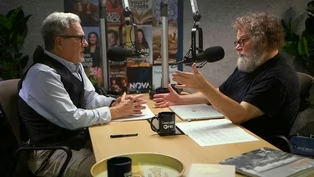 Now Playing
Extended Cut: How Skid Road Birthed a Literary City
Video has Closed Captions
Co-hosts Knute Berger and Stephen Hegg explore the origin story of Seattle’s libraries. (48m 58s)
Extended Cut: The Case of the Treasonous Doll Spy
Video has Closed Captions
Co-hosts Knute Berger and Stephen Hegg explore the story of WWII’s “Doll Spy.” (39m 18s)
Extended Cut: In the Name of Cod
Video has Closed Captions
Co-hosts Knute Berger and Stephen Hegg explore the Alaska Purchase. (44m 11s)
Extended Cut: The Potlatch Riot of 1913
Video has Closed Captions
Co-hosts Knute Berger and Stephen Hegg explore Seattle’s Potlatch Riot. (53m 26s)
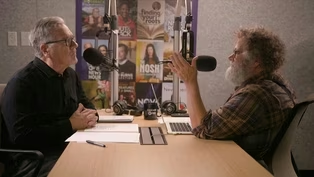
Extended Cut: The Mystery of the Mima Mounds
Video has Closed Captions
Co-hosts Knute Berger and Stephen Hegg explore the Mima Mounds. (44m 20s)

Video has Closed Captions
Season 11 of Mossback's Northwest premieres Thursday, October 9th, at 8:50pm on Cascade PBS. (30s)
Providing Support for PBS.org
Learn Moreabout PBS online sponsorship











Support for PBS provided by:
Mossback's Northwest is a local public television program presented by Cascade PBS