Mossback's Northwest
Extended Cut: The Potlatch Riot of 1913
Clip: Season 11 | 53m 26sVideo has Closed Captions
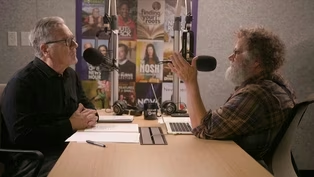
Co-hosts Knute Berger and Stephen Hegg explore Seattle’s Potlatch Riot.
Seattle once hosted a celebration called The Golden Potlatch. In July 1913, political tensions mixed with revelry erupted into a riot, resulting in a brief period of martial law and intense battles over freedom of speech. Mossback hosts discuss the differing accounts of why the riot took place, the political undercurrents at play and how so much of what happened then resonates with our world today
Problems playing video? | Closed Captioning Feedback
Problems playing video? | Closed Captioning Feedback
Mossback's Northwest is a local public television program presented by Cascade PBS
Mossback's Northwest
Extended Cut: The Potlatch Riot of 1913
Clip: Season 11 | 53m 26sVideo has Closed Captions
Seattle once hosted a celebration called The Golden Potlatch. In July 1913, political tensions mixed with revelry erupted into a riot, resulting in a brief period of martial law and intense battles over freedom of speech. Mossback hosts discuss the differing accounts of why the riot took place, the political undercurrents at play and how so much of what happened then resonates with our world today
Problems playing video? | Closed Captioning Feedback
How to Watch Mossback's Northwest
Mossback's Northwest is available to stream on pbs.org and the free PBS App, available on iPhone, Apple TV, Android TV, Android smartphones, Amazon Fire TV, Amazon Fire Tablet, Roku, Samsung Smart TV, and Vizio.
Providing Support for PBS.org
Learn Moreabout PBS online sponsorship(bright uplifting music) - Hey, everybody.
Welcome to Mossback, the official podcast of the Mossback's Northwest video series from Cascade PBS.
I'm Stephen Hegg.
- And I'm Knute Berger.
- And today, we're talking about a 1913 riot that tore through downtown Seattle, destroying property and spurring a brief moment of martial law.
The rampage was triggered by deep conflict between so-called patriots and so-called socialists, but also by the power of the media, the press, to persuade and inflame.
The event and its aftermath launched fierce battles over freedom of speech issues that resonate eerily today.
If you haven't already seen the video, take a moment to watch it.
It'll put this conversation in context, and you'll see intriguing images from the time period.
But for now, let's travel back to the early 20th century and to Pioneer Square.
(warm playful music) This event, the Free Speech Riot of 1913, happens in the middle of a citywide celebration called the Golden Potlatch.
What is the Golden Potlatch?
- Well, the Golden Potlatch was a celebration very much like Seafair.
You think of a Seafair and you think of boat races, military planes, the Navy comes to town, there're parades, torch light, whatever.
Well, this was actually hatched in Seattle in the early aughts.
So, from 1910 to 1914, Seattle had what was called a Potlatch, Golden Potlatch Festival.
It was a citywide civic event.
It had the Navy, it had the planes, it had everything that Seafair has today.
It had a court with kings and queens.
It had people in costumes.
The idea behind it was that Seattle had grown dramatically in the the gold rush era, so 1897.
But if you look from 1900 to 1910, Seattle went from 80,000 people to 250,000 people, roughly.
I mean, a huge growth.
That's three times.
And it was a prosperous city.
It was becoming a more complicated city.
A lot of big changes were happening, both physically and commercially.
And Seattle wanted to promote itself the way a lot of big cities do, and they wanted to have something akin to Mardi Gras, or something akin to Portland's Rose Festival.
And the Golden Potlatch was an idea that kind of localized the celebration of who we were as a people.
- Seems like it might have been a continuance from the very successful and very famous AYPE that ended in 1909.
- Yes, exactly.
So the Alaska Yukon Pacific Exposition in 1909 was a huge game changer for the city.
And coming out of that, people were like, well, why don't we do these kind of festivals?
It was a commercial thing and also a cultural thing, and it had these very kind of deep colonialist themes in it.
This is the era of the fraternal organization.
And so, you had organizations of white people posing as indigenous people.
We were claiming the colonial right to all the land between here and Alaska.
And so, a lot of the North Coast Native costumes, and mythology, and whatnot were embraced.
And there was this rosy view of the potlatch, which was of course, a celebration in Northwest Indigenous where people would come together and share.
A wealthy person would sponsor this thing for the whole village and give his wealth away.
- And I think it's interesting that the term potlatch was used, since it is a native term.
- Yes, it was done on purpose, because they wanted to kind of appropriate this concept of a benign sort of celebration.
But it wasn't benign in the eyes of colonizers.
British Columbia made it illegal to have potlatches, and seized indigenous artworks, and not just sending stuff to museums, but destroying it or putting it in storage.
The potlatch for native people was illegal.
But for white members of the Chamber of Commerce in Seattle who paraded in red face, we could put this appropriative benign face on the whole thing.
- So a potlatch for me, but not for the.
- Yes, exactly right.
- The video mentions some of those troubling details about these events, and I'm looking at it with my 2025 glasses on.
Some people marched in red face and even wore sort of KKK-type robes.
Do we have any evidence of a public reaction to these kinds of performances?
- Well, the photographic evidence shows that, and I think theoretically, diversity was something that the potlatch was meant to showcase.
And if you look at the floats and things that were in the parades, some of them are cringe inducing, like you mentioned, the people marching in costumes that even then people would associate with the Klan, though they weren't explicitly that way.
But then there were also floats of parading members of the Black community.
So, it was meant to be kind of all encompassing, promoting business, promoting identity, promoting local culture, and having a good time while doing it, aerial displays.
And a big chunk of it revolved around parades through town, and Pioneer Square was kind of the epicenter of the celebration.
So in 1913, this had been going on a couple of years, it was a big deal, it got bigger every year.
- And no problems with the 1911 and the 1912 celebrations?
- No, not that I know of anyway, but it's nothing on this scale, nothing of this type.
- Very good.
- With all that change going on, though, there were things that had to do with labor strife, that had to do with the kind of increasing right wing orientation of some in politics, people against socialists.
It was a period where the IWW was strong, and the Socialist Party in Seattle was also a factor.
And so, politically, it was a period where there were strong extremes on the right and left in the city, and they were tussling for who could do or who could say what, and this was an ongoing thing, just as a matter of course, over the years.
- So we're focusing on a huge riot that happened in the streets of Seattle in July of 1913.
And the video points out there were different accounts of what happened, and who started it, and what the deal was.
But let's go to Thursday, July 17th, 1913.
Who is Annie Miller, and what was she doing in Pioneer Square that day?
- Well, it's interesting because the riot happened without anybody really knowing about Annie Miller.
After the riot happened, people came forward with their accounts of how it started.
So, the potlatch lasted for better part of a week.
And on Thursday night, people were gathered in Pioneer Square, festivities were going on, and in what's now Occidental Park, at the intersection of Washington and Occidental, there was a kind of a speaker's corner.
Street speakers could set up a box, or a table, or whatever and give speeches in public.
And this was controversial in Seattle, had been over the years, because a lot of people considered dangerous radicals were speaking about socialism or speak... - Oh, my god.
- The city was arresting people for that.
There was a big arrest of speakers up at Pike Place Market at one point where they put them on the chain gang.
Seattle had a chain gang, by the way, during this period.
- So were soapbox speakers just banned no matter what the subject matter was, or was it very political?
- It was very political.
- Seattle had allowed soapbox speaking, so people could do it.
It was an exercise of free speech.
Annie Miller was a woman who was speaking on behalf of women's rights.
She had a table, she had a stand to stand on, she was at the intersection of Occidental and Washington, and she was promoting the rights of women.
Big crowd was there, largely sympathetic.
There were members of the IWW, there were socialists, there were business people, there were just people gathering around, listening to her talk.
Now, the different versions of that are that, one, there was a sailor who came up and took exception to what she was saying, allegedly tried to hit her.
Some accounts say he did hit her, others, that he just took a swing at her.
They knocked over her table, and her literature was scattered and that kind of thing.
And a man, well-dressed man with a diamond ring, took objection to this sailor trying to hit a woman.
- "How dare you, sir?"
- Yes.
And said something to the effect of, "And you would hit a woman," and punched the sailor.
A melee erupted.
Annie Miller was sort of lifted out of the crowd by sympathetic people.
The sailor went off and came back, apparently, with a couple more sailors and a couple of soldiers who were, again, in town, probably drinking.
This was a very popular.
The saloons were very full - Oh, you think so?
- and very active, and a brawl ensued, and the sailor-soldier contingent got the worst of it.
Their version was, this woman was disparaging the flag, disparaging America, how dare she?
And someone in the crowd started a riot, a wobbly.
And of course, the IWW was the most radical organization in Seattle.
- Known as Wobblies - Wobblies, Industrial Workers of the World.
They were for worldwide revolution and a non-capitalistic system.
And they pursued bare knuckle tactics too.
They weren't Quakers.
(both laughing) And it was not a Wobbly event, but there were people there with Wobbly buttons and whatnot.
So this brawl breaks out, and the serviceman side is saying, the Wobblies attacked us while preaching revolutionary dogma, and disparaging and spitting on the flag, and this kind of thing.
The Annie Miller version was, I was talking about women's rights, they pushed me around, and somebody came to my defense.
So, that incident took place on a Thursday.
The next day, Friday, in the late evening, the crowds are back in Pioneer Square, a huge contingent of sailors and soldiers shows up, and are among the revelers, as are many Seattleites out having a good time, and they proceed to go on a rampage.
And the intention... - Who is they?
- The sailors, soldiers, and then many local people following their lead.
And it's a patriot riot.
It's the, we're gonna... And so, the intention was to destroy or loot any IWW office that they came across, and there were headquarters.
Everybody knew where these things were, Union Hall type of thing.
But it expanded beyond that.
They began attacking the office of the Socialist Party and other more sort of... And it got crazy enough that they even attacked a gospel mission.
They were attacking businesses that were unrelated.
And they were going in, they were throwing all the furniture and desks and everything into the street and lighting 'em on fire.
I mean, it was a bonafide riot.
And it was noted in the press, but also by some people who witnessed what was going on, that the police weren't doing anything.
The authorities just kinda turned their back and let the riot play out.
But it did a substantial amount of property damage throughout downtown.
And it was considered, I think, by the mayor at the time as, as a crisis, emergency situation.
- But wait.
The Seattle Times had a totally different version of events the next day.
What was that version?
- Well, their version of events was essentially that the service people didn't do anything wrong, they were set upon by these brutal IWWs, they were disgusting, traitorous people who deserve no less than a public beating.
The Seattle Times and its publisher, Colonel Blethen, he was known as a pretty far right guy, and used the paper to blast anybody who he perceived as unpatriotic.
- It sounds like the sailors and their citizen friends came back Friday loaded for bear, that they wanted to fight.
What caused this?
What was the momentum behind this?
Just word of mouth?
- I think word of mouth was a big part of it, guys going back to their ship or to their base and saying, we got in a big brawl with these burly IWW loggers.
- And this woman.
- Well, they didn't mention the woman, I don't think.
They didn't want to be seen to have been beaten in a brawl sparked by offending a lady.
And I think you have a number of things going on here.
One is this sort of patriotic furor, how dare you insult America, that kind of thing.
But also, the Seattle Times reported on this bruhaha in Pioneer Square, and their version was very political, very biased toward the anti-red.
And I'll read you a little bit.
There's a front page article on Friday.
So this is the day after the brawl.
- And they're an afternoon paper?
- And they're an afternoon paper.
And they come out and they say, practically, let's see.
"A gang of red flag worshipers and anarchists were brutally beating two blue jackets and three soldiers who had dared protest against the insults heaped on the American flag at a soapbox meeting on Washington Street last night."
So their version is very different from what we've heard from Annie Miller, who had a sworn affidavit, which was supported by other sworn affidavits, about what the fight started.
It was not a socialist rally, it was a pro women's issue speech that was being given, and it got out of control.
Now, the other thing is that during potlatch, the saloons were wide open, soldiers and sailors were packed in, as were regular citizens.
And so, on that Friday night following this newspaper account, it breaks out into a big bruhaha.
- And the Seattle Times had a definite point of view that had a target, they had a target?
- Yeah.
I mean, their reporting on it is, there were a whole bunch of traders gathered.
I mean, they say anarchists and IWW members, but it was not.
There were a lot more people there than that.
And they're taking the sort of hardest spin on what it is.
These people hate America.
Go beat 'em up.
That's essentially what some people read into the Times' coverage, but they're pretty explicit about it.
I mean, they're definitely not trying to tone things down, let's say, that rhetoric they're using.
- So Saturday morning comes.
Where is the city's leadership?
Where is the police?
What happens on Saturday?
- Well, the mayor steps in, in a big way.
Saturday morning, the smoke from the riot is just starting to clear.
And there were thousands of people in this riot, and businesses destroyed and offices burned.
And the mayor was George Cotterill.
George Cotterill was a progressive.
He allowed soapbox speakers in Seattle.
He was in favor of various progressive laws.
He had served in the legislature.
He'd gotten the open primary passed in the legislature.
He was involved with public, or making public infrastructure public as opposed to private.
So city light, our watershed, that kind of thing.
So he's promoting very progressive ideas.
- Doesn't sound like a candidate that Colonel Blethen would fall in love with.
- No.
He had beaten Hiram Gill for the mayor's office the year before.
And Hiram Gill had been recalled because of his... He was seen as corrupt, as pro vice.
And the women's vote helped get him recalled.
And Blethen was on the other side, he was a Gill supporter, as many business people were, because they made a lot of money off of vice.
And so, he didn't like Cotterill.
Cotterill won hands down over Gill.
And so, they were enemies on a very local scale, as well as this kind of ideological scale.
- So how did Mayor Cotterill step in?
- So, because of the potlatch riots, Cotterill directed the police and took charge of the police.
I mean, we have a police chief that's in charge of the police.
Well, in an emergency situation, the mayor had emergency orders issued saying, I'm in charge of the police, they have to do what I say.
And we're gonna close all the saloons, we're gonna eliminate, for the time being, all public soapbox speakers, street speakers, that's gonna go away.
And we are going to prohibit the issuance of the afternoon paper, meaning The Seattle Times, Colonel Blethen's paper, today and tomorrow within the city limits.
So two days of no newspaper, unless proofs of the publication are first submitted to him, Cotterill, barring all street meetings except religious gatherings.
- Ooh.
- So Cotterill is basically saying, I'm shutting your paper down, but if you wanna publish it, you have to run your copy by me and I get to blue pen it.
Now, he qualified that by saying, "You can say anything you want about me.
This is not a political thing.
But I don't want you promoting more public disorder."
- So he blamed the Times for stirring up the sailors and the other people for fomenting unrest?
- Yeah.
It says, "Cotterill said he acted under law which says, in the case of riots, tumult and violent disturbances of the public order, the mayor shall have, as an exigency in his judgment may require the right to assume control for the time being of the police force.
But before assuming control, he shall issue a proclamation to that effect."
Which he did.
- How did that go over?
- Well, Blethen, yeah, went nuts about that.
I mean, he opposed it completely.
It was a violation of First Amendment rights, it was a violation of his right to free speech to print whatever he wanted in his newspaper.
And the government, let alone a mayor who he didn't like in the first place, had no right to try and shut his paper down.
So he went to court to get a restraining order on the mayor, and the court saw things Blethen's way.
- On a Saturday?
- On a Saturday, emergency court.
And he wanted to see Cotterill and the police chief arrested.
Cotterill sent police down to the Seattle Times building to surround it, to make sure that they weren't gonna get any papers out.
So you have this... To me, this is this interesting case where it's a free speech riot, and every side is both promoting free speech and violating free speech.
- And restricting it.
- Yes, exactly.
Because Blethen is like, you can't go out on the street and stand on a soapbox and promote socialism.
And if you do, you deserve to be beaten up.
And then he says, "Yeah, but my newspaper.
I can say whatever I want.
I can tell my reporters to write whatever I want.
You can't restrain that.
I'm protected."
And likewise, other people are pointing out that, well, free speech is good for you, but you don't allow it for us.
So, Cotterill basically had to back off.
Also, people objected to the close the saloons.
This was really unpopular.
- Stop the presses, but don't close the saloons.
- Exactly.
And of course, one, Cotterill was pro prohibition, so he was an early advocate, as many progressives were.
And so, there was probably a bone to pick there from their days of arguing about vice.
And also, I did find a newspaper clipping where it said the owner of a downtown bar ordered his bartender to violate the mayor's order and get arrested so they could challenge it in court.
And I thought that was... I mean, you have to be a very loyal employee to get arrested on behalf of your boss.
But this shows that that was a very unpopular aspect of the mayor's edict.
- Well, when did things settle down?
What was the?
- Well, it's interesting because they didn't settle down right away.
I mean, they settled down in the sense that the Times was able to publish, and they published, in the days that followed, a succession of blistering attacks on Cotterill.
Cotterill proclaims himself king, he claims himself Tsar, he's a red lover.
And so, they continue to beat up Cotterill.
A recall campaign was formed and defeated, Cotterill won.
So Blethen did not get him kicked out of office.
There's a lot of discussion in the newspapers about what happened, and who did what to whom.
So you have the version of The Seattle Times, which is sort of the far right version.
You have the PI and the Star taking a little bit more of a moderate stance.
They're not really arguing with that, but they're doing some reporting of things that might be kind of contrary.
And then you have the labor press.
And so, the Union Record is the major labor newspaper, they're reporting on it, the Commonwealth, which is the socialist newspaper, is commenting on it.
So you're getting, because of free speech, you're getting all these different views coming in.
So you have Blethen's version, and then you have, here's the Union Record's version.
And this is several days later, their weekly.
"Mob of soldiers and sailors led by hirelings of kept press burn and pillage in Seattle.
Friday evening, July 18th, there was witnessed in Seattle one of the most disgraceful occurrences ever beheld in a supposedly civilized community.
A mob composed of a few bearing the uniform of the United States soldiers and sailors, led and supported by a number of civilians, attacked, wrecked, and burned the wreckage of the headquarters of the IWW, the regular Socialist Party, and the so-called Yellow Socialists, destroying in the neighborhood of $5,000 worth of property."
I think it's interesting, within the labor movement you had, the IWW was on one extreme, global revolution, will use violent, they're often accused of being anarchists or communists.
The Socialist Party was relatively mainstream.
They're to the left of the progressives, but they're working through the political system.
They're not trying to completely overturn it.
And the labor movement was sort of split into factions.
You had things happening in the labor movement that had to do with using Black workers as strike breakers.
You had unions that wanted to be all white.
You had others that were trying to integrate.
You had socialists adopting some of the progressive causes, but opposing others.
It's a time of a lot of political ferment.
We tend to think about socialists didn't enter Seattle politics until Kshama Sawant got elected to the city council.
- Well, I look back on Seattle history, and, let's say, the general strike of 1919, and the tensions before and during World War I, and the Russian Revolution.
There is this generalized tension about socialism and about Bolsheviks.
But on the world stage, none of that had happened quite yet, but there was still... What was the tension, the general social tension about socialism on the far left and the Wobblies?
- Right.
Well, I think there were a lot of factors there.
And I think that the sort of gilded age produced a backlash politically.
And this this era where you had large numbers of barely employed or manual laborers who were not making enough money, they weren't in unions, they didn't have political support particularly, many of them are itinerant.
The IWW appealed to this group of hardworking, but this large population, kind of a floating population if you will, going from job to job to job.
And this is happening as a result of excesses of the 19th century and the late 19th century.
And I think the interest in those causes grew.
There was also an anarchist movement back then, and violence related to that.
And so, even before World War I, you had this government crackdown on people believed to be anarchists.
Some of the utopian communities like Home across the sound from Tacoma was an experimental community that hosted people who were anarchists, and the government cracked down on them and tried to drive them out.
So it was a period too of very divided politics, and not just Democrats and Republicans, but other movements that were seen as a threat to the capitalist order, to civic life.
- Well, all of these events and some of the forces, and certainly the hyperbole, the sensationalism, reminds us of the current day internet and social media.
But what also resonates to me is, I think, correct me if I'm wrong, you're talking about a city that has grown very rapidly, there are even greater disparities in wealth.
- I mean, there is a kind of thing which is, if you wanna become a big city, be careful what you wish for.
This is a period where the competition between Seattle and Tacoma had largely been settled in Seattle's favor.
So this became the boom town, this became the place where you went to make money, where there was tremendous opportunity.
I also think that, in the West in general, certainly in the Pacific Northwest, utopian communities, utopian politics, some of these parties had substantial constituencies.
I read that, for example, when Cotterill and Hiram Gill were running for mayor, the socialist candidate got more votes than Hiram Gill did.
- And this was in 1912?
- This is the year before.
And Seattle did have a somewhat progressive orientation.
Washington State went for Teddy Roosevelt in 1912, the Bull Moose Progressive Party, but that didn't mean those people were anti-capitalist, that didn't mean those people were anarchists.
So I think you have a politics where you have people on the extremes, and then you have this middle that can kinda lean both ways.
It can lean conservative, it can lean liberal, depending on what the issue is, depending on who's pushing what, when.
- What effect did this event, this series of events have on politics in the city?
- The politics of Seattle got, I think, more conservative in tune with the sort of national issues as a result of World War I, as a result of the Russian Revolution.
In 1917, communism was suddenly seen as this real threat.
The Seattle General Strike was organized by organized labor generally, but the General Strike scared the powerful class, and they blamed it on the Wobblies.
They said, well, this is a strike by these Wobblies, this is Bolshevism come alive.
- In other words, we told you so.
- Yes, exactly, but they played a minor role.
And the mayor at that time, Ole Hanson, ran for president based on national celebrity he gained by being the tough anti-communist mayor who told those Wobblies to shove it.
And then of course, in the 1920s, you have kind of an increased period of red scare, conservatism, immigrant hatred.
This is when many of the laws limiting immigration into the United States kick into effect.
It's a really interesting period.
And the enthusiasm for the potlatch died.
- I'm not surprised.
- I mean, they organized one in 1914.
I thought they didn't have one in 1914, but it was basically a very small affair, and then the war started, World War I started, and the potlatch just vanished.
They tried to bring it back for a few years in the 30s, but then the Depression and World War II put an end to that.
And so, there was a way of this sort of civic boosterism just went on the shelf for a while.
- This story also resonates very clearly with me with what's happening today in the country when it comes to journalism, how are things covered.
You covered, for instance, WTO as a journalist.
- I did.
- What similarities, or what resonates with you when covering this 112-year-old story?
- Yeah.
Well, one thing I'm really struck by, and I've been struck by this in other circumstances, but newspaper publishers ran their newspapers like little fiefdoms, Blethen, the Hearsts, the whatever.
These families own the paper, and part of the pleasure of owning a paper was being able to put in it what you wanted to.
Some were very devoted to reporting and opinion.
Others infused their reporting with opinion.
And the fact that there were so many newspapers covering this event is wonderful from a historian's perspective, because you can see what the radical people thought on right and left, you can see what the mainstream was saying, You can see what they weren't saying.
Some papers are reporting with objective reporting, some papers are reporting with very biased reporting.
And so, you get this complexity of the city.
And so, one thing it reinforces for me, and I felt this before, is, Seattle in the early 20th century was served better by its newspapers than it is now, or better, really, by its media in general.
Because people were reading, there were papers that reflected all kinds of views, plus immigrant papers or papers for particular ethnic groups.
And yeah, you get a lot of that on the internet, but what you don't get are the numbers of reporters that these papers were putting on the street to go get news, whatever it was.
The Seattle Times had a reputation for crime reporting, the Seattle Crimes, they used to call it.
Seattle Star was seen as a more progressive of the dailies.
They had biases, they had viewpoints.
But as a reader, you got a wide variety of thing, and you could subscribe to your your favorite paper.
Now what I worry about, and of course, Cascade PBS has a part of this story, which is shrinking newsrooms or newsrooms that are being eliminated, and I just don't see any good that comes from that.
I mean, it may be a necessity economically, or in terms of changing technology.
The media's been shaking out for quite a while.
But on the whole, is the media, television, whatever, the internet, blogs, vlogs, whatever, podcasts, are we really better served?
I'm not sure we are.
- We have media that are searching for markets.
So I'm gonna serve this particular part of the politic, because that's gonna be my market.
So columnists or influencers are staking out their territory and not reporting objectively.
- Well, I think what strikes me is that if you sit down with a copy of The Seattle Times or PI from the teens, you see an extent of coverage by reporters and columnists that dwarfs anything newspapers do now, columns and columns of reporting, columns of reporting on everything, and people obviously took the time to read that.
It was commercially viable to engage the public in that way.
And I think, down the road, it's a huge gift to historians.
I'm not so sure that the collective reporting that we're doing now is gonna offer that same kind of gift to future historians.
I just think more is better, and I think it's true of free speech, even if you don't like it, even if you hate it.
- So, is Seattle deserving of its stereotype of wild, uncontrolled protests that any kind of protest or event is going to get hijacked by certain people, or it's just going to be out of control?
I mean, it is a rough and tumble stereotype that we deal with.
- Well, you asked me about WTO, and I was editor of Seattle Weekly at that time, and orchestrated extensive coverage of what turned out to be protests and riot, and all the aftermath of that.
And one thing I learned about being at ground zero when the tear gas and the rubber pellets and whatnot were being fired is that nobody comes back from a riot with the same version of events, because it depends on what piece of it you saw.
If you were in a turtle costume marching along Fifth Avenue with a longshoreman, you had a very different view of that than if you were confronting a Seattle Police Department tank.
And so, it doesn't surprise me in thinking about the 1913 riot that there were different versions of events, and a lot of word of mouth and a lot of rumor, and all that kind of thing.
So, it's difficult to relay the complexity of those events because they're often good and bad mixed, or a confusing collision that, who's at fault?
I mean, both with WTO and with the Capitol Hill protests and others, a lot of time was spent afterwards picking it apart, what went wrong, who was at fault, what really happened?
And in 1913, they were doing the same thing.
They were not just from ideological perspectives, but other perspectives.
There was an effort to figure out what the hell just happened, and I don't think it was something people expected to happen.
I mean, you're celebrating the city, you have everything positive going for you, and then there's this rage fest in downtown, and I think it took a lot of people by surprise.
- Well, again, you covered WTO as a journalist.
Was there reporting that was coming out of that protest that really shaped the days ahead?
- Yes.
It was an event that was analyzed not just by journalists, but by protesters and politicians a long time afterwards.
First of all, the City of Seattle did its own investigation of why did this happen, who let it happen?
Looked at city policies, looked at why we were hosting the World Trade Organization in the first place, and how come there wasn't more security, or how come the police did what they did?
I mean, you could argue that Mayor Paul Schell, who was mayor at the time, and to some degree, Norm Stamper, lost their jobs and credibility because it was basically seen as kind of a civic disaster.
And it did a lot of damage to Seattle in terms of the city's awareness.
And you'll see, in the year two following WTO, other cities saying, they were hosting something and saying, well, we don't want another Seattle.
Seattle became like a shorthand version sh-- show.
- And that's the stereotype we continue to live with.
- Yeah, there's still some of that.
And the thing was, it was an event that blew up on television.
The president came to town, so all the media was here.
There were all those side stories of these prominent world leaders on both the protest side and the political side.
The other thing about it that's interesting though is that the argument about media participation, there were many of the protestors believed that the media emphasized too much the anarchists lighting dumpsters on fire and throwing rocks or whatever.
And I was part of a panel that was held, I don't know, within weeks of WTO, to analyze the press, and there were a combination of activists and reporters, journalists from different media.
And I remember there was an argument that broke out on this panel over what is violence?
Now, you think, well, can't we agree on what violence is?
No.
There were people who said, oh, the anarchists were peaceful, they didn't hurt anybody.
Property destruction is not violence, was an argument that many activists made.
And on the other hand, I remember standing outside of, I think it was Nike Town, and there were these black-clad anarchist guys with these high powered slingshots shooting ball bearings, both at the crowd, but at the windows, trying to break the windows.
And when you heard those things hit the window and ricochet off, I mean, it would've killed somebody if it had hit them.
Is that violence?
That's the kind of thing that... So it was interesting because you go into it, and yes, there are biases and whatnot, but there's also so much room for just disagreeing about the terms of what happened, and this is an example of that.
The 1913 Potlatch Riot is sort of an example of how people were refusing to see the same thing.
- Did the journalism around WTO, the reporting around WTO as it was happening, affect how the protest played out in subsequent days?
I mean, the WTO conference lasted a period of days.
Did some of that journalism affect what happened the very next day, for instance?
- So, well, like in 1913, one thing that happened at WTO was, the morning after the big protest, and the rioting, and everything that happened on that event, downtown was locked down.
And so, a newspaper like Seattle Weekly, that was distributing free in news boxes, we couldn't distribute a paper to our main audience.
- You were being muzzled.
- Yes.
And we had spent extraordinary resources in making sure that we covered every aspects of it.
We had guys in the conference, we had people outside, we had people going to Eugene to talk to anarchists.
We had been covering it for a year before it even happened, trying to talk about context and why is this happening.
Afterwards, there was a lot of finger pointing and people saying, well, the protests were fine until those anarchists acted up, and others... And then you totally forgot about the events leading up to WTO, which included peace vigils, and seminars, and people climbing water towers and waving banners.
I mean, there was a lot of very peaceful stuff going on.
And so, afterwards, you ended up with a whole other constituency.
They were furious that the traffic had been blocked.
They were furious they couldn't shop downtown at Christmas time.
That probably did Paul Schell more damage than anything else How dare you take downtown off the grid at Christmas?
Protests continued after WTO.
There were protests... I remember when the horse police and the flash bang grenades were being used at 1st and Pike, I think that was maybe the next night, as protesters were marching in places that hadn't been put off ground.
There were marches on Capitol Hill.
And so, yeah, I think it continued.
But I do think there was a robust discussion, community discussion about, yeah, what the hell just happened, and could it have been better, could we have avoided the negative parts?
- What does this story teach us about history, how it's told, and how to get to the truth?
- I think it's important to look as much as you can at the context for an event, and look at the different perspectives.
And if you find that there's a unanimity of what people say about something, it's good to question that, but also, you're using the judgment of a reasonable person in terms of trying to determine what is most likely, or what do we absolutely know happened?
And so, when you have a variety of sources, newspapers expressing opinions and stuff, I mean, you're like a juror to some degree.
You have to take all this in and then kinda come to a reasonable conclusion.
What is it that you think happened?
How does it compare with other historical events?
So it's a thing where you have to think and make connections maybe beyond the specific topic that you're trying to determine.
And some things you'll never get at a... You might get to your own conclusion, but you won't necessarily know the truth.
That's why there's so many conspiracy theories and that kind of thing.
People, they make connections that may or may not exist, they make inferences.
- And they go back to their own echo chambers, they go back to the same source, which repeats the cycle so it reinforces their own already held belief, instead of consulting a variety of sources and balancing what you see, hear, or read.
- Yeah.
And I don't think you'll find the truth unless you're willing to question yourself, your own beliefs, or question... There are things that happen where there are many truths within it.
And like you say, you're gonna pick out which truth to hold onto based on what you believe, or what you grew up believing, or what someone told you to believe.
We're not always this objective source.
I do believe that more voices are better than fewer, because it just gives you more to work with as a historian, it gives you more to work with in terms of trying to see things from different angles and see dimensions of a story that... And so, you'd think a riot would be very straightforward, and that's the way it's tempting to report it.
Something ignited this, X people did this to Y people, and look at it in a very confrontational way without necessarily going for the complex narrative.
And people don't necessarily want complexity.
It's hard to explain, it's hard to read, or it's hard to listen to.
And so, historians, just like anybody else, you have to find a way to get to the story you think is true, and then tell it in a way where the most people will listen to it without being driven into their biases.
(tranquil uplifting music)
 New
NewExtended Cut: How Skid Road Birthed a Literary City
Video has Closed Captions
Co-hosts Knute Berger and Stephen Hegg explore the origin story of Seattle’s libraries. (48m 58s)
Extended Cut: The Case of the Treasonous Doll Spy
Video has Closed Captions
Co-hosts Knute Berger and Stephen Hegg explore the story of WWII’s “Doll Spy.” (39m 18s)
Extended Cut: In the Name of Cod
Video has Closed Captions
Co-hosts Knute Berger and Stephen Hegg explore the Alaska Purchase. (44m 11s)
 Now Playing
Extended Cut: The Potlatch Riot of 1913
Video has Closed Captions
Co-hosts Knute Berger and Stephen Hegg explore Seattle’s Potlatch Riot. (53m 26s)
Extended Cut: The Mystery of the Mima Mounds
Video has Closed Captions
Co-hosts Knute Berger and Stephen Hegg explore the Mima Mounds. (44m 20s)

Video has Closed Captions
Season 11 of Mossback's Northwest premieres Thursday, October 9th, at 8:50pm on Cascade PBS. (30s)
Providing Support for PBS.org
Learn Moreabout PBS online sponsorship












Support for PBS provided by:
Mossback's Northwest is a local public television program presented by Cascade PBS