Mossback's Northwest
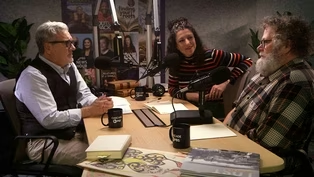
Extended Cut: Upon Further Review: Seattle's Food Evolution
Clip: Season 11 | 47m 6sVideo has Closed Captions
Co-hosts Knute Berger and Stephen Hegg explore Seattle food history with special guest Rachel Belle.
co-hosts Knute Berger and Stephen Hegg explore Seattle food history with special guest Rachel Belle.
Problems playing video? | Closed Captioning Feedback
Problems playing video? | Closed Captioning Feedback
Mossback's Northwest is a local public television program presented by Cascade PBS
Mossback's Northwest
Extended Cut: Upon Further Review: Seattle's Food Evolution
Clip: Season 11 | 47m 6sVideo has Closed Captions
co-hosts Knute Berger and Stephen Hegg explore Seattle food history with special guest Rachel Belle.
Problems playing video? | Closed Captioning Feedback
How to Watch Mossback's Northwest
Mossback's Northwest is available to stream on pbs.org and the free PBS App, available on iPhone, Apple TV, Android TV, Android smartphones, Amazon Fire TV, Amazon Fire Tablet, Roku, Samsung Smart TV, and Vizio.
Providing Support for PBS.org
Learn Moreabout PBS online sponsorship(gentle calm music) - Hey everybody, welcome to Mossback, the official podcast of the Mossback's Northwest video series from Cascade PBS.
I'm Stephen Hegg.
- And I'm Knute Berger.
- I'm Rachel Belle.
- And today, we're serving up one of our favorite topics, food.
Here in the studio with us is Rachel Belle, host of Cascade PBS' "The Nosh" and the podcast, "Your Last Meal" to talk about Seattle's most iconic and beloved foods, then and now.
If you haven't already seen the video, take a moment to watch it.
It's a good teaser for this conversation.
Plus, you'll get to see Rachel try lutefisk for the first time, and you can find the video in the show notes.
But for now, let's dish.
(gentle bright music) Every season, Knute, you host a Mossback series that reviews a previous episode based on what you've learned from that episode and based on audience reaction.
There have been a lot of Mossback episodes that feature or mention Seattle foods.
What did audiences react the most to?
- Seattle foods.
- [Stephen] All of them.
- People love the topic of food history and partly nostalgia and food and taste, you know, those things go well together.
And we've done a lot of different episodes on foods, you know, searching for the origins of, you know, salads or dungeness crab, or looking at the settlers and what they ate of clams and shellfish and that kind of thing.
Food is a big part of our history.
And, you know, Rachel is such an expert on kind of current food trends and scene but she also has her own history here and how things have changed during the time that she's been in Seattle.
I just thought it would be really fun to have a conversation about kind of foods then and now and how things have changed in our lifetimes as well as in history.
- And here was an opportunity to dig in and cross-pollinate with Rachel, who's even has a cookbook to her credits, "Open Sesame."
- Yes, if you like Tahini, black sesame, sesame seed, sesame oil, the book came at in November, 2024.
Get it anywhere in Seattle.
I'm always trying to sell copies apparently.
(group laughs) - When you first got together to talk about this collaboration, what shape did it take initially?
What were you thinking you might talk about?
Because if you talk about Seattle food, there's food and then there's a whole lot of other food.
- Well, I think my first thought was, well, you know, we've talked about the Seattle dog, we've talked about chicken teriyaki being kind of a Seattle thing.
And so I wanted to find out like, is that still true or have other things come along and taken their place, or have things like that changed over time?
So is Seattle dog what it used to be?
Maybe it's something different.
And so we just began talking, but then the conversation got onto restaurants that we remember, eating experiences, you know, from childhood, and all of those kinds of changes.
So we kind of ranged all over the place.
And then as we began to focus in, we thought, well, we can't do video on food without trying food, having it on screen.
So that became part of the episode.
- And when we started talking, what became clear very quickly to me was that we have a lot of generational differences with food, partially because we are different generations.
But also I moved here 20 years ago and you grew up here, and so there were things like the Nanaimo Bar that you said, "Oh, it's such a Seattle thing" and I said, "No, it's not."
You would've a hard time finding that.
And I think a lot of people don't know what it is.
So that's kind of what happened and our conversation was like.
What I know and what Skip knows and then the big gap between.
- Well, that's what I was gonna ask.
What the differences were between your idea of what a Seattle food is and your idea of what a Seattle food is.
- Yeah.
Well, the Nanaimo bar thing is interesting 'cause actually it comes from Nanaimo, it comes from BC.
But one thing that really defined Seattle foods for two generations at least was Sunset Magazine.
And things like Sunset Magazine, we'd have recipes for things like Crab Louie or Nanaimo bars or things that became very much a part of the household local dishes.
- I still subscribe to Sunset Magazine.
- There you go.
- I think it's a great magazine actually.
- [Rachel] Me too.
I love it.
- Especially for food and travel.
- I remember it as the magazine you were gifted when you got married.
- Oh yeah.
Well, I was gonna say something else about the magazine.
I don't know how much we have to get into that.
But they actually like shut down over the pandemic and I was so upset about it because it's such an old magazine.
It's like over 100 years old, so I was so happy when they came back.
- So do you guys agree on what is a Seattle food?
- Some of the things.
I think the things that are undeniable are the things that naturally are from here, like clams and oysters and gooey duck, things like that.
Like, that's not a trend.
But I think, yeah, the differences were things like pho, I consider pho a Seattle food.
You know, obviously it's a Vietnamese food, but my favorite fact that I like to say anytime I have the chance is that there are more pho restaurants in Seattle than there are Starbucks.
There's a really rich history of why we have so much Vietnamese food here.
So I think, you know, when you think of the city in a modern way, we have such a strong Asian influence.
And even that has changed over time with immigration patterns.
- Well, it's so interesting because Teriyaki was a food that you centered on early on the Seattle's first teriyaki restaurant and how that whole franchise just exploded.
And now there's, you know, of course a teriyaki place also on every block.
- Yeah, years ago when I was at The Weekly, we had a really great food writer who did a story on the history of teriyaki in Seattle.
I thought every city had teriyaki in every strip mall.
And if you ask my children what food were they raised on, especially when I was a single dad, they were raised on Toshi's Teriyaki they had one in Kirkland.
And on my way home from work, I stopped in and, you know, did the traditional thing of like thinking, oh, I'm giving them a really good healthy meal, chicken, salad, rice, it's all the food groups.
And my kids still talk about that.
- I've heard this a lot from locals who said they didn't know it was a local food until they moved away, especially to the East coast, and they can't find teriyaki anywhere.
I didn't know for maybe 10 years living here that it was a, quote, "Seattle food."
Obviously it comes from a Japanese background, but in Japan, teriyaki is more of a light glaze.
It's not as sweet as it is here, so it's our version of teriyaki.
And then like you mentioned, like the way that it's packaged, like always coming with those scoops of rice, always that little iceberg lettuce salad.
- Well, I wonder if Korean food and Korean barbecue bulgogi and those things are making inroads on that, not because it's an Asian food but it's a great takeout item.
You can get it at Costco, it's savory, it's delicious.
- And there's some teriyaki places where you can get it too.
I've noticed that one thing that's changed with teriyaki is they've added other dishes into it from other cultures.
But you're right, they all have the characteristic of easy takeout.
- I've been told that a lot of the teriyaki restaurants in Seattle are owned by Korean families.
So that might be why.
But yeah, again, it's immigration patterns.
Like of course, in LA they have a huge Korean food scene, there's Koreatown.
And obviously we have some here, but it's not as strong as some of the other Asian cuisines.
- Well, when I was growing up, and as I remember growing up, I remember the food, it's seafood.
I mean, you know, it was salmon, it was clams, it was, you know, I wasn't big on oysters, but I razor clams.
My folks were clam diggers from way back.
And I wonder now, is Seattle a seafood destination the way it was?
I'm sure it has that reputation.
- 100%.
- Do you think so?
- Oh yeah.
I would say this anecdotally.
Every time somebody's coming to visit and I get sent all these people, where should my friends eat?
You know, where should my parents eat?
What do you want?
Everybody wants seafood every time, which actually I find is a challenge to recommend places because you know, it depends, like for me, as somebody who likes a little bit more of like creativity in cooking, there's the classics, you know, there's like Ray's Boathouse and Elliot's Oysters, Elliot Oyster, oh my gosh, Elliot's-- - Elliot's Oyster House.
- Elliot's Oyster House.
I never knew that was so hard to say.
But personally, I like to send people to more creative places, but a lot of people just wanna be by the waterfront.
So I find that actually one of the most challenging questions is, where should we get seafood?
- Well, it is, and I wonder if it's because Seattle has a reputation for seafood.
But I think having worked in the 80s as a server at McCormick's Fish House, one of the most iconic fish places in Seattle, it's no longer there, but it was certainly the hub of seafood dining.
Everybody dropped in there.
Famous or not famous, they all came.
But I wonder if it's the reputation that precedes that.
So they get here in Seattle and I'm finding that seafood, especially salmon, crab is very expensive.
And apart from the very sort of touristy places on the wharf, maybe like, you know, Fisherman's Wharf, San Francisco idea, it's not that easy to find and it's very expensive.
Despite we, you know, we have the throwing the salmon identity from the Pike Place market, we're not as big a seafood destination as we used to be.
- I will say though, there's a lot of oyster happy hours around town and it's not just in seafood places, like, you know, Tom Douglas has a place that does it.
I mean, you can look online, like there's lists everywhere.
But I think that it is still, but you're right, it is very expensive and that's part of the problem.
But people still want to eat it and there are these little happy hours.
I mean there's at least like 10 or 15 where it's like, you know, at this time you can get 'em for a dollar and then in a half an hour they're up to $2.
- Yeah, yeah.
I think one thing that's changed, and I think cost may be part of this, is seafood as an everyday item at home.
I mean, my ancestry is Scottish and Norwegian, so we ate fish like all the time for every meal, you know, type of thing.
And you know, we would serve crab, we would have it for ourselves as well as for guests to kind of show off, you know, the bounty, salmon, that kind of thing.
But you know, we're also eating cod, we eat halibut.
And you know, I don't think it's as affordable at that level as like, you know, I'm gonna stop by the fish market and get a cheap dinner as it used to be.
Restaurants, I think it's still plentiful.
And I also think there's more competition from seafood restaurants in other cities because, you know, you flash freeze something in Alaska, you know, in a bearing sea and it can be in Paris in hours.
- It's like bringing Olympia Oysters to San Francisco.
Once we had a train, you know, and a way to pack oysters.
you could do it.
- You could do it.
- Yeah, I think that's why.
And it's like, they're doing a great job, but I'm hesitant to send people to those places that are on the waterfront because it will be, you know, just a piece of salmon that's cooked with, you know, olive oil butter or salt and pepper and the meal will be, you know, 45/50 bucks for that where you can make that at home and there's not like a lot of excitement around it.
If people are listening and they wanna know a good place to get seafood, that's a little more interesting.
I always send people to RockCreek in Fremont.
They have a really interesting kind of more global menu and you're not on the water, but the food's very good.
- What were the foods that you two tasted on camera?
- Well, one of the foods was pho.
- Yes.
- And it was kind of revelatory for me because, you know, there's good pho and not so good pho and I'm not a pho aficionado.
And yeah, so Rachel suggested that we try it, it's becoming much more ubiquitous.
- Something that I learned was that a lot of the places actually use a powder instead of making the bone broth, which I had no idea 'cause at first when I moved here, I remember thinking like, all the fun places I'm going to are good.
Like, it all kind of tastes similar to me.
But I've been noticing in the past several years that some taste better than others.
And I was told when it's not as good, they're probably using like a bouyon.
But otherwise, this is like bones that are cooking, you know, overnight.
And it's just this cauldron that never stops boiling.
They just add to it, add to it, add to it.
And that's what you want, you want like that collagen so that like when you sip the broth you can actually-- - [Stephen] That concentration.
- Yeah, like, feel some of that like on your mouth, like, the fat a little bit.
It's so good.
And we talked about the story of Seattle's first pho restaurant, which is still open.
- [Stephen] Which is where?
- Pho Bac, they opened in 1982.
- [Stephen] Down on Boren and... - Down in the ID, yeah.
- Jackson and Boron where they meet there.
- Yeah, so the two daughters of the owners have taken over and they've opened a bunch of restaurants in Seattle.
They have an excellent coffee shop called Hello Em, where they do a lot of interesting Vietnamese coffee drinks.
But yeah, they're doing a great job.
So there are a lot of pho places, but they're not all the same.
But I love how in the city, you know, you could see like a construction worker enjoying pho or like, you know, like, in other places that might be seen as like, oh, you have to be a foodie to know about this.
Everybody eats pho in Seattle.
- Why the rise in popularity?
Is it because it's a comfort food and it's hot, and it's nutritious and not especially caloric?
- Do you wanna know how it got popular in Seattle, like why there's so many?
Okay, so what happened, let's go back to the 70s in the Vietnam War.
There were a plane or two of Vietnamese immigrants who were coming to the States and they landed in California.
And the governor of California at the time, Jerry Brown said, "Nope, don't let them outta the plane.
We don't want these immigrants here."
That funneled up very quickly to Washington state.
Remind me of our governor's name at the time.
- [Stephen and Knute] Dan Evans.
- And Dan Evans said, "They are welcome here.
Fly them up immediately."
So a lot of immigrants were welcomed here and that's how it started.
The way that it works in the Vietnamese community with pho was that, one family would sponsor, another family would sponsor and another family and they'd say basically like, "Here's the blueprint on how to open a pho restaurant.
We'll help you do it."
So it just kind of passed from family to family and opened and opened.
And then I think people just tried it and were like, oh my God, this is really good.
You know, people who aren't Vietnamese, and so they just kept opening and they were doing well so they stayed open.
- Banh mi, do you think Banh mi are on the same climb too?
'Cause I love banh mi.
- I don't think.
I mean, banh mi is very good but I don't think it's as popular.
You might be right, it's the perfect climate here, you know?
It's like we have a lot of gray, cold, rainy days and you have this soup and it's so herbaceous, and like all of those like tasty flavors from all the different spices, yeah.
- It's also customizable.
You know, you can put all kinds of stuff in it, cilantro or beans sprouts.
Or you not, it could be beef, it could be chicken, it could be, you know?
There's some way that you can kind of tailor it, the way you can't really tailor chicken teriyaki.
- That's true.
And you can actually make every bite different because you could put like a little sriracha or a little hoisin sauce and like a little jalapeno or bean sprout.
You could actually have a different bite for the whole bowl.
- Yeah.
- Okay, food tasting number two.
What was it?
- Well, we had a tasting of clam nectar and matcha.
- These two things went head to head.
- [Stephen] Well, not together?
- Yeah, yeah.
We had 'em on the table at the same time and talked about it because Rachel had not really tried clam nectar, like Ivar's style clam nectar.
- Well, that's why you don't have the bloom in your cheeks.
You have to have clam nectar.
- [Rachel] I know.
- And I had never had matcha.
I had never tried matcha.
See any reason to try matcha, but it's everywhere now in everything.
And we're not even mentioning all the bubble teas and all the weird stuff.
- Yeah, matcha lattes though you can get at practically every coffee shop.
And obviously this isn't like something that was born in Seattle, but it's so popular.
- Yeah, it's everywhere.
And clam nectar, I wrote in one of our episodes about how Roland Denny, who was an infant when the Denny party landed in Seattle in November of 1851, his mother was ill, he couldn't nurse.
And he was kept alive by Duwamish women who brewed up clam broth.
And he was nurtured on this until his mother recovered.
And he was credited, he lived into his 80s, you know.
And people were saying, "Well, he lived so long because of the clam nectar."
And I worked at the newspaper that was right across the street from Ivar's on the waterfront.
And their open stand there, they served clam nectar.
And so I used to-- - I went there once with you to try the clam nectar.
- There you go.
- And then remind me of the ad slogan that they did decades ago of like-- - Oh, it was something to the effect of, you know, you have to have a letter from your wife- - To have more than three cups.
- to have more than three cups of clam nectar.
- Because it has such potent effects.
- Yes.
Now I have to say, here's a little behind the scenes.
We of course had to get all of these foods in advance, you know, even if it wasn't a long time in advance, it was, you know, at least a couple hours.
And I don't think the matcha had a fair shot.
So I tried the clam nectar, I thought it was delicious.
It's, you know, salty, and you have that like seafoody flavor.
It was very like umami and good.
But Skip didn't love the matcha and he thought it was bitter and I think that's because it was sitting around because matcha is actually kind of sensitive.
You're not even supposed to like bring it up past a certain temperature.
If you do, it kind of gets bitter.
And I think it's because it was sitting around for several hours because, I don't know, I think it's so good.
Like there's a chance you might not have liked it, but I don't think that it was at its best.
- So you're saying we need to rematcha?
- Yeah.
Ooh.
(Knute and Rachel laughs) - Okay, bad dad joke.
- I'm trying to matcha your puns over here.
- So not too far aside, but in Canada of course, this Caesar is a very favorite drink.
It's a Bloody Mary made with clamato juice.
- [Rachel] Oh, right.
- Why isn't that caught on down here, I wonder?
- I have no idea.
- Hmm.
- Is that a thing now in BC?
- [Stephen] Oh yes.
- Oh, I think of that drink as being so '70s or '80s.
- Oh, I think it's very, you know, brunch Bloody Mary fair.
- [Knute] I trust Stephen on cocktails.
- Yeah, yeah, yeah.
Well, I learned, I do a lot of research and history for my podcast "Your Last Meal" and the Bloody Mary's with like the entire meal sticking out of them, you know, those started in Wisconsin.
And I interviewed this guy who, besides, you know, like the chunk of cheese and the pickles and all of that, it's an entire Cornish game hen sticking out of the glass.
And it is now one of my goals to make pilgrimage to Wisconsin simply to eat this Cornish game hen Bloody Mary.
- How big is the glass?
- Ooh, good question.
- [Stephen] It would have to be big.
- It didn't look that big.
I think it was some kind of physics to keep all of this balance without spilling it over.
- There was a very short-lived restaurant between Mick McHugh and Victor Rosellini, Mick and Vic's, downtown.
- [Stephen] That's right.
- And it was a few blocks uphill from where the Seattle Weekly offices were.
And I would get so angry at my boss or other people in the newsroom there.
I would storm uphill for lunch and I would have a Bloody Mary at lunch with, you know, a sandwich of some kind.
Those things were like the size of a milkshake, you know, an old school milkshake, you know?
And it was the best Bloody Mary I've ever had.
- [Stephen] People don't drink-- - That's very mad men of you.
- It was, but it was not fueled by any pretension other than I have to get my blood pressure down, you know?
I'm not sure that was-- - [Stephen] Yeah, a little salt and alcohol will do that.
- It's the perfect thing to drink at lunch though because it has, you know, the tomato juice so it's not like straight alcoholic, it coats your stomach in something nourishing as well.
- Yeah, it's also like a teriyaki meal, you can convince yourself, "Hey, it's a vegetable."
- Yeah.
- Yeah, I remember when I was waiting tables, how many people drank and how much they drank at lunch, those days are gone by.
- [Knute] Yeah.
- Yeah.
Okay, let's get to lutefisk.
I am part Norwegian, but I have never had lutefisk.
- Amazing.
- So Rachel, what was, and it's a religion to Knute here.
So what was-- - A religion I reject.
- I was just gonna say the same thing, it's like putting a kid, you know, on a pew on Sunday who wants to be watching a football game.
Like, you were not a fan of lutefisk growing up.
And you were forced to eat it every holiday, right?
- I was.
Yes, I was.
- Like I say, it's a religion.
- Yeah, you know, I've heard so much about this food and I've never heard anyone say anything positive about it ever.
Everybody just eats it because they have to, tradition, they're force fed it.
So I didn't really have high hopes.
I was shocked that I actually liked it.
It was not gross to me.
You know, you hear that it's gelatinous, it might differ, you know, with different products, but it looks translucent.
But it's a piece of cod, so it flakes off in the same way that a regular piece of cod does.
But it does have like a slightly more rubbery texture, a little bit.
But it wasn't gelatinous in the mouth, I didn't think.
- Did they tell you it was soaked in lye first?
- Yeah, but so are pretzels and, you know, I eat those.
But at the end of the shoot when I was told that I could bring the whole piece of lutefisk home since I liked it, I was like, "I'm good.
I don't need the whole piece."
It's not cravable.
- My dad and other relatives would joke about lutefisk as if it's a test of how Norwegian are you.
- Well, it's obviously a food that was created for preservation.
You know, like if you're gonna pour lye over fish, they needed to preserve the fish for the winter, so we don't really need to be eating it anymore.
- Yeah, amen.
You know, yeah, as Rachel said, it was a custom in our household.
My grandmother would make it and we would be served lutefisk every Christmas Eve.
And everything happened in a particular order, we talked reading the Bible or whatever.
And the eating of the lutefisk and the finishing of the lutefisk that's on your plate.
You know, I one time wrote about it and I said it was like, Calvinism on the plate.
You know, it was like you had to suffer before you could get any presents.
- [Stephen] It'll be good for me.
- As I said in the series that we made, like, first of all, you can only get it one place in Seattle now, at Scandinavian Specialties, as far as we know.
- Yes.
And it's actually made in Poulsbo, which is another little, it's kind of other ballard.
- Seems logical.
- Yeah, and the thing that I was most surprised about was that it was served warm.
When I hear about a gelatinous food, I thought it was gonna be cold.
So that was surprising to me.
And you cooked it in butter?
- Yeah, I mean, this is the weird thing because I hate the stuff, but I thought I've gotta cook it, right?
So I ended up with this 2 pound or 2.5 pound slab of undercooked lutefisk.
- Is it uncooked though or is the lye cook and you're just warming it up?
- The lye preserves it, but you have to bake it, or you can boil it or you can steam it.
There are other ways of cooking it, I decided to bake it.
And you have to put it in a situation where it can drain off a lot of fluid before you put it in the oven and then you can salt it, you can put some butter on it and then you bake it.
But to me, and I love cod, right?
It's like, you know, whether it's fish and chips or a filet or whatever, but to me, there's something just gross about it.
I mean, the taste of it is one thing, but the feel of a two pounds of it reminds me of, like, the thigh of a drowning victim.
- Wait, what do you mean it reminds you?
Tell us about your past.
(Knute and Stephen laughs) - I imagine that it's-- - I need an alibi.
- I imagine it's so corpse-like that I find it just repellent.
But I figured I could win either way because if she tasted it and hated it, I would be vindicated.
If she tasted it and loved it, it's like, "Hey Granny, I could cook lutefisk better than you did."
- I also think it's the kind of equivalent of gefilte fish.
- [Stephen] That's what I was gonna ask.
- And you know I'm Jewish and I love gefilte fish, so I think I was poised to like lutefisk as well.
I have graduated to making my own gefilte fish, but growing up, you know, you'd get it in the jar and it's all that gelatin.
That part gross me out.
But once you scraped all that off, I like it.
I mean, it's very like green eggs and ham.
I like it in a jar, I like it in a car, I like it homemade.
I'll eat it anytime, anywhere.
- I think when somebody tells you that this is gonna be good once you scrape all that stuff off, that's not a good-- - My dad would drink the gelatin from the jar.
That's the only thing I remember actually, like gagging as a child, like I had to look away.
It was so gross.
When you make it yourself, there's no gelatin.
The no gelatin guarantee that I offer my guests at Passover.
- What else did you guys eat?
What did you try?
- Bagels.
- [Stephen] Oh, bagels.
- Bagels.
- That's interesting.
- Yes.
- [Stephen] Bagels are kind of a newcomer to Seattle, I think.
- So for years, people were either telling me that we had no good bagels or asking me where could I get a good bagel.
And I had nothing to tell them for a very long time.
But during the pandemic, that's when the trend started of a lot of new bagel places opening up.
And these were people who were really taking it seriously in an artisan way.
And, you know, bakers who were applying what they might apply to, like, making a loaf of sourdough bread to a bagel.
And I think part of that was because, you know, restaurants had to close down and you couldn't serve full meals.
So some places like Rachel's Bagels & Burritos, Rachel's Bagels & Burritos in Ballard, it's a tongue twister, they were a full-service restaurant and they changed their concept to bagels and they changed their name because it was something easy to do to go, and you didn't have to have all these ingredients that you might lose out on if people don't come in.
So I think that's how it started.
We got bagels from Hey Bagel, which is my favorite place.
It's in New Village.
The owner's Andrew Rubinstein, who no longer owns Rubenstein's Bagels.
But I thought it was important to try them because I feel like we got good pizza in Seattle and then now we have good bagels and we can talk about in a little bit, we have suddenly recently had an explosion of Italian sandwiches, like East Coast style hoagies that people were really craving.
So I think it's interesting.
I don't know if we're having more East Coast transplants, if it has to do with economics because restaurants are really expensive right now and everyone can afford a bagel or a slice of pizza or a sandwich, or if these are just foods that are universally liked and are always accepted.
But I'm noticing people like really gravitating towards these less expensive, but still very well-made artisan products.
- I used to go up to the deli on 15th Avenue East every Sunday morning and get my Sunday New York Times and bagels.
- [Rachel] Yeap.
- So I got bagel lessons because, I mean, I like bagels, but I don't seek them out particularly.
And I usually buy something in a four pack from the grocery store store or something.
Yeah, so Rachel gave me one of these bagels from the place that she likes, and it was really good, but it was really hard for me to tear it in half.
- They're sturdy.
- I just looked like, oh.
I felt like Superman with kryptonite.
- It was like we were tearing a phone book in half, yes.
- And this is a positive characteristic apparently.
And then you're not supposed to, I always thought cut a bagel in half and then you put, you know, cream cheese and your smoked salmon on it and ate it like a sandwich, right?
But no, these days you're supposed to rip it and smear it in a, you know, dip it in something.
- So that's not everywhere, but that like some places do that.
And again, that's because of economic reasons because they don't wanna be making sandwiches that's like more labor and they have to buy all this stuff.
So the idea is you just get your bagel whole and then you can take it home and cut it if you want, but we're not gonna toast it.
And I think that's part of it was like a marketing thing to get people onto it without going, "Why aren't you gonna toast my bagel?"
It was like, we have a fun little saying though, it's the rip and dip.
And people are like, "Oh, the rip and dip," which I do prefer to eat it that way.
But yeah, they have like the crust, which is the signature and thing that people really look for in East Coast bagels.
At Hey Bagel, they're very chewy and they have like the big holes that you would see in sourdough bread and they are made with sourdough.
- I don't think for many, many years, a long time, there were enough people in Seattle who could tell what a good bagel was.
- [Rachel] Agreed - So until that time, there was just no comparison.
You know, it was this round, kind of semi-tough, dense.
- Round bread.
- I've worked with people from New York or Chicago who just are almost in tears.
Like, we can't fight a bagel here.
And one was a doctor that I worked with.
He announced that he was moving back to Chicago.
- What was he going to get, a pizza?
- No, he wanted a real bagel.
- Bagels in Chicago, I didn't even know that was a thing.
- Yeah.
Well, more than Seattle.
- Okay, yeah, maybe more than Seattle.
- Do you think when you mentioned bagels and the popularity of bagels, I now think of Seattle as such a huge bakery.
I mean, the bread making and the bakeries that are going on, it's crazy, and great and good.
I'm not a big bread eater, but boy, when I find a baguette or some rustic bread that I really like, you know, I'll just keep eating.
- Agreed.
I think a lot of the local bakeries are using local grains.
And I think it's a West Coast thing, you know, these kind of artisan products.
- [Stephen] Is it?
- Yeah.
I mean, well obviously bread is popular everywhere, but I think to embrace the local grains, like that's kind of something that happens more on the coast.
Yeah, I think that's part of it.
Like people are feeling very proud about like making sourdough bread using grains from, you know, up near Bellingham.
And it might be the same thing, like, it's bread and water.
Like, these are things that you can sell for a lot of money, but don't cost a lot of money to make.
I think all of this, the like overarching interesting part is just, what does it even mean like for a food to be a Seattle food?
You know, we've talked about Vietnamese food, we've talked about food that's popular on the East Coast and beyond globalization, I don't know what the word would be, countrization, like, you know, people are moving more than ever before and settling and they miss the foods from where they came from.
So like, that's different than like an immigration pattern, but it is hard to define after a while.
And that's because food is changing everywhere.
Like, the idea of saying rejecting a food because it's not authentic.
People like me who, you know, are reading, writing, talking about food all the time, we don't like that phrase because, like for example, al pastor, like you think of that as Mexican food, but that dish came from the Middle East, you know?
Like there was an immigration pattern, they came over with their spits of lamb and then that turned into pork, and then the pitas became tortillas.
But people think of it as Mexican food.
Like food travels, and I think this idea of just rejecting things is just, there's kind of no reason to do that.
Like, people kind of frown upon Americanized Chinese food like it's not as good.
But like the reason we have that Chinese food is because we brought all these people here from China to build the railroads.
They were making the food from home and we didn't like it.
So they made it sweeter and they fried it.
And it's its own kind of food that has a story.
- And I think what's going on now is that a lot of people are trying to find a way to support community, smaller community restaurants because now it's just a matter of survival.
Food is so expensive and dining out is so expensive.
I don't see how restaurants make it.
I wonder if there's a bubble that's gonna happen.
But I think, you know, a lot of the pronouncements and judgements are, well, try this place in Columbia City or try this place in Rainier Valley.
- There was an article in the Seattle Times that came out in November that said that, as far as chain restaurants go, we are the most expensive in the nation.
I only learned maybe five years ago that it is different in different city, I thought a Big Mac was a Big Mac everywhere and it costs the same, and that's not true.
- [Stephen] It's not even the same in the same city.
- Exactly, exactly.
So that's chain restaurants.
But restaurants in general, Seattle is the second most expensive in the country.
San Francisco is only slightly more expensive.
We are 17% above the national average.
Going back to the chains though, for example, a Denny's Grand Slam breakfast in Seattle is about $16, and in Austin, Texas it's about $11.
So that's a big difference.
And I think all of us here can feel that it's expensive, but when you see it on paper and numbers, it's like, whoa.
I mean, I went out for Happy Hour recently and I had one beer and then a few small shared plates and it was $100.
I mean, it's very expensive.
And it's not the fault of the restaurateurs.
You know, because of our high minimum wage here, and a lot of places pay above it.
I mean, for example, Dick's pays $22 an hour to start and then it goes up very quickly.
And rent is expensive here, the food costs are expensive.
So nobody's trying to gouge, it's just a really hard industry.
- Yeah, I don't think any restaurant is, they're not trying to increase their profits, they're trying to hang on.
- [Rachel] Yes.
- And kudos to them, I love restaurants, I love the hospitality scene, I spent years in it.
And I just love that place and that situation, whether it's a neighborhood place or a special night out, it's a great experience.
We bond over food.
And if it's a special experience and we're gonna spend several hundred dollars or more, it is an experience that will really mean something.
So thumbs up to everybody that's doing it.
But boy, it's a tough challenging time for restaurants.
- Well, it sort of redefines fast food.
You know, like fast food used to be cheap.
And even if you compare it within a now cheap, I mean, when I was a kid, Gil's Drive-in was a burger place that also sold Kentucky Fried Chicken on Rainier Avenue between Genesee and Columbia City.
And I worshiped at this place.
I love their hamburgers.
10 cents for a hamburger.
- Whoa.
What year was this?
- Oh, this is 1960s.
- Okay.
You know, Dick's, these places had similar prices.
Dags, Dick's, Burger Master.
I mean, you ate out and part of it was fast and cheap.
It's no longer particularly fast, although it can be, but it's no longer cheap.
And expensive fast food is just like, to me, it's like a contradiction in terms, you know?
And I'd rather spend $100 on a decent meal somewhere that isn't fast food, that's local.
And I also... And maybe this is, you know, from a different era, even when I was young, not a kid, but I just never patronize restaurants where you have to wait in line to get a seat.
- I just learned this about you.
So I have a newsletter with Cascade PBS called "The Nosh."
And I do a Q&A with somebody, you know, important in the city every week.
And Knute was my recent guest.
And I said, you know, "Where do you like to go out to eat in the city?"
And it was like, tell them.
Tell them.
- I go to neighborhood restaurants.
And I live in Madison Park and there are a lot of decent restaurants.
And they're not super fancy, you know, but there's, you know, one or two dishes at these places that I love to go to.
There's hardly ever a line.
If there is a line, I'm not going.
I'll go to a place next door that doesn't have a line.
And so to me, like the really good restaurants are the local restaurants.
The restaurants you can walk to or that you can, you know, pop in or maybe you can go once a week.
And you know, it feels good to be patronizing these small places.
And because Madison Park tends be, have a lot of rich people in it or you know, in the surrounding neighborhoods, people look at the demographics and they'll put fancy restaurants in there, they never do very well.
- [Stephen] I noticed that.
- Yeah.
And I mean, Thierry Rautureau couldn't make it there, you know, at one point.
- He was there for quite a while.
- He was there for a long time, but his last effort there just bombed.
And I don't know whether it was this space or what.
And I mean-- - That was LUC, I believe.
- Yes.
- Yeah, LUC.
- And I used to bump into him at the grocery store, we'd talk about smoked salmon.
Like, what do you like, what do you like, that kind of thing.
And so, you know, neighborhood restaurants to me are something I can support if they tend to be expensive.
I'm not looking for the unique food experience, I'm not looking for Canlis, or Canlis as it used to be, you know, I'm just looking for something that is good in the community.
And you know, I'm not gonna run far field.
I see those articles in the newspaper.
It's like, you know, 25 new restaurants you should know about.
I'm like, I don't need to know about.
- Oh, my heart starts palpitating.
And I think that's why we have such different takes and, you know, doing this episode is, when I read that, I was like, oh, that's why, you know, you have an idea of what Seattle food is and I have a different idea because I want to go everywhere and I want to eat everywhere.
- And try everything.
- And try everything.
So I think I'm getting a little bit more of a literal taste of like the trends and what's happening in Seattle now because i am willing to sometimes wait in the line, drive across town.
I read those lists all the time because, I don't know, I'm a curious eater, which sometimes burns me 'cause, you know, you'll go back and be like, "This dish was very good.
I'm gonna get it again."
And I'll be like, "I gotta get something new" and then I wish I got the thing that I got last time that I knew was good.
- Well, and then the next week, there's a list of the Seattle restaurants or the local restaurants that have closed.
And it's usually the same numbers.
- [Rachel] Yes.
- So there's this tumult, there's these waves going through the hospitality and restaurant association, restaurant industry.
You know, going in history when you asked what are the places that I loved and remember most, they're all closed.
And they're old places.
The Doghouse.
I mean, the best dive restaurant bar ever in Seattle, open all the time, even the day Kennedy was shot, you know?
I mean, it was just a fabulous place.
Bakeman's, you know, the great sandwich place.
And as a reporter, you could go to Bakeman's, you'd meet everybody from City Hall, or you could eavesdrop on other tables.
And the dark on dark meat Turkey sandwich.
I mean, to die for.
- Western Coffee Shop in the same neighborhood.
- Yeah, down on Western Avenue.
Fabulous, fabulous place.
The lunch counter in the basement of Frederick & Nelson.
I mean, the best classic diner lunch counter in Seattle, I think it was.
So, you know, to me that's part of our history, is, you know, when I think about dining and in addition to dishes, I think about these places that were sort of normal people, working people, not elite people.
You go there.
I mean, like at The Dog House, you know, you could have a scotch and soda with a hamburger and play on the pinball machine.
And a waitress would, you know, be mean to you, and that was like part of the experience.
- Well, I think, yeah, food obviously reflects a culture, and that makes a lot of sense what you're saying 'cause you're talking about these places that were inexpensive, like working class places where you could just see everyone in the neighborhood.
And now, people in Seattle make a lot of money.
And so there's more fancy restaurants, you know, there's more restaurants representing different cuisines.
So I think it just really represents this time in your life when you were working downtown compared to this time when, you know, I might be the age that you were back then.
Yeah, it's very interesting.
Like, you are reflecting on an old Seattle that I don't think we'll ever have back.
- And nobody contacts Mossback and says, where can I get a fancy meal?
What's the hip new place?
- Well, Rachel, let me ask you, what are the emerging trends, either in foods or restaurants, that are, if you can think of them, are not unique to Seattle but certainly emerging in Seattle?
- One thing that I like as a lover of language is seeing how the restaurant names have changed over the years.
So when I moved here in 2005, everything was a one word, one syllable.
It was Lark, Crush, Crow.
- Cannon.
- And then came the ampersands, you know?
It was this flood of ampersands with like Brimmer & Heeltap.
And now if an ampersand place opens, I roll my eyes.
I'm like, "Really?
That's so 2010."
- And now it's a sentence.
- We're done with that already.
Like it became how to cook a wolf and it became very literary.
So I think that's interesting too.
Like, all of this just really reflects what else is going on in the culture.
- Well, that's so true.
I think of all the bars that used to be on Broadway, Boondocks, Sun Deckers and Green Thumbs, you know?
I mean, you can't get more '70s.
- So I just could see the corduroys walking by.
- I think what's going to happen is, restaurants are gonna have to get a lot more creative just by necessity.
And I think this was a reaction to the story about how expensive, you know, food is, dining out is.
There's going to have to be a lot more deals.
And I think people are gonna be picky.
I think people are gonna cook at home a lot more.
- I think that's already happening too.
There was a Seattle Times article that a lot of places, like Renee Erickson is taking one restaurant that is fine dining and turning it into more of like a neighborhood restaurant.
And it's not gonna be cheap, but instead of saying, oh, it's a $200 steak dinner, maybe it's a $50 dinner.
- Right.
Yeah.
I do think there's gonna be a retrenchment of the giant chain sort of operations, Ethan Stowell, Tom Douglas.
Things have to be sized correctly.
What do you think is on the horizon?
Yeah, no, I'm not a prognosticator.
I'm thinking we should come back and do another one of these in maybe 10 years.
- Yeah.
- And then we'll see how right or wrong we were and where things went 'cause I'm happy to follow Rachel and other people in terms of what's happening 'cause I know I don't know.
- I think beyond the food, and this is a nationwide trend, I think something that's really positive important is just the way people are being treated.
You know, the MeToo that really changed things in restaurants and a lot of things have come out in the past several years of just the yelling that chefs used to do and like the mistreatment of women and, you know, queer people in restaurant spaces.
And I'm sure it's still happening, but it is so much better than it used to be, people are getting paid so much better.
I mean, at least in Seattle, you know, with our minimum wage.
I think that they're just creating better workplaces for employees, which is such a positive.
And, you know, that ends up being more expensive for us.
But like, if you believe everybody should have insurance, if you believe everybody should be able to live in the city that they work in, then it's important.
- Well, this has been fun.
- I know.
Should we end on a positive note?
- Yes.
Again, I think that the creativity and innovation in food and the restaurant industry is going to win the day.
It's hard, but people, you know, in the restaurant industry are the most creative and hardworking people and in the entire food industry.
And I think that's what's gonna make the difference.
- I would love to hear, just before we end, like what if you have friends coming into town, what is the number one place that you recommend, or cuisine or a dish?
- Right, what do I recommend?
Oh man, this is an edit point 'cause I have to think.
I just don't go out like I used to.
- Uh-huh, yeah.
We don't have to do that, yeah.
- I'll serve them lutefisk so they go home.
- Wow, introvert.
Party of one.
(Rachel and Knute laughs) (gentle bright music)
 Now Playing
Extended Cut: Upon Further Review: Seattle's Food Evolution
Video has Closed Captions
Co-hosts Knute Berger and Stephen Hegg explore Seattle food history with special guest Rachel Belle. (47m 6s)
Extended Cut: How Skid Road Birthed a Literary City
Video has Closed Captions
Co-hosts Knute Berger and Stephen Hegg explore the origin story of Seattle’s libraries. (48m 58s)
Extended Cut: The Case of the Treasonous Doll Spy
Video has Closed Captions
Co-hosts Knute Berger and Stephen Hegg explore the story of WWII’s “Doll Spy.” (39m 18s)
Extended Cut: In the Name of Cod
Video has Closed Captions
Co-hosts Knute Berger and Stephen Hegg explore the Alaska Purchase. (44m 11s)
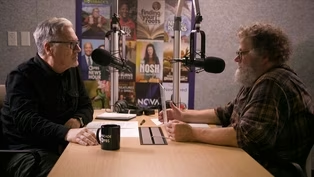
Extended Cut: The Potlatch Riot of 1913
Video has Closed Captions
Co-hosts Knute Berger and Stephen Hegg explore Seattle’s Potlatch Riot. (53m 26s)
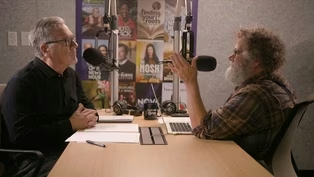
Extended Cut: The Mystery of the Mima Mounds
Video has Closed Captions
Co-hosts Knute Berger and Stephen Hegg explore the Mima Mounds. (44m 20s)

Video has Closed Captions
Season 11 of Mossback's Northwest premieres Thursday, October 9th, at 8:50pm on Cascade PBS. (30s)
Providing Support for PBS.org
Learn Moreabout PBS online sponsorship















Support for PBS provided by:
Mossback's Northwest is a local public television program presented by Cascade PBS