Cook's Country
Glazed Pork and Potatoes
9/20/2025 | 26m 55sVideo has Closed Captions
Honey-Glazed Pork Shoulder, Creamy Potatoes and Leeks; sheep’s-milk cheeses
Test cook Bryan Roof makes a juicy Honey-Glazed Pork Shoulder for host Bridget Lancaster. Tasting expert Jack Bishop explores the world of sheep’s-milk cheeses. Toni Tipton-Martin shares the Welsh tradition of celebrating the leek, and test cook Ashley Moore makes host Julia Collin Davison Creamy Potatoes and Leeks.
Problems playing video? | Closed Captioning Feedback
Problems playing video? | Closed Captioning Feedback
Cook's Country is presented by your local public television station.
Distributed nationally by American Public Television
Cook's Country
Glazed Pork and Potatoes
9/20/2025 | 26m 55sVideo has Closed Captions
Test cook Bryan Roof makes a juicy Honey-Glazed Pork Shoulder for host Bridget Lancaster. Tasting expert Jack Bishop explores the world of sheep’s-milk cheeses. Toni Tipton-Martin shares the Welsh tradition of celebrating the leek, and test cook Ashley Moore makes host Julia Collin Davison Creamy Potatoes and Leeks.
Problems playing video? | Closed Captioning Feedback
Where to Watch Cook's Country
Cook's Country is available to stream on pbs.org and the PBS app.
Providing Support for PBS.org
Learn Moreabout PBS online sponsorship♪♪ -"Cook's Country" is about more than just getting dinner on the table.
We're also fascinated by the people and stories behind the dishes.
We go inside kitchens in every corner of the country to learn how real people cook.
And we look back through time to see how history influences the way we eat today.
We bring that inspiration back to our test kitchen so we can share it with you.
This is "Cook's Country."
♪♪ -Today on "Cook's Country," Bryan makes Bridget an impressive honey-glazed pork shoulder, Jack invites Julia to a tasting of sheep's milk cheese, I share the history of how the leek became the national vegetable of Wales, and Ashley makes creamy potatoes and leeks.
That's all right here on "Cook's Country."
-Funding for this program has been provided by the following.
-Monument Grills, offering innovative technology and design for the grilling enthusiast, with a lineup of gas grills designed with durability in mind, including the Eminence 605 with LED touch panels and side and rear infrared burners.
Learn more at MonumentGrills.com.
-Teakhaus, inspired by a passion for cooking and respect for our planet.
Each board is handcrafted from sustainably sourced wood designed for every step, from food prep to presentation.
Teakhaus.
♪♪ -A holiday roast does not need to cost you an arm and a leg, but it may require a shoulder.
Pork shoulder that is.
Bryan's here, and he's going to show us how to turn a pork shoulder into a beautiful roast.
-Pork shoulder, also known as pork butt, when it's cut from higher up on the hog there.
It is an absolutely wonderful cut.
It's affordable.
When cooked right, it's tender, juicy.
It's one of my favorite cuts.
-Definitely my favorite.
Yep.
-So it requires very little upfront work.
We're just going to do a dry brine.
-Okay.
-Okay.
So we're going to combine 3 tablespoons of kosher salt with 3 tablespoons of light brown sugar.
Just mix that together.
So this is really going to play to this salty sweet combination -- sugar and salt.
Kind of like bacon or, you know, char siu -- those iconic salty sweet dishes.
Alright.
So that's all set there.
Alright, so this is a 6 to 7 pound bone-in pork butt.
And it's called pork butt because they used to cure them in barrels which were known as butts.
-Right.
-But it is definitely a shoulder cut.
So we're going to give that a 1-inch crosshatch.
So 1-inch crosshatch pattern.
We're going to go about 1/4 inch deep just through the fat cap.
And this is going to help the fat render a little bit more easily in the oven.
And it's also going to help that salt penetrate as it sits.
So we're going to rub this all over, our sugar salt mixture all over the pork, so we'll do about half of it on this back side here.
I've gone ahead and lined the countertop with plastic wrap.
And the reason I like to season the pork on plastic wrap is because if you're just going to season it on a board, all the sugar and salt you throw onto it bounces off.
Now that we're seasoning it on the plastic wrap and we wrap it all up, it's all going to stay in contact with the pork.
-100%.
-And the other half will go on top and on the sides of the pork.
And then we're just going to wrap it up kind of like I'm making a burrito here, you know.
-Nice.
-Give it a fold.
Give it a fold.
And then all that sugar and salt stays on there.
-Mm-hmm.
-I'm going to place this pork shoulder into the refrigerator and let it sit for at least 12 hours.
If we can go full 24 hours, it's going to be so much better for that.
And during that time, it'll allow the salt and sugar to start to penetrate the meat.
-Okay.
Sounds good.
-Alright.
This has been sitting in the refrigerator for 24 hours.
So we peel off the plastic wrap here.
Okay.
You can see a lot of that sugar and salt has all dissolved.
It's got this nice shiny look to it.
I'm going to transfer it to a wire rack in a rimmed baking sheet.
We lined the sheet with aluminum foil.
It's just going to help it make it easier for us to clean up.
-Yes.
-We're going to cover it with aluminum foil.
So we're going to put this into a 325 degree oven.
So we're covering it with foil for the first two hours so we trap the heat so it cooks a little bit more quickly, because all in, we're going to cook this thing for about six hours.
-Whew.
Okay.
That is beautiful.
-Oh, this looks nice, doesn't it?
-Wow.
-Alright.
So we've had this in there.
We started it for two hours, covered with foil, took off the foil, went another three hours.
And we're looking for 180 degrees.
We're at 181 right now, and that's great.
So now we're going to build a glaze and then we're going to start the glazing process here.
-Mmm.
Alright.
-So we have 1/2 cup of honey.
And to that we're going to add 1 1/2 tablespoons of soy sauce, 2 teaspoons of red wine vinegar, 3/4 of a teaspoon of red pepper flakes.
-Salty, sour, sweet, spicy?
-Mm-hmm.
And then a 1/4 teaspoon of five spice powder.
This is a nice combination of warm spices.
It really rounds out the honey and kind of plays well with the pork.
So we'll just give this a quick mix.
-Very holiday-ish.
-Alright.
So we're going to add 1/4 cup of this glaze to the pork.
Just want to brush it on nice and heavy.
-Psh.
Good call on the foil on the pan bottom.
-Yeah, yeah.
Gets a little messy otherwise, so.
That's about 1/4 cup of glaze on top.
And it already looks fantastic.
-Yep.
Let's call it a day.
[ Laughs ] -[ Laughs ] Let's go home.
So now we're going to put it back in the oven for another 30 to 45 minutes until we hit 190 degrees.
-Okay.
-Oof, look at that pork shoulder.
-It's always a good sign when Bryan says, "Oof."
[ Both laugh ] -So we're looking for 190 degrees.
You can see how that honey is caramelized nicely.
It's absolutely gorgeous.
-Absolutely shellacked to mahogany goodness.
-So we're going for 190 here.
191.
Alright.
That 190 degree temperature is going to leave us with very tender pork.
But it's also going to be sliceable, not just fall apart shreddy like barbecue.
-Got it.
-Alright.
So we'll just transfer our pork butt.
You can see, like, the fork slides so easily in and out of it.
Boom, boom.
-Nice.
-That's how you also know, if you didn't have a thermometer, that's how you could tell.
-Okay.
-So this has been cooking for a very long time.
So it's going to require a very long rest.
We're going to let it sit here uncovered for a good hour.
And it'll still be hot when we carve into it.
-I believe it.
-Bridget, this has been resting for an hour.
It's cooled down considerably.
But before we start carving it, we want to remove the bone that's in here.
So we're going to go ahead and we're going to work our boning knife underneath this.
It's kind of loosening the bone from the roast.
-But like you said before, we're not getting it to that shreddable pork texture.
-Right.
-So it's not -- you're not going to be able to just pull that right out.
-Right.
We hit 190 degrees and it's still sliceable, but not kind of fall apart tender like it's, like, barbecue.
That shoulder bone just slips right out with a little bit of coarseness.
This is a long one, huh?
Okay.
And before we start carving it, this is the point where you might want to bring that to the table, show your guests.
So we're going to hit it with a little bit more glaze.
Another couple tablespoons of glaze.
Alright.
Great.
And now we're going to slice it in 1/2 inch thick slices.
And we're going to use a serrated knife because it helps us get a little bit more purchase on the slices there without just pushing down with the blade.
-Alright.
So you got that crackling crust on top to get through.
-Yeah, and we want to go for about 1/2 inch thick.
It's still very, very tender and dangerously phenomenal.
So we'll just put these slices down a little bit.
Present them a little bit more nicely.
-The problem with this is your guests will forget to eat all the side dishes.
It's kind of amazing.
-So, one last gilding of the lily here.
We're going to hit it with the remaining honey.
-Oh, you're always bringing up the Shakespeare with your lily and your gilding.
-[ Laughs ] Alright, I think we're ready to eat.
-I'm ready to eat for sure.
-Alright, I'll give you an end piece that's got all that crust on it.
And then a little something from the center.
Ready to do this?
-Yes.
Where are you going first?
-I'm going to go with a little bit of the -- of the center piece here.
-Alright.
-Then I'll finish off with a nice crust.
-nice.
Cuts beautifully.
Nice and moist on the inside.
-Mmm.
-The salty sweet -- fantastic.
But the pork itself -- super porky.
You can't get this from a pork tenderloin or even a pork loin, anything like that.
You really have to go to a shoulder cut to get that kind of flavor.
-A little bit of the crusty edge.
-Oh, let me get that.
I mean, that's the stuff that dreams are made of right there.
It almost has this bacon persona to it.
-Mm-hmm.
The five spice powder that comes in, there's warm notes of the five spice.
That really -- It's kind of got a coziness to it.
-But it's still subtle.
This does not need even a little bit of sauce, a little bit of gravy, nothing.
The meat itself is so juicy, so tender.
-I dare say this is astoundingly delicious.
-Pork perfection.
-Thank you.
-Thanks, Bryan.
If you'd like to make this beautiful holiday roast for your next dinner table, rub a mix of salt and brown sugar all over the pork roast before refrigerating overnight.
Roast the meat covered and then brush with a honey glaze before returning to the oven.
Finish it with more honey glaze just before serving.
So from "Cook's Country," a holiday worthy honey-glazed pork shoulder.
-I'm digging into some of this skin now.
♪♪ -There are nearly 2,000 types of cheese in the world, but today we're going to focus on cheese made from sheep's milk.
And Jack's here to tell us more.
-I'm so excited about this because a lot of Americans aren't that familiar or think they're not familiar with sheep's milk cheese, but I'm like, have you had Pecorino Romano from Italy, or feta from Greece, or Montego from Spain?
So I brought some more unusual cheeses that you may not be familiar with, including one of my favorite cheeses on the planet.
So start tasting.
-Okay.
-And there's some crackers and some water.
The reason we're not that familiar with sheep's milk cheese is because it's really not produced in the United States.
For every 30,000 pounds of cow's milk cheese, we produce one pound.
-Wow.
-Yeah.
-That's it?
-Yeah.
And that's because there was a ban on importing sheep from Europe for decades.
-Really?
-So we just didn't have the animals.
-Oh, I didn't know that.
-And that ban has been lifted.
So there's some American cheeses now on the table, as well as some European cheeses.
And sheep's milk cheese is having kind of a renaissance or -- here in the United States.
And so it's super exciting.
The thing that I think is most interesting about sheep's milk cheese is sheep's milk has twice the fat of cow's milk.
-No kidding.
-And what do we know about fat?
-Yeah.
It's flavor.
-Yeah, it makes things delicious.
The other thing is, I think a lot of people get confused or -- between goat's milk and sheep's milk, and they think, "Oh, I don't like goat's milk cheese.
I'm not going to like sheep's milk cheese."
But that funkiness, that barnyard-y, that sort of acidity that you get with goat's milk, you don't get that in sheep's milk.
Um, you get grassiness, butteriness, nuttiness.
You know, depending on how long the cheese has been aged.
And you -- you can see that some of these cheeses have been aged much longer than others.
But I love, love, love sheep's milk cheese.
We tasted so many different cheeses, and I brought four here that I think represent the diversity of what you can get from a sheep's milk cheese.
They're all delicious, and I'm curious if you love the same cheese that I love.
-Mmm.
-[ Laughs ] You don't have to.
-This is amazing.
I mean, these are -- They all taste really good.
And they're so different.
This one -- very soft, spreadable.
I can imagine spreading it on toast, using it on bruschetta, making a dip with it.
I mean, it's so smooth.
It reminds me of a goat cheese, but milder, not as acidic.
-So do you want to see what this is?
-Yeah.
-Yeah.
-So this is an unaged cheese from California, from a place called Bellwether Farms up in Petaluma, north of San Francisco.
And it's, as you said, it's a lot like a fresh goat cheese, but it's milder in flavor, and it's absolutely delicious.
-It's really good.
Okay.
I'm monitoring your response to see.
-Is that your favorite?
No.
This one blew my mind.
I would have never in a million years thought that this was sheep's milk.
It tastes like a Brie, obviously, but, like, almost on the edge of triple creme because it is so rich.
And yeah, that spread on crackers with fruit.
-So this has a bloomed rind, like a Brie or Camembert.
This is from New York.
It's Old Chatham.
-Oh.
-So this is aged closer to two months.
And it's just... it is divine.
And you really see all that extra fat in the milk translates to incredible cheese.
-Yeah.
You can see it's almost melting itself on the plate.
Oh!
Alright.
This one has what I would expect to be a good melter, because it's reminding me of a good mozzarella that would melt and maybe brown a little bit.
Mild flavor.
-Yeah.
So this is from Greece.
This is Kasseri.
It's actually from a producer called Orino.
And so this is aged at, like, three to four months.
It's what we use here in the test kitchen for pastitsio, for moussaka because it is such a good melter and it's got just a lovely buttery flavor.
-Yeah.
This last one is really, um... I mean, I love them all, but I-I really could eat a lot of this.
It's like a Manchego but has so much more flavor, more complexity.
I can tell by the rind that it's probably aged for a while, and the color.
-This is from the French Pyrenees.
It is Ossau-Iraty.
And it is just buttery.
You compared it to Manchego, but I feel like it's more complex.
-Yeah.
-I'm not going to say any more, but I am going to say, which one do you think is my favorite?
-Well, it's between these two for me.
-Okay.
-This one because it's my favorite, but this one because it's got -- You called it divine, which it is.
And it's from Old Chatham, which I feel like you would like.
So I'm going to go with this one.
-And which one's your favorite?
-This one.
-Well, the good news is we have the same favorite.
-Oh, we do.
We both like the one from France.
-You want to [Indistinct].
I adore that cheese.
[ Both laugh ] -Oh, here you go.
You've been watching me eat it.
Here.
One for the road.
-One for the road.
Um.
Thank you, Julia.
This is such fun.
-Oh, this is amazing.
Thank you.
If you want to learn more about sheep's milk cheese, check out our website.
Cheers.
-Cheers.
♪♪ -Many countries have official national dishes, but what about a national vegetable?
In Wales, the patriotic connection to the leek runs deep.
Leeks have been part of the Welsh diet and culture for centuries.
They're valued for their flavor, nutrition, and use in folk medicine.
In her 1867 Welsh cookbook, Lady Augusta Llanover noted that the leek is the most wonderful herb for nutritive, as well as medicinal purposes.
The humble leek is also associated with Saint David, the patron saint of Wales.
Legend has it that he encouraged soldiers to pin a leek to their hats in a battle against the Saxons, as a way to differentiate themselves from the enemy.
The Welsh won that battle and the leek became a symbol of luck.
Now, on Saint David's Day, March 1st, many Welsh pin a leek to their clothes as a symbol of national pride.
And here in the U.S., we may not pin them to our clothes, but at "Cook's Country" we sure like them.
We showcase them in our recipe for creamy potatoes and leeks.
♪♪ -Potatoes and leeks are a classic combination found in any number of recipes, but today, Ashley has promised to show me something new.
-I promise I will.
Now, this is one of those really comforting, ultra rich side dishes.
-Mmm.
-It's going to be sort of like a potato gratin with leeks in there, but we're actually not going to use the oven at all.
-Okay, so it's all stove top.
-All stove top.
-Very cool.
-So first, let's start with some leeks.
Nothing goes better with potatoes than leeks.
They get super, super tender, almost grassy in flavor.
They're just a great ingredient to pair with potatoes.
-Yeah.
-So I'm going to start by trimming off the root end of this leek.
Now this is going to be 2 pounds total.
-Okay.
-And I'm just going to be using the whites and the light green parts today, but I'm just going to go ahead -- Any time I use just that part of the leek, I always put the darker part in a zipper lock bag, and you can keep it in your freezer when you make stock or anything in the future.
-Very cool.
-Yeah.
So I'm going to cut this in half, lengthwise first.
And then I'm going to cut the leeks into 3/4 inch pieces.
Now, I haven't washed the leeks yet.
-Yeah.
Good.
-I'm going to be doing that in the salad spinner.
And that's because leeks, as they grow, they grow concentrically.
So as they come up, some dirt can get trapped in between the layers of the leaves.
-Boy, does it get trapped.
-Yeah.
Alright.
So I'm going to go to the sink.
I'm going to wash the leeks.
-Okay.
-Yeah, you'd be surprised how much dirt actually does hang on to some of these leeks.
So it's a good idea to use a salad spinner if you have it.
Alright.
So now I'm going to be toasting some panko first.
I've got 1/2 cup of panko, which is the Japanese breadcrumbs.
And I've got 2 tablespoons of butter here.
And I'm just going to melt that over medium heat.
The 2 tablespoons of butter is melted.
Now I'm going to add the panko.
Again, that's 1/2 cup and 1/2 teaspoon of some salt.
I'm just going to make sure everything is coated nicely with the butter.
We're looking for a golden brown color.
And that'll take us anywhere from three to six minutes.
And again, we're over medium heat.
-Okay.
-I think that looks pretty golden brown to me.
-Picture perfect.
-Picture perfect.
Alright, so now I'm going to transfer the panko to a bowl.
And I'll just let these hang out while we cook the rest of the recipe.
So now, thanks to this skillet being nonstick, I'm just going to use some paper towels, wipe out any excess breadcrumbs.
If you leave them behind, they just have a tendency to burn.
We don't want any burnt anything today.
-Nope.
-Just going to melt 2 more tablespoons of unsalted butter over medium heat.
Alright, so the butter is melted.
Now I'm going to add the leeks.
Alright.
Mmm.
They already smell delicious.
And I have a little bit more salt.
I have 1/4 teaspoon of salt.
-Mm-hmm.
-Alright, so I'm going to let these cook for about six minutes over medium heat until the leeks are tender.
And I'm going to go in there about halfway through and just stir.
-And you have the lid on because you want them to sweat and you want them to soften.
-Exactly.
-Okay.
-Let's check the leeks.
Oh, yes.
-Oh, those smell good.
-Yes, they do.
Really tender.
Oh, yeah.
But you know what they need?
Some potatoes.
-Okay.
-They do.
They need some potatoes.
So I've got 1 1/2 pounds of Yukon gold potatoes.
I cut them into 3/4 of an inch pieces.
-You left the skins on.
-I did.
Because Yukon skin is so tender.
It's not like a russet or a sweet potato.
It's just going to melt in with everything else.
Alright, so just to give this a good stir before I add any of the liquid.
-I love how this is just all going into one skillet.
-I know, it really could not be easier.
Alright, so it's all in a nice even layer.
Now, I'm going to add some chicken broth as opposed to water.
And it's going to cook in the chicken broth.
And we're going to be adding some white wine as well.
And that's just to add as much flavor to this recipe as possible.
So that was 1 1/2 cups of chicken broth.
And I've got 1/4 cup of dry white wine.
Any kind of white wine that you would drink, add it to your food.
-Okay.
And finally, 1/2 a teaspoon of salt.
So I'm just going to stir this just to incorporate all of the salt and the wine and the chicken broth.
Alright, as you can see, we are up to a vigorous simmer.
-Mm-hmm.
-So now I'm going to just cover the skillet with this lid.
Turn the heat down to medium low.
And I'm going to cook this for 20 to 25 minutes until the potatoes are fork tender.
-Okay.
-Alright.
Now in the meantime, we're going to be adding a little bit of cheese to our faux gratin.
This is Gruyere cheese.
It's been aged.
Obviously made in Switzerland.
It's been aged for about 10 to 12 months.
-So it has those little crunchy bits.
-Yes, the crystals.
-And that deep nuttier flavor.
-Mm-hmm.
Really melts nicely and goes beautifully with leeks and potatoes.
So I'm going to use the large holes of the box grater.
And now I'm going to shred 2 ounces of the gruyere.
Let's check on the potatoes.
Oh, yeah.
So I'm looking for fork tender.
Again, it's been about 20 minutes.
Yep.
Just there.
Fork tender.
Perfect.
-Nice.
-Alright, so technically, they are cooked at this point.
But we're going to take them a little bit further.
-Okay.
-So I'm going to add some heavy cream.
This is 3/4 of a cup of heavy cream.
-Mmm.
Hello.
-Yeah.
Just a little.
And then we've got some pepper.
1/2 a teaspoon of ground pepper.
And now these are just going to cook for about four to six minutes longer.
And what I'm going to be looking for is I'm going to be looking for a trail to be dragged down the center of the potatoes when I drag my spatula through there.
-Gotcha.
So you're thickening the cooking liquid into a sauce.
-Exactly.
Yep.
And as the potatoes break down a little bit more, they're going to help to thicken the sauce a little bit more too.
-That makes sense.
-Yeah.
So again, four to six minutes.
So let's see with the spatula.
That is exactly what I was looking for.
You see that trail right there?
-Nice and thick.
-Alright, I'm going to turn off the heat.
We are done cooking at this stage.
All I need to do on the stove top now is just add that shredded gruyere.
Again, that was 2 ounces.
-Oh.
That looks delicious.
-Mm-hmm.
But we aren't done.
All I need to do is sprinkle the panko from earlier.
-Right.
-Again, like I said, gratin-ish.
-Yeah.
-A faux gratin.
-[ Chuckles ] -And then finally, I have 2 teaspoons of one of your favorites -- chopped fresh thyme.
-Ooh, it is one of my favorites.
-Yep.
Going to add that just at the end here.
You also could use oregano if you had that on hand.
And that's it.
-Gorgeous.
-Mm-hmm.
So let's eat.
-Oh, yeah.
Mm-hmm.
Alright, I'm digging right in.
Get the potato, get a leek.
-Panko.
-Mmm.
Mm-hmm.
That is delicious.
You can taste the gruyere because it was added at the end.
And the thyme is not at all overpowering, I thought, because there's a good amount of it and it's sprinkled on at the end.
It's really just a nice background floral accent.
-Yeah.
Really aromatic right there.
-Yeah.
Mmm.
I'm gonna try just the leeks.
-Yeah.
-Mm-hmm.
Oh, they have that silky texture I love.
But they've lent so much flavor to the sauce.
-Yeah.
Really subtle onion flavor.
-Mm-hmm.
-And the potatoes are cooked beautifully.
Again, Yukon gold potatoes.
You really can't go wrong.
They're so tender, especially with the peels on.
-I could see this going with all sorts of things.
I mean roast chicken, roast beef, fish off the grill.
-Yeah.
Even though there is the cream in there, it's not super, super rich.
-Mnh-mnh.
-It's not like I'm going to go have to sit on the couch after eating this.
-[ Laughs ] Ashley, this is delicious and so quick.
Thank you for showing me how to make it.
-You're welcome.
-If you want to make this really simple potato and leek side dish, start by toasting panko with a little butter in the skillet.
Give the leeks a head start before adding the potatoes.
And finish with a little cream and gruyere.
From "Cook's Country," a wonderful new side dish of creamy potatoes and leeks.
You can find this recipe and all the recipes from this season, along with our product reviews and select episodes at our website, cookscountry.com/TV.
I daresay this would be a good vegetarian main course.
-Oh, that's a great idea.
Yes.
-Right?
-Let us help with dinner tonight.
Visit our website anytime for the newest seasons, rigorously tested recipes, full episodes, ingredient advice, and equipment reviews.
Cookscountry.com/TV.
-"The Complete Cook's Country TV Show Cookbook" brings together every recipe, tasting, and test from 18 seasons of the beloved TV show.
With trusted equipment recommendations and insights from the entire cast, this book is your guide to the very best in regional cooking.
The cost is $24.99, $15 off the cover price of $40.
To order, head to our online shop at cookscountry.com/book.
-Funding for this program has been provided by the following.
-Monument Grills, offering innovative technology and design for the grilling enthusiast, with a lineup of gas grills designed with durability in mind, including the Eminence 605 with LED touch panels and side and rear infrared burners.
Learn more at MonumentGrills.com.
-Teakhaus, inspired by a passion for cooking and respect for our planet.
Each board is handcrafted from sustainably sourced wood designed for every step, from food prep to presentation.
Teakhaus.
♪♪ ♪♪ ♪♪ ♪♪ ♪♪ ♪♪

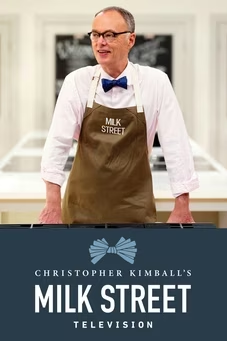
- Food
Christopher Kimball’s Milk Street Television
Transform home cooking with the editors of Christopher Kimball’s Milk Street Magazine.









Support for PBS provided by:
Cook's Country is presented by your local public television station.
Distributed nationally by American Public Television