
Italy Made with Love: Legacy of Umbria
9/9/2026 | 25m 11sVideo has Closed Captions
Umbria’s legacy lives through weavers, painters, woodworkers, and timeless craft.
In Umbria, generations of artisans carry forward a legacy of craftsmanship. From traditional weavers and replica painters to door makers and wood sculptors, each preserves time-honored skills, transforming humble materials into enduring works.
Problems playing video? | Closed Captioning Feedback
Problems playing video? | Closed Captioning Feedback
Support provided by:

Italy Made with Love: Legacy of Umbria
9/9/2026 | 25m 11sVideo has Closed Captions
In Umbria, generations of artisans carry forward a legacy of craftsmanship. From traditional weavers and replica painters to door makers and wood sculptors, each preserves time-honored skills, transforming humble materials into enduring works.
Problems playing video? | Closed Captioning Feedback
Where to Watch Made With Love
Made With Love is available to stream on pbs.org and the PBS app.
Buy Now
Made With Love
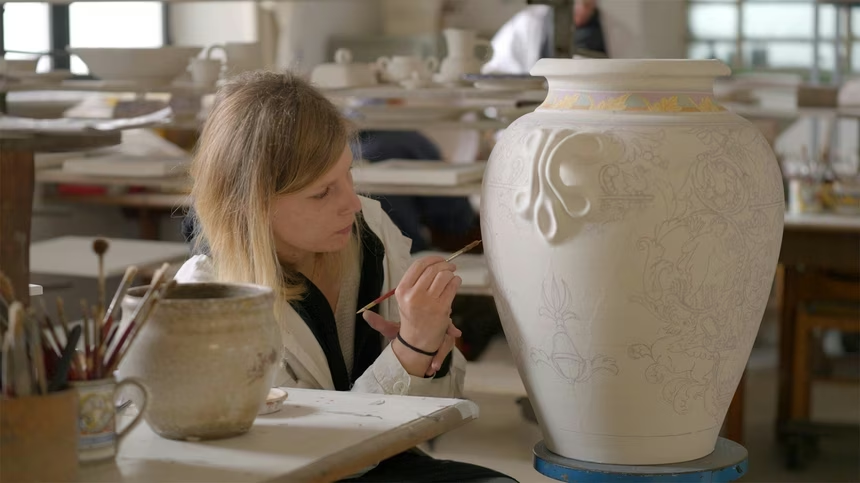
Made with Love celebrates the artisans keeping age-old traditions alive — an intimate journey into their workshops, kitchens, and the passionate hands behind extraordinary craft. Without them, a piece of our shared heritage would be lost.Providing Support for PBS.org
Learn Moreabout PBS online sponsorshipNarrator: Umbria, Italy, a land that time forgot.
These quiet streets have always been an artisan's paradise.
♪ Whether it's painting recreators crafting masterpieces from the Italian Renaissance, or a weaver reviving an ancient art form that was almost lost to history, traditional methods are key to who they are.
It's not only for me or for Umbria, every single community has to preserve his history and his traditional work.
Uncover the legacy and experience the artistry of these master craftsmen in "Italy Made with Love."
Perugia, the hill-topped capital of Umbria, lies almost halfway between Florence and Rome.
It was central Italy's hub for textiles dating from the Middle Ages.
After the Renaissance and with the invention of the mechanized loom, the art of hand-weaving began to die out, but Marta Cucchia picked up the thread.
Marta: I'm Marta Cucchia.
I'm a weaver from Perugia.
Narrator: Weaving demands obedience.
Marta's work is woven into her family history.
In 1921, her great-grandmother Giuditta Brozzetti opened this workshop to this medieval Perugian specialty.
Narrator: In the Middle Ages, Perugia was a market town, and one of its products was textiles, especially the Perugian tablecloth.
Narrator: At that time, Perugia had been relatively independent of the pope, and in the 16th century rebelled against the Holy See's efforts to control it through taxes on salt.
To punish the city, the pope banned textile production for commercial purposes, pushing Perugia further into isolation and self-sufficiency.
Narrator: When the ban was eventually lifted, commercial work resumed... But the invention of mechanized looms during the Industrial Revolution almost brought an end to these sacred and beautiful textiles.
When Marta's mother decided to close her hand-weaving shop, Marta, age 23, wouldn't hear of it.
Narrator: Today she and her apprentice run one of the last hand-weaving studios in Italy.
Textiles are the fabric of her life.
Every weaving progresses on two planes-- the warp and the woof.
Marta: Now I'm making the warp.
The warp is the base of every kind of fabric the vertical threads, and we are using in this studio the warping machine invented by Leonardo da Vinci.
With this machine, I can make a really big warp with the 3,600 threads of warp along 80 meters.
Narrator: The warp forms the backbone of the finished textile.
Any mistakes she makes in this time-consuming wrapping process will come back to haunt her later.
And this work takes one week for our biggest loom, and sometimes I have to be really careful because sometimes I make a mistake like this, and this is a real tragedy because if I jump one turn around this machine, this group of threads is shorter than 5 meters, disaster.
Then we have to undo everything.
Yeah.
Narrator: She carefully removes the finished warp and braids it to keep the individual strings organized.
Then it goes to the loom.
For a large piece, the warp alone can be unwieldy.
Narrator: At her smaller loom, she manipulates the 82-foot-long threads like a puppet master.
Marta: Now I'm using my oldest loom.
This loom works with 4 harnesses, and I control the harnesses with my feet, with a pedal, and I open the warp with my feet.
For every different position of the pedals, I have a different opening of the warp, and in this opening, I send the shuttle with a bobbin inside.
Narrator: After thousands of moves of shuttle and warp, the result will look something like this.
Every handmade item is different.
A pillow might take 3 days to weave.
A tablecloth can take up to two weeks.
Sometimes it's tough to tell where the weaver ends and the loom begins.
It's up to Marta and a shrinking number of her colleagues to carry Perugia's medieval weaving culture into the future.
Marta: Keep alive this traditional work is important not only for me, of course, because it's my passion, but because it's a part of our local community and culture, and then it's not only for me or Perugia.
Every single community has to preserve his history and his a traditional work.
This is really important.
Every single piece in my studio is my baby.
This work is my passion, but I think at this point of my life, I'm a part of this studio.
My life is not a life of Marta.
Marta is a part of the studio like a loom.
Narrator: Renaissance Italy in the 15th and 16th centuries saw an explosion of creative arts.
While not everyone is fortunate enough to see the works of Leonardo, Michelangelo, or Raphael in person, one Umbrian family business has created the next best thing.
I'm Stefano Lazzari, founder of the Bottega Tifernate company and the Pictografia technique here in Citta' di Castello, Umbria.
Narrator: For 30 years Stefano and his sister Francesca and his father Romolo have devoted themselves to meticulously recreating Renaissance masterworks.
Stefano: The mission is to make a painting with the same feeling, the same material in the same way of the ancient bottega.
I started this work because I love the art.
I want to stay every day in contact with the original paintings, and so the Pictografia technique permit to me to study every day Raffaello, Leonardo, Michelangelo, Piero della Francesca.
This is my love.
This is my life.
The Pictografia technique, which relies on this magic machine, is the family's proprietary method for copying works of art onto canvas, board, or fresco panel to match the color and medium of the original masterpiece.
Stefano has been refining the secret process for 30 years.
[Thrumming] Stefano, voice-over: The process is to reproduce in a mechanical way one painting but with the same color and the same material so when the work is finished, we have a work that is similar--it's very, very close--to the original one.
Narrator: The human touch augments the work of the Pictografia machine.
Narrator: Nadia Tacchini has worked at Bottega Tifernate for 16 years, making reproductions as authentic as possible.
Narrator: Today Nadia works on Leonardo da Vinci's "Lady with an Ermine" using the same type of oil paint colors as the master.
No detail is overlooked to make these modern-day masterpieces.
Narrator: When the painting is complete, it gets a coating of beeswax to protect it.
Narrator: During the Renaissance, Umbria developed its own pigment, umber, from its brownish red soil and its own school of painting with masters such as Perugino and Raphael.
Today, thanks to the Lazzari family's bottega, the Renaissance masters are enjoying another rebirth.
Narrator: In northern Umbria, bordering Tuscany, lies the little village of Pistrino di Citerna.
Dating back to medieval times, Citerna became the first Umbrian town to join the Kingdom of Italy in 1860.
Life here is like stepping through a door to the past, literally.
Giacomo, voice-over: My name is Giacomo Belli, and with my brother Gabriele, we are the owner of the enterprise Porte del Passato in Citta di Castello.
Narrator: Excellent examples of Umbrian self-reliance and resilience, the Belli brothers restore and reproduce antique doors.
Giacomo: Because my father started this work with the antique doors-- and I was very young when he started the work, but I work at with him, eh-- he teach me from the start to the end each steps of this kind of work.
Narrator: Working with antique doors demands authentically antique wood, some as old as 400 years, salvaged from demolished homes.
For Giacomo's employee Francesco, fashioning old floorboards into a door requires several steps-- cleaning... shaping... and fastening.
The finished door is like a piece of fine, handcrafted furniture.
Over 100 years or so, weather can take its toll on a door.
Giacomo gives a 17th-century door a little love.
Giacomo: On a rustic door, because we live in Umbria, we have the example of a lot of the antique doors of the monastero in Assisi, Gubbio, a lot of places.
You can follow the way they worked.
Narrator: Giacomo restores what he can and replaces what he can't.
Giacomo: It's a pleasure to work on this kind of things.
For instance, when I work on this surface, clean the wood, give the wax, you feel that it's something different from the ordinary.
Narrator: He tries to avoid glue, which wasn't used by 17th-century artisans.
Giacomo: This is important because during the time, the wood move, but this particular structure gives elasticity, and so even if the door move, it doesn't break.
Narrator: The doors he works on have survived centuries, and with his craftsmanship, they'll hopefully last centuries more.
Giacomo: When you work on this kind of things, like these beautiful doors, you have to love it.
When you love it, you feel a special sensation to work on it.
Yes, you feel responsible, but you feel also happy and happy to have the possibility to work on something that lived in the past times and maybe have something to teach to you, and so when I work on these things, always I learn something.
Narrator: The Umbrian landscape has plenty to teach craftspeople who take time to be inspired.
In southwestern Umbria, the city of Orvieto rises above the countryside on a colossal pillar of volcanic stone called tufa.
And while stone may be the most prominent material, one family has carved a living out of wood.
When the Michelangeli family opened their first shop over 200 years ago, they specialized in wood furniture.
Today sisters Simonetta, Raffaela, and Donatella, along with Simonetta's daughter, carry on the tradition.
Narrator: Inspired by nature, Gualvario Michelangeli began layering wooden shapes into elegant and whimsical sculptures, going wherever his imagination took him.
Woman: After attending the art school, he start creating his amazing sculptures with the overlapping of the layers and creating the third dimension, so starting from the cat, and then he investigated a lot of animals, and then he fell in love with the female shape, and he start creating faces and women.
Narrator: His style brought him worldwide acclaim, but he wouldn't live to enjoy it.
Gaia: When he was at the top of his career, unfortunately, the cancer, and he passed away very young because he was only 57.
Narrator: He left behind a legacy that his daughters couldn't turn their backs on.
The sculptures were his life and would be theirs, too.
Gaia: At the very beginning, he was not super happy having 3 daughters because this is a pure male work, so he was saying, "Oh, who is going to be the next generation?
Who will continue our tradition?"
But the 3 girls, they had the power to continue the activity of the family and improving and improving and make the Michelangeli name even more popular around the world.
Narrator: In the workshop, they found a treasure trove of ideas, a priceless inheritance built up over decades.
Today the sisters create a sculpture inspired by one of their father's owl designs.
With skills she learned by watching her father, Simonetta uses a plywood template to trace the design for cutting.
Narrator: When Simonetta has fashioned enough overlaps, the owl can start being assembled.
The thickness of each piece might need adjusting for the best fit and effect.
The wooden sculpture grows layer by layer like the rings of the Michelangeli family tree.
How long does it take to build an owl like this?
About 7 generations.
Gaia: Every single piece that's made in this workshop is a part of our self because every time we are selling one piece, it's kind of part of our self going away.
Narrator: Their workshop is in an old theater, which is appropriate because each piece is a performance, an act of love between generations.
Gaia: We are really linked to Italian tradition, so we never are in contrast with our history, so we bring the DNA of being Italian, the DNA of being in Umbria because we are very linked to the nature.
We are very linked to the slow way to produce.
Narrator: By carrying on their father's vision, they've become ambassadors of Umbrian art and craft.
Narrator: On the high, stone slopes of Orvieto, it's the wooden sculptures made with love that endure.
Umbria, from its ancient stone villages to vast woodlands, creativity can be found everywhere, living on for generations in its artisans.
Marta: [Speaking Italian] Narrator: That passion and dedication is infused into everything they do here.
Woman: [Speaking Italian] Narrator: These artisans are bringing history to life as they continue to carry on their craft for generations to come.
♪ dedicated artisans from around the world.
[Fire burning] Honoring their work, to help preserve these traditions for generations to come.
For more information, visit... [Exhaling] ♪
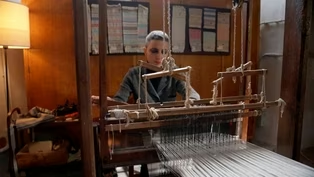
Weaving Umbria: The Art of Marta Cucchia
Video has Closed Captions
An Umbrian weaver preserves centuries-old textile traditions on historic hand looms. (2m 34s)
Providing Support for PBS.org
Learn Moreabout PBS online sponsorship














Support for PBS provided by: