
Italy Made with Love: Savoring Tuscany
9/9/2026 | 25m 40sVideo has Closed Captions
In Tuscany, time-honored traditions shape a rich culture of craft and cuisine.
Italy Made with Love: Savoring Tuscany captures a region where artistry and flavor are inseparable. From expert butchers and olive oil and wine producers to framemakers and mosaic artists, Tuscan artisans blend tradition with innovation, transforming local materials into expressions of place, history, and a rich, enduring cultural identity shaped by dedication and care.
Problems playing video? | Closed Captioning Feedback
Problems playing video? | Closed Captioning Feedback
Support provided by:

Italy Made with Love: Savoring Tuscany
9/9/2026 | 25m 40sVideo has Closed Captions
Italy Made with Love: Savoring Tuscany captures a region where artistry and flavor are inseparable. From expert butchers and olive oil and wine producers to framemakers and mosaic artists, Tuscan artisans blend tradition with innovation, transforming local materials into expressions of place, history, and a rich, enduring cultural identity shaped by dedication and care.
Problems playing video? | Closed Captioning Feedback
Where to Watch Made With Love
Made With Love is available to stream on pbs.org and the PBS app.
Buy Now
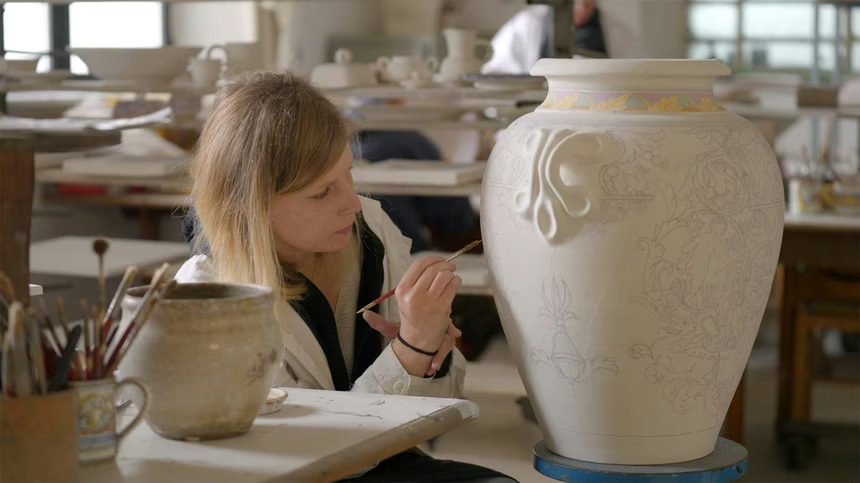
Made With Love
Made with Love celebrates the artisans keeping age-old traditions alive — an intimate journey into their workshops, kitchens, and the passionate hands behind extraordinary craft. Without them, a piece of our shared heritage would be lost.Providing Support for PBS.org
Learn Moreabout PBS online sponsorshipNarrator: Tuscany, the birthplace of the Italian Renaissance.
It's home to show-stopping architecture, iconic vineyards, and some of Italy's most devoted artisans.
♪ From perhaps the most famous butcher in the world, to masterful mosaicists, these artisans are creating works of art that stand the test of time.
[Leonardo speaking Italian] Go inside the heart of this craftsmanship where taste, tradition become art in "Italy Made with Love."
[Bell tolling] Narrator: The long artistic tradition here can be seen in soaring cathedrals that reach for the open skies... And iconic images inspired by breathtaking landscapes.
But some of Tuscany's most gifted artists are masters in another medium... One that honors tradition and at the same time it always seeks to reinvent itself and there's only one place to see it... On your plate.
Tuscan food can be as basic as it is delicious, but when it comes to meat, one man has taken the art of simple cooking to a whole new level.
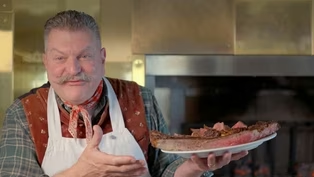
[Dario speaking Italian] Narrator: Dario Cecchini is sometimes called the most famous butcher in the world.
With a personality as big as a T-bone steak, it can be easy to see why.
Dario: To beef or not to beef... Narrator: Although Dario comes from a long line of butchers, he almost took a very different path.
As a young man, he decided to walk away from the family business and become a veterinarian.
Then his father got sick, and Dario came back to his small hometown of Panzano in Chianti and returned to the family butcher shop to support his younger sister and grandmother.
He's been here ever since.
Narrator: As someone with a deep love for animals, Dario brings a unique point of view to being a butcher.
Narrator: Since he believes that no part of the animal should go to waste, Dario uses cuts of meat that others might overlook.
And when he cooks, he does so with great respect for where the meat comes from.
Narrator: Another thing that makes Dario unique-- although he has several restaurants here in Panzano, he doesn't lean on fancy recipes, just the taste of the meat itself.
Narrator: As Dario's fame as a butcher has grown, he's had the chance to travel and feed people worldwide, but he vows that he'll never leave his hometown behind.
Dario: Fabuloso!
[Cooing] Narrator: Most great paintings have frames, and even though frames can be easily overlooked, there's a lot more to them than just what you see on the margins.
These carefully-designed borders are works of art in their own right, elegant windows that invite us to take a closer look at some of the world's greatest masterpieces and perhaps even show them in a new light.
[Both speaking Italian] Narrator: 20-year-old Tommaso Maselli works with his father, Gabriele, a frame-making maestro.
The shop was founded by Tommaso's grandfather back in 1955, and he's been in the business of making and restoring frames ever since.
Tommaso starts by sketching out a pattern for a new frame, one that draws its inspiration from the 19th century.
[Tommaso speaking Italian] Narrator: Each of Tommaso's hand-carved frames are unique.
It can take him up to 5 days to create one, and before he makes even a single cut, he has to make sure every detail is just right.
When he's ready to dig in, he'll have to choose from more than 300 tools.
As he cuts, even a single mistake could mean starting over.
Narrator: Tomasso is learning to hone his craft at Italy's prestigious school for artistic restoration.
He's also done years of on-the-job training with his father watching closely.
[Gabriele speaking Italian] Narrator: It's a painstaking process, shaving and chiseling the wood away bit by bit, slowly revealing the pattern within.
[Tommaso speaking Italian] Narrator: Some Renaissance frames were created right alongside the art being made here in Italy, in places like Tuscany and Venice.
During the Middle Ages, these hand-carved pieces of wood were part of the artwork itself and used mostly in religious paintings.
By the 15th century, the frames started to become separate pieces designed to showcase paintings, with cheaper woods like spruce or pine used for less important parts, and more expensive and desirable ones like walnut on the outside.
Today, the Masellis use many of the same methods as framers did centuries ago.
When Tommaso finishes carving the design, his father Gabriele takes over.
[Gabriele speaking Italian] Narrator: He applies glue and several layers of gesso, Italian for plaster, which creates a smooth base coat around the frame.
If the mixture is too hot, it can create air bubbles along the surface.
And if the temperature in the workshop is too cool, this will leave brush strokes behind.
Then he has to add a layer of gold leaf.
During the Renaissance, gold was added to frames and even to paintings themselves to add a glittering, other-worldly elegance.
Back then, these thin sheets of gold were made by hammering down Florentine coins known as Florin.
Today, the Masellis use gold made by machine instead.
Narrator: Gabriele cuts the gold leaf to fit.
Petroleum jelly makes the gold stick to the brush as he carefully applies it.
If the gold doesn't layer on perfectly, it can mean scraping it off and starting over.
Narrator: Since today's gold is thinner than during the Renaissance, Gabriele has to coat the frame twice and then burnish it.
When he's finally done, the gold finish is even more durable than a coat of paint.
Narrator: This father-son team does their work with pride and of course with love, for each other and for the frames they make.
[Gabriele speaking Italian] Narrator: Mosaics... It's an art form as unique as it is extraordinary.
The building blocks can be anything, from stones and seashells to glass and ceramic tiles.
And as tens of thousands of tiny pieces come together, the effects can be stunning.
For thousands of years, magnificent mosaics like this have been symbols of wealth and power and told stories of faith.
Today, they remain a powerful reminder that even the smallest choices can produce something truly epic.
[Water rushing] Here in Tuscany, a special style of mosaic-making is still being practiced, although only a handful of people have the right mix of experience and skill to make these colorful compositions.
At Scarpelli Mosaics, Leonardo Scarpelli carries on the art of Florentine mosaic, also known as commesso.
Commesso is done using only brightly-colored stones.
It was born in Tuscany more than 600 years ago.
[Leonardo speaking Italian] Narrator: Leonardo has been asked to make a new commesso tabletop.
He starts by sketching out exactly what he hopes to create.
Narrator: The sketch is made on adhesive paper and divided up into thousands of tiny sections.
Leonardo traces each individual line with a handmade scalpel, cutting with the hands of a surgeon and the heart of an artist.
Narrator: Then it's time to choose the stones.
He can spend up to a few months trying to find just the right color for every single spot.
Narrator: Choosing the right stones for a new commesso takes a careful eye, and it's part of the process that Leonardo began to learn back when he was just a little boy.
Narrator: Any of these natural gems could become raw material for his singular vision, but he doesn't find them alone.
Like Leonardo, his sister Catia has gone from Tuscany to Sicily and beyond, from gurgling riverbanks to lava-crusted craters in search of unique specimens.
They also bring in stones from all over the world.
Catia: You have to look at stones and imagine what's inside.
You have to transform a stone, which is the hardest material, into something alive, two dimensional.
So give life to stones.
Narrator: When Leonardo has chosen what he believes are the perfect stones, he sticks the adhesive paper to them.
Then he needs to get each stone down to size, often using traditional handmade tools-- the exact same kind that commesso artists used back in the 1500s.
[Scraping] Narrator: The work is painstaking.
Leonardo can spend several hours cutting and shaping a single stone.
If it breaks, he'll have to start all over, and he might even have to hunt for a replacement.
[Filing] One by one, Leonardo assembles the rocks like pieces of a handmade puzzle.
Each one needs to be precisely matched.
Any unexpected gaps or rough edges will ruin the overall effect.
Narrator: This natural glue is made of beeswax and pine tree resin.
It's sticky enough to hold the pieces together, but not so sticky that he can't make any last-minute adjustments.
This process is as traditional as commesso-making itself, used in the 1500s by artisans enlisted by the Medicis-- Florence and Tuscany's ruling family for centuries.
[Filing] The last step is putting on a coat of wax.
This adds polish and gives it a smooth, even surface.
But Leonardo believes that what really makes a great commesso is something deep inside.
[Catia speaking Italian] [Renzo speaking Italian] [Leonardo speaking Italian] Narrator: Just 15 miles outside Florence, deep in the heart of wine country, sits a massive stone fortress, the site of a daring political plot.
Back in the 15th century, the Pazzis-- a clan of bankers-- hatched a plan here to take down the Medicis, who wielded power over every facet of life in Florence and later all of Tuscany.
In the end, the Pazzis were exiled or killed, and the Medicis continued to reign for centuries to come.
Now, the castle has been reimagined as a modern mecca for some of the region's finest flavors.
Woman: Here we are.
It's the castle, Castello del Trebbio.
Narrator: Today, the Medicis are ancient history, as Anna makes her own memories in a place her parents bought decades ago.
Anna: My family live here with our kids and my sister.
You see how big it is, big table, so everyone can share the good glass of wine and a fantastic extra-virgin olive oil together.
And then, this is the courtyard.
We have a beautiful cortil, we say in Italian, where you can spend time in the open space, but you are in a private and closed garden.
Narrator: The castle has some other secret spaces, including one that's tucked away deep below its thick walls.
Anna: We are under the castle in the cellar, a room that we call orcia where we keep the oil.
The temperature, it's perfect.
These are the conca where we use to keep the fresh-pressed oil.
Narrator: Making olive oil is a Tuscan tradition, and producing small batches like this are both art and science.
Instead of using heat or chemicals, Anna and her team grind olives by hand, but they need to make sure the friction doesn't cause the oil to lose flavor or aroma.
The oil also needs to be kept between 55 and 60 degrees and shielded from both light and oxygen.
Today, Anna is going to taste a batch of olive oil to see how it's turned out.
Warming a glass of olive oil helps unleash the smells hidden inside.
Ah!
The aroma, it's fantastic.
Narrator: The scent of a first-rate olive oil is crucial, but so is the taste.
I show you how we taste in the mouth.
[Slurping loudly 4 times] Narrator: It may seem silly... [Slurping in slow-motion] But by drawing air into her mouth, Anna can taste the flavors more intensely.
In your mouth, you feel the aroma of the bitterness.
You feel the aroma of the green that remember you the olives, a little bit spicy and the bitter behind, and this is, once again, a sign of high-quality oils.
Anna: I'm very proud about this oil.
Narrator: That homegrown olive oil is a key ingredient for years, Anna's parents made wine right here on the castle grounds.
Today, Anna's husband Stefano carries on the tradition.
[Stefano speaking Italian] Narrator: There's no sure bet when developing a new wine, but Stefano hopes to create an elegant elixir that delights the senses.
[Clink] Narrator: The new wine is a success.
To celebrate, they open a vintage bottle from the castle winery-- in this case, one made by Anna's parents.
[Cork pops] Perfecto.
You're lucky.
Ha ha!
[Clink] All across Tuscany, natural splendor, man-made beauty, and devotion collide.
Catia: We invite everybody to come and discover something that they will never see anywhere else in the world.
Narrator: These artisans are bringing treasures to life, put focus on their craft, respect for those who forged the path before them, and with love.
[Clink] dedicated artisans from around the world.
[Fire burning] Honoring their work, to help preserve these traditions for generations to come.
For more information, visit... [Exhaling] ♪
Video has Closed Captions
Legendary butcher Dario Cecchini honors Tuscan traditions through his craft. (2m 50s)
Providing Support for PBS.org
Learn Moreabout PBS online sponsorship












Support for PBS provided by: