
Italy Made with Love: The Green Heart
9/9/2026 | 25m 36sVideo has Closed Captions
Umbria’s artisans thrive through nature, tradition, and self-sufficient creativy.
Italy Made with Love: The Green Heart reveals Umbria's spirit shaped by isolation, ingenuity, and land. Truffle hunters use time-honored methods; lacemakers craft delicate designs; ceramic artists shape vibrant works; olive oil and wine producers follow nature and knowledge. Once isolated, Umbria built creative self-reliance still thriving today. It celebrates simplicity skill tradition mastery.
Problems playing video? | Closed Captioning Feedback
Problems playing video? | Closed Captioning Feedback
Support provided by:

Italy Made with Love: The Green Heart
9/9/2026 | 25m 36sVideo has Closed Captions
Italy Made with Love: The Green Heart reveals Umbria's spirit shaped by isolation, ingenuity, and land. Truffle hunters use time-honored methods; lacemakers craft delicate designs; ceramic artists shape vibrant works; olive oil and wine producers follow nature and knowledge. Once isolated, Umbria built creative self-reliance still thriving today. It celebrates simplicity skill tradition mastery.
Problems playing video? | Closed Captioning Feedback
Where to Watch Made With Love
Made With Love is available to stream on pbs.org and the PBS app.
Buy Now
Made With Love
Made with Love celebrates the artisans keeping age-old traditions alive — an intimate journey into their workshops, kitchens, and the passionate hands behind extraordinary craft. Without them, a piece of our shared heritage would be lost.Providing Support for PBS.org
Learn Moreabout PBS online sponsorship♪ Narrator: Umbria, known as the Green Heart of Italy it's renowned for medieval towns, rich history, and lush rolling hills and vineyards.
Amongst its idyllic landscape artisans are forging new paths while utilizing age-old traditions.
Discover the ancient technique of hunting the rare and treasured truffle, and meet the ceramicists passing on Renaissance traditions through generations.
Giorgio: We produce pottery here since the medieval age.
♪ Narrator: Go inside the heart of Umbria, and discover the spirit of these master artisans in "Italy Made with Love."
♪ Umbria has long prized its independence, and sometimes that comes with a price.
Over many centuries, as Umbrians tried to resist papal rule, they often had to fend for themselves.
Luckily, their lands are fertile, and, even today, their woods are home to a rare treasure.
Here in the Green Heart of Italy, one family seeks it out.
Narrator: When it comes to artisanal foods, fresh truffles are culinary gold.
Umbrians had harvested the elusive fungi for at least 600 years.
Still, finding them is an art.
Narrator: A family hobby for generations became a family business 30 years ago.
Narrator: Most varieties of truffles defy cultivation.
Finding them requires an expert nose.
Nerina, or Neri, is the family chief truffle hunter.
Narrator: Some truffles can sell for hundreds of thousands of dollars per kilo, so most truffle hunters keep their hunting grounds a secret, a secret that can be deadly.
In 1997, the community was scandalized when several truffle dogs were found to be intentionally poisoned.
Today Andrea, Maurizio, and Neri hunt in a private reserve.
Umbria's geographic alchemy of soil and climate produces Italy's highest number of black truffles, which grow in this region all year round.
Narrator: 8-year-old Neri started training as a puppy.
Narrator: Traditionally, pigs were used to hunt truffles but were deemed too aggressive, damaging the soil and tending to eat the prize.
Italy banned truffle pigs in 1985.
Since truffles reproduce by spores but lie hidden in the ground, being dug up and carried off by animals is part of their reproductive cycle.
Narrator: Maurizio gently collects the truffle before Neri can eat it up.
Maurizio: Ah ah ah ah.
[Speaking Italian] Narrator: Carefully filling the hole protects the site.
With luck, they'll find a ripe truffle in about 3 months.
Narrator: Now Neri's on a roll.
Her hard work gets rewarded with her favorite biscuit, precious to her than any truffle.
Narrator: It's time for the truffle hunters to enjoy the fruits of their labors, courtesy of Maurizio and Andrea's mother Gabriella.
I am Gabriella Bianconi, and I am a truffle chef.
Narrator: Today's menu-- bruschetta and frascarelli pasta made with garlic, olive oil, and shaved truffles.
Gabriella: When the oil starts to make a bubble around the pan, the sauce is ready.
I just warm the truffle, the garlic, and the oil.
The bruschetta with black truffle, my favorite.
Narrator: Gabriella uses the same sauce to adorn her fresh-made pasta.
Gabriella: This pasta is very old and traditional.
The name is f=rascarelli.
Frascarelli, the name is from this whisk--frasca.
Narrator: Frascarelli likely dates back to ancient Roman times, when it was prepared as a quick meal during the busy harvest season.
Flour, water, and eggs with a little lemon become a silky pasta... The perfect canvas to showcase the truffles.
Gabriella: Frascarelli-- very typical recipe from Umbria, the best way to taste the black truffle, and very easy to do.
Narrator: Easy to do as long as you have the truffles.
The hunt continues.
It's training time for Maurizio's daughters Alessia and Giada and Andrea's dog Eddie.
Bravo.
Bravo.
[Speaking Italian] Narrator: Truffles and the Bianconi family draw their strength from the connection to Umbrian soil.
Each generation prepares the way for the next.
Tucked away in the quiet, stone streets of Orvieto lies a little shop where a family tradition unspools.
Narrator: Wedding dresses are not a big part of their business because making one can take several months, longer than some engagements.
Loretta and Giulia specialize in Orvieto-style lace, which reworks Irish lace-making techniques that first came to Umbria in the beginning of the 20th century.
Narrator: Loretta learned from her mother and grandmother but put her needles aside for decades.
In 1999, Loretta opened her own shop.
Crafting a lace gown is an arduous yet elegant process.
Narrator: To support the delicate flowers and leaves.
She creates an ornate guide rope.
Narrator: Once the net is done, the crochet is removed, washed, starched, and ironed.
The finished dress will require hundreds of lace leaves, flowers, circles, and other elements.
Narrator: Several months from now when the dress is complete, it will surely illustrate how much Loretta and Giulia love what they do.
Narrator: For over a decade, they've grown a friendship and a passion for lace that keeps them in stitches.
For centuries, the town of Deruta, perched beneath Perugia and above the Tiber River, has made the most of its precious natural resource-- clay.
Moretti, voice-over: I'm Giorgio Moretti.
I'm the owner of L'Antica Deruta.
I know company very famous for production of hand-painted ceramics.
Narrator: Since the turn of the 14th century, Deruta artisans have created stunning glazed pottery called majolica, typically using a white, tin-based glaze.
Less than two centuries later, they perfected a more brilliant version called lusterware.
Giorgio: Deruta is very famous village.
We produce pottery here since the medieval age because the clay that we use for making these vases is found here in the Tiber River.
Narrator: For the past hundred years, Giorgio's family has carried on the tradition.
He and his sister Camilla are the third generation.
Giorgio: Yes.
The very, very beginning was my grandmother.
She was a very great painter in town.
Then my father had the vision to create a company collecting art works with this name of L'Antica Deruta.
Narrator: Taking their cues from 15th- and 16th-century Renaissance traditions, Giorgio and his 12 artisans revisit classic forms for modern tastes.
Giorgio: The production of pottery in Deruta is very ancient, and nowadays it's not much different from the past.
We make the shape on the wheel manually.
Narrator: The art of ceramic goes back at least 30,000 years.
The potter's wheel came to Italy sometime before 1500 as the Middle Ages gave way to the Renaissance.
The process of going from clay to majolica takes at least 5 steps and plenty of talent at every turn.
At any step along the way, from shaping to firing to carrying the piece to and from the kiln, disaster could strike.
Giorgio: And when we have the shapes ready and dry, we make the first firing at about 1,000 centigrade.
Narrator: The forests of Deruta have traditionally provided the wood to stoke the kilns.
Today these kilns are gas-fired, and the unglazed, fired pieces are called terracotta-- cooked earth.
Giorgio: Then the plain terracotta is a dipped in a glaze for glazing process.
Narrator: The white, tin glaze-- which forms a canvas for the bright, painted design to come-- typifies early majolica pottery.
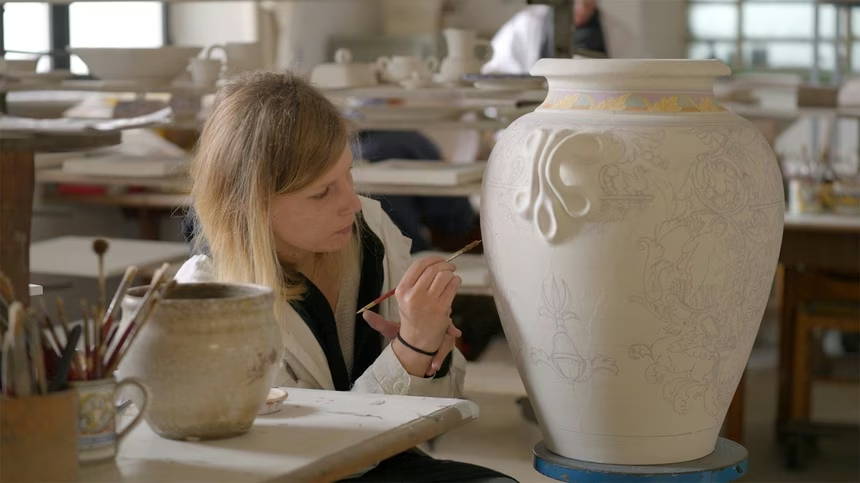
The piece is ready for the most crucial step--painting.
Vanessa Miucchi has been working here for 5 years.
Giorgio: That is the main part of the work, the part that takes 90% of the process and makes the difference in the final work.
Narrator: The boldly colored, intricately painted designs on a white field are what separates Deruta's world-renowned majolica pottery from other types of ceramics.
Giorgio: We try to keep the tradition alive because this is very ancient work, original pieces from Deruta in the major museum all over the world, and the Renaissance was a very famous period for Deruta.
Narrator: Before she paints, Vanessa transfers the traditional designs onto the pottery.
The design is drawn on duster paper, then perforated along its outline with a fine needle.
She lays the perforated paper on the vessel and beats it with a bag of charcoal dust, transferring the drawing.
Narrator: The colors that go into the kiln are not the colors that come out.
That's the art and the magic of majolica.
The vessel will be fired again at over 1,000 degrees.
Two firings is typical, but when precious metals such as gold, silver, and platinum are used, it could take up to 10.
Narrator: The slow process can't be rushed, or the vase will be ruined.
[Birds chirping] Giorgio: Now our challenge is to keep this tradition alive and to continue working in the same quality, the same tradition without changing the history that we receive from the ancient time but try to be contemporary for the market.
Narrator: Though some of the glaze formations may have been changed and the kiln runs on gas instead of wood, the spirit and methods of this pottery stays true to the old Umbrian ways.
Among the gently rolling hills and fields of northwestern Umbria, a plot of land unfolds.
It's the Gritti vineyard, part of a delectable family business.
I'm Ursula Gritti.
These are my kids, and we are olive oil and wine producers here in Umbria.
Narrator: While this part of Italy has a winemaking tradition, it's not as well-known for its olive oil, even though it produces some of the country's best.
Ursula: Umbria is one of the most recently discovered regions of Italy, so it's not a long time that people are speaking and knowing where Umbria is.
We came here in '94 and started the farming in '97.
Narrator: Ursula, originally from Germany, and her husband Carlo moved to Umbria from Venice when their children Andrea and Pilar were small.
It was supposed to be a vacation home, but 8,000 olive trees and a sprawling vineyard later, they knew they were here to stay.
Ursula's husband Carlo passed away in 2006.
Andrea and Pilar carry out their father's dream, happily doing work that's as relentless as the beauty of the Umbrian countryside.
Narrator: Andrea manages the fields while Pilar takes care of the business end, but she also helps with the harvest.
Narrator: Today the siblings hand-pick bushels of olives.
Narrator: They'll select only the best ones to crush into oil, prized for its slightly spicy flavor.
Narrator: When Pilar and Andrea aren't working with olives, they make wine.
Narrator: They're in business with a temperamental, silent partner--Mother Nature.
Ursula: We never know what the season brings, and so every year is different.
Every year has surprises, and we live with every year hoping and not sleeping every night very well because we keep the fingers crossed that everything goes well.
Narrator: In 2019, the siblings started their own line of organically grown wines, even sourcing their barrels from local farmers.
Narrator: So far, they've enjoyed two good seasons.
Now it's time to taste the results.
Ursula: I'm very proud of my kids.
Andrea is a hard worker, Pilar, as well, and so-- [Laughter] Che?
What?
Ursula: Let's start with a white wine, which is the Grechetto.
Color is nice.
It's quite intensive... So-- Mm.
Try?
Did you try?
Mm-hmm.
Yeah.
It's very nice.
Yeah?
Narrator: Though they're not native to this region, it's clear the Gritti family has found its place in the Umbrian sun.
Down Umbria's stone streets and across its pastures and woodlands, creativity continues to thrive here as artisans pass on their skills to a new generation.
Ursula: For sure the history of Umbria shaped the way of living of the Umbrian people.
Giorgio: We are deeply in love with these jobs, and we are doing our best to keep the tradition alive and to pass to our next generation.
And so, it's all about passion here.
♪ Today, these artisans share their flavors, textures, and designs with the world, while still managing to remain uniquely Umbrian.
[Birds chirping] Narrator: "Made with Love" shares the stories of dedicated artisans from around the world.
[Fire burning] Honoring their work, to help preserve these traditions for generations to come.
For more information, visit... [Exhaling] ♪
 New Episode
- Drama

Benjamin Wainwright stars as Maigret in the contemporary adaptation of Georges Simenon's novels.
 New Episode
- Drama

Hugh Bonneville stars in a crime drama inspired by one of the largest robberies in British history.
 New Episode
 New Episode








Support for PBS provided by: