
Juneteenth at the Charles H. Wright Museum of African American History and Faith in Detroit
Season 54 Episode 23 | 26m 46sVideo has Closed Captions
Celebrating Juneteenth and GRAMMY-winning musician Cory Henry shares his story of faith.
The Charles H. Wright Museum of African American History is preparing for the Juneteenth holiday. We’ll talk with the museum’s president about what’s planned for visitors.
Problems playing video? | Closed Captioning Feedback
Problems playing video? | Closed Captioning Feedback
American Black Journal is a local public television program presented by Detroit PBS
Juneteenth at the Charles H. Wright Museum of African American History and Faith in Detroit
Season 54 Episode 23 | 26m 46sVideo has Closed Captions
The Charles H. Wright Museum of African American History is preparing for the Juneteenth holiday. We’ll talk with the museum’s president about what’s planned for visitors.
Problems playing video? | Closed Captioning Feedback
How to Watch American Black Journal
American Black Journal is available to stream on pbs.org and the free PBS App, available on iPhone, Apple TV, Android TV, Android smartphones, Amazon Fire TV, Amazon Fire Tablet, Roku, Samsung Smart TV, LG TV, and Vizio.
Providing Support for PBS.org
Learn Moreabout PBS online sponsorship- Coming up on "American Black Journal," the Charles H. Wright Museum of African American History is preparing for Juneteenth.
We'll talk with the museum's president about what's planned for visitors.
Plus gospel artist Cory Henry discusses how the Black church impacts his life and his music.
Stay right there, "American Black Journal" starts now.
- [Narrator 1] Across our Masco family of companies, our goal is to deliver better living possibilities and make positive changes in the neighborhoods where we live, work, and do business.
Masco, a Michigan company since 1929.
Support also provided by the Cynthia and Edsel Ford Fund for Journalism at Detroit PBS.
- [Narrator 2] The DTE Foundation is a proud sponsor of Detroit PBS.
Through our giving, we are committed to meeting the needs of the communities we serve statewide to help ensure a bright and thriving future for all.
Learn more at DTEFoundation.com.
- [Narrator 1] Also brought to you by Nissan Foundation, and viewers like you.
Thank you.
(upbeat groovy music) - Welcome to "American Black Journal."
I'm your host, Stephen Henderson.
On June 19th, the country will celebrate Juneteenth National Independence Day.
This is the federal holiday that commemorates the day in 1865 when the last group of enslaved African Americans in Galveston, Texas finally learned that they were free more than two years after the Emancipation Proclamation.
The Charles H. Wright Museum of African American History is marking the holiday with a variety of activities.
This year's theme is a day of freedom, culture, and community.
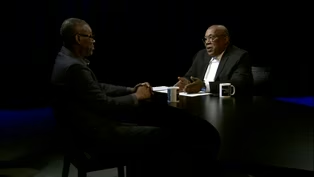
Here to tell us more is President and CEO Neil Barclay.
Welcome back to "American Black Journal."
- Thank you, Stephen, it's great to be here.
- It's always good to see you.
I think it will be hard to think of Juneteenth this year outside the context of all the things that are going on, in particularly in a national sense that seek to roll back much of the progress, at least from a legislative and judicial standpoint that African Americans have made- - Absolutely.
- Since the 1960s.
But in particular, the recent Supreme Court ruling about the Voting Rights Act and how it's applied, really wiping out much of the infrastructure that we have been using to wipe out centuries of discrimination before that is, to me, just an incredible parallel with the idea of commemorating Juneteenth.
What the court is saying in many ways is, "Look, racism's over, discrimination is in the past.
We don't need these tools anymore to assure that people are treated equally."
The celebration of Juneteenth reminds us that all of that is foundational in this nation, and that there likely won't ever be a day that race doesn't play a role and that discrimination doesn't exist.
- Well, certainly, not as long as we ignore the fact that it does play such an important role in all of our lives, right?
This notion that disparate impact is not something that we should consider, how the law, how our jurisprudence affects people in the real world, is what the Supreme Court now feels is not the way to look at these cases, to just look at them as based on merit, based on any number of other factors, some of which in and of themselves are also discriminatory- - Are soaked in the history of race.
- And so ingrained in the history of race and frankly are reasons why the Voting Rights Act in this case was even put into place, right, where some of the same tactics that we're now seeing today.
So that's certainly, as a historian, it was an institution that really focuses on history.
It's quite a sort of a shocking evolution of the law right now that we see.
- I mean, it's really cutting the legs out from under all the infrastructure that we've built to make the progress that we have.
But nonetheless, this is a celebration, we should talk about that.
- Yes, but it also, it brings up why voting is so important too, right?
And for many people that just don't vote, right, and it just shows you how, even with everything that's happening in other parts of gerrymandering, for example, as onerous as it looks, it doesn't look so bad if you think about people voting.
- Yes, right.
That's right.
- If more people come out to vote.
- If everyone who was eligible voting- - Would come out to vote- - The results would look different without some of those tools.
- Exactly.
So Juneteenth is a celebration.
- Yes, it is a celebration.
Let's talk about what that's gonna look like at the museum.
- Oh, it's so great.
You know, it's interesting because, you know, one of our largest days of the year has always been MLK Day, right.
And now the second holiday has taken on an equal amount of just opportunities for us to celebrate so many aspects of our culture.
It's an all-day celebration.
There's something really, literally for everyone of every age, it's programmed to be intergenerational.
So there are, I'm sitting here looking at the list, there is everything from silent yoga in the Rotunda, you know, to, you know, kids, to Jamal Jordan will be on hand, the official historian for Detroit, to really give us some of the context of the day.
There's book giveaways, there's culinary heritage.
We look at our sort of food culture, you know, obviously in Galveston that was a big deal and big in this celebration, you know, the food that was used to celebrate and the legacy of food and health too that we talk about some of those issues as well.
But it's gonna be a great day.
You know, and I think we're really looking forward to it.
- Yeah, it is a newish holiday.
And compared to MLK Day, which is now what, 40 years old almost.
- 40 years old, yep.
- It's really new.
Is it evolving?
I loved the parallel that you drew to it when you started talking about it and I'm not sure that everyone is thinking of it in those terms, but talk a little about how it has kind of found its own footing in the few years that we've had it.
- Well, it's a great example of traditions and African American culture that people are just not as aware of.
And I think making it a holiday has made it people more aware of it.
But, you know, the year after the Juneteenth occurred in 1865, starting in 1866, celebrations were held in Galveston, Texas for Juneteenth.
And as you know, those celebrations went on, you know, through the '20s and '30s, people coming from the north through the south, south through the north, and bringing those traditions- - The migration.
- The migration.
Through the great migration coming up to the north, they brought these traditions, right.
And so, in many communities, Juneteenth is not a new celebration.
What's new about it is it's now a national holiday and more people outside of the African American community are becoming aware of this incident, how it happened, the history of it, and are celebrating with the African American communities this really extraordinary event.
- Yeah, I mean, one of the things I really like about the holiday and the commemoration of it it's about this delayed, this literal delayed freedom for these enslaved people in Galveston.
But I think it points us to a deeper thought about what freedom is and who controls who's free and who's not.
Certainly we are all subject to governments and other kinds of authorities, but that's not the only freedom that matters.
And the freedom of culture and expression and history and celebration are just as important, and the holiday really makes us think about that.
- Yeah, if not more so in some ways.
Particularly in this moment, our understanding of who we are, our history, where we came from is really the armor that we have in getting through what is a very challenging period I think for African Americans, you know, this notion that we as a people have had these kinds of upfronts, if you will, but that we continue to evolve and to move beyond 'em in a way that remains, that really brings front and center our real desire to be free, to understand what freedom means, to understand what the Constitution promised all people, and to make that real in this world, you know?
So all of those things come up, you know, as a part of this, to think about two years later, you know, so people looking back, "Wow, for the last two years I could have, you know."
- We didn't have to continue to- - But boy, when it happens, they're gonna celebrate that.
And hopefully make that part of who they are, that freedom and that ability to really express their culture, their identity in important ways.
- Yeah, and that's a huge part of course of the museum's overall mission and purpose.
- Overall, absolutely.
- We've got a few minutes left.
Talk just a little about the state of the museum, which I think is, I've said this to you before, much better since you came to town.
- Appreciate that.
- There's a lot more, I think, hope and positive momentum coming out of it.
But give us an update.
- Yeah, the museum is doing quite, is doing well, I think, you know, it's a challenging time obviously for all Black institutions, but I think the museum has really found a kind of rhythm where we're not seeing ourselves as just a museum, but really as a community asset.
And not just for the African American community, but for Southeast Michigan and frankly nationally.
And so, that idea about our work has really led us to do things like the right conversations where we brought in everybody from Nikki Giovanni to Benjamin Crump, you know, folks that really have a lot to say about the present moment or leaning more into performance history has such a, I mean, African Americans have had such a vast contribution in the area of performing arts, right?
Whether it's dance, music, et cetera.
So that, the African World Festival, we continue to evolve into really a celebration of the African diaspora and particularly Detroit's role in it.
So, you know, we are I think really trying to do more and more, I think the coming year will see us also move more into communities.
You know, I think a lot of tourists and things are coming through the museum itself, but now we see ourselves as being able to contribute to work that's happening in neighborhoods, right, and I know that Mayor Sheffield, that's of her great passions and initiatives that she wants to see.
And we are totally on board for that and are looking forward to being able to create things in communities throughout Detroit, actually throughout southeast Michigan.
- Throughout Michigan, yeah.
- So it's gonna be, it's a really exciting time for us, I think, and the next season is pretty extraordinary.
- Yeah, yeah, it gets better and better.
- It does.
- Yeah.
Well, thanks for being here and we look forward to Juneteenth.
- I do too.
- Yeah.
(both laughing) There are several other events taking place in Metro Detroit in celebration of Juneteenth Independence Day.
Here's a look at some of the activities this month.
(upbeat groovy music) We have another installment from the new Faith in Detroit Project led by Christ Church Cranbrook in partnership with Detroit PBS and others.
The initiative lifts up stories of faith and resilience.
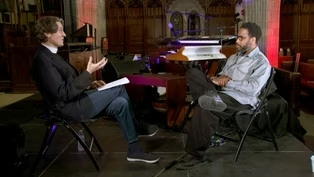
Today, we hear from Grammy-winning keyboardist and composer Cory Henry, who was in town recently for a performance at the church.
He sat down with Faith in Detroit Director, Father William Danaher, to discuss the deep influence of the Black church on his life and his music.
(light piano music) - Cory Henry, it's great to have you with us in this interview.
And you are such a magnificent talent.
And one of the things that you said in an interview that you gave in 2025 is that you differentiate the work you do as a musician from the work you do in church.
And you differentiated the work of church as being the place of ritual.
There's alter calls, there's baptisms, and the work of being a musician, it's just as much a ministry.
You actually said the power of God comes through the gift of music.
Can you tell us a story about that?
- Yeah, I believe deeply in the power of God and the gift of music.
Since I was a kid growing up in church, my mother played several different instruments and she taught me when I was literally one or two-years-old, my grandmama actually said the other day.
She was like, "You was seven, eight months playing."
I was like, "Come on, man."
But I never forget when I was playing in church at around the age of four or five or six-years-old.
And I was finishing up a song and my mama was like, "Play the church chords," you know, and like she meant like the preaching chords or whatever.
And I just played these chords and somebody was like, "Ah, hallelujah!"
And started like running around and like doing all this crazy stuff.
And I was like, "What is going on?
Like, why is that response happening?"
And all I did was play a chord.
I didn't even know it was because I played the chord at the time, but now I'm thinking back, I was like, they're reacting very, you know, emotionally and all these different things.
And I figured out from that moment, you know, how powerful music was.
People come to church every Sunday for music, you know, I mean, of course, people go for the Bible and for Word, but like, I know tons of people who's just going to be lifted by the music, lifted by the people singing.
- One thing that you mentioned is that you and your grandmother, she had a huge role in your life and that one of the things you like to think about and pray about, and also to reflect on in the scriptures, was about the biblical figure of David and his gift of music.
And in fact, you mentioned in an interview a couple of years ago that 1 Samuel 16:14-23, where David would play music to soothe King Saul's soul.
- (whooshes) Whew.
Yeah, that scripture stands out to me, David stands out to me as a important biblical figure because the number one thing for me is like, he was the man after God's own heart, right?
Like, the fact that he was a worshiper musician, you know, masterful on his instrument and was able to not just like play the music, but like to be able to communicate the music in a way that changed people's hearts, spirits.
And I see that to be evident so many times when I've played in church or around the world where people have, they come in sad or they come in mad, they come in angry, they come in, whatever that thing is, but then they leave, you know, changed and happy and blessed.
And that's the goal is to play music so well that people's lives are changed.
♪ I can't explain it ♪ - One of the things you did say in another interview I did some research on, is you did have a moment in your life where you were far away from church and from religion and then found yourself drawn back.
And I was wondering if that was a, in a sense, your musical gifts helped you transcend the church for a bit and you kind of followed your music where it was taking you, and then you found the music of the church drawing you back.
Can you talk about that journey back and forth?
- So I played in church, like, specifically for 20 years or so, and then I stopped for almost 20 years, it's crazy, but I stopped for a lot of different reasons.
I kind of was angry and I had rightful just reasons to be upset with the church and people that I respected.
And I didn't want to really be in the church, but the music and the Spirit of God never left me.
I never felt like I was far from God, even though I had left the church.
But I had to have all those experiences outside the church because it has made me who I am today, being able to talk to people, learn about other experiences and cultures has shown me a lot, right, and it seemed like I got to the end of a point where it felt like I needed to be back.
And I had a friend of mine tell me, he was like, "Yeah, you should have made that gospel record years ago, man.
You would've been way more famous."
And I was like, and I said to him, I was like, "No," right, like, because I didn't live the experience that I needed to sing about.
And that's super important.
Like, I made a record called "Church" and won a Grammy.
And I don't think it won a Grammy because I just made it, I think it won a Grammy because it's a true experience, right?
Like, when I listen to the album, you are hearing my whole life on record.
Like, my grandmamas singing a song that we used to sing 30 years ago and like, or still sings to this day actually.
But I think about when I was a kid, hearing some of these songs, some of the songs I recorded, and before I recorded the record, I was just like, it felt like I needed to be back.
Like, I knew the sound never left me, but I wanted to be back in fellowship and like community with people of believers and things like that.
And it's been important, it's been important.
I'm happy that I had the transition to go from being in church to being so far removed and now being back technically.
- Can you say a little bit more about the kind of church you're building now?
For example, the kind of plant you have in LA.
- I started the Church Experience in LA a year ago on resurrection Sunday last year to be exact, you know, He got up and so did we, He got up and started the Church Experience.
And this whole experience is for, it's for everybody, first off.
Literally for everybody.
I mean, like, no matter where you come from, no matter what your belief system in or whatever that, it's like, it's for everybody.
And, like, the people who grew up in church but don't go to church because they have their own things.
And it's a lot of people like that that wanna come back to church, but they won't go to the churches that they grew up in.
But they need and they want a space, I need and I want a space where freedom is like, freedom is exalted a little bit, like freedom is like lifted up versus like somebody telling you what to do, when you can praise, when you gotta sit down.
And we're doing that in LA and I'm seeing people from all different walks of life, Jewish people, Muslims, like young, old, white, Black, Hispanic, like, they're all coming there and they're like (harmonizes) and like crying their eyes out.
And I'm like, "Whoa."
Like, back to the power of God.
Like, my church is, it's like a piece of what heaven is, because correct me if I'm wrong, like, there's like no preaching in heaven as much as I learned, right?
There's like praise and worship and like- - Yeah.
- Just like worship in heaven.
- There is no need for instruction 'cause everybody sees face to face.
- Boom, boom.
And that also stands out to me.
When I learned that, I was like, "Oh no, I want a slice of heaven on earth."
- There's something that came up in a documentary that was done connected to the church, which was amazing.
- Mm, thank you.
- It was one of your cousins I think said that you had lost your mom at seven, your dad at 14.
And first of all, those traumas are never fully transcended, and I'm so sorry that you had to go through with that and going through that trauma, who stepped up?
Who stepped in?
And does that trauma inform a little bit your concern to make sure that that church makes room for everybody?
Is that okay we go there?
- Yeah.
My grandmama, she was a big deal.
She stepped up, my grandparents stepped up.
My godfather Bishop Jeffrey White stepped up, him and Lady Drew, my mama.
I wanna say those four people were very influential, especially when I was a teenager, but the streets of Brooklyn stepped up.
I used to run the streets crazy, like, I learned so much being in New York and I definitely have to give New York credit 'cause there's just a lot that happened as a teenager that like, if I wasn't in the streets, I wouldn't have known good and bad.
But my grandmama is like, she's the closest thing to God I know, right?
Like, she's a theologian, has a master's degree and like prayer warrior and like every day she's just like reminding me to be more godly, you know?
And I also want to shout out Bishop Jeffrey White, my godfather, for being a musical influence, a big musical influence to me.
Those are some people I would love to shout out.
- And you grow and as you think about the work that you're doing now and building a church in full, do you find yourself thinking about those people who struggle with difficulty, or struggle with distance, or struggle with getting into church?
Is part of what you're doing creating that space so that everybody who has in some ways either had a difficulty or distance, or has a bit of church wound finds their way back to God and to the power that church can be for people?
- Absolutely.
I'm trying to build a space and I'll continue to build a space that I feel is safe for people like me, right?
Like, people who've been to church, people got hurt by a church, people who want to come back to church, you know, 'cause people want to have a space where they can worship God.
And a lot of people feel like they can't do that at church, which is so crazy.
What I'm building is like, I want people to feel comfortable to feel God because they need God.
And I want God to make the changes.
I'm not trying to make the changes, right?
Like, whatever your thing is, whatever you like to do, whatever you do outside, it's like, that don't got nothing to do with me.
But if you're supposed to be changed, God will change you.
That's like, I don't feel that my job is to be like, "You gotta live this way because the Bible says so" and blah, blah, blah.
It's like, they can go to Sunday morning church and get that if they want it, you know?
But at my church we are just like, come in and let's worship together and let's start there and then the changes will be made or whatever the case, you know, things will happen, and I feel good about that.
I'm not, like I said, I'm not trying to do anything more than that.
- You can see more of Father Danaher's conversation with Cory Henry at americanblackjournal.org.
That's gonna do it for us this week.
You can find out more about our guests on our website and you can connect with us anytime on social media.
Take care and we'll see you next time.
(upbeat groovy music) - [Narrator 1] This program is made possible in part by Lilly Endowment and Christ Church Cranbrook.
Across our Masco family of companies, our goal is to deliver better living possibilities and make positive changes in the neighborhoods where we live, work, and do business.
Masco, a Michigan company since 1929.
Support also provided by the Cynthia and Edsel Ford Fund for Journalism at Detroit PBS.
- [Narrator 2] The DTE Foundation is a proud sponsor of Detroit PBS.
Through our giving, we are committed to meeting the needs of the communities we serve statewide to help ensure a bright and thriving future for all.
Learn more at DTEFoundation.com.
- [Narrator 1] Also brought to you by Nissan Foundation and viewers like you.
Thank you.
(gentle piano music)
 New
NewCelebrating Juneteenth at the Charles H. Wright Museum of African American History
Video has Closed Captions
Clip: S54 Ep23 | 11m 39s | The Charles H. Wright Museum is marking the holiday with a variety of activities. (11m 39s)
 New
NewGRAMMY-winning artist Cory Henry discusses influence of the Black church for Faith in Detroit series
Video has Closed Captions
Clip: S54 Ep23 | 12m 50s | He sat down with the Faith in Detroit director to discuss the influence of the Black church on his l (12m 50s)
Providing Support for PBS.org
Learn Moreabout PBS online sponsorship New Episode
- News and Public Affairs

Top journalists deliver compelling original analysis of the hour's headlines.

- News and Public Affairs

Today's top journalists discuss Washington's current political events and public affairs.
 New Episode
 New Episode
 New Episode
 New Episode
 New Episode

 New Episode
 New Episode
 New Episode
Support for PBS provided by:
American Black Journal is a local public television program presented by Detroit PBS