
NORTH episode
Season 18 Episode 1 | 54m 35sVideo has Closed Captions
NORTH investigates the impact of the northern landscape on craft artists.
Indigenous canoe practices, reclaimed materials, a craft school in the forest, and more demonstrate how natural and urban environments inspire the handmade in the Great North. The featured artists and institutions include Jeremy Frey, Haystack Mountain School of Crafts, Sayaka Ganz, Tia Keobounpheng, Canoe Journey – Lawrence Family, Suquamish, and Canoe Journey – Willard Bill Jr.
Problems playing video? | Closed Captioning Feedback
Problems playing video? | Closed Captioning Feedback
NORTH episode
Season 18 Episode 1 | 54m 35sVideo has Closed Captions
Indigenous canoe practices, reclaimed materials, a craft school in the forest, and more demonstrate how natural and urban environments inspire the handmade in the Great North. The featured artists and institutions include Jeremy Frey, Haystack Mountain School of Crafts, Sayaka Ganz, Tia Keobounpheng, Canoe Journey – Lawrence Family, Suquamish, and Canoe Journey – Willard Bill Jr.
Problems playing video? | Closed Captioning Feedback
Where to Watch Craft in America
Craft in America is available to stream on pbs.org and the PBS app.
Buy Now
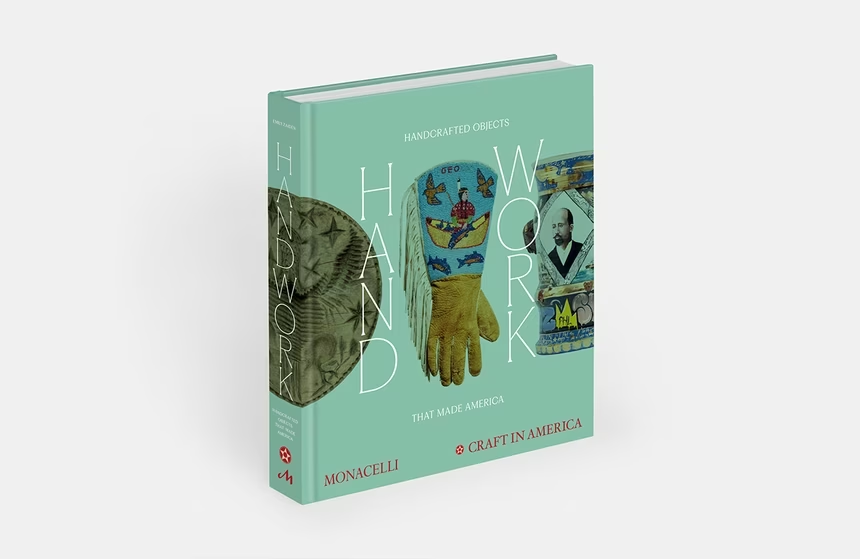
The Handwork Book
Celebrate America’s spirit with Handwork: Handcrafted Objects That Made America, a visually stunning, deeply inspiring new book that brings together unexpected, overlooked, iconic, and everyday handmade objects spanning more than 250 years.Providing Support for PBS.org
Learn Moreabout PBS online sponsorship♪ Jeremy: The basketry I practice is a tradition of the Maine tribes.
When I change traditional to contemporary, it's just another moment in time for that art form.
Sara: Haystack Craft School has earned a reputation as a think tank for craft.
It is a space not just to make things, but to think about what making things means.
♪ Tia: Coming back to fiber and working with my hands, questions that I held within myself started to make their way into the work.
Questions about my personal connection to my lineage.
Sayaka: I grew up looking for a place where I feel I belong.
So, to me, these plastics are like orphans that got abandoned by us.
I want to give them a place where they can be appreciated and they can look beautiful and alive.
[People singing] Willard: Each year, our canoe journey has reunited our Coast Salish tribes.
The canoe is a living being.
She takes care of us, keeping us safe in the ocean.
Sovereign: These are the dances that Native people had to hide for so many years, and now it's our job to keep sustaining our way of life.
♪ ♪ ♪ ♪ ♪ ♪ ♪ Jeremy: My whole philosophy is around innovation.
Color, design.
But also, it's not just about what you're looking at... It's everything it took to get there.
♪ I have to innovate new ways of how I'm using the material.
♪ But to imagine something... a vessel, a structure, this whole thing, and then have it materialize... that's a really great feeling.
♪ ♪ Jeremy: The basketry I practice is a tradition of the Passamaquoddy tribe.
My family has wove baskets for seven generations that we know of.
What I did was I took this ancient tradition and I kept pushing it and pushing it.
I didn't set out to become a contemporary artist.
I just started making contemporary baskets.
♪ Jeremy: My work derives from the local forests.
All my baskets, the structure is black ash.
What I'm looking for in a tree is straight growth, no knots, thicker growth rings.
[Chainsaw buzzing] Jeremy: Ash is very flexible, very strong.
It's the perfect tree for making an amazing basket.
I bring it home, debark it.
Once it's debarked, I pound the surface every single square inch.
And what that does is it breaks the fiber between each growth ring.
Caleb: Once that's done, then we take the growth rings off.
We strip that off the tree, we put them in stacks.
Tie them up and put them away, or process right away and use in baskets.
[Wood scraping] Gal: In our Passamaquoddy communities, basket-making is a large part of a lot of families.
My father was a fisherman and a basket-maker.
My parents made utility baskets, which are to carry heavy things, and big laundry baskets.
It was like a basket-making assembly line, and I predominantly wove as a child.
-Just made a new form.
-Oh, you did?
Did you see the one that's in there?
Jeremy: When I was younger, we were very poor.
My mother, she didn't spoil us with toys, but she'd bring us art supplies.
And so, my brothers and I, we were drawing constantly.
And then we moved to sculpture.
We used to use clay and make spaceships and dinosaurs and all of these creatures, and those were our toys.
[Lathe whirring] Jeremy: This is where it all starts.
Most of my pieces are made on forms.
And I make all of my own forms.
Sometimes they're longer, sometimes they're wider.
I try and go for the most elegant form to me in the moment.
And then I'll cut it apart into pieces that can fit out through the small opening when the basket's woven.
I couldn't make a giant basket with a tiny opening because I couldn't get the pieces out from the basket.
My imagination is limited by how these forms are made.
♪ Jeremy: When I graduated high school, I started working in restaurants.
It's high pace, high stress, thankless.
I ended up getting into the party lifestyle, getting into drugs a bit, and um, it just seemed to get more and more chaotic.
So, finally, I called my mother and I said, "Hey, I'd like to come home and just kinda start over."
And, at the time, she was learning a new style of weaving from an elder in the community, and she was like, "Hey, you wanna try weaving?"
And I was like, "Sure, whatever."
Gal: I said, "You know, you gotta keep your hands busy."
And I just taught him the process.
Jeremy: The material... it has to be straight, you know?
So, like, wherever there's something crooked... I think it took about a year, him just learning how to put pieces together.
Jeremy: I finally finished my first basket, and it was so ugly and gappy, and just... [Chuckles] ...the material was bad, but it ended up selling for a couple bucks.
And so I kept making those, and then it was pretty early on that I decided to start innovating.
Just thinking about dozens and dozens of new designs that could be done.
Some of the traditional weavers were very negative about the changes I was making to the basketry.
And that's where I came up with the idea of, you know, everything anyone ever does was contemporary at one time.
And so when I change traditional stuff to contemporary, it's just another moment in time for that art form.
♪ ♪ Theresa: I find his trajectory so remarkable because I wrote the grants that sent Jeremy and his generation of basket-makers into the national juried Native American art markets, the largest one being the Santa Fe Indian Market, where he achieved enormous success in 2011, becoming the first basket-maker east of the Mississippi to have ever won the Santa Fe Indian Market in its 90-year history.
So, this basket I made for my brother's wife.
Well, for him.
He gave it to her as a gift.
Theresa: [Gasps] That's really beautiful.
Yeah, that -- wow.
What always amazes me at your work is the symmetry, too.
And your innovations.
Most of us were weaving baskets in the same style as our grandparents, and you were like, "No, I'm not doing that!"
♪ Jeremy: One of the things I've been playing with recently is color, exploring the way colors interact together.
And what I realized is that on a canvas, unless you really build the paint up, it's two-dimensional.
But on a basket, you can make a three-dimensional surface.
If three people are looking at a piece, they're seeing different things because they're looking at different angles.
And so you can have color play in ways that paints can't.
A personal challenge is to see what I can make next.
And it's hard with weaving, 'cause weaving is just up, down, over, and under.
But I feel like the universe always says you're on the right path.
I had this opening in New York, which, for many artists, that's a dream.
I had the first solo show by a Maine Native in a contemporary art museum.
Gal: Last year, Jeremy won the MacArthur genius award.
That was a major... shock.
I don't know that there's a bigger award you can get as an artist.
I'm not sure there is.
So, then you're back to that thing again, you know?
"What's next?"
[Chuckles] Gal: I can't believe that Jeremy's success would be from our baskets.
From my family making them to survive, selling for $5.00 a piece in the '60s.
I could just hear my father saying, "Good job, son."
[Chuckles] ♪ ♪ Jeremy: There is an invasive insect that's killing all the trees, the emerald ash borer beetle.
It eats the inner bark of the tree, and then the bark falls off and the tree dies.
It's all over the US.
It's in Maine.
So, we're losing the material that the baskets are made of.
♪ I have a stockpile of prepared material, but someday I might be one of the last people weaving in black ash.
♪ ♪ ♪ Jeremy: I'm never fully satisfied.
I'll never make a perfect basket, no matter how hard I try.
But I think that they can always go further and be more.
I just want to make the best piece I can.
♪ ♪ ♪ ♪ ♪ ♪ Sayaka: I moved to Fort Wayne in 2002.
But I spent my childhood in Japan.
We were told as children that when we throw things away prematurely, before they are ready to be tossed, then these objects cry in the trash.
We anthropomorphize everything in Japan.
And so, animals are almost like the bridge between the world of objects and the world of people.
The title of this piece is "Suzaku."
In Japanese, "suzaku" means like a vermilion bird.
It's a phoenix-like, mythological bird.
I made the wings a little bit too short, so now what I'm doing is making extra length, so this bird can fly very long distance.
[Drill whirring] Sayaka: At first, I start building the metal armature, the structure to hold all the plastic's weight.
Then I get to attach the plastics.
This is my favorite part.
I get to be spontaneous and playful.
It's like I'm discovering the sculpture as it comes together.
♪ Sayaka: Human beings invented plastic for our convenience.
Something that can last forever, and we don't have to worry about it.
And now we're worried about it because it lasts forever.
But I use plastic to create animal sculptures.
♪ As a child, I just loved to draw and make things with my hands.
And I also loved jigsaw puzzles and Lego.
♪ I was nine when my family moved to Brazil.
Everything seemed so gigantic.
The streets seemed wider, the vegetables seemed like three times larger than Japan.
And there were all these beautiful hummingbirds and butterflies.
Animals were really a comfort to me.
♪ I went to Hong Kong when I was a sophomore in high school.
And then I went to Indiana University, wanting to be a veterinary medicine major.
I switched to art almost immediately.
I took a welding workshop and I looked at a pile of discards from other students.
Something just clicked.
At the end, my professors really loved the animal sculptures I was making.
In Fort Wayne, there's a community effort to clean the river.
They commissioned me to make a sculpture using some of the metal debris that came from the river.
I wanted to create these wavy lines that are flowing, and they're stacked on top of each other.
But, once I started, each wave shape started to look like birds to me, so that's why I called them "Birds in the Billows."
I just couldn't help it.
You know, I, even -- even the river turned into birds for me.
They all turn into animals.
This is a 1/6th-scale model of the sculpture I'm building for the city of Fort Wayne.
This is inspired from early flying machines before airplanes.
Inventors like Leonardo da Vinci were looking at bats and birds.
These shapes reflect that.
What we do is we take a piece of wire, and this helps us replicate this curve in the actual scale.
So, this is... the general form.
Can you put a piece of blue tape right here at the end?
Yeah.
Nayade: Working with Sayaka, it feels like a very collaborative space.
On this piece, we are bending pipes, and I do the cutting and she does the welding.
Sayaka: We have to be careful and take it, like, a little bit at a time and add more pressure, more pressure.
-54.
-Okay.
[Machine whirring] Sayaka: We'll work our way until we get to the right curve that we want.
Nayade: Yeah, it's almost close.
Sayaka: Yeah, it's close.
56.03.
[Machine whirring] Sayaka: Yeah, I think this is good.
Nayade: Okay, perfect.
♪ Sayaka: A lot of the household plastics are made to fit our hands or the parts of our body.
Coat hangers are made to mimic our shoulders.
I think those kind of qualities make them look very nice and organic.
So, I went straight to animals again.
Plastic allowed me to suspend things out in the air more, and create streaming lines that express movement, like the horses galloping, and penguins diving, trails of bubbles behind them.
My art is a collaborative process with the viewers.
You can focus on the fact that we are replacing real animals with plastic animals because we have so much plastic in this world.
Or you can focus on the beauty of it all.
♪ -Do you see it?
-Yeah, I see it.
Oh, I've got it now.
-If you can just hold and support it.
-Yeah, for sure.
Nayade: Yeah, it looks cool.
Sayaka: Yeah.
Sayaka: In Japan, my parents and I and my brother would go to the beach every weekend, and that continued in Brazil.
Now I'm so far away from any ocean, in Indiana; we're landlocked.
♪ I think we all still kind of have a yearning for the ocean.
♪ ♪ The whale, I think of her as symbolizing the wisdom of the ocean.
She has such a compassionate and nurturing kind of face.
This little spider became her eyes.
Her name is Nanami, and I call her Mother Nanami.
I don't know, it just makes me wanna give her a hug and be like, "Mom!"
[Chuckles] I started making corals, playing with plastic goblets and bowls.
When I was doing the research, I found out that 25% of the world's corals are bleached.
That's when the ocean temperature is too warm.
If they don't recover, they die.
♪ I made this coral color gradation that goes from red to blue to green to yellow, and then white, to show one-quarter of corals are bleached.
♪ I grew up looking for a place where I feel I belong.
So, to me, these plastics are like orphans that got abandoned by us.
I want to give them a place where they can be appreciated and they can look beautiful and alive.
♪ ♪ ♪ ♪ Perry: Haystack is a craft school located on the coast of Maine.
We're only in operation from May to October.
We teach classes and workshops and provide residencies in all craft disciplines.
[Dremel whirring] Sara: Haystack is a place for experimentation, in ways that are as much about what happens in your head as what happens in your hands.
The remoteness of Haystack is absolutely, I think, crucial to its identity.
You're literally at the ends of the earth, this land of rocks and moss and trees.
Perry: The campus was designed by Edward Larrabee Barnes.
It's a jewel of mid-century modernist architecture.
The buildings hover above the granite landscape.
They're built on pier and beam, and they're all related to each other by a set of walkways and staircases.
Sara: Haystack was founded in 1950.
The founders built its first campus at the foot of Haystack Mountain.
But the government planned to build a road that was going to threaten the bucolic feeling, and so they started looking for a place where that would never happen.
This campus opened in 1960 and has been here ever since.
Perry: We have a ceramic studio, a woodworking studio, a small metals studio, a fiber studio, a graphics studio, and a hot shop.
Every two weeks, we invite an entirely new cohort of students and an entirely new set of instructors who teach all of the various disciplines in our studios.
That means that every two weeks, there is an entirely new school here.
The Open Studio Residency is a unique program of artists, architects, writers, thinkers.
It is not led by instructors.
Sok: My name is Sok Song.
I'm a printmaker based in New Haven.
I was an origami artist for about 20 years, doing installation and books.
So, when I learned printmaking, I merged the two practices together, and that process is called a graphite transfer.
It's a method of using carbon copy paper and to use pressure to make a mark.
Perry: The Open Studio Residency becomes a very transformative experience for the artists who come.
Instructor: So, you wanna take this end and trim it down a little bit.
Perry: It opens up new ways of thinking, to explore different media, to explore different craft techniques.
Sok: I've been able to go pop around in the different studios and learn from other people.
Instructor: Keep doing that until you have enough, and it will form a circle.
-Like this?
-Mm-hm.
Ahree: My name is Ahree Lee.
Part of my practice is I weave with conductive thread and weave in Arduinos and LEDs, put some of them together into larger structures.
So, I thought I was gonna be working on a little more of that, but I left it open so I could kind of experiment with whatever I felt like experimenting with, like paper clay.
And I actually made a weaving with paper clay.
It's already gotten my gears turning about making structures for weavings.
Perry: The workshop experience is not built around the expectation of a final product.
You could come to Haystack and fail in every experiment that you make, and we see that as being really valuable experience.
Kristine: My name is Kristine Rumman, and I make sculpture and performance.
I'm working on a wearable ceramic suit.
I came with an idea that I didn't quite know how to build.
But I think what's so special about this residency is that you're working in tandem with other people in their specialties.
Phirak: My name is Phirak.
I'm originally from Cambodia.
I am trained as an architect by trade, but now working as a product designer with my own company.
So, my work explores materials through digital fabrications, and I work with clay a lot, and using 3D printer to create objects.
-Here, maybe like... -Is it still fragile?
Kristine: I sent him a file, and we printed a digital fabric pattern that's based on Palestinian textiles.
Phirak: That's cool.
Yeah.
I don't know if we can see it, but, like, the Bethlehem Star has points on it, and I'm losing a little bit of those points.
You're losing the resolution already by image to clay.
Right.
Yeah, yeah, yeah.
So, you have to find a better, even higher image resolution to compensate for this.
Okay, so, maybe we could adjust the file a little bit.
[Bell chiming] Perry: The studios are open 24 hours a day, so participants can work very long hours.
Your meals are taken care of for you.
They're shared collectively, creating a sense of community.
Natalie: My name is Natalie Baxter.
I have two kids at home, but here, you don't have to think about, "What's for dinner?"
It's all just like, "Oh, a bell rang, and you can eat now."
[Chuckles] It's amazing.
[Sewing machine whirring] Natalie: I make soft sculpture that's rooted in quilting.
I did this big series of assault weapons that were made of fabric, that are stuffed, that are sort of droopy.
I'm using a traditional craft method passed down to me from my grandmother, my great-grandmother, my great-great-grandmother, who were all quilters.
[Power hammer clanking] Perry: That is, I think, what is the most exciting thing about craft.
It's grounded in tradition, it's grounded in history, but it always speaks to the contemporary moment.
Sara: Haystack has earned a reputation as a think tank for craft, that it is a space not just to make things, but to think about what making things means.
Savannah: My name is Savannah Bustillo, and I am a grad student at the University of Iowa.
I came here with this idea of making paper with the water of the Atlantic.
My family is from Colombia, and so I have a lot of text in my work that talks about the experience of generations of family members that have crossed the Atlantic Ocean back and forth to get to the US.
The text is made through watermarks, which is a process where you add an additional element onto the mesh which displaces the pulp.
I think it's a metaphor for thinking about my family's displacement.
But the ways I'm thinking about it have already started to change just from my conversations with the other people here.
We're all gonna leave with something physical, a made thing.
But I think being here at Haystack, the greatest gift is making connections with other artists, and that is where the expansiveness of our practices will continue to grow.
Perry: This is our 75th season.
It's really become an important place for craft in America.
Every year, Haystack is a new institution.
Every year, Haystack feels not like it's 75 years old, but like it is brand new.
♪ ♪ ♪ ♪ Tia: Geometry has created this space where I can imagine what it might be like if our diversity and our uniqueness as people was just allowed to be expressed.
I am embedding the many patterns into each other, so I'm not othering, I'm not dividing.
The geometry has given me a world which allows me to imagine things that I haven't ever experienced before.
My name is Tia Keobounpheng, and I am an artist.
I grew up in a small Minnesota village called Parkville, the middle of five children.
My dad is a self-taught architect, and my mom ran the household.
Our Finnish-American heritage was a really strong force in our family.
After high school, I went on an exchange program to Oulu, Finland.
I lived with a host family.
In Finland, I learned how to weave.
I came back, and I studied weaving at the University of Wisconsin-Superior.
But I diverted into design.
♪ Souliyahn: I had finished architecture school, and I was working for a large architecture firm.
There was a design lecture on the paper clip on a Saturday morning.
This one person came up to me, and she did not have a voice 'cause apparently she was at a rock concert the night before.
Eight months later, after that lecture, we got married.
Tia: We would do residential design work together, where he would focus on the architectural component, and I would do the interior.
Souliyahn: And then our two boys arrived, and began growing up.
Tia: When my kids were little, I was really focused on making jewelry, and that felt like enough.
But, by the time I turned 40, I was starved, in a sense that I didn't have a practice that nurtured my creative spirit.
So, in 2017, I started the 100-day projects.
I was thinking I could just give myself 20 minutes a day to do one drawing a day, and with some sort of theme for that 100 days.
Souliyahn: Her 100-day projects kept going and going, and it became two and a half years.
Tia: 855 days consecutive, committing to this practice.
Souliyahn: I think it transformed her.
She slowly distanced herself from design.
Tia: I started working in little sculptures, brought weaving back, and in that process of working with my hands, I realized the difference between making objects that serve a purpose or a function for others, and making objects that are serving me and serving my emotional needs.
♪ Casey: Tia is part of an important generation of artists who are finding expression through fiber, and creating these really monumental and significant works.
Tia has come into a fluency with her practice that's really moving to see.
Tia: I will start with drafting interconnected concentric circles onto the wood.
Everything is drafted by hand.
It takes a lot of time.
Then I begin to map the patterns onto that foundation.
And I will use trace paper to see how patterns could coexist within that plane.
I drill holes into the wood for the patterns.
Then I will add colored pencil.
Once I get to the threading, it becomes like painting, and so there's a lot of experimentation to get the color correct.
The method that I've developed, I think of it as "unweaving," in the sense that I am building warp fields of the dense, parallel threads that would normally have weft moving through them, and I omit the weft.
Coming back to fiber and working with my hands, the ideas and the questions that I held within myself started to make their way into the work.
Questions about my personal connection to my lineage.
That's Grandma's mom.
-Really?
-Mm-hm.
Wow.
Tia: I started to build my family tree.
I thought I was 100% Finnish.
My maternal grandmother, who was a Finnish immigrant, died before I was born.
But I did know my maternal grandfather.
This is Helmer.
Helmer is my grandpa.
He took me fishing once.
Is that him?
This was him as a child.
And then this is the oldest photo we have of his mother.
She is the daughter of Wilhelmina.
I learned that my great-great-grandmother was Wilhelmine Adamsdotter.
She grew up in a reindeer family, that was how it was phrased, and she was born in Norway.
And when I looked to her grandfather, Hans Mickelsson Purnu, I was stunned because he was not Finnish.
He was Sámi.
♪ Troy: The Sámi are Indigenous people of the northern parts of Norway, Sweden, Finland, and the northwest corner of Russia.
♪ We have been living there since time immemorial, and are distinct from the majority populations of those countries that have colonized us over the last 500 years.
Most Sámi traditionally have been hunters and fishers and small-scale farmers.
But Sámi people are most well-known for reindeer herding.
Today, the reindeer herders are in many ways the ones who are doing the best to preserve the language and traditional culture.
Tia: I had to re-evaluate identifying with being Finnish, and now I am trying to engage with my Sámi lineage.
I took a 1,600-mile drive north through Finland up into Norway to the birthplace of my great-great-grandmother Wilhelmine.
I am developing deep relationships with Sámi people, deep connection to my ancestral land.
I am beginning to learn the way that the Sámi people see the world.
Troy: Sámi culture places a high value of living within the natural community.
The plants, the animals, the landscape, the sea.
And that our job is to contribute to it and take care of it.
[Waves sloshing] Tia: Through this process, the work started to answer questions for me.
My "Who Do You Think You Are" series features capsule forms that ultimately end up becoming abstract portraits of people, and it speaks about the way that we influence each other through relationship and family.
The "Threads" series really focuses on holding multiple patterns together.
Layering colored pencil on the wood, and then embedding two or more patterns through a single layer of parallel thread.
Oh, wow, Tia.
Tell me everything.
Tia: Okay, so this show is titled "Gullat."
It is a Sámi word that means "to hear," but also "to belong to a place."
They're kind of disparate meanings, but it's in the context of the Sámi origin story that involves the creator placing the beating heart of a two-year-old reindeer into the center of the earth, so that when the Sámi are discouraged or beleaguered, as long as they can place their ear to the land and hear the heart beating, there's hope for the future.
Ah!
Tia: That origin story brings hearing and belonging together.
But it also then speaks to the relationship that one should have with the earth.
-On this wall... -This was one of the earlier ones too, where I... Tia: This new series is a leap forward.
I've been existing in this geometry world that is symbolic of the natural world, and now the wood grain of the panel comes in, and that is the voice of nature, literally.
This body of work is reflective of spending time with Sámi folks who are sharing and teaching.
♪ Casey: It's rare that you find an artist who has made an important discovery about themselves and is also following it to its limits and beyond.
Tia: I am allowing myself to be who I think I've always been.
And I realized that this is what it means for me to be an artist.
♪ ♪ ♪ Willard: In the Pacific Northwest, if we go back 500 years, it really was a densely populated, thriving, thriving area.
Canoe was the best way to travel because the forests were so dense at that time.
So, there were little hunting canoes that you could just take out by yourself, or if you were in a river, you'd use a river canoe.
For Puget Sound, there was a freight canoe.
And then, just for daily life, how to get from A to B from your winter village to maybe your summer fishing camp, an ocean-going canoe made the most sense.
♪ This year, in our canoe journey, there's well over a hundred ocean-going canoes moving from one Native people's reservation to another each day.
[Indigenous drumming and singing] Nigel: A big part of the canoe journey is protocol.
The order in which we ask permission to come ashore.
When we arrive, we have to do it in a certain way that is not declaring war; we have to come in peace.
We do a circle first to kinda show who we are.
We pull up with paddles up.
Man: We have traveled long and hard... Nigel: You introduce yourself, announce your intentions, and ask permission to come ashore.
Man: We bring our families, our elders, our children.
We humbly ask for permission to come to shore.
Woman: [Greeting in Native language] Willard: The hosts will then invite us in and help us get to shore.
Man: Watch your step!
Willard: The hosts will then feed us, take care of us.
There's people here from all over the world.
Canada, of course, British Columbia, and then our Alaskan tribes, Native Hawaiians, Maoris here.
Most significantly, the canoe journey has very much reunited our Coast Salish tribes.
Nigel: But, for a long time, our canoes, our ceremonies, our religion, our gatherings were illegal, were banned by the federal government.
And in Suquamish, we didn't have canoes for a long time.
They were outlawed.
In 1989, the father of canoe journey, Emmett Oliver, helped advocate for having a canoe presence in the Washington centennial maritime celebrations.
Emmett: There was a willingness to accept the idea that the canoe could be featured.
You see what I mean?
Nigel: And he encouraged my mom to go to those centennial meetings.
Barbara: I was a centennial commissioner, and I was at the tables and making decisions about the state planning their 100th birthday.
And I would just say things like, "Oh, we got baskets older than that.
So what?"
But it was decided to have a canoe paddle from Suquamish to Seattle, and it was called the "Paddle to Seattle."
That day, there were just 13 canoes participating in it.
Our Suquamish tribe, we didn't have any traditional canoes to use.
We had been borrowing one out of the museum that was like a hundred-year-old canoe we weren't supposed to borrow; we weren't supposed to take it out in the water.
But the Paddle to Seattle inspired many, many tribes, and they worked with the state of Washington to get logs so we can build canoes.
Barbara: Four years later, 25 canoes traveled to Bella Bella, British Columbia.
There, another tribe said, "Everybody, come to my reservation."
And then it just kept going.
Man: Lift!
-Watch your step.
-Hey, watch your step.
Barbara: With each canoe journey, the resurgence of the language, of the culture, of everything, was just coming raring back.
It's just broke open what was forbidden for so long.
Man: [Indistinct command] [Water sloshing] Man: [Indistinct command] [Group singing] [Group singing continues] [Group singing continues] Willard: We established the Black River Canoe Family a year and a half ago, but my kids have traveled on canoe journey for well over 20 years.
They were born into it, but they have really... but they've stayed with it.
How's the pace back there?
Man: It's good.
Willard: My daughter Sovereign is our lead puller, and even though she's 21 now, she's had that role since she was 12 or 13.
Sovereign: Me and my cousin Leila, we're at the very front of the canoe, and so we set the pace for everyone behind us.
We might choose to do a slower pace because we will be traveling so far, or when the current changes or there's a riptide, sometimes I'm the first one to see that, and so I'll call out those power pulls to make it through safely.
For me, it really is more of a mental strength than it is a physical strength.
Just being able to keep going.
But it's not the same thing as my brothers in the back who can pull a lot more water.
Nice and easy.
Good job.
Freedom: My father, he knows how to push you in a way that's healthy and in a way that you can grow your mental strength and spiritual strength so that you can stay out there all day, every day, for the entire journey.
Justice: Today is Day 5, and we had a 30-mile pull yesterday, and then another long one today, but we're making it happen.
For us, our canoes are alive.
They have a spirit, and when you feed good energy into that canoe, it takes really good care of you.
Willard: Being a canoe skipper, I am responsible for the lives of those people in the canoe.
How we travel, where we travel, those decisions come to me.
It's the one place where I get to boss everybody around; they have to listen.
[Laughter] Freedom: We have a lot of good laughs out there on the water.
I think that's another big part of it, too, is, like, we have a lot of fun out there.
Sovereign: Every day, so far, everybody's putting their heart and soul into it.
I'm just really thankful to be out here with my family and be able to do what we love.
♪ ♪ Barbara: In 1989, after the centennial, we met people who somehow held onto the traditional knowledge, so they would teach us at Suquamish.
We'd bring somebody from Quinault about preparing cedar bark or somebody from Makah to teach us how to make hats.
Cedar, to the Suquamish people, is everything.
I mean, we call it the long-life-giver.
-Thank you.
-Yeah.
Barbara: From the bark, I'm making hats for family members, for friends and for guests.
You want the weave to be tight and you don't wanna hurt the weave.
So something that's blunt just nudges the weave tighter.
I look for the cedar bark that has two tones.
Your design shows up better when there's contrast.
I can't gather cedar bark myself, but I have grandkids who have learned to gather for me.
Elilai: I'm gonna find a cedar tree that's, like, within arm's length.
If I can wrap my arms around it, that's the perfect size.
I'll carve out a small piece, and then I'll just tug at it.
If the inner bark is, like, nice and moist, if it pulls with me, and that's when it's good.
Once I take a strip this size, I'm done.
Because over time, this tree bark is gonna grow back.
Nice.
What I'm doing out there is ceremony for me.
It's my way of sovereignty, my way of life.
[Wood scraping] Ian: It means a lot to me to be able to make the paddles for these canoes and for these journeys.
It's almost like a meditation that I do while I'm making each one.
When you're out on the water, you may encounter rough weather, and now you got waves coming at you, so you need a paddle strong enough to push through that.
I think this is my fifth year in a row now of making graduation paddles.
The paddles is kind of like a metaphor for our graduates for college.
They're going to run into more challenges, and I want them to have this paddle to know that they can make it through.
Nigel: Come on, strong people!
What you got, strong people?
Nigel: In Suquamish, we wanted to learn how to carve a canoe.
And so, we hired a Native carver from Vancouver, BC.
We asked him to teach several of our young people how to carve the canoe.
One western old-growth cedar tree made two canoes, and those two canoes travel together on the canoe journeys all the time.
We are Suquamish!
Paddlers: We are Suquamish!
Qal'qalexich!
Paddlers: Qal'qalexich!
Nigel: As skipper, the Qal'qalexich... how it got its name was on one of the days that our young people were carving it, a pod of killer whales came by right at the end of the boat ramp, and they jumped and breached and all of that.
So, we named the canoe "Qal'qalexich": in our own language, "killer whales."
[Geese calling] [Group singing] [People cheering] [Singing continues] Willard: It really is an emotional outlet getting to our final destination, 'cause it's months of physical training, the spiritual practice that we put into it.
A little bit of sadness that it's over.
[Group singing continues] Willard: With our canoe journeys each year, a tribal community volunteers and comes and offers to host.
So, the host tribe this year is Lower Elwha Klallam.
Sovereign: Canoe journey isn't just being on the water.
We learn about other tribes through their songs and through the dances.
The dances are storytelling.
[Group singing] Willard: The tribe that is hosting has a protocol list.
[Crowd cheering] [Drumming and singing] Willard: They try to start from those tribes or canoe families that are the furthest away from their homeland.
The visiting tribes are given time on the floor to come share in song and dance and gifting, 'cause it's our ancestral way of governance.
[Drumming and singing] Willard: This goes on for four, five, or six days.
[Drumming and singing continues] [Energetic drumming and singing] [Crowd cheering] Sovereign: These are the dances that Native people had to hide for so many years.
Now it's very healing for our people and for the people who witness it.
[Group drumming and singing] Sovereign: Being able to dance these dances, to sing our songs, to speak our language, this revitalization really is because of the generations before me who protested and fought for our rights that we have today.
And now it's our job to carry that work forward, to keep sustaining our way of life.
[Drumming and singing continues] [Drumming and singing continues] [Drumming and singing fades] ♪ ♪ ♪ ♪ Narrator: Watch all episodes of Craft in America online, with additional videos and more.
Visit Craft in America at pbs.org.
This episode of Craft in America is available on Amazon Prime Video.
 New
Video has Closed Captions
Preview: S18 Ep1 | 1m | NORTH investigates the impact of the northern landscape on craft artists (1m)
Providing Support for PBS.org
Learn Moreabout PBS online sponsorship
- Arts and Music

Innovative musicians from every genre perform live in the longest-running music series.
 New Episode
- Arts and Music

Intimate portraits of six of the most influential and celebrated classical music artists.


 New Episode

 New Episode
 New Episode

 Recently Added

Support for PBS provided by: