
November 25, 2026
11/25/2026 | 55m 47sVideo has Closed Captions
Richard Haass; Billie Jean King; Adam Serwer
Richard Haass, President Emeritus of the Council on Foreign Relations, discusses President Trump’s foreign policy and America’s changing relationships with allies and adversaries. 39-time Grand Slam champion Billie Jean King reflects on her fight for gender equality in tennis in a new documentary. The Atlantic staff writer Adam Serwer examines the impact of redistricting on Black political power.
Problems playing video? | Closed Captioning Feedback
Problems playing video? | Closed Captioning Feedback
November 25, 2026
11/25/2026 | 55m 47sVideo has Closed Captions
Richard Haass, President Emeritus of the Council on Foreign Relations, discusses President Trump’s foreign policy and America’s changing relationships with allies and adversaries. 39-time Grand Slam champion Billie Jean King reflects on her fight for gender equality in tennis in a new documentary. The Atlantic staff writer Adam Serwer examines the impact of redistricting on Black political power.
Problems playing video? | Closed Captioning Feedback
Where to Watch Amanpour and Company
Amanpour and Company is available to stream on pbs.org and the PBS app.
Watch Amanpour and Company on PBS
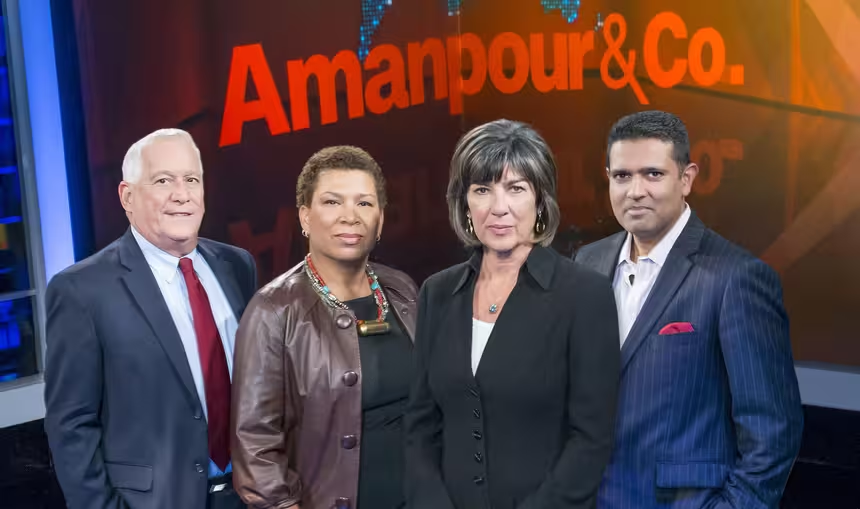
PBS and WNET, in collaboration with CNN, launched Amanpour and Company in September 2018. The series features wide-ranging, in-depth conversations with global thought leaders and cultural influencers on issues impacting the world each day, from politics, business, technology and arts, to science and sports.Providing Support for PBS.org
Learn Moreabout PBS online sponsorshipHello everyone and welcome to Amanpour & Company.
Here's what's coming up.
Fresh tariff threats and major national security concerns as Trump doubles down.
Veteran diplomat Richard Haass lays out how America's relations with its friends and foes have changed in Trump 2.0.
Then, a trailblazer on and off court tennis legend Billie Jean King on her lifetime of achievements and the personal sacrifices she made to make the sport what it is today.
Plus, the dangers hidden beneath the Democrats' blue wave.
Atlantic writer Adam Serwa speaks to Michelle Martin about Republican gerrymandering and the risks to democracy ahead.
♪♪ >> "Amanpour & Company" is made possible by... William Atwood and Leslie Williams.
Candace King Weir.
Charles Rosenblum.
Norma C. Warner and Paul D. Warner.
Monique Schoen Warshaw.
The Sylvia A. and Simon B. Poyta Programming Endowment to Fight Anti-Semitism.
The Strauss Family Foundation.
The Peter G. Peterson and Joan Gantz Cooney Fund.
Koo and Patricia Ewen, committed to bridging cultural differences in our communities.
The Barbara Hope Zuckerberg.
And by contributions to your PBS station from viewers like you.
Thank you.
>> Welcome to the program, everyone.
I'm Christiane Amanpour in London.
The rule book thrown out, alliances in tatters, and old foes brought in from the cold.
It's been a big year for American foreign policy.
The Trump administration launched its war with Iran, a major military intervention in Venezuela, and just today reopened its favorite playbook, more tariffs, on some of America's closest trading partners.
President Trump has migrated towards adversaries, Putin and China, and dismissed warnings from his own intelligence services about one of America's most powerful CEOs and his links to Beijing.
So, with U.S.
national security in question and the Democrats poised to take control of Congress, where is foreign policy headed next and is there a strategy at all?
Ambassador Richard Haass spent his career on the front lines of American diplomacy at the State Department and beyond, and he's now President Emeritus of the Council on Foreign Relations and author of the subset Home and Away.
He joins me now from New York.
Welcome back to our program.
Great to be with you and a day before Happy Thanksgiving.
And a Happy Thanksgiving.
So on this day before Thanksgiving, what is there to give thanks about when it comes to American foreign policy?
If you are on the receiving end of a lot of Trump policies, I'll get to tariffs in the moment.
But can you explain to the world whether it's just, you know, business as usual, and of course, the stock market, and of course, money talks, that means, you know, Jensen Huang has been reinstated?
And what about national security?
Well, the short answer, Christiane, is this is not business as usual.
Or another way to put it, if you take every American president since World War II, beginning with Harry Truman, through Joe Biden, including the first Trump administration, there was an awful lot of continuity.
Our friends could expect certain things with confidence, our adversaries could expect certain things with confidence.
We would be a part of international institutions, we would favor trade, it's a long list.
And Donald Trump 2.0, who's now been president for two years and has two years to go, represents a striking departure from the traditions of American foreign policy.
We're tougher on our friends than we are on our adversaries.
He himself tends not to think of our adversaries as our adversaries.
His calling Vladimir Putin friend made that, I thought, pretty stark.
You had the interventions in Venezuela and then Iran.
What's so interesting about those, particularly Iran, was how outside that was the tradition of a Trumpian foreign policy.
And the only thing I can make of that, and I don't think you'll disagree with me, is all the assumptions prove wrong.
He thought that was going to be another Venezuela.
He thought it was going to be quick and easy.
And it's a war of choice that's turned out to be horrifically counterproductive and costly for the United States.
But otherwise, again, when we look at his approach, we no longer promote democracy or human rights.
Let me say one last thing and then I'll stop.
For a long time, our goal was to make the rest of the world look more like us.
The rule of law, democratic, respect for human rights.
And now what's happened is just the opposite.
We're beginning to resemble much of the rest of the world.
Suddenly we don't have the rule of law.
We have government intervention in markets.
We have crony capitalism.
This is turning things on its head.
- Well, then Richard Haass, was it crony capitalism?
Was it the rule of the market?
How dangerous do you think it is, or maybe not, that national security appears to be playing second fiddle to the stock market or to President Trump's favored CEO of what I believe America thinks is its major economic engine, the AI revolution and chips?
Is Trump himself standing to benefit?
Because I think he owns some stock.
I mean, I don't know the details, but certainly there's reporting on personal involvement as well.
Where do you come down on this specific issue?
Putting aside the corruption, because President Trump is reported to own a significant number of shares of Nvidia, but let's just put that aside.
One is that national security is taking a backseat.
If AI is as significant as everyone says it is, and there's no reason to question that, China is clearly the only other country that is involved seriously in AI.
The idea that the United States would make available high quality ships to China obviously contradicts American national security interests, but that's what happens.
And the idea that support for the CEO and chairman of NVIDIA takes priority over that, again, shows that national security is taking a backseat to commercial interests.
And then secondly, I'm old enough to remember when Republicans stood for things like small government and respect for markets and the rule of law and the idea that the President of the United States would personally intervene to force the board of a publicly traded company to bring back a CEO who appears to have violated U.S.
export laws and clearly violated the laws and rules of his own company in multiple relationships with people who report to him and are not telling the truth to his own board and to senior officials.
That again is truly unprecedented and dangerous because countries invest in the United States because of the rule of law, because the idea that our markets establish a level playing field for all.
So I don't know what's going to happen in the next few days with Nvidia stock, but I do know this is truly corrosive to the ability of the United States to continue to be a safe port for the investment of others.
So it's very confusing as well.
I asked in the lead up and the introduction to you, is there a strategy at all?
So on the one hand, President Trump himself identified China as a major competitor in his first term.
Biden followed him by keeping on most of the policies that Trump had initiated.
Even now, when it comes to AI, he has said, you know, I'm going to paraphrase, but whoever wins AI wins and therefore we need to win.
And that was about governance around AI.
So saying that we don't want China to win.
We want to win.
And yet allowing this trade of chips to China.
I honestly don't understand it.
Can you tell whether there is a economic or foreign policy perspective, which you may or may not agree with, but some kind of strategy behind this latest thing with Nvidia?
To be honest, I can't discern a strategy because strategy by definition means a degree of consistency.
And I just don't see it.
There are those who argue to be fair, that we should be providing advanced chips to China, because we want to get them addicted to American chips, rather than have an alternative.
And we want the entire world to be using American chips.
That's a hell of a price to pay if we want to get them involved with American chips rather than their own, if we're going to accelerate their AI.
And by the way, they're not going to give up their domestic chip capability.
We've seen that time and time again with areas of high priority for the Chinese economy and for their military.
But to answer your question in a larger way, no, there is no strategy.
There is no consistency.
Just take one geopolitical issue.
We have put on indefinite hold arms for Taiwan.
What that does is signal to China that raises questions about doubts about America's willingness to go to bat for Taiwan if push ever came to show.
So no, Christian, I can't discern a strategy towards China.
What's so odd about it?
Trump 1.0, the first Trump presidency, if you go back and look at it, was actually quite tough towards China.
Trump deserves credit, I would say, for questioning the consensus.
If we only brought China into the World Trade Organization and did business with them, they would become a more open, moderate, reasonable country.
It didn't work out.
So Trump blew the whistle on that.
But Trump 2.0 is all over the place when it comes to China.
Okay, so I think that's really interesting, because Trump 2.0 appears all over the place when it comes to Ukraine as well.
And Russia particularly, we've talked about how we call Putin friend, how he even posted it on Truth Social, not content with just saying it, you know, into his ear, but then posting it for the whole world to see.
And of course, that drew a huge amount of backlash from European allies, from Ukraine and many in the United States as well.
But here's my question.
Trump seems to be believing in 2.0 that he can entice Putin by whatever means that he's employing to get him to stop this war.
He rightly, again, let's give him his dues, he rightly in 1.0 called out Angela Merkel for doing the Nord Stream 2, even after Putin had invaded and annexed Crimea, right?
But now he's doing the same thing, because we saw what happened after Nord Stream 2, Putin invaded the full-scale invasion.
And now Trump's trying to do, or maybe this is not happening anymore, but the diesel deal, trying to do all these other deals with Putin.
In other words, the Merkel playbook, which he rightly condemned in 1.0.
A hundred percent.
Trump, as well as his two envoys, Steve Whitcoff and Jared Kushner, seem to think the rest of the world is motivated by the same things they're motivated by, which is financial gain.
And you see it with the Russians, you see it with the Palestinians, you see it with the Iranians.
And they seem not to understand, how would I put it, that man does not live by bread alone.
And it could be nationalism, it could be power, it could be a desire to avenge humiliation, whatever.
But we cannot incentivize through economics the good behavior of others.
And when it comes to Russia, what we're not doing is we're not helping Ukraine in any meaningful way.
We've cut off military help.
We've cut off economic help.
We won't even allow the Europeans to transfer to Ukraine those patriot anti-missile systems the Europeans have paid for.
So what does that mean?
Ukraine is vulnerable to Russian missile strikes.
And we've eased up on Russia when it comes to sanctions.
Plus, the war with Iran has been a major benefit to Russia because Russian energy is selling 50 percent higher than it was before this war.
It's so ironic.
Donald Trump says he wants to make peace in Ukraine.
He is sabotaging his own peace prospects.
If he'd only help Ukraine, put some pressure on Russia, I actually think he could get a ceasefire in Ukraine.
So what do you think now?
Because while Trump was saying what he was saying to Putin and Xi, who are essentially on the same page when it comes to Ukraine, the European allies, along with Trump's envoys, Kushner and Witkof, were holding a different press conference in Berlin.
And there's all sorts of sound, and Kushner has written about it.
Maybe there's some kind of potential NATO Article 5 kind of security guarantee for Ukraine, et cetera, et cetera.
You must have been studying what came out of that summit or those two summits very carefully.
Do you see a breakthrough at the moment, a possible breakthrough?
- In a word, no.
I don't know what Article V-like means.
If you're talking about an Article V commitment and having Western troops on Ukrainian soil, that's a serious commitment.
That would be 100% unacceptable to Vladimir Putin and this Russian government.
So I don't know where Jared Kushner is getting this from.
Again, if we want to see diplomatic progress in Ukraine, let's do more to help Ukraine.
Let's put economic pressure on Russia.
This is not brain surgery.
It's not that complicated.
And the administration, when it comes to Ukraine and Russia, unfortunately, has not been all over the place.
They have been consistently pro-Russia now for two years.
And that's extraordinarily -- it's counter-American strategic interest, and it's also inconsistent with basic ethics and morality.
-So, one last big war that we have to talk about is what you talked about at the beginning, Iran.
So, obviously, you know that there's a lot of talk about whether Trump will do it again, do it bigger, stronger, finally get this over.
He thinks that they're winning, the U.S.
is winning.
But there's a lot of pressure from Israel to get Trump to go back in and do something together.
What is your best judgment, your analysis of where the balance stands now between the United States and Iran and what might happen next?
Right now you have a kind of no war, no peace situation where Iran is getting some of its oil out through various means.
We're getting quite a lot of ours out.
We're convoying a lot of things.
But I don't think this situation will last forever.
Iran's going to push back against it.
It's putting too much economic pressure on Iran.
That leaves then two choices.
The president could resume military hostilities.
The problem there, Christian, is nine or ten months of military hostilities haven't brought about capitulation, haven't brought about the kind of regime change we want, and it risks bringing about Iranian escalation against the energy and water infrastructure of all the Arab countries of the region, which would be a nightmare.
So I think at some point I do believe that Donald Trump is going to have to return to the negotiating table.
And the question is what kind of a deal is he willing to put his name to in order to get the straight reopened on a permanent basis.
What kind of economic benefits is he prepared to give Iran.
And what is he going to do to make sure that Iran does not get nuclear weapons.
Again there's going to have to be a diplomatic approach.
Some version of the old Obama negotiated agreement where we place ceilings on Iranian capability in the nuclear area.
There would be intrusive inspections and there would have to be certain economic benefits.
But unlike the Obama deal I think this one would have to be open ended without any sunset or expiration provisions.
But both of these what they have in common to deal with the straight and to deal with the nuclear I believe are going to require diplomacy.
I think we should have learned over the last nine plus months that we cannot bomb our way to an acceptable outcome.
And because Iran is very much in the focus of certainly the Democrats maybe a lot of Republicans as well now but in Congress who are going to have control of both houses of Congress.
What do you think they can and will do, let's say on the Iran war?
They've talked about potentially defunding it.
They've talked about hauling in Hegseth for investigations and in potential impeachment hearings.
What do you think they can do that would be the most constructive now for the U.S.
and for the world stability?
I think would be a political and strategic blunder of the first order for them to cut off funding or make it impossible to continue the war.
They would then take ownership of the outcome.
They would save Donald Trump from the consequences of his own folly.
They would own the Iran war.
That would be politically stupid to be to be blunt.
What they should do is hold serious hearings into the war, how it started, how we got there, what our options are, the pros and cons and so forth.
But under the American political system, and you know this, the initiative when it comes to foreign policy is with the president, is with the executive.
Congress can't take over control of this war.
What it can do is put a spotlight on past, present, and future decisions of the United States.
And it can begin to think creatively about what comes after this war.
What are U.S.
relations with the Arab countries who have lost confidence in us?
What about the Israeli-Palestinian situation?
What about the long-term relationship with Iran or Saudi Arabia?
These are the kinds of questions Congress ought to be focusing on, but they should not get in the position of taking ownership of the war or stopping it.
Again, they would then take ownership of this war.
And I think politically, that would be an error of the first magnitude.
And finally, because we were talking about how Trump had a lot of, you know, the right instincts, certainly in foreign policy, in 1.0, and appears to have exactly the opposite instincts in 2.0, and yet appears to be doubling down as we've discussed.
Where do you think the next two years of Trump foreign policy are going to go?
Why do you think he's changed so much between 1.0 and now?
It's a really interesting question.
One I've been asking myself.
One is you're probably going to see a lot of foreign policy.
It's very hard to do things legislatively when you have a democratic Congress.
They'll do some things through executive order.
But I think a big part of the next two years will be foreign policy.
Donald Trump loves legacy.
So I think he is going to try to get a peace in between Russia and Ukraine.
The question is, again, whether he keeps pushing on that Vladimir Putin wants.
He's got to end this war with Iran.
He wants to have some kind of a breakthrough with China.
I hope it's not at the expense of US relations with Taiwan.
Beyond that, it doesn't seem to me he has much of an agenda.
It's just these big things.
But he definitely wants to put his name on not just buildings in Washington, shall we say, but also he'd like to put his name on a big piece.
And I think the one he's thinking most about is Russia, Ukraine.
And if he'd only change his policy, he could actually get there.
Again, he's getting in his own way because of his pro-Russian tilt.
If you take a more balanced position, I actually think he could finally bring that war, if not to a permanent end, at least to a ceasefire.
>> Really interesting.
Richard Haass, thank you so much, indeed.
An icon, a legend, a trailblazer, and, yes, a goat -- these are all words used to describe our next guest, Billie Jean King.
She changed tennis both on and off the court with 39 Grand Slam titles.
She is one of the greatest players ever to have picked up a racket, but there would have been even more titles had she not also been fighting for women's rights.
Because of her activism, tennis is now one of the few sports where women are close to financial parity with their male counterparts.
And now a new documentary shows the extraordinary sacrifices and personal cost that went into this work.
It's called Give Me the Ball.
The film shows how Billie Jean King learned that pressure is a privilege and also how to live her authentic self.
Here's a bit of the trailer.
- I was living a lie.
Everyone thought I was totally choking.
Of course, girls always choke, right?
Big mistake.
They miscalculated on me.
This is an opportunity to change the hearts and minds of people.
- And Billie Jean King is joining me now from New York.
Welcome back to our program.
Yet another wonderful body of evidence about your trailblazing life.
So I'm just gonna ask you a kind of a dumb, boring question, but go back all of those years.
What was it like being a young girl who wanted to play tennis knowing nothing about it, where women stood, what the sport was?
What was it like for you back then?
- Well, I think as a young girl, I mean, I already knew I was a second class citizen and I'm a white girl, so I knew my sisters of color, people with disabilities, were in a very different situation.
But it inspired me to want to make the world a better place.
That's what happened when I took up tennis.
And I love history.
So I read all the history of tennis, which I really, truly think helped me shape the future of it.
And the documentary starts with a mash-up of the questions that you're answering when I guess the interviewers are.
And it goes, "I tried to do that.
I tried, I tried, I tried to do all these things."
What eventually, yes, it was really effective.
Just give us things that you were trying to do with your racket, both on and off the court?
Well, one of the first things is I was trying to change tennis for men and women from amateur to pro.
Because amateur means it's a hobby.
And we weren't, this is not a hobby for all of us.
We're playing full time, making no money.
And it was ridiculous to be called amateurs.
So we were really the good ones.
We were pros.
And that's what pro means.
You're really good at your art or whatever you're doing.
So I wanted to be pro.
It became basically a professional sport in 1968.
Wimbledon gave money for the first time.
And you know, Rod Laver got 2,000 pounds.
And I got 750 pounds.
It was right then I knew that was another challenge.
Not only do we just start professional tennis, now we're going to have to fight to get equal money or at least get closer to equal money.
And it was a really, really hard go.
I mean, it was exhausting.
And finally, in 1972, as you know, I finally said to the media, which I had not planned to do, that we're not coming back next year.
And then I said, oops, I haven't told the women.
Hold on, I'm going to play that clip.
Okay.
I'm going to play the clip.
Because as we were talking about '68, when you got #750 prize money for winning, we showed you hoisting that phenomenal trophy.
And now you're talking about 1972, and I'm going to play this clip.
Because it's, you know, you're leveraging your power, and it was risky.
I am so ticked.
I'm in the media room talking to reporters.
I'm like sitting internally, I'm not externally showing it.
Internally, I am going crazy.
And finally I said, I really think we should get equal prize money and probably if we don't get it, we probably shouldn't play.
And as soon as I said it, I went, oh my God, I haven't even talked to the women, you are so stupid, Billy.
You know, this is my inner voice.
How did you do this?
Oh, my God.
But I was so ticked.
So I went and talked to the women.
I go, "You guys, I think I might have made a huge mistake."
So what was their initial reaction?
It's amazing.
I mean, you operate a lot on your gut, but as you say, you know that you have a mission.
What was the women's initial reaction when you said, "Well, I told them we're not going to play if we don't get equal pay"?
No, I actually asked them, "What do you think?"
Because I thought, "Well, there's no way we'd go back."
But they said, "No, we've been talking about it.
It's great.
We might as well do it now.
We're never going to do it otherwise."
And also, I went and got a sponsor, because Larry, my former husband, and I own tournaments.
So I understood what mattered, and it's money.
And Bristol-Myers said they'd do the whole thing, which I did not expect.
So it was an amazing moment for all of us, and the women were absolutely thrilled.
We were thrilled because when we talk about More Money, we mean all the way down to first round, not just the winners.
And look, you know, you just mentioned your husband, Larry.
He passed away this past spring, but he features quite heavily in the documentary.
And I had not seen that much of him in the other stories that have been told about you, the other films, the other, you know, the other, the docs and things like that.
I want to know what was going through your head when I guess a filmmaker said, "Hey, and we want to talk to Larry about you and about everything," i.e., not just the business and the support he gave you at the beginning, but the emotional issues that you had with him, eventually leaving him everything.
Just why was it important to have him weigh in too?
Well, first of all, I decided with this, you know, I wrote a book about five years ago.
It's called All In.
And I thought that would be a good book to use as an outline.
And when I talked to Liz Garbus, who's the director and Elizabeth Wolfe, I said, I don't want to have input in this.
I want you to just do it because I think it'll be stronger if I don't get too involved.
And they were in shock.
They're like, "Really?
Nobody ever does that."
And I said, "Well, I really want to do that because I want it to be as truthful as possible and let's just go for it."
I know it's not going to be pretty sometimes.
I know it's going to be difficult, gut-wrenching.
And it was.
It was difficult.
But I thought Liz Garbus and Elizabeth Wolfe did a great job, and of course, the whole production team.
And it took a village to get this to happen.
And I don't know if people realize how much work goes into it.
You know, in the beginning, and you've said it many times, Larry King was a feminist.
He believed in women's rights.
And yet, of course, you grew apart.
Well, you certainly did.
He wanted to keep the marriage going.
You wanted out after a while, for all sorts of reasons, including exploring your own life and your own sexuality.
But I want to know what, looking back at this documentary, struck you about what Larry said about you and the situation.
Did you sort of focus on one of the soundbites or something that he said in the doc?
Well, I thought, I mean, it was the best part I like is when we talked at Cal State LA when we were both at college and talking about feminism.
And he yelling at me, not yelling, but very strongly saying, you know, you're the best known athlete, you're this and I get two scholarships and you don't get any, even why, because you're a woman.
And he was right on.
And I, you know, and I had experienced that already, but he was right on.
And it was it's great to be with somebody if when they're like a guy, particularly in those days back in the early 60s, he was a feminist.
I mean, that was very rare back then.
And I just I loved it because he was right on and we could do things together.
And it was fun.
And like, let's go for it.
And all those things that I like and like, I really liked that part where he talks about that the tough parts when you know, he said that I always wanted to marry a lawyer, which is not true.
I don't care.
I wanted him just to be happy.
You know, I don't care about what your profession is, as long as you're pretty happy.
But, you know, some of the things in there.
In Give Me the Ball, in fact, I know I didn't name it either.
Liz and Elizabeth and the production team named it, because I guess I walk around, I guess I walk around a lot saying, Give me the ball, because the first time I saw the documentary and at the end it says, like, give me the ball, and I go, oh, is that the name of it?
And I thought that was pretty funny.
It was good.
But it does -- I do say it.
It's a good one.
It's about accepting responsibility.
Yeah.
Yeah.
Yeah.
And I just think also that you have got these slogans, pressure is a privilege, you know, champions are just, all these things that you say to yourself, that you've employed for yourself, but also that you are trying to inspire the other tennis players around you at the time and those who've come after you.
So, you know, we've talked a lot about how your work ethic, how your tennis ethic, how your fight for equal rights and equal pay, you know, really did inspire so many of the current female players, and they always talk about it, including in this doc.
But what you haven't talked a lot about, and the doc, I think, raised it, was your emotional turmoil and yet your ability to power through.
We see a lot of female players right now in a lot of emotional turmoil for all sorts of things, personal life, on-court life.
And it tends to, you know, you can see them imploding, a lot of them, on court.
But you talk about having to compartmentalize and separate.
Tell me a little bit about that, because you went through a lot of emotional upheaval as your marriage was collapsing, as you fell in love with another woman, the hairdresser Marilyn Barnett.
And we saw that, of course, shown in the dark at the sidelines of the King versus Bobby Riggs, when they were both sitting together, Marilyn and Larry.
Tell me about the pressure and how you dealt with it.
- Well, obviously I barely dealt with it, but I did.
And also I had an eating disorder, which helped me a lot, and that I could barely get through it because if I won, I would just binge the next day.
I finally had one day off from playing.
And of course, that was great.
It was very numbing, just like an alcoholic.
Why do they drink?
They don't want to feel pain.
And that was the same thing I was using food for.
And I ended up going to Renfrew and going six weeks, staying there.
I have therapy.
I still have therapy.
I love therapy.
I think it's so important to be able to discuss things and learn about yourself and make changes that have to happen.
It's not easy, but it works.
And when I was playing, what was so difficult is I had people telling me, if you discuss anything about what you're feeling about your sexuality, we will not have a tour.
Well that made it pretty simple, didn't it, for a few years.
It was so difficult though, because I don't like to keep secrets.
I'm not big with it.
I like to talk to the media in an honest way, because you have to remember in those days we didn't have social media at all.
So without the media, we would never be known today.
And so I'm always very thankful to the media.
Oh, like you, Christiane, the media are the ones who tell our stories.
And so it was so difficult to keep measured all the time and to decide what group I'm talking to, what can I talk about, what can I not talk about, how do I talk about it?
It was very difficult.
And I was always on pins and needles for a few years, really.
But I knew it was necessary if we were going to have this tour, which was much more important than me, one person.
And it was for the future generations.
Like, you look at what the players playing today.
Without us, they wouldn't have what they have today.
Now, they may or may not know that, but we know it.
And we knew what we were doing at the time, that we were doing it for the future generations, the ones that are playing right now and having a great life.
They have tons of tournaments, make lots of money on and off the court.
And that's what we envisioned.
And we wanted our sport to grow.
I mean, tennis is the healthiest sport in the world, which I don't know if everybody knows that, but they should.
You can live 10 more years if you're like me.
I'm old now.
And so I don't feel old.
I feel young.
I play tennis because it makes me feel better.
The film ends with you playing tennis with your wife, Ilana.
It's really quite touching.
She's obviously feeding you the ball, but you're doing all those moves even though you're not necessarily running.
Tell me where that shot was.
I know she told me that it's at a very crucial tennis court, the last shots in the film.
That court is the very first court I was on with Susan Williams at the Virginia Country Club in Long Beach, California.
That's where I hit my first tennis ball.
And that's why it was so appropriate to end this documentary with playing on the court where I hit the first ball.
I mean, Ilana, you know, was number one in the world in doubles.
In fact, she won the US Open about 50, 51 years ago in doubles.
So she was a great player from South Africa.
So she had her own set of challenges with apartheid and all the things that went on.
So it's been such a journey and it continues.
But I hope that this documentary is on Disney Plus, if you haven't seen it.
And it's worldwide, obviously, but I hope people will see it.
I hope it will help them.
And I hope some future generation person now, young person will take up the mantle and really, really be inspired.
And also get into politics, get in there, just get in there and make the world a better place.
Yeah, I mean, it's a great exhortation.
And I guess we can't end this.
We've got a minute left.
Talk to us about, again, no matter how many times I see you, see it.
The King Riggs match in 1972, three?
Yeah, three.
Yeah.
Do you remember how you felt?
Yes.
I knew it was huge.
We had been saying no to Bobby for two years.
Chris said no.
I said no.
But he came after me first for two years.
And I kept saying, no, we're not going to play.
And he said, oh, you can't beat me.
And I said, no, we can beat you.
We can't beat the best players, but we definitely can beat you.
And he said, no.
And then Margaret Court took up the, he asked her and then she lost.
And so I told Larry, I have to play him because I have to just get everyone to be quiet.
And also it's an opportunity to change the hearts and minds of people throughout the world because it was going to be global.
And back in '73, that was kind of unusual.
It did.
Yeah.
And it did.
It did.
You can never get enough of that match.
Best of five sets, let us just say it.
We have to close now because we've run out of time.
But it was the best of five sets and you won in three straight.
Anyway, an example to us all.
Billie Jean King, thank you very much indeed.
Thanks, Christiane.
Now, the whole world knows about the blue wave that swept America in the midterms, and yet our next guest says gerrymandering still helped the Republicans.
Adam Sower, staff writer at The Atlantic, says redrawing congressional maps did limit Democratic gains and diluted black political power.
He tells Michel Martin historic turnout helped Democrats overcome those barriers this time, but he warns the process could be more effective in future elections.
Thanks, Christiane.
Adam Sower, thank you so much for joining us once again.
Thank you so much for having me.
So the Democrats in this midterm elections pulled off what got to be the most lopsided midterm election in a century.
They took back both houses of Congress.
They flipped seats of Republican strongholds.
They won races that few thought were competitive.
But still, you say in your latest piece in The Atlantic, gerrymandering worked.
Why do you say that?
Well, you can think of it sort of like a cup that holds water.
If you pour too much water in the cup, it's going to overflow, but that doesn't mean the cup doesn't work to hold water.
And that's basically what happened here.
Gerrymandering could not hold back the lopsided results of the election in certain places.
You know, but if you look at states like Texas, for example, or Florida, there were really lopsided results despite Democrats winning, or despite Democrats getting about half the vote.
So, in many places, the drawing of districts really did tamp down on gains that Democrats would have made.
The New York Times estimated that they would have won a bunch more seats had the lines been drawn neutrally.
And the truth is that it worked also for the Democrats.
California, you know, gerrymandered its districts in response to Texas doing so.
And they and Republicans got fewer seats than you might have expected, given their proportion of the vote.
And that's wrong.
You know, it's obviously, you know, the parties cannot unilaterally disarm when it comes to redistricting and gerrymandering because the effects are so strong.
But it would be a mistake to look at this election and say, see, gerrymandering didn't work because in the most lopsided election in 100 years, the district lines didn't manage to hold back, you know, 100 percent of the gains that Democrats made.
Some people would think, Adam, you're being such a buzzkill.
Like, why don't you just, you know, take the win?
You know, they they did the they did things that people thought were impossible.
I mean, winning a well, a statewide race is a different is a different animal.
Like winning that Senate race in Mississippi is not an issue of sort of gerrymandering or the seat in Alabama that Samari figures was was it was drawn to make him lose and he won anyway.
So why do you think it's important to point this out?
For one thing, by definition, you're not going to see results like this every time.
In a more normal election, these districts are the way that they're drawn are going to do, you know, what they were intended to do.
And part of how you know this is if you know, for example, in North Carolina, which is being described as a sort of textbook dummy manor in the sense that the drawing of districts the way that they did backfired, they don't want to redraw those districts again.
And they don't want to redraw those districts again, because they understand that this was a sort of unusual election, it was a wave election.
And so next time around, the election will probably be more normal and the gerrymanders will work as intended.
And I think in general, even if the gerrymanders had not worked at all, there is something really terrible about lawmakers trying to draw districts in such a way that it insolence insulates them from the feedback of their constituents.
I mean that is really an attempt to hack democracy because the only way that democracy works is if the people's representatives can get feedback from the people and when the people don't like that they've done something those lawmakers have to be concerned that they might lose their office because otherwise they can simply act without regard for what the people think and you know that is not the consent of the government.
Let's back up and talk about how did this start?
How did this whole this sort of mid cycle gerrymandering start?
Because everybody people hopefully they showed up for class in middle school that day we know they pointed out that the census is supposed to happen every 10 years it's under the Constitution it counts everybody in the United States for the purpose of you know apportioning these districts so it's supposed to happen once every 10 years.
This is clearly not once every 10 years.
So how did this whole thing start?
Well yeah I mean look we could go back to the beginning in the 19th century with the first gerrymander you know which is which is named after the congressman who drew the district.
This is something that has been part of American politics for a long time but it this was a particularly egregious example because you're supposed to redraw the districts after a number of years and Trump wanted Republican states to do mid-decade redistricting because they understood that there was going to be a big backlash to everything that they were doing and they wanted to make sure or try to make sure that they could keep their congressional majorities even if the American people did not want them to keep those majorities.
Let's go state by state because this is some of the things you point out in your piece.
You say that, for example, you're drawing on some of the New York Times reporting that in Texas, Democrats won more than half of the popular vote, but they netted 14 seats.
Republicans won 24, almost twice as many.
With a hypothetical party blind map, like one drawn by computer simulations, Democrats almost certainly would have won a majority of Texas House seats.
Let's go to Florida.
Based on what we know, this is, I'm quoting your piece now, "Thanks to mid-decade redistricting, only eight of Florida's 28 congressional districts will go to Democrats, despite Democrats winning about 48% of the vote, and in Tennessee, eight out of nine congressional districts will go to Republicans, with one close race still uncalled after Democrats won about 44% of the vote.
On the Democratic side, California's redrawing of the maps will leave Republicans with only four seats out of 52 after the GOP won about 30% of the vote.
So it's interesting that you're one of the few people who do write about this.
And I'm just curious why you why you think that is.
I don't know why that is.
But it's important to me, because my view of American democracy is that it is constantly been threatened by the desire to exclude certain people from the democratic process.
And historically, the people that they have tried to exclude are black people.
And, you know, this is no exception.
The Supreme Court gave a ruling that essentially said not only is partisan gerrymandering legal, but if you do racial gerrymander, racially discriminatory gerrymandering, and it's rooted in a partisan interest, then it's fine.
And that is an attitude that would have legalized a ton of Jim Crow era voting restrictions because after all, the Democrats really didn't want Republicans at the time to win elections with black votes.
So I think, you know, this issue is a really important one because it goes to the heart of do we as a polity, do the American people get to choose their leaders or not?
I think that's a really important basic question and a prerequisite for democratic governance.
And the other thing is that when lawmakers feel like they don't need to heed the will of the people, then they can act unscrupulously and, you know, profit from their office without having to worry that there will be any consequences for doing so.
The focus of your piece is you want to call attention to the fact that there are still consequences to this.
There was tremendous interest in this earlier in the election season.
But once the results came in, a lot of the sort of interest went away, although I am curious about why you think it didn't work, especially it didn't work in places that it was particularly intended to work.
I'm thinking about, you know, Texas didn't work in Alabama.
Why do you think it didn't work in those places?
- Well, I think that, you know, particularly in the South, the Democratic Party owes a lot of their victories to record turnout by black voters who were rightfully incensed by the Supreme Court, allowing parties to discriminate against black voters on the basis of race to try and diminish their political influence in the drawing of districts.
So I think that's one reason.
And I think another reason is a lot of people don't like when politicians are engaging in those kinds of shenanigans.
And when it's as obvious as it is here, I think there's a bigger backlash.
I think the other reason simply is that people who disapprove of the president were highly motivated to turn out.
And a lot of the president's supporters did not turn out because they aren't feeling very good about what he has delivered.
I mean, if you remember, Donald Trump ran on lowering inflation and not getting involved in foreign wars.
He said Kamala Harris would have us involved in World War III and I'm going to lower your grocery prices.
And he proceeded to start a war in Iran and engage in, which was an inflationary policy decision on top of his tariffs, which are also inflationary.
And then when the tariffs got refunded, the companies kept the money.
So you had a sort of extra special tax on consumers that went to some of the richest people in the country.
So I think there were a lot of Republican voters who stayed home because they were disappointed in the president, which in turn really made those Democratic votes count even more because there was less of an opposition.
And so again, this is a once in a century type thing.
So it's not gonna, it's probably not going to repeat itself again in two years.
And for that reason, we shouldn't look at the gerrymanders as a one cycle thing.
The question is how these gerrymanders perform in more normal elections.
It's very clear that the Republicans and Democrats who drew these lines to advantage their their parties believe that they will hold in future elections, even if they didn't hold it in a wave election.
Do you think that these results say something about black political power?
I think that historically black voters have been a very pro-democracy constituency in the United States and I think that is because historically, you know, we have had a color caste system in the United States that has placed black people at the bottom.
So black people have been very supportive, black women in particular, of universal rights as sort of exemplified by the words of the Declaration of Independence, not the founders actions, unfortunately.
And so as a result, you know, when, when black voters feel like their right to vote is being attacked, a right to vote that has been won with literal blood, you know, I think they respond very strongly to that.
And that's what we saw in this midterm.
And I think justifiably so.
You know, this the Supreme Court decisions, the redistricting, these all were really attacks on black political power, because Republicans do not want to try and get black voters to vote for them.
And they it's easier for them to try and disenfranchise them or diminish their political power.
And I think that backlash is rooted in that.
But it's also rooted in, I think, you know, a faith in the American system that black voters have to be able to change the system for the better.
That is remarkable considering how often that system has been rigged against black Americans historically.
I do wonder whether it says anything about white voters in the South and their more of an openness to vote for candidates that they perhaps had not been willing to consider previously.
There is some evidence.
I'm curious about that.
The predicate of this is that voting in the South particularly has been racially polarized.
Right.
I think that I would want to wait to draw conclusions.
I mean, obviously, since the Civil Rights Act, Democrats have not been able to win the white vote.
But you did see a larger proportion of the white vote, for example, going into Mississippi, a very racially polarized state, going to Scott Cologne.
So there is evidence that white voters have become more open to that.
Obviously, in Florida, a lot of white voters pulled the lever for a black Republican candidate because he won that race.
- Well, very closely identified with President Trump, it has to say.
- Yeah, so it's a bit of a different situation.
But what I will say is, I think we sort of have to wait.
I think the jury's still out on that one because we don't know whether that proportion of the white, greater proportion of the white vote going for black candidates for Democrats in these races in the South was a result of so many white voters staying home because they supported the president and they were disappointed with what he did.
It would I mean, I think, you know, obviously racial depolarization is desirable and sort of, you know, the long term.
But that's only if it comes as a result of, you know, civil equality, which is something that we have not achieved in the United States yet.
So where does this go from here?
I mean, you argue that Democrats owe black voters in particular a renewed commitment to protecting their voting rights.
And I think I might argue other voters as well who who have demonstrated that this is important to them.
What should that look like?
I mean, I think there should be legislation to restore the parts of the Voting Rights Act that the Roberts Court has eviscerated.
I think there should be legislation to ban gerrymandering.
And there are a number of ways to solve the gerrymandering problem.
You know, so obviously each one has advantages and drawbacks.
But I think those are the two things that Democrats should focus on, you know, as a way of doing right, both by their constituents, but also, you know, everybody in the country.
The truth is, is that this kind of attempt to disenfranchise people harms democracy.
So it really affects everybody.
And I understand that sometimes people, you know, the thing that they, they're so angry at the other party that they just want revenge or they want to get back at the other party.
But this is a race to the bottom in which everybody loses.
And so, you know, I think the problem is that I do not see any signs from Republicans that they're, you know, that they've learned their lesson and they're willing to come to the table on this.
So any legislation might have to wait for, you know, when Democrats have both majorities in both chambers and a Democratic president in the White House.
But I do not think I think the most important thing is not to get complacent because, you know, gerrymandering wasn't as effective as Republicans wanted it to be in an election that was, after all, a once-in-a-hundred-year event.
Before we let you go, you have argued that America faces a longstanding crisis of elite accountability, and yet you're saying that that frustration with powerful people escaping consequences is part of what fueled Trump's rise to begin with.
So now that this election has taken place, that this opportunity exists, but how would you kind of position the Democrats going forward?
How would you tell them to talk about this?
There are people who are trying to argue that the Democrats should focus on affordability and not really do aggressive oversight of the Trump administration.
And I think that's a mistake, because if you remember in 2016, Trump ran on quote unquote, draining the swamp.
He was feeding off this sense of elite impunity.
And of course, everybody understood at the time that he was an example of that impunity, and he was going to take advantage of it.
And indeed he has supercharged elite impunity.
I mean, even what you've seen recently with this Nvidia scandal and his role in restoring the CEO who had been ousted.
There is a sense that there is one law for billionaires and politicians and connected people and a completely different set of laws for the rest of us.
And until, you know, political parties start forcing consequences on people who seem to be above the law, their lawbreaking is going to get worse, harsh consequences for everyone else, and no consequences for us.
And I think voters in both parties are actually really angry about that.
I think Donald Trump took advantage of that anger from the right in order to get elected both times.
And I think if Democrats, you know, want to discharge their responsibilities, you know, as a co-equal branch of government, they should be extremely aggressive in making sure that they look into potential law breaking by this administration and make sure that those who broke the law are held accountable.
And you know, to people who would call that revenge, that's not revenge.
That is upholding the law.
That is the role that Congress has as a co-equal branch of government.
- Adam Sarwar, thanks so much for talking with us.
- Thank you so much for having me.
- And finally, a super moon lights up night skies around the world.
This phenomenon happens when the moon's orbit takes it closer to the earth, making it look larger in the sky.
It's what's known as a moon illusion.
And it also happens to coincide with Thailand's largest annual light festival, an historic full moon celebration offering light to the Buddha.
Just look at these pictures of visitors and local people sending thousands of lanterns up into the night sky.
And that's it for our program tonight.
If you want to find out what's coming up every night, sign up for our newsletter at pbs.org/amanpour.
Thank you for watching and goodbye from London.
 New
Gerrymandering in the Midterms Helped Both Parties. But at What Cost?
Video has Closed Captions
Adam Serwer examines the impact of gerrymandering on the midterms. (18m 21s)
Providing Support for PBS.org
Learn Moreabout PBS online sponsorship New Episode
- News and Public Affairs

Top journalists deliver compelling original analysis of the hour's headlines.
 New Episode
- News and Public Affairs

Today's top journalists discuss Washington's current political events and public affairs.
 New Episode
 New Episode
 New Episode
 New Episode
 New Episode



 New Episode

 New Episode

Support for PBS provided by: