
Tamara Keith and Amy Walter on partisan redistricting
Clip: 4/20/2026 | 7m 46sVideo has Closed Captions
Tamara Keith and Amy Walter on partisan redistricting and the midterms
NPR’s Tamara Keith and Amy Walter of the Cook Political Report with Amy Walter join Geoff Bennett to discuss the latest political news, including Labor Secretary Lori Chavez-DeRemer leaving her post, partisan redistricting and the midterms and Democratic fundraising advantages.
Problems playing video? | Closed Captioning Feedback
Problems playing video? | Closed Captioning Feedback
Major corporate funding for the PBS News Hour is provided by BDO, BNSF, Consumer Cellular, American Cruise Lines, and Raymond James. Funding for the PBS NewsHour Weekend is provided by...
Tamara Keith and Amy Walter on partisan redistricting
Clip: 4/20/2026 | 7m 46sVideo has Closed Captions
NPR’s Tamara Keith and Amy Walter of the Cook Political Report with Amy Walter join Geoff Bennett to discuss the latest political news, including Labor Secretary Lori Chavez-DeRemer leaving her post, partisan redistricting and the midterms and Democratic fundraising advantages.
Problems playing video? | Closed Captioning Feedback
How to Watch PBS News Hour
PBS News Hour is available to stream on pbs.org and the free PBS App, available on iPhone, Apple TV, Android TV, Android smartphones, Amazon Fire TV, Amazon Fire Tablet, Roku, Samsung Smart TV, LG TV, and Vizio.
Providing Support for PBS.org
Learn Moreabout PBS online sponsorshipGEOFF BENNETT: The U.S.
labor secretary's resignation marks the third Trump Cabinet departure in recent weeks.
To discuss that and more on redistricting and the midterms, we turn to our Politics Monday duo.
That's Amy Walter of The Cook Political Report With Amy Walter and Tamara Keith of NPR.
It's great to see you both, as always.
So, the labor secretary, Lori Chavez-DeRemer, is stepping down from the Trump administration to take a job in the private sector.
That's according to the White House communications director.
Tam, we know President Trump is willing to stand by embattled officials, until he isn't.
What tends to be the tipping point?
TAMARA KEITH, National Public Radio: Yes, and this is the third embattled official that is now out.
Remarkably, normally, this happens from a presidential post on TRUTH Social, his social media site.
In this case, it was just a post from the White House communications director.
Trump didn't even get his hands dirty on this one.
It has varied each time, but there is often a nexus that involves testimony on Capitol Hill or controversies that threaten to break out and get out of control and unable to manage.
And so here we are.
The other issue at play here is that, if President Trump expects that Republicans will have a narrower margin in the Senate after this year, then he may want to lock in new Cabinet officials that he will be able to get confirmed.
So now might be the time for this turnover And often there is a decent amount of turnover, depending on the administration.
Certainly, the first Trump administration had a ton.
Typically, that second year is a time of turnover.
GEOFF BENNETT: All right, well, let's talk about redistricting.
We just saw Lisa's terrific reporting there.
Amy, polling shows Virginians narrowly favoring this measure, even though the Democratic governor, Abigail Spanberger, won statewide by roughly 15 points.
So why that disconnect?
Is this not going -- well, who knows, right?
But is it going to pass?
What's the... AMY WALTER: Right.
The disconnect is, you do have a lot of independent voters who don't like Donald Trump, but who also like the partisan -- the nonpartisan redistricting that has already taken place and that the current map is all about.
I mean, in California and in Virginia, the conversation about redistricting has centered really around Donald Trump, at least the conversation on the Democratic side, let this be a check on Donald Trump.
But I think if we want to step back just a little bit further as to what this all looks like now in the big picture, the first is, even when Virginia is done tomorrow night, there's still one more state that can redraw its lines.
Florida meets in a special session next week.
The potential there is that they redraw a map that would give Republicans two to three seats.
That is likely to be our last map before the 2026 election.
Overall, what we see is essentially a wash.
After all this redistricting, all these new lines drawn in many of these states, neither side is likely to come out ahead on this.
GEOFF BENNETT: Really?
AMY WALTER: Yes.
The second is that it's been interesting to watch sort of the pressure campaigns from both sides.
On the Republican side, the president got a lot of what he wanted, Texas and North Carolina and Missouri, but he didn't get everything he wanted.
He really pressured a state like Indiana, for example.
That rebuffed him.
Same with Kansas, New Hampshire.
And on the Democratic side, even dark blue states that didn't have to go through this whole referendum process, like Virginia and California did to redraw their lines, Illinois and Maryland, they decided not to take up redistricting.
So not everybody jumped on board from the pressure on both sides.
And, finally, I think we're not likely to see the end of this.
Remember, we have a Supreme Court case that is yet to be decided involving the Voting Rights Act.
If indeed this gets overturned, the Section 2 of the Voting Rights Act, what we could potentially see for 2028 are Southern states redrawing their maps.
They would no longer have to draw minority-majority districts.
That could give Republicans up to a dozen seats.
GEOFF BENNETT: What stands out to you about all of this?
TAMARA KEITH: It is fascinating.
I'm a Virginia resident and so I'm being bombarded with mailers and advertising on TV and it is just nonstop.
And the message that the no-campaign is pushing is very interesting because in part they are playing to the priors of Democrats, Democrats who have railed against gerrymandering for years, replaying quotes from former President Obama, from Governor Spanberger in the past saying that gerrymandering is bad and shouldn't happen.
And now it has turned around.
But when you talk to voters, Democratic voters who are predisposed to think gerrymandering is bad, they say, OK, well, you got to fight fire with fire.
This one time, it's OK.That's what we saw from voters in California and it's what we're seeing from Democratic voters in Virginia as well, this sense that, you may not like it, but you might just vote for it anyway.
GEOFF BENNETT: Yes.
Let's look ahead to the midterms because we're seeing some eye-popping numbers, fund-raising numbers, from Democrats, including James Talarico in Texas, who reported more than $27 million raised in a single quarter.
What stands out the most to you in these early numbers, Amy?
AMY WALTER: For sure, the energy that Democrats are feeling on the ground, we're seeing it in special elections, where they have been outperforming Kamala Harris' showing in those same districts in 2024, one sign of their enthusiasm, Democrats' enthusiasm.
Another sign is individual fund-raising.
That's how partisans tend to show their interest in elections, because a lot of that money that Talarico raised isn't just from Texans.
It's from Democrats across the country.
To me, the biggest, and maybe we will call it the $300 plus million question for this year, is, what is going to happen to the $340 plus million in the MAGA Inc.
Super PAC account?
That is the President Trump's super PAC that every Republican in America is desperate to get a piece of.
How and when he spends that is going to be a very, very big story.
Again, these numbers are impressive; $340 million in just -- in a very small playing field, that's a big deal.
GEOFF BENNETT: Yes.
And, Tam, of course, we know from history that fund-raising money doesn't always translate into votes.
TAMARA KEITH: Money does not necessarily always translate into votes.
The other thing I will just note quickly is that, although Democratic candidates are raising a lot of money, the Democratic Party, the DNC and the Democratic Party committees, are not raising as much.
And so that might make coordinating or prioritizing where the money goes a little bit more challenging coming into the fall, because these high-profile viral candidates are able to just direct money to ourselves.
GEOFF BENNETT: Tamara Keith, Amy Walter, thanks, as always.
AMY WALTER: You're welcome.
TAMARA KEITH: You're welcome.

Cities turn streetlights red to protect nocturnal ecosystems
Video has Closed Captions
Cities turn streetlights red to protect nocturnal ecosystems (5m 51s)

Killing of 8 children spotlights domestic gun violence
Video has Closed Captions
Killing of 8 children in Louisiana renews focus on domestic violence involving guns (6m 6s)

Mideast experts on U.S. and Iran priorities in negotiations
Video has Closed Captions
Middle East experts analyze U.S. and Iran priorities in potential negotiations (8m 26s)
News Wrap: Kash Patel files lawsuit against The Atlantic
Video has Closed Captions
News Wrap: Patel sues The Atlantic over story alleging excessive drinking and absences (6m 10s)

Next round of U.S.-Iran talks in doubt as tensions rise
Video has Closed Captions
Next round of U.S.-Iran talks in doubt as tensions rise ahead of ceasefire deadline (8m 12s)
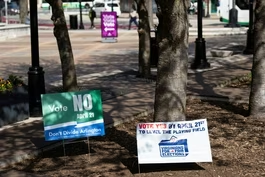
Redistricting fight reaches Virginia as voters weigh new map
Video has Closed Captions
Redistricting battle reaches Virginia as voters weigh new congressional map (5m 52s)

Retired admiral on U.S. strategy behind naval blockade
Video has Closed Captions
Retired admiral breaks down U.S. strategy behind naval blockade (4m 2s)
Providing Support for PBS.org
Learn Moreabout PBS online sponsorship
- News and Public Affairs

Today's top journalists discuss Washington's current political events and public affairs.

- News and Public Affairs

FRONTLINE is investigative journalism that questions, explains and changes our world.












Support for PBS provided by:
Major corporate funding for the PBS News Hour is provided by BDO, BNSF, Consumer Cellular, American Cruise Lines, and Raymond James. Funding for the PBS NewsHour Weekend is provided by...