
Taking Note — Nathan Meltzer
Special | 16m 16sVideo has Closed Captions
Nathan Meltzer first picked up the violin while living in Vienna and attending elementary school.
When several of his friends from baseball joined an orchestra, Nathan Meltzer joined them and chose the violin simply because it was easy to carry to and from school. Now a Juilliard alum, Meltzer enjoys working with contemporary composers. He performs a piece by Béla Bartók and discusses Bartók’s folk music inspiration and his desire to preserve Hungary’s musical legacy.
Problems playing video? | Closed Captioning Feedback
Problems playing video? | Closed Captioning Feedback
Major series funding for GREAT PERFORMANCES is provided by The Joseph & Robert Cornell Memorial Foundation, the Anna-Maria and Stephen Kellen Arts Fund, the LuEsther T. Mertz Charitable Trust, Sue...
Support provided by:

Taking Note — Nathan Meltzer
Special | 16m 16sVideo has Closed Captions
When several of his friends from baseball joined an orchestra, Nathan Meltzer joined them and chose the violin simply because it was easy to carry to and from school. Now a Juilliard alum, Meltzer enjoys working with contemporary composers. He performs a piece by Béla Bartók and discusses Bartók’s folk music inspiration and his desire to preserve Hungary’s musical legacy.
Problems playing video? | Closed Captioning Feedback
Where to Watch Great Performances
Great Performances is available to stream on pbs.org and the PBS app.
Buy Now
Great Performances Newsletter
Subscribe to the Great Performances newsletter to keep up with the latest full episodes to stream, exclusive content, and more!Providing Support for PBS.org
Learn Moreabout PBS online sponsorshipMore from This Collection
Taking Note is a new digital series spotlighting rising instrumentalists who have received Career Grant Awards from the Avery Fisher Artist Program. Each year, the program awards $25,000 to instrumentalists and chamber ensembles in support of professional music development.
Video has Closed Captions
Pianist Dmitry Yudin immigrated from Moscow to the United States to follow his older sister. (10m 52s)
Video has Closed Captions
First taking up the violin at age three, Keila Wakao was raised in a musical family. (11m 55s)
Video has Closed Captions
Cellist Leland Ko shares the impact his teachers have had on him on his musical journey. (14m 8s)
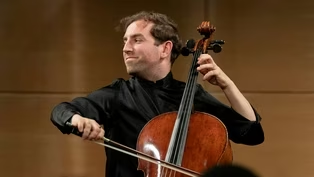
Video has Closed Captions
Cellist Tommy Mesa's love of music began with his interest in playing drums. (10m 44s)
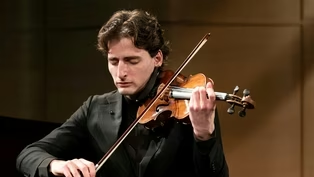
Video has Closed Captions
Following in his brother’s footsteps, Joshua Brown picked up the violin at age two. (9m 3s)
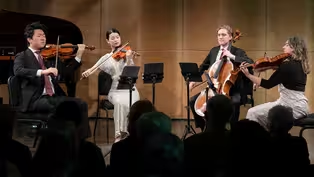
Video has Closed Captions
Composed of violinists Lucy Wang and Hao Zhou, violist Aiden Kane, and cellist Tate Zawadiuk. (11m 54s)
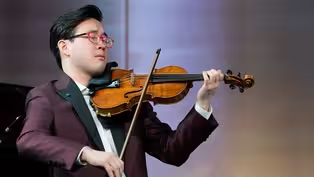
Video has Closed Captions
A profile of violinist Julian Rhee, winner of a 2024 Avery Fisher Career Grant Award. (10m 11s)

Taking Note - Balourdet Quartet
Video has Closed Captions
A profile of Balourdet Quartet, winner of a 2024 Avery Fisher Career Grant Award. (9m 18s)
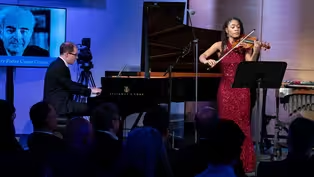
Taking Note - Njioma Chinyere Grevious
Video has Closed Captions
A profile of violinist Njioma Chinyere Grevious, winner of a 2024 Avery Fisher Career Grant Award. (8m 41s)
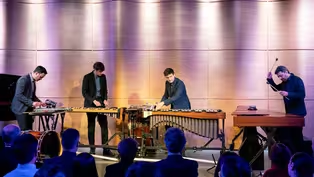
Taking Note - Sandbox Percussion
Video has Closed Captions
A profile of Sandbox Percussion, winner of a 2024 Avery Fisher Career Grant Award. (10m 4s)
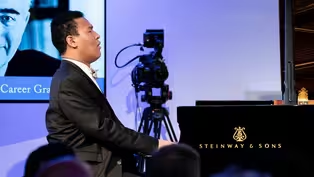
Taking Note - Clayton Stephenson
Video has Closed Captions
A profile of pianist Clayton Stephenson, winner of a 2024 Avery Fisher Career Grant Award. (9m 57s)
Providing Support for PBS.org
Learn Moreabout PBS online sponsorshipIt is a long road from where I was born, in Washington to where we are now, Lincoln Center, where I went to school at Juilliard.
♪♪ I learned that I was awarded a 2026 Avery Fisher Career grant through an anonymous call on my phone, a number I didn't recognize.
And I and I picked up, and it was it was Veronique.
And she shared this wonderful and incredible news.
It was a couple days after the new year.
I just spent on vacation without my instrument for about a week.
And so I was in a very relaxed state of mind.
I was visiting my parents.
So, yeah, I was I was surrounded by people that I... That I love and feel supported by.
I have a couple ideas of of what I'll be using the grant funds for.
Primarily is... I want to record my my second album.
I recorded an album when I was 18 years old.
I've changed a lot since then.
My playing has changed a lot since then.
My musical ideals have changed a lot since then, and so I really want to, kind of update my, my recording portfolio to, you know, reflect who I am now.
It is a long road from where I was born in Washington to where we are now, Lincoln Center, where I went to school at Juilliard.
Although my my path there was was even longer.
When I was very young, my family moved to Vienna.
And I lived in Vienna for six years, where I did speak German at some point, but have since forgotten all of it except “Schmétterling.” And then from Vienna to Bloomington, Indiana, where I studied at the IU String Academy.
And then it was 2014 that I moved to New York.
I started playing the violin because, my family was living in Vienna at the time.
And as you do when you live in Vienna, my family only cared about baseball.
And so I was a avid baseball player until I was 12 years old.
And I just happened to go to an elementary school that had an orchestra program for second graders, and a lot of my baseball friends were were picking up an instrument to, you know, play in this elementary school orchestra.
And I lived in an apartment building with a one floor walkup.
And so I didn't want to carry a cello up one flight of stairs.
And so I picked the smallest instrument that I could, and kept with it.
And here we are.
But it was totally just it was kind of random.
And it was happen.
Happenstance and, you know, just a series of, of delightful dominoes that that fell.
I recently started playing on a 1682 Andrea Guarneri violin that was bought for me about four years ago, underwent a lengthy restoration period at Rare Violins of New York.
They did a really beautiful job.
And so I've been playing on it just shy of three months, and I couldn't be more happy with it.
Musical instruments are a are a tricky, funny thing.
The connection with an instrument is either it's either there or it's not.
You're going to have to learn how to play any instrument that you pick up.
And the question is, Are you intrigued enough by the sounds to want to explore what it has to offer?
And what intrigued me so much about this violin was that I loved what was there already.
But I could tell that over the course of the rest of the time that I'm playing on this violin, I'm constantly going to be able to, to keep learning from it.
♪♪ My experience with, with different kinds of repertoire started when I was relatively young, when I started going to the Perlman Music Program.
Toby Perlman, the founder, really wanted for one of the three chamber pieces that all the kids play in the summer.
It was very important to her that one of those pieces be contemporary, and I didn't get the point of it.
I really it was my I it was not the piece of chamber music that I was most looking forward to during the summers.
But as I got a little bit older, as I started, meeting more composers, I started dating a composer who's now my fiancé.
And so she really roped me into that, that whole world.
And I started getting fascinated with just music that represents the here and now, because it's beautiful to to look back upon the music that we've heard all our lives, music that has been with us for hundreds of years, the music that I was raised with and I think the you know, what makes that interesting is also the context of, you know, that was new music, too, and that was reflective of what's of what society was like then.
And so exploring, exploring music from this kind of new angle is also really fascinating to me.
♪♪ And so what I played at the, at the award ceremony was the last movement of the first sonata for violin and piano by Bela Bartok.
♪♪ Which is a relatively early work of his.
And it's kind of characterized by the, this kind of rawness that he kind of moved away from when he became a little bit older and things became more mathematical and a little bit more rounded out.
But earlier in his life, he had this, like, incredible kind of like almost barbaric sense of, of rhythm, of sound, of chromaticism.
And the last movement of that, of that first violin sonata is really just one of my favorite pieces to listen to, pieces to play.
♪♪ A lot of what's kind of characterized these first couple of, of Bartok sonatas is that there does seem to be this kind of like severe disconnect between what the violin does and what the piano does.
There are some reviews from, from the premieres that, you know, that the piece was kind of just two people going on their own journeys.
The pianist has this whole kind of lineage of ideas that the violin sometimes comments on, but most of the time goes on their own way.
And when they kind of meet up at these like pivotal moments in the piece that just that's what makes everything click into place.
♪♪ So the piano is this is really hammering away for so much of this piece.
And the violin is kind of snaking around and sliding and making a few kind of, you know, more subtle colors, but a lot of it is kind of hushed or scampering.
But yeah, so then those, you know, maybe six measures out of the piece where, where the two voices coalesce, just makes it all work.
♪♪ I think Bartok was was the absolute modernist.
I think of the, you know, in the history textbooks, what is kind of defined the modern era, the modernist era, which is no longer modern, because that piece was written a little bit of a tangent.
That piece was written in 1924, 1922 even.
It's very early in music history.
I mean, Fauré was still alive then.
Brahms had just died.
And so there's this very kind of striking tonal shift.
Bartok really wanted to preserve the legacy and the history of Hungarian folk music.
And he would literally go into the countrysides with wax cylinders and, and make physical recordings of, of people singing, of people playing these kind of small villages around Hungary.
And then either very obviously incorporated those into his, into his music, like with the Romanian dances or like with the sonatas and a lot of the quartets and all of this, you know, slightly more jagged music, which is incorporate aspects of it.
Bartok's, you know, wish for, for his career was to preserve the legacy of this music because he was worried that it would be wiped away by the Nazis.
And so he he seemed to have a real kind of calling and ethical reason for incorporating so much of this folk music, community music into, into what he turned into this, like high art music in this very sometimes difficult to understand.
Yeah.
And I find that to be a very admirable and inspiring, you know, personal mission.
♪♪ ♪♪
 New Episode
- Arts and Music

Innovative musicians from every genre perform live in the longest-running music series.

- Arts and Music

Join the legend for a musical journey through the people and places that shaped her career.








 New Season
Support for PBS provided by:
Major series funding for GREAT PERFORMANCES is provided by The Joseph & Robert Cornell Memorial Foundation, the Anna-Maria and Stephen Kellen Arts Fund, the LuEsther T. Mertz Charitable Trust, Sue...