
Why the ancient story of ‘The Odyssey’ still resonates today
Clip: 7/17/2026 | 7m 23sVideo has Closed Captions
Why the ancient story of ‘The Odyssey’ still resonates today
Christopher Nolan's "The Odyssey" is shaping up to be one of the biggest movies of the year. The highly anticipated film is already breaking ticket-sales records. Jeffrey Brown takes a look at what's driving the excitement and why a story that's nearly 3,000 years old continues to resonate today. It's part of our arts and culture series, CANVAS.
Problems playing video? | Closed Captioning Feedback
Problems playing video? | Closed Captioning Feedback
Major corporate funding for the PBS News Hour is provided by BDO, BNSF, Consumer Cellular, American Cruise Lines, and Raymond James. Funding for the PBS NewsHour Weekend is provided by...
Why the ancient story of ‘The Odyssey’ still resonates today
Clip: 7/17/2026 | 7m 23sVideo has Closed Captions
Christopher Nolan's "The Odyssey" is shaping up to be one of the biggest movies of the year. The highly anticipated film is already breaking ticket-sales records. Jeffrey Brown takes a look at what's driving the excitement and why a story that's nearly 3,000 years old continues to resonate today. It's part of our arts and culture series, CANVAS.
Problems playing video? | Closed Captioning Feedback
Where to Watch PBS News Hour
PBS News Hour is available to stream on pbs.org and the PBS app.
Providing Support for PBS.org
Learn Moreabout PBS online sponsorshipGEOFF BENNETT: Christopher Nolan's "The Odyssey" is shaping up to be one of the biggest movies of the year.
The highly anticipated film is already breaking ticket sales records.
Jeffrey Brown takes a look now at what's driving the excitement and why a story that's nearly 3,000 years old continues to resonate today.
It's part of our arts and culture series, Canvas.
JEFFREY BROWN: Once again, Odysseus is struggling to return home.
MATT DAMON, Actor: No one could stand between me and home.
I heard the gods.
JEFFREY BROWN: This time in Christopher Nolan's film version of "The Odyssey," reportedly costing some $250 million, starring Matt Damon in the title role, Anne Hathaway as his wife, Penelope, and a big cast filled with other stars to tell a big story... ACTRESS: Who doesn't understand pain or blood?
JEFFREY BROWN: ... the end of the Trojan War and the 10-year journey of Odysseus back to the island of Ithaca.
All of it, of course, stems from the original epic poem attributed to Homer and dating back as far as the eighth century B.C.
One renowned recent translation was done by University of Pennsylvania classic scholar Emily Wilson, who also translated Homer's "Iliad," and who, in a previous "News Hour" appearance, showed us her "Odyssey" and Iliad tattoos.
Her forthcoming book of essays on classics, translation, and more is titled "Crossing the Wine-Dark Sea."
And Emily Wilson joins us now.
Thanks so much for being with us.
So, speaking of crossing the wine-dark sea, here we have Odysseus doing it again.
What is this story about for you at its core?
EMILY WILSON, Author, "Crossing the Wine-Dark Sea: Journeys Through Ancient Literature": There's so much.
It's hard to sum up an epic poem, isn't it?
But it's a poem about a homecoming from war and how that journey affects everyone that Odysseus encounters.
So it's about community.
It's about who belongs in a particular place, what it means to have a home.
And it's about the relationship between hosts and guests.
JEFFREY BROWN: We should say you were not involved with the film, but I did see that the director, Christopher Nolan, he cited your translation, and particularly that first line of the epic that begins, "Tell me about a complicated man."
So who was Odysseus?
EMILY WILSON: Odysseus, as that first line already hints, is multiple.
And that's part of the secret of his survival.
Many of his epithets in the original Greek start with the prefix polloi, meaning many.
And so he's much turning, he's much crafty.
He's complicated, in that he can be many different characters, many different disguises.
He can be many men to many different people.
JEFFREY BROWN: On the one hand, a real adventure story, of course, with monsters and myths and fighting and everything, but you're saying also something much deeper that has long captured the imagination.
EMILY WILSON: Exactly.
It's a profound poem about communities, families, heroism, fame, memory.
Half the poem is not adventures.
And I really hope that it -- that the Nolan movie has both the big budget action elements of the poem, but also something about emotional and social subtlety and depth.
JEFFREY BROWN: In the run-up to the film, of course, there was so much talk about it.
Some of it involved the use of American accents and modern dialogue.
TOM HOLLAND, Actor: My dad is coming home.
ROBERT PATTINSON, Actor: You're pining for a daddy you didn't even know, like some sniveling bastard.
JEFFREY BROWN: What do you think, as a translator?
Is something lost in that approach, or is that perhaps a right approach to reach a mass audience?
EMILY WILSON: I mean, I personally am very fond of Homer's words, but, of course, that's not the only thing that one can do with the Homeric poems.
I mean, going back even to the sixth and fifth centuries BCE, people have been reinventing these stories for different genres, different performance contexts.
"The Iliad" and "The Odyssey" were the basis for a huge amount of Athenian drama, where people like Aeschylus and Euripides were reinventing these myths for the Athenian stage, reinventing them also in terms of how can we make this poem resonate with the ongoing Peloponnesian War?
So I don't think Nolan is doing something in a way completely different from what those ancient poets were doing in reinventing myth.
And also with different tools, you can tell different stories, right?
Different media can say different things.
Film is a visual storytelling medium in a way that epic poetry is not.
JEFFREY BROWN: There are also questions, of course, about casting and perhaps inevitably these days on social media questions about the casting of Helen of Troy by a Black actress, Lupita Nyong'o, very renowned actress, of course, with some suggesting this was an example of Hollywood's wokeness.
Does any of that surprise you?
EMILY WILSON: There's nothing surprising whatsoever about it.
And there's also nothing surprising whatsoever about the idea that people think, at least some people performatively online suggest that, of course, we know exactly what a daughter of Zeus born from a swan's egg would look like.
Seems to me that that maybe is not entirely a real realistic story to start with, and that we need for Helen of Troy somebody who looks magical and looks as if she can have an almost divine capacity to see through the disguises and stories of others.
It doesn't seem to me that it's entirely unambiguous that a daughter of Zeus must look a particular way within -- how do we translate that into some mortal woman is playing a daughter of Zeus.
Why aren't they getting outraged about that?
JEFFREY BROWN: So, as someone who has been long steeped in this, what are you -- what are you going to look for in the film?
EMILY WILSON: I'm going to try and just have an open mind.
I'm excited about the fact that there are themes that are already part of Christopher Nolan's concerns that are essential in "The Odyssey," for instance, the themes of time and memory and sophisticated narrative techniques, where we're juxtaposing the past, the present, the future with one another, and themes of communication and miscommunication across time and space.
JEFFREY BROWN: And, finally, in this era when the humanities are being cut so many places, devalued in others, and when we hear so much about people not reading in depth, not reading epic poetry, certainly, what's the case for the classics today?
EMILY WILSON: Well, I really hope that this film helps to bring some more people back to the idea that, yes, you should read big books and you should read ancient, alien, different books that will take you to a different time and place.
One of the big arguments for doing so is that we're living in this time of an extraordinary change.
There's an unpredictability to the future, and in that context, learning something about how the world is radically different now from the way it was 2,500 years ago, and we can imagine societies very different from our own, that's part of what the study of antiquity, including reading ancient poems like "The Odyssey," can give us.
JEFFREY BROWN: All right, Emily Wilson, translator of "The Odyssey" and "The Iliad," thank you so much.
EMILY WILSON: Thank you so much.
Brooks and Capehart on Trump's election claims
Video has Closed Captions
Brooks and Capehart on what Trump is trying to accomplish with his election claims (9m 19s)
Documents fail to back up Trump's election claims
Video has Closed Captions
Trump tries to undermine trust in elections, but documents don't support his claims (5m 37s)
Former intelligence official on Trump's election allegations
Video has Closed Captions
Former intelligence official weighs Trump's election security allegations (6m 48s)
The role of conspiracy theories in the American Revolution
Video has Closed Captions
The surprising role of conspiracy theories in the American Revolution (4m 29s)
State officials on Trump's efforts to reshape elections
Video has Closed Captions
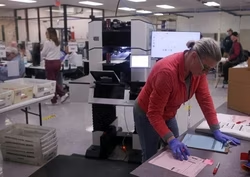
Battleground state election officials respond to Trump's efforts to reshape voting process (7m 33s)

World Cup brings Gazans moments of hope amid devastation
Video has Closed Captions
World Cup brings Gazans moments of joy and hope amid devastation (5m 10s)
Providing Support for PBS.org
Learn Moreabout PBS online sponsorship New Episode
- News and Public Affairs

Today's top journalists discuss Washington's current political events and public affairs.

- News and Public Affairs

FRONTLINE is investigative journalism that questions, explains and changes our world.
 New Episode
 New Episode
 New Episode
 New Episode
 New Episode
 New Episode
 New Episode
 New Episode
 New Episode
 New Episode
Support for PBS provided by:
Major corporate funding for the PBS News Hour is provided by BDO, BNSF, Consumer Cellular, American Cruise Lines, and Raymond James. Funding for the PBS NewsHour Weekend is provided by...