
The Truth about Quantum Computers
Clip: Season 53 | 6m 44sVideo has Closed Captions
Microsoft's breakthrough in quantum computing could have a huge impact on science, and our future.
In early 2025, Microsoft announced it had made a huge breakthrough in quantum computing. If their claims are true, their discovery could have huge implications not just for science and technology, but for all of our futures.
Problems playing video? | Closed Captioning Feedback
Problems playing video? | Closed Captioning Feedback
National Corporate funding for NOVA is provided by Carlisle Companies. Major funding for NOVA is provided by the NOVA Science Trust and PBS viewers.
Support provided by:


The Truth about Quantum Computers
Clip: Season 53 | 6m 44sVideo has Closed Captions
In early 2025, Microsoft announced it had made a huge breakthrough in quantum computing. If their claims are true, their discovery could have huge implications not just for science and technology, but for all of our futures.
Problems playing video? | Closed Captioning Feedback
Where to Watch NOVA
NOVA is available to stream on pbs.org and the PBS app.
NOVA Labs
NOVA Labs is a free digital platform that engages teens and lifelong learners in games and interactives that foster authentic scientific exploration. Participants take part in real-world investigations by visualizing, analyzing, and playing with the same data that scientists use.Providing Support for PBS.org
Learn Moreabout PBS online sponsorship- It's bold.
It's weird.
And it could change pretty much everything.
I'm talking about quantum computing.
For decades, the tech world has been trying and kinda failing to figure out how to actually make quantum computers live up to the hype.
Until early 2025 when Microsoft announced they'd cracked it.
They say the key is hiding in some of the strangest particles in the universe, majoranas.
Tiny, ghostlike quantum entities that are their own antiparticles.
If they're right, Microsoft is closer than ever to a massive breakthrough.
But what makes them so confident now?
And why has quantum computing been so hard to get right?
To understand quantum computing, first we need to understand what quantum computers are, exactly what problem Microsoft was trying to solve, and why this is all such a big deal.
And stick with me, because we're going quantum here, and any time we do that, things can get a little spooky.
See, quantum computing is a field within computer science and engineering that pulls from quantum mechanics, the physics of matter and energy at the atomic and subatomic level.
One of the strange properties of physics at the quantum scale is superposition, the idea that particles can exist in two or more states at once, like a top spinning clockwise and counterclockwise at the same time.
I told you, spooky.
The idea is to use these strange laws of quantum mechanics to build computers that can quickly solve really complex problems.
Take data encryption, which is used to keep information secure.
Right now, online data encryption uses a lot of math to send information that can easily be understood by the intended recipient, but not by anyone else.
At the most fundamental level, online encryption relies on multiplying two large prime numbers together, making a new, incredibly large number.
Without any additional information, it can take a lot of computing power and a really long time to figure out those first two prime numbers.
Which makes this method pretty secure for traditional computers.
See, from your personal laptop to the world's biggest supercomputer, traditional computers are based on classical physics, and they use electrical impulses that code information in a binary way, using either 0 or 1, which are bits.
But the limits of binary and possibilities of problems like overheating mean there will be some problems traditional computers simply don't have enough power or enough time to solve.
Quantum computers, on the other hand, compute in a whole different way.
Instead of bits they use quantum bits called qubits, which can be zero or one or both or anything in between.
Because qubits can be more things at once, they can find and compare possible solutions to some problems much more quickly than a traditional computer.
But we don't fully have quantum computers yet because qubits are really sensitive to their surrounding environment, making them susceptible to decoherence.
Basically, the qubits can lose their quantum state.
They become damaged, losing information and making errors.
The more qubits you add to a chip, the more powerful the computer will be, but the more likely it is for the qubits to lose their state and make errors.
So that's the problem the tech world has been grappling with for decades.
How to avoid decoherence and make a quantum computer that's reliable and practical at scale.
And tech companies have tried a few different methods for solving this problem.
IBM and Google have both built quantum computers using superconducting materials to create qubits, and the Canadian company Xanadu has made a quantum computer that uses photons, particles of light, to create qubits.
But neither of these methods is completely reliable or scalable.
That's because superconducting quantum computers need to be kept super cold, and photons are really easy to lose and really hard to manipulate.
So Microsoft is working on another approach, topological qubits, which use special particles called Majorana fermions.
In particle physics, the idea is that somewhere out there, most particles should have a corresponding antiparticle, which has the same mass, but with an opposite charge.
And if a particle meets its antiparticle, boom, it's over for them both.
But Majoranas are particles that are also their own antiparticles, meaning if they met, they might annihilate each other, or they might not.
They can exist in two states.
In theory, anyway.
No one's ever been able to actually use Majoranas.
Until now.
Microsoft claimed not only had they observed Majoranas, they also figured out how to control them.
And they said they'd be able to use them to build reliable qubits that would be able to hold up in ways that other qubits can't.
This breakthrough would provide a much faster pathway to quantum computing at a much larger scale than anyone else has been able to achieve.
Microsoft was faced with an avalanche of skepticism.
And as of filming, the data hasn't firmly established everything they claimed.
But some are optimistic that Microsoft can improve its chip and provide the breakthrough the industry has been waiting for.
If they do, the whole world will change fast as we gain the ability to solve all kinds of problems we can't currently fully explore.
For example, we might be able to create computer simulations of our world, down to the molecular level.
That would open the door for incredible breakthroughs in chemistry and medicine.
Or we could develop new battery technology, which could be key for mitigating climate change.
But quantum computing could also open up new problems.
Remember how it could take traditional computers a really long time to access encrypted data?
Quantum computers would have access to all of our private information within minutes.
That means whoever cracks quantum computing on a large scale first could get really powerful, really fast.
The field of quantum computing holds fascinating and exciting possibilities for science and technology, but it also opens new questions for all of us to consider.
Can we build these powerful new machines?
And if we can, what will it look like to wield that kind of technological power responsibly?
(gentle music)
The Mind-Bending Physics of Origami
Video has Closed Captions
Clip: S53 | 5m 52s | A simple fold can completely change how a material behaves. (5m 52s)
Video has Closed Captions
Clip: S53 | 5m 48s | Modern physics and imaging techniques are finally solving the mystery. (5m 48s)
Why Earth’s Core Is Younger Than Its Surface
Video has Closed Captions
Clip: S53 | 6m | Time isn’t the same for everyone, according to Einstein. (6m)
 Now Playing
The Truth about Quantum Computers
Video has Closed Captions
Clip: S53 | 6m 44s | Microsoft's breakthrough in quantum computing could have a huge impact on science, and our future. (6m 44s)
The Problem That Broke Physics (And Led to Chaos)
Video has Closed Captions
Clip: S53 | 6m 12s | The “butterfly effect” is often cited in pop culture, but it’s actually rooted in physics and chaos. (6m 12s)
The Ocean Wave Scientists Thought Was Impossible
Video has Closed Captions
Clip: S53 | 5m 46s | These massive walls of water may be far more common than we once believed. (5m 46s)
Is Electricity Instant? A Shocking Experiment from 1746
Video has Closed Captions
Clip: S53 | 5m 56s | It’s taken over 250 years of shocking experiments to understand how quickly electricity moves! (5m 56s)
Does Notre Dame Sound Different Now?
Video has Closed Captions
Clip: S53 | 6m 8s | Restoring Notre Dame wasn’t just about stone and stained glass. (6m 8s)

Video has Closed Captions
Preview: S53 Ep10 | 30s | Witness how Native North Americans have generated scientific knowledge over thousands of years. (30s)

Video has Closed Captions
Preview: S53 Ep9 | 30s | Follow the relentless quest that led to a breakthrough treatment for a deadly disease. (30s)
Video has Closed Captions
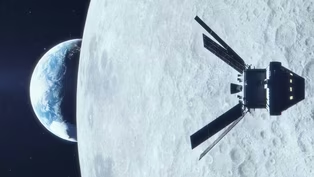
Preview: S53 Ep7 | 30s | Follow the Artemis mission to bring humanity back to the Moon for the first time since Apollo. (30s)

Athens: Birth of Democracy Preview
Video has Closed Captions
Preview: S53 Ep8 | 30s | Archaeologists investigate the dramatic origins of democracy in ancient Greece 2,500 years ago. (30s)
Stone Age Temple Mystery Preview
Video has Closed Captions
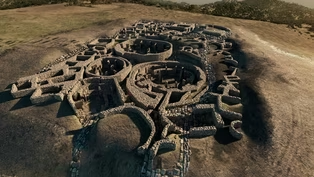
Preview: S53 Ep6 | 30s | Surprising evidence at the world’s oldest temple overturns our understanding of human history. (30s)
Video has Closed Captions
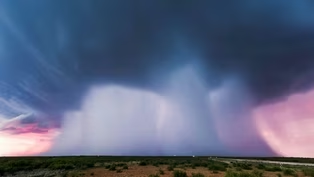
Preview: S53 Ep5 | 30s | A deadly—and growing—global weather phenomenon mystifies scientists. (30s)
Video has Closed Captions
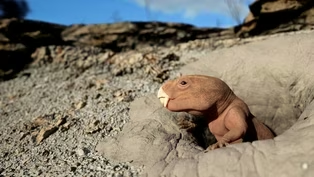
Preview: S53 Ep4 | 30s | Explore mammals’ surprising origins, long before the age of dinosaurs. (30s)

Video has Closed Captions
Preview: S53 Ep3 | 30s | Do speech buttons really allow dogs to talk to us? Scientists investigate. (30s)

Angkor: Hidden Jungle Empire Preview
Video has Closed Captions
Preview: S53 Ep2 | 30s | New evidence sheds light on the remarkable life—and mysterious collapse—of the ancient jungle city. (30s)
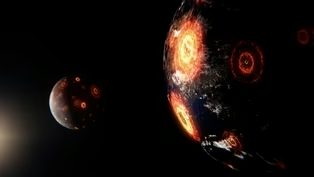
When Earth Was Bombarded by Asteroids
Video has Closed Captions
Clip: S53 Ep1 | 3m 41s | What studying the surface of the Moon revealed about Earth’s apocalyptic youth. (3m 41s)
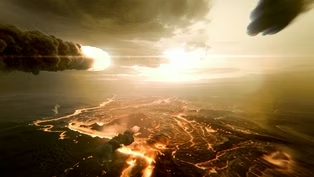
Asteroids: Spark of Life? Preview
Video has Closed Captions
Preview: S53 Ep1 | 30s | What if violent asteroid impacts actually jump-started life on Earth? Explore a dramatic theory. (30s)
Providing Support for PBS.org
Learn Moreabout PBS online sponsorship
 New Episode
- Science and Nature

Miles O'Brien travels the world searching for solutions to today’s most urgent challenges.



 New Episode







Support for PBS provided by:
National Corporate funding for NOVA is provided by Carlisle Companies. Major funding for NOVA is provided by the NOVA Science Trust and PBS viewers.