
Why is Ice Slippery?
Clip: Season 53 | 5m 48sVideo has Closed Captions
Modern physics and imaging techniques are finally solving the mystery.
Ice is actually pretty complex. In fact, physicists have spent more than a decade trying to understand why it’s so slippery.
Problems playing video? | Closed Captioning Feedback
Problems playing video? | Closed Captioning Feedback
National Corporate funding for NOVA is provided by Carlisle Companies. Major funding for NOVA is provided by the NOVA Science Trust and PBS viewers.
Support provided by:


Why is Ice Slippery?
Clip: Season 53 | 5m 48sVideo has Closed Captions
Ice is actually pretty complex. In fact, physicists have spent more than a decade trying to understand why it’s so slippery.
Problems playing video? | Closed Captioning Feedback
Where to Watch NOVA
NOVA is available to stream on pbs.org and the PBS app.

NOVA Labs
NOVA Labs is a free digital platform that engages teens and lifelong learners in games and interactives that foster authentic scientific exploration. Participants take part in real-world investigations by visualizing, analyzing, and playing with the same data that scientists use.Providing Support for PBS.org
Learn Moreabout PBS online sponsorshipLet's talk about ice!
Why is it so extremely slippery!
That's actually not a trivial question and physicists have been arguing about it for more than 100 years.
You probably already know that molecules behav differently in different states.
Like, in liquid, molecules form weak bonds, but they still have enough energy to slip and slide past each other to fit the shape of their container.
In solids, molecules are packed close together, often in a regular pattern, which helps solids keep a distinct shape.
Because these molecules can often nestle closer together than they can in liquids, the solid form of a material is usually denser than the liquid form.
But, ice acts a little differently.
Ice is the solid form of water.
Oh, my gosh.
That's why ice is slippery.
But ice acts a little differently.
Ice is the solid form of liquid water, but depending on the temperature and pressure conditions, ice can freeze in a lot of different ways.
In fact, there are more than a dozen variations of ice crystals.
And scientists are still finding more.
The most common ice is hexagonal ice.
It's called ice 1h.
“One” because it was the first kind discovered, and “h because its the hexagonal form.
In this form, the water molecules form layers of honeycombs that stack on top of each other to form the whole crystal.
These crystals take up more space than the same number of liquid water molecules.
That means ice is les dense than water, so it floats.
Another important type is Ice Ic.
Here the “c” stands for cubic because in this form, the water molecules create a cubic-centered crystal structure.
This kind of ice form at colder temperatures than Ice Ih, and can sometime be found in Earths atmosphere.
And as it turns out, these crystal structures are key to understanding why ice is so slippery.
But scientists in the 1800 didn't know anything about them when they started studying the problem.
So what did they think was going on?
Some of the first people to try to solve the mystery were big names like Lord Kelvin (famous for the temperature uni Kelvin) and Michael Faraday (Mr.
Electrodynamics).
Back around 1850 Kelvin and his brother studied the relationship between pressur and the melting point of water.
For example, the idea was tha if you stand on an icy sidewalk, the weight of your body coul make the ice melt a little bit, creating a liquid layer on the surface of the ice.
That layer would reduc friction, make the ice slippery, and suddenly youre not standing anymore.
Farada also thought that a thin layer of liquid on the surface of ice seemed to be the key to making it slippery.
And in 1859, he proposed that liquid wate always coats the surface of ice, even at temperatures far below freezing.
This idea didnt catch on right away, and Kelvins pressure melting theory was the most widely accepted explanation for a long time.
Then, in 1939 a pair of researchers proposed it was actually friction doin the melting, not just pressure.
Their thinking was that when a material, like an ice skate, is dragged across ice, the heat generated by friction could melt the ice enough to form a thin layer of lubricating water.
As it turns out, while pressur melting and frictional melting can play a role they dont tell the whole story.
The arguments start to fall apart when you get to temperatures of about -20°C, where it would take wa more pressure than an ice skate pushing down on the ice to melt it.
Plus, in an experiment with friction in the 1960s, friction no longer produced enough heat to melt ice at -35°C but the ice was still slippery.
With modern imaging tools, weve finally been able to take a closer loo at the atomic structure of ice.
And weve found that ice isnt such a perfect crystal, after all.
In a study published in 2024 scientists found that at around -150°C, the surface of ice actually has a mixture of Ih and Ic crystals.
And as the temperature increases, molecules near the surface and between the hexagonal an cubic regions become disordered, and the ice loses a lot of its rigid, crystalline structure.
The disordered layers are still somewhat rooted in place because theyre bonded to the bulk of the solid, bu they also have some wiggle room.
At the surface of the ice, in particular, these disordered molecules have dangling bonds that reach outward, like one of those blow up wav arm guys from car dealerships.
Those wavy arms have a lot of extra mobility, but they also have some elasticity, so they can spring back to their original position.
In ice terms, that means the wiggly molecules for a super thin quasi-liquid layer thats way more viscous than liquid water, almost more like oil.
And just like oil that layer acts as a lubricant, which is why ice feels so slippery.
In the end, Faraday wasnt so far off in 1859.
Sure, friction and pressure can play a role, but ice is slippery because well, thats just the way it is.
Its a consequence of imperfections in the ice crystal itself.
And knowing tha is actually kind of a big deal.
A lot of the worlds energy is lost to friction, so new ideas about slipperiness could also mean new ideas for lubrication and manufacturing thats more fuel, cost, and energy efficient.
Or new ways to make winte sports and winter driving safer.
After a hundred years, theres a whole world of ne possibilities for what we can do with ice.
The Mind-Bending Physics of Origami
Video has Closed Captions
Clip: S53 | 5m 52s | A simple fold can completely change how a material behaves. (5m 52s)
 Now Playing
Video has Closed Captions
Clip: S53 | 5m 48s | Modern physics and imaging techniques are finally solving the mystery. (5m 48s)

Why Earth’s Core Is Younger Than Its Surface
Video has Closed Captions
Clip: S53 | 6m | Time isn’t the same for everyone, according to Einstein. (6m)

The Truth about Quantum Computers
Video has Closed Captions
Clip: S53 | 6m 44s | Microsoft's breakthrough in quantum computing could have a huge impact on science, and our future. (6m 44s)

The Problem That Broke Physics (And Led to Chaos)
Video has Closed Captions
Clip: S53 | 6m 12s | The “butterfly effect” is often cited in pop culture, but it’s actually rooted in physics and chaos. (6m 12s)
The Ocean Wave Scientists Thought Was Impossible
Video has Closed Captions
Clip: S53 | 5m 46s | These massive walls of water may be far more common than we once believed. (5m 46s)
Is Electricity Instant? A Shocking Experiment from 1746
Video has Closed Captions
Clip: S53 | 5m 56s | It’s taken over 250 years of shocking experiments to understand how quickly electricity moves! (5m 56s)

Does Notre Dame Sound Different Now?
Video has Closed Captions
Clip: S53 | 6m 8s | Restoring Notre Dame wasn’t just about stone and stained glass. (6m 8s)
Video has Closed Captions
Preview: S53 Ep10 | 30s | Witness how Native North Americans have generated scientific knowledge over thousands of years. (30s)
Video has Closed Captions
Preview: S53 Ep9 | 30s | Follow the relentless quest that led to a breakthrough treatment for a deadly disease. (30s)
Video has Closed Captions
Preview: S53 Ep7 | 30s | Follow the Artemis mission to bring humanity back to the Moon for the first time since Apollo. (30s)
Athens: Birth of Democracy Preview
Video has Closed Captions
Preview: S53 Ep8 | 30s | Archaeologists investigate the dramatic origins of democracy in ancient Greece 2,500 years ago. (30s)
Stone Age Temple Mystery Preview
Video has Closed Captions
Preview: S53 Ep6 | 30s | Surprising evidence at the world’s oldest temple overturns our understanding of human history. (30s)
Video has Closed Captions
Preview: S53 Ep5 | 30s | A deadly—and growing—global weather phenomenon mystifies scientists. (30s)
Video has Closed Captions
Preview: S53 Ep4 | 30s | Explore mammals’ surprising origins, long before the age of dinosaurs. (30s)

Video has Closed Captions
Preview: S53 Ep3 | 30s | Do speech buttons really allow dogs to talk to us? Scientists investigate. (30s)
Angkor: Hidden Jungle Empire Preview
Video has Closed Captions
Preview: S53 Ep2 | 30s | New evidence sheds light on the remarkable life—and mysterious collapse—of the ancient jungle city. (30s)
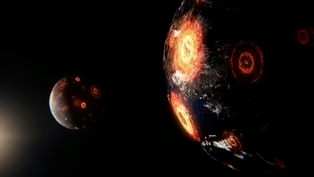
When Earth Was Bombarded by Asteroids
Video has Closed Captions
Clip: S53 Ep1 | 3m 41s | What studying the surface of the Moon revealed about Earth’s apocalyptic youth. (3m 41s)
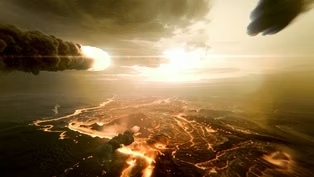
Asteroids: Spark of Life? Preview
Video has Closed Captions
Preview: S53 Ep1 | 30s | What if violent asteroid impacts actually jump-started life on Earth? Explore a dramatic theory. (30s)
Providing Support for PBS.org
Learn Moreabout PBS online sponsorship
 New Episode
- Science and Nature

Miles O'Brien travels the world searching for solutions to today’s most urgent challenges.



 New Episode







Support for PBS provided by:
National Corporate funding for NOVA is provided by Carlisle Companies. Major funding for NOVA is provided by the NOVA Science Trust and PBS viewers.