
These Are the World’s Oldest Mummies
Clip: Season 52 | 2m 49sVideo has Closed Captions
They're older than King Tut, Ötzi the Iceman, and even the ones found in the Atacama Desert.
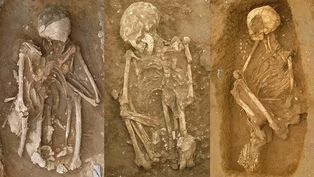
Across southeastern Asia, researchers have identified dozens of mummies that are between 4,000 and 11,00 years old. After scanning the bones with invisible wavelengths of light, they found that almost all the bodies have been exposed to heat, preserved for millennia by smoke from a fire.
Problems playing video? | Closed Captioning Feedback
Problems playing video? | Closed Captioning Feedback
National Corporate funding for NOVA is provided by Carlisle Companies. Major funding for NOVA is provided by the NOVA Science Trust and PBS viewers.
Support provided by:


These Are the World’s Oldest Mummies
Clip: Season 52 | 2m 49sVideo has Closed Captions
Across southeastern Asia, researchers have identified dozens of mummies that are between 4,000 and 11,00 years old. After scanning the bones with invisible wavelengths of light, they found that almost all the bodies have been exposed to heat, preserved for millennia by smoke from a fire.
Problems playing video? | Closed Captioning Feedback
Where to Watch NOVA
NOVA is available to stream on pbs.org and the PBS app.
Buy Now
NOVA Labs
NOVA Labs is a free digital platform that engages teens and lifelong learners in games and interactives that foster authentic scientific exploration. Participants take part in real-world investigations by visualizing, analyzing, and playing with the same data that scientists use.Providing Support for PBS.org
Learn Moreabout PBS online sponsorship- Scientists think they found the oldest mummies in the world.
They're older than King Tut, older than Otzi the Iceman, even older than those found in the Atacama Desert.
They may not look like those more familiar mummies, but scientists consider them mummies because somebody artificially preserved them after death, and they did that by smoking them.
Some of the newfound mummies are at least 11,000 years old, which means they might have been alive at the same time woolly mammoths and saber-toothed cats roamed the earth.
Who were they, who made them, and how did they end up like this?
Across southeastern Asia, researchers have identified dozens of mummies.
Some were whole bodies and others only parts that are between four and 11,000 years old and possibly even older.
But how were they preserved?
Well, some of the mummies have visible char marks on them suggesting they were burned, but not all of them do.
So the researchers did two other kinds of analysis to check for invisible evidence of burning.
X-ray diffraction and Fourier-transform infrared spectroscopy.
Both involve scanning the bones with invisible wavelengths of light to see inside, kind of like an x-ray at the doctor.
Together, these tests can show whether the structure of a bone has been altered by exposure to heat, how hot that heat was, and which parts of the corpses got the worst of it.
And what the scientists found was that almost all of the bodies had been exposed to at least some heat, preserved for millennia by smoke from a fire.
This is what they think happened.
First, a corpse would be folded up and bound, curled in on itself in a way that a person can't really manage when they're alive.
Then it would be placed over a low temperature fire for an extended period.
This is called smoke drying, which preserves the body by removing the moisture and preventing it from decomposing.
It's basically the same concept people have used for millennia to preserve meat, you know, like smoked ham.
Once it's dry, it's a lot less appealing to all those bacteria that would normally go to town on it.
Next, the mummy would be moved into a significant location like a home or a special cave to be cherished before finally being buried.
What's significant is that this is actually super similar to more modern mummification practices in Australia and Papua, Indonesia.
In Papua, smoked mummies are still kept in some private homes.
And it's not a coincidence.
The ancestors of modern indigenous Papuans and Australians were very closely related to the southeastern Asian peoples of pre-neolithic times.
So it's possible that smoked mummification has actually been passed down directly from generation to generation for more than 10,000 years.
 Now Playing
These Are the World’s Oldest Mummies
Video has Closed Captions
Clip: S52 | 2m 49s | They're older than King Tut, Ötzi the Iceman, and even the ones found in the Atacama Desert. (2m 49s)
Signs of Life on Mars? NASA's Discovery, Explained
Video has Closed Captions
Clip: S52 | 3m 38s | NASA’s Perseverance rover may have found the clearest signs of ancient life on Mars yet. (3m 38s)
The Next Big Earthquake Could Sink Parts of the Pacific Northwest
Video has Closed Captions
Clip: S52 | 5m 8s | A massive earthquake along the Cascadia Subduction Zone could sink parts of the Pacific Northwest. (5m 8s)
How Harvard Discovered It Has an Original Copy of the Magna Carta
Video has Closed Captions
Clip: S52 | 3m 13s | They paid only $27.50 for it from a London bookseller in 1946. (3m 13s)
This Giant Telescope Will Reveal The Universe in Unbelievable Detail
Video has Closed Captions
Clip: S52 | 5m 59s | Go behind the scenes as NOVA visits the Vera Rubin Observatory in Chile. (5m 59s)

The Science of Scratch-Offs: What Your Brain Can’t Resist
Video has Closed Captions
Clip: S52 | 6m 39s | You probably won’t win big playing the Lottery but your brain may want to keep trying. (6m 39s)
These Smart Glasses Know Who You Are, and Much More
Video has Closed Captions
Clip: S52 | 4m 18s | Two students created glasses that can identify people on the street, without them knowing. (4m 18s)
The Rocket-Less Future of Space Travel
Video has Closed Captions
Clip: S52 | 5m 17s | Space elevators? Nuclear rockets? The future of space travel could look radically different. (5m 17s)
Do Aliens Exist? This Famous Equation Offers a Clue
Video has Closed Captions
Clip: S52 | 5m 4s | The Drake Equation helps scientists estimate the odds of finding intelligent alien civilizations. (5m 4s)
Video has Closed Captions
Clip: S52 | 5m 7s | If the universe as we know it started with the Big Bang, will it also have an end? (5m 7s)
Building Blocks of Life Discovered on Distant Asteroid
Video has Closed Captions
Clip: S52 | 6m 3s | Scientists have discovered the building blocks of life in samples retrieved from a distant asteroid. (6m 3s)
This Asteroid Might Make Impact With Earth in 2032
Video has Closed Captions
Clip: S52 | 3m 33s | An asteroid is on a collision course with Earth, possibly making impact in 2032. (3m 33s)

Operation Space Station: Science and Survival Preview
Video has Closed Captions
Preview: S52 Ep20 | 30s | See how ingenuity and teamwork keep the crew alive and doing science 250 miles above Earth. (30s)

Operation Space Station: High-Risk Build Preview
Video has Closed Captions
Preview: S52 Ep19 | 30s | Astronauts and Mission Control relive terrifying moments during construction of the ISS. (30s)
How Astronauts Avoided Disaster Building the International Space Station
Video has Closed Captions
Clip: S52 Ep19 | 4m 30s | A dangerous spacewalk, a toxic leak, and a breathtaking view of Earth. (4m 30s)
The Failure That Led to the Columbia Tragedy
Video has Closed Captions
Clip: S52 Ep19 | 1m 35s | A small piece of insulation caused catastrophic damage. (1m 35s)
Video has Closed Captions
Preview: S52 Ep18 | 30s | Find out why deadly flash floods are on the rise and how we can protect ourselves from them. (30s)
Ancient Desert Death Trap: Preview
Video has Closed Captions
Preview: S52 Ep17 | 30s | Explore mysterious 9,000-year-old Stone Age megastructures found in the Arabian Desert. (30s)
This Is Where the First Alphabet Was Born
Video has Closed Captions
Clip: S52 Ep16 | 3m 5s | It became the basis for most written languages, beginning 4,000 years ago in the Sinai desert. (3m 5s)
Human: Building Empires Preview
Video has Closed Captions
Preview: S52 Ep16 | 30s | Discover how two revolutionary ancient inventions changed the course of humanity forever. (30s)
Göbekli Tepe: The 11,500-Year-Old Mystery That Rewrote History
Video has Closed Captions
Clip: S52 Ep16 | 2m 47s | What archaeologists found here reveals one of the biggest turning points in human history. (2m 47s)
Would You Face a Bear With a Spear? Ancient Humans Might Have
Video has Closed Captions
Clip: S52 Ep15 | 3m 6s | This form of bear hunting took nerves of steel. (3m 6s)
Human: Into the Americas Preview
Video has Closed Captions
Preview: S52 Ep15 | 30s | Follow ancient humans’ journey into an icy and perilous new land. (30s)
Human: Neanderthal Encounters Preview
Video has Closed Captions
Preview: S52 Ep14 | 30s | Discover how Homo sapiens outlasted Neanderthals – and how they helped make us who we are today. (30s)
Did Homo sapiens and Neanderthals Interbreed?
Video has Closed Captions
Clip: S52 Ep14 | 2m 59s | Ancient bones reveal that early Homo sapiens and Neanderthals didn’t just coexist. (2m 59s)

At the Edge of Extinction, These Neanderthals Were Cannibalized
Video has Closed Captions
Clip: S52 Ep14 | 2m 59s | Inside the Tunnel of Bones, a macabre Neanderthal mystery unfolds. (2m 59s)
Video has Closed Captions
Preview: S52 Ep13 | 30s | Follow Homo sapiens as they venture out of Africa and spread farther than any other human species. (30s)
How Did Early Humans Hunt Monkeys?
Video has Closed Captions
Clip: S52 Ep13 | 2m 54s | These monkey bones showed that early humans could thrive in the rainforest. (2m 54s)
This Was One of the First Known Human Ritual Sites
Video has Closed Captions
Clip: S52 Ep12 | 2m 41s | Early humans may have brought offerings to this enormous stone snake. (2m 41s)
This Discovery Rewrote Human History
Video has Closed Captions
Clip: S52 Ep12 | 2m 50s | In a remote cave, in North West Africa, a chance discovery uncovered some mysterious human remains. (2m 50s)
Video has Closed Captions
Preview: S52 Ep12 | 30s | Trace the remarkable origin story of Homo sapiens and the crucial moments that shaped our species. (30s)
Ultimate Crash Test: Impact Preview
Video has Closed Captions
Preview: S52 Ep11 | 30s | Forensic science is put to the test after the first-ever staged multi-vehicle pileup. (30s)
Ultimate Crash Test: Countdown Preview
Video has Closed Captions
Preview: S52 Ep10 | 30s | A first-of-its-kind experiment aims to stage a multi-vehicle pileup to gain new data on car safety. (30s)
Critical Condition: Health in Black America Preview
Video has Closed Captions
Preview: S52 Ep9 | 30s | After centuries of pseudoscience, researchers examine the causes of racial health disparities. (30s)
Why Just Planting Trees Won’t Save the Planet
Video has Closed Captions
Clip: S52 Ep8 | 3m 4s | Could restoring lost forests help slow climate change? (3m 4s)

Video has Closed Captions
Preview: S52 Ep8 | 30s | Follow scientists in a quest to understand how complex forest ecosystems can help cool our planet. (30s)
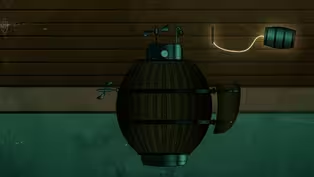
The World’s First Combat Submarine
Video has Closed Captions
Clip: S52 Ep7 | 10m 49s | Its nickname was the “Turtle”. (10m 49s)
Revolutionary War Weapons Preview
Video has Closed Captions
Preview: S52 Ep7 | 30s | Explore key military technologies in the American colonies’ fight for freedom. (30s)
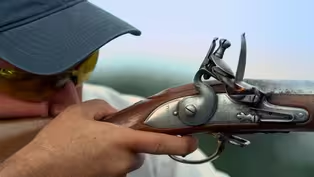
Video has Closed Captions
Clip: S52 Ep7 | 4m 57s | A team of experts put an 18th-century musket to the test — revealing how deadly it really was. (4m 57s)

What Went Wrong on the Dali Before the Baltimore Bridge Collapse
Video has Closed Captions
Clip: S52 Ep6 | 2m 57s | The container ship Dali lost power causing it to crash into Baltimore’s Key Bridge. (2m 57s)
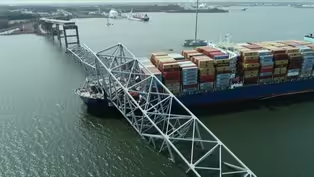
What Caused Baltimore’s Key Bridge to Collapse?
Video has Closed Captions
Clip: S52 Ep6 | 2m 57s | Engineers explain how a vulnerability made the bridge open to catastrophe. (2m 57s)

Baltimore Bridge Collapse Preview
Video has Closed Captions
Preview: S52 Ep6 | 30s | Follow the investigation into the deadly container ship collision that closed the Port of Baltimore. (30s)
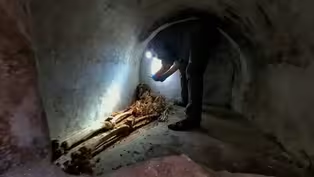
This Pompeii Priest Had an Unexpected Rise to Power
Video has Closed Captions
Clip: S52 Ep5 | 2m 58s | In a recently discovered tomb in Pompeii, archeologists made a startling discovery. (2m 58s)
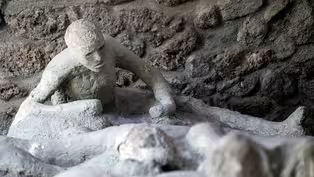
Pompeii's Secret Underworld Preview
Video has Closed Captions
Preview: S52 Ep5 | 30s | Archaeologists uncover new truths about Pompeii, a wealthy Roman playground with dark secrets. (30s)
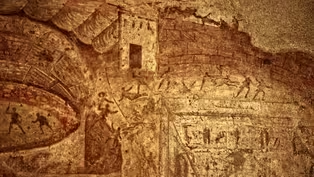
A Brutal Gladiator Fight in Ancient Pompeii
Video has Closed Captions
Clip: S52 Ep5 | 2m 37s | At a gladiator match in ancient Pompeii, tensions exploded and spectators became fighters in a riot. (2m 37s)
What's Inside These Ancient Egyptian Jars?
Video has Closed Captions
Clip: S52 Ep4 | 1m 58s | A nearly 3,000-year-old canopic jar is discovered in an Egyptian tomb. (1m 58s)
Opening a Sealed Egyptian Tomb
Video has Closed Captions
Clip: S52 Ep4 | 2m 38s | Archaeologists remove the mud brick seal of an unopened Egyptian tomb. (2m 38s)
How the Afterlife Shaped Ancient Egypt
Video has Closed Captions
Clip: S52 Ep4 | 1m 15s | Discover why the ancient Egyptians invested so much in life after death. (1m 15s)
The God’s Wife of Amun: Powerful Women in Ancient Egypt
Video has Closed Captions
Clip: S52 Ep4 | 3m 3s | Discover a time in Ancient Egypt when women held a role with extraordinary power. (3m 3s)
Video has Closed Captions
Preview: S52 Ep4 | 30s | A long lost ancient cemetery opens the door to a unique period in Egyptian history. (30s)
Providing Support for PBS.org
Learn Moreabout PBS online sponsorship
- Science and Nature

Capturing the splendor of the natural world, from the African plains to the Antarctic ice.
 New Episode
 New Episode






Support for PBS provided by:
National Corporate funding for NOVA is provided by Carlisle Companies. Major funding for NOVA is provided by the NOVA Science Trust and PBS viewers.