
Cook's Country
Tucson Tacos
Season 18 Episode 1821 | 27m 55sVideo has Closed Captions
Mesquite-Grilled Tacos Rasurados
Test cook Bryan Roof travels to Tucson for some tasty tacos and makes host Bridget Lancaster smoky Mesquite-Grilled Tacos Rasurados. And equipment expert Hannah Crowley reviews portable burners.
Problems playing video? | Closed Captioning Feedback
Problems playing video? | Closed Captioning Feedback
Cook's Country is presented by your local public television station.
Distributed nationally by American Public Television
Cook's Country
Tucson Tacos
Season 18 Episode 1821 | 27m 55sVideo has Closed Captions
Test cook Bryan Roof travels to Tucson for some tasty tacos and makes host Bridget Lancaster smoky Mesquite-Grilled Tacos Rasurados. And equipment expert Hannah Crowley reviews portable burners.
Problems playing video? | Closed Captioning Feedback
Where to Watch Cook's Country
Cook's Country is available to stream on pbs.org and the PBS app.
Providing Support for PBS.org
Learn Moreabout PBS online sponsorship♪♪ -"Cook's Country" is about more than just getting dinner on the table.
We're also fascinated by the people and stories behind the dishes.
We go inside kitchens in every corner of the country to learn how real people cook, and we look back through time to see how history influences the way we eat today.
We bring that inspiration back to our test kitchen so we can share it with you.
This is "Cook's Country."
-Today on "Cook's Country," Bryan visits Tucson and then makes his version of mesquite-grilled tacos rasurados.
And Hannah reviews portable burners.
That's all right here on "Cook's Country."
-Funding for this program has been provided by the following.
-Monument Grills -- made for everyone from the backyard master to the weekend host and the beginner just starting out.
Monument brings people together.
Monument Grills -- The everybody everywhere grill.
-TeakHaus.
Inspired by a passion for cooking and respect for our planet, each board is handcrafted from sustainably sourced wood designed for every step from food prep to presentation.
TeakHaus.
♪♪ ♪♪ ♪♪ ♪♪ ♪♪ -Stretching all the way from southern Arizona to northern Mexico, the Sonoran Desert is home to one of North America's oldest food traditions.
I met up with Felipe Garcia, the president of Visit Tucson, to learn more about Sonoran cuisine.
-Sonoran food is very simple food.
A lot of meats, a lot of flour, seafood, but it's really using simple, quality, local ingredients.
And that's what makes it, again, so unique.
-Layered with influences from Mexico, America, and several groups of indigenous peoples, Sonoran cuisine is an amalgamation of these cultures and the unique desert environment it emerged from.
-People think that Mexican food is like one set of, like -- there's like three or four kinds of food.
It's so diverse and there's this amazing pocket in the Sonoran Desert.
-Part of this pocket is Tacos Apson, a taco joint in Tucson, Arizona, run by husband and wife duo Francisco Javier Durazo and Yazmin Aldecoa-Durazo.
Tacos Apson opened 22 years ago as a way to showcase all that Sonoran cuisine has to offer using flavors of their Mexican hometown, Agua Prieta, Sonora.
-We decided to have something 100% the most original we can do from our state of Sonora, Mexico, to Arizona.
-Tucson is just 60 miles from the southern border, meaning Yazmin and Francisco can travel back and forth with ease, bringing ideas and ingredients with them.
Francisco is the man behind the grill.
Every day he cooks one of their most popular menu items, mesquite-grilled tacos rasurado.
-I started picking up ideas from different taco shops in Mexico.
I was selling carne asada burritos and pastor tripa but not ribs.
I said I've never seen this before so I was surprised.
It's very simple.
If I take it to Arizona and I do this, It's going to be a boom.
-Everything about this dish is made to reflect Sonora, but the mesquite wood is one of its true distinctions.
Mesquite is a family of small trees and shrubs suited to survive in the arid Sonoran environment and was one of the most crucial ingredients in the diets of indigenous people in the region.
Mesquite wood can be used in a variety of different applications, from food and fuel to traditional medicine, but at Tacos Apson, it's the mesquite charcoal that makes the food sing.
-When the heat and smoke combine in the carne asada, it's totally different.
It's got to be 100% mesquite.
So you have the flavor of the mesquite and it's when you put them together, that adds a special flavor to them.
That unique flavor comes originally from Sonora.
-It's also the flavor that represents the resourcefulness needed to survive in this kind of rugged environment.
-We have to be resilient and you use what you have available.
And mesquite trees, that's one of the plants that are available and that's what you use.
-That's what we have.
-It's amazing.
I mean, the heat that it radiates is beautiful and the flavor it gives.
-Francisco's days always start the same way -- Hauling massive bags of mesquite charcoal into the kitchen and firing up the grill.
When the coals are glowing, he knows they're ready for the meat.
He places a gorgeous rack of ribs on the smoking grill.
Then comes the second most important ingredient -- a hefty coating of Mexican sea salt.
After the ribs have been grilled and salted on both sides, he takes them off and carves each one off the rack.
He carefully assembles them back on the grates, cut side down, and takes care that every rib is positioned for maximum flavor from the charcoal below.
Another generous shower of salt and the ribs are ready to go.
As soon as they come off the grill, Francisco shaves the meat right off the bone, warms their flour tortillas, and char some jalapeños and spring onions to go on the side.
After we've got our toppings from the salsa bar, I'm ready to try this Sonoran staple.
Let's go eat.
-Excellent.
Always some limon.
-It's not a taco if you don't put limon.
-Absolutely.
-Mmm.
-Like it?
-I more than like it, I love it.
I love how the meat, the rasurado is so rich compared to, like, the carne asada tends to be a little bit more lean, but you really get that smoky mesquite coming through.
-Mm-hmm.
-You really taste it here.
Just salt, meat, and charcoal.
-And that's all.
-As Felipe puts it, the simplicity of the meal is really what makes it Sonoran cuisine.
-So you cannot hide anything.
You cannot cheat.
You cannot do something if the meat is not good or tortilla.
So you know it's going to be very basic and you will taste the ingredients.
-But for Yazmin and Francisco, it goes beyond delivering exceptional food to their community.
It's about preserving the traditions of the region and keeping the foodways of the Sonoran Desert alive.
And you can taste the commitment to that tradition in every bite at Tacos Apson.
♪♪ -Well, it looks like you were well fed.
-It was amazing.
I mean, tacos rasurados -- it really changed my entire perspective on tacos.
I'd never had rib meat tacos before.
-But I see a lot of vegetables.
So it looks like we're going to start at that salsa bar you were hitting up.
-Absolutely we are.
So we're going to start with the aguamole, which was explained to me as like a way to stretch guacamole.
Rather than make a stiff batch of guacamole, this is like a water thinned-down version of an avocado sauce.
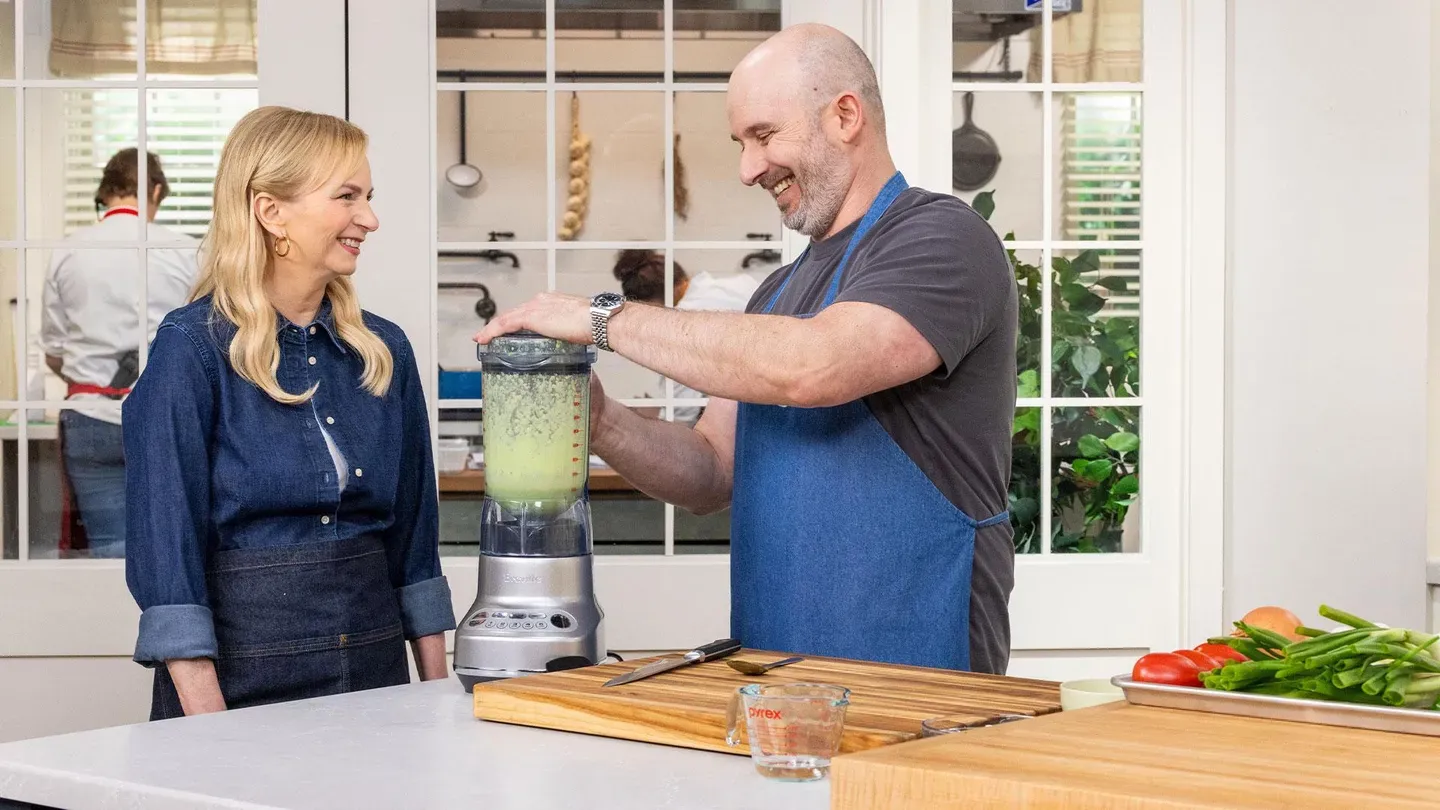
So we're going to add half of an avocado to our blender here.
And then one minced garlic clove.
Thank you.
A tablespoon of lime juice, 3/4 of a teaspoon of salt.
And then to help the blender do its job here we're going to add 1/3 cup of water to start.
Throw a lid on this thing and we'll just blend it for about 10 seconds.
-Okay.
-All right, let's take a look.
So it's still looking a little bit thick.
So we'll add a little bit more water and blend it up a little bit more.
Okay.
We'll take a look at it now.
This is perfect.
It's pourable but it also thickens up a smidge as it sits.
So we can just go ahead and drop this into our bowl here.
-Okay.
-So now we can talk about some of our salsa tatemada ingredients.
So we have here Roma tomatoes, jalapeños, and an onion.
That's going to be part of our salsa tatemada.
Tatemada means it's charred salsa.
-Okay.
-So all these things will go onto the grill.
So we're only going to use half of this onion here.
So we'll just take and cut it in half.
I want to keep the root end intact because we don't want it to fall apart on the grill.
All right, so that is good now.
And then our garnish for the tacos is going to be these beautiful spring onions also called cebollitas.
So when you have these, you just want to trim off any of the dead end there and pull off any leaves or of the stem that doesn't look great.
-Okay.
-So just give them a thin shave.
So our salsa and our garnish are prepped.
And now we can talk about the beef.
So these are an entire rack of beef ribs here, seven-bone beef rack.
These are back ribs.
So rosurado means shaved in Spanish.
This is about 4 pounds.
It's a big boy.
-That is a gorgeous cut.
-Yeah, it's wonderful.
Like the flavor that comes off this meat, especially when you shave that meat in between the bones, is just phenomenal.
-Awesome.
-So if you want to carry that.
-Yep.
-I'll carry the beef ribs and we'll head out to the grill.
-Sounds great.
♪♪ -They say you can't take it all with you.
I don't buy that because I know for a fact you can take portable burners just about anywhere.
And to prove this point, we've got Hannah here.
She's going to take us through an army of different kinds of portable burners.
-You're right.
There are a whole lot here.
This is not all we tested.
We tested 15 different burners.
Yeah, these things can be great if you're in an RV, if you have a small kitchen, if it's a holiday, even just cooking outside, I love to use mine at home for that.
So we tested 15 total.
The price range was massive.
I'm talking $12 for a little electric burner to $1,500 for that big fella over here.
-For this one?
-$1,500.
-$1,500?
Yeah, that better call me pretty or something.
-We'll come back to that big fella over there.
But we learned a ton.
We tested them all different ways.
We held fondue at precise temperatures.
We made tomato and egg stir fry.
We deep fried zucchini because we want these to be real burners.
We use real cookware on them, not camp cookware, because we want to do real cooking on them.
-Okay, great.
-And we found a winner in each fuel type.
-That's handy.
-So let's talk electric first.
Clearly they're smaller and lighter and plug and play, which is nice.
-Right.
-Literally you just plug it in and you're ready to cook.
-Right.
-But there's a catch.
They're not that powerful.
Most in our testing could never even boil water.
-I think that's a bare minimum.
You need them to boil water.
-It's the bare minimum.
Our winner right here from Imusa was able to do it.
It was slower, but it was able to do it.
-Okay.
-Nice, simple controls.
Wipe clean.
Like I said, plug and play.
For $12, a really handy extra burner.
But look how small it is.
You're not going to be using Dutch ovens.
You're not going to be using stockpots.
Smaller pans.
Handy, inexpensive.
A nice option if that's what you're looking for.
But let's talk about gas ones.
-Okay.
-So gas, you have to use it outdoors or in a very well ventilated area and you have to buy fuel separately.
So I have a butane fuel source right here.
And there was a little bit of a downside with that.
So you'll notice all these four chambers, that's where the butane goes inside them.
And you never want the pan to overhang the fuel chamber.
-That's a dangerous thing.
-A dangerous safety issue.
And if you'll notice how close it is, we quickly ran into issues with pan size here.
Most of these could only be used with much smaller pans than we preferred, except for our winner over here from Grill Boss.
So this also uses butane and you have the same limitation, but it has a second fuel hookup.
So you can hook up a propane tank like the one you use on your gas grill.
-Right.
-You have tons of runway there with the propane tank.
You're not going to run out halfway through your project, and the propane tank sits on the floor away from the burner.
So you can use any pot you want on here.
You want to use a full Dutch oven on here, you're going to be fine.
-All right, so that first one was $12.
What's this one?
-This is $55.
-Oh, that's not bad.
-Yeah.
They were all plenty powerful.
We actually had to turn some down because flames were licking up the side of pans.
But on the other side of things, on the low, some of them would flicker out or some "low" was actually pretty hot and we scorched our fondue.
This guy had some finesse.
You could keep the fondue nice and perfect, and it could also boil water really fast.
Let's go down to induction.
-Now this one I feel like should be studded with diamonds.
-It should be for that price.
Induction has been popular in other parts of the world for a long time, and it's becoming more and more popular here.
So induction burners work with a coil inside that creates a magnetic field.
You put a pot with a ferromagnetic bottom on there, and it will enter the energy field.
And they will interact in a way that heats the metal of the pan, which then in turn cooks the food.
And you can test by just putting a magnet on the bottom of your pan.
If it sticks, it's going to work on induction.
-All right.
A good thing to check.
And how about the performance here?
-These were fantastic as far as performance.
These boiled water in 20 minutes, which was the same as on a gas stove.
The other thing is precision.
You could literally type in 285 degrees, and that will produce that right here.
Very precise.
And cool to the touch.
So, you know, you could have a pot of boiling water on here and slide $100 bill under there.
-If you had it left.
-So if you can't spend that kind of money, over here for less than one-tenth of the price at $117, the Duxtop was a fantastic option.
I think, you know, 5% of people probably should get that one.
95% should probably get this.
-Sure.
-It was responsive, easy to clean, great control panel.
The trade off is it's a little smaller.
This is so big because it has to house a big heating coil and all the machinery required to cool it down afterwards.
This, smaller coil, smaller machinery, smaller pans on top work best due to all of that.
-So maybe a 10-inch skillet max.
-I wouldn't say max.
You can use a 12 if you want to.
Give it time to preheat, even out.
Expect best performance, though, 10 inches and under.
-That is a lot of information.
So thank you.
And if you want to find out more about our complete ratings of portable burners, go check out our website.
♪♪ -All right, Bridget, today we're using mesquite hardwood charcoal for this recipe, okay?
And mesquite charcoal is like the aroma, the perfume of Tucson, Arizona.
It's in the air.
It's on the food.
It's just really a unique flavor.
So for comparison, I have our traditional charcoal briquettes which are just compacted, pressed, small pieces of wood that have been carbonized versus these whole pieces of mesquite wood that have been carbonized and pressed.
You can really see the difference.
You'll notice the difference in the way it burns, but also especially in the way it tastes.
-Okay, great.
-And I have six quarts of that mesquite charcoal burning right here.
-Mm-hmm.
-I'm going to pour that evenly over half the grill.
So we have a hot side and a cool side.
Okay, so we're just going to put the grate on this and cover the grill and let that heat up for five minutes.
And I've got both the top and the bottom vents fully open.
All right, the grill's been heating up for five minutes and we can go ahead and clean it.
And oil it.
All right.
The grill's nice and hot.
Now we could go ahead and start grilling our vegetables for our salsa.
So we're going to put the spring onions here.
Put the bulbs resting right over the coals.
They take the brunt of the heat.
Get those nice and charred.
So we'll just kind of work all these vegetables on and off the grill as they get done cooking.
It takes about 10 to 15 minutes to cook all these vegetables entirely.
-You can smell it immediately.
Grilled onions.
Nothing better.
-These tomatoes actually take the longest to cook because there's so much water in them.
And as they get done charring on each side, they're nicely browned and cooked, we'll start removing them from the grill and we'll rotate new vegetables in.
-Great.
-So we're just working over this hot side here.
See this kind of nice charring?
-Oh, yeah.
-That's exactly what we're looking for.
And it happens quick because this hardwood charcoal is so intense.
So this is all very active grilling.
You got to stay involved with this and turning the vegetables as they get more and more charred.
And so this will take about 10 to 15 minutes until we're finished with the entire batch.
-Okay.
-Okay, these spring onions are nicely charred, so we'll start pulling those off.
-Those are gorgeous.
-So you want to char them and also at the same time cook them all the way through.
So you don't want to just quickly blast them.
You want to give them a little bit of time on the grill.
These tomatoes are going really quickly because they're over the really intense part of the fire here.
We'll pull those off.
All right, so this is our last few jalapeños getting charred here.
We'll just drop those onto the tray.
Everything's nice and charred and tender.
It's looking good.
-Bountiful.
-So now we're ready for our ribs.
All right, so we're going to throw our ribs on there.
We're going to start them with bone-side down.
And we're gonna sprinkle the tops with some salt.
-Okay.
-We're looking to put about a little bit more than 2 teaspoons, about 2 1/4 teaspoons on top of these ribs.
It's a generous sprinkle of salt.
This is coarse sea salt.
Now at this stage it doesn't always look like it, but there's a lot of fat on these ribs.
So as they begin to cook, they'll go about six minutes on this first side, we want to be ready to kind of extinguish any flare ups.
So we're going to use like what Francisco did is a water bottle.
-Okay.
-So when those flare ups start to happen, you just kind of like pop it.
I'm actually going to remove this lid here so I have a little bit more access all the way around.
-Nice.
-It seems counterintuitive to grilling.
It seems like it's going to extinguish all this.
But this is a good reason why we're using a two-level fire here or a half-grill fire.
So we could just remove these ribs if it gets to be too aggressive and just extinguish these flames.
Then we'll go back on top and let it go.
-Nice.
-You want to go till they get nice and browned on the first side, extinguishing the flames as they pop up.
And if it gets to be too much you can just kind of maneuver them around the grill, have the fatty half hanging off away from the coals for a second, and kind of rotate it to give the charcoal a little bit of a break.
Okay, so it's been about six minutes.
Let's take a look.
Nicely browned on that side.
Gonna extinguish a few flames here.
-Hubba hubba.
Awooga.
-We're going to hit it carefully with some of that coarse sea salt and let it go for six minutes on this second side.
Same thing, just manning our water bottle, extinguishing any flare ups.
Okay, it's been six minutes on the second side here.
We could transfer these ribs to our cutting board.
-Oh, wow.
-So they're already looking gorgeous, right?
-Yes.
-Okay, so now if we were to cut into them as we're about to do, you're going to see that they're almost still raw on the inside in between the bones.
So we're going to cut them in between the bones at this stage.
With our chef's knife.
-Oh, yeah.
It is pretty pink.
-All right.
Let's cut through this last rib here.
Now we're going to put these back on the grill.
But first we're going to nestle them inside one another like this.
And we'll just drop these back onto the grill.
-Mmm.
-Cooking the ribs like this is going to allow us to cook all that rare meat that's still stuck to the bones there that was in between the ribs.
-Mmm.
-And this will get nice and charred and crispy.
-Gorgeous.
-We're absolutely going to hit it with some more of our salt.
Okay, and we'll let that go for five minutes on that side.
Okay.
It's been five minutes on that cut side.
Gonna flip these ribs over.
-Ohhh.
-Take a look at how gorgeous those are.
See all that meat in between the bones is now nice and crispy.
So this will be our final cook on this side to cook the rest of that rare meat up against the bone.
We'll hit it one more time with some salt, about another generous 2 teaspoons, about 2 1/4 teaspoons.
And that'll go for five minutes.
Okay.
These ribs are finally ready to come off.
-Can I help you out there?
-Drop them onto the tray.
-Ohh.
-Okay.
These ribs are looking gorgeous.
So when we go back inside, we're going to throw these into a 200-degree oven and let them sit and just hang out while we make our salsa.
-All right.
And then it's almost taco time.
-It's taco time.
Okay, our ribs are resting in a 200-degree oven.
And while they're doing that, we could finish our salsa tatemada.
-Lovely.
-All right, so we have our tomatoes here that have been nicely charred on the grill.
And we're just going to remove the core.
We can drop the whole tomatoes in with the charred skin on there.
-Great.
-We want that charred, smoky flavor.
And then our onions, we're going to just remove the root end from the onions.
And then one jalapeño.
So I'm just going to remove the stem, keep the seeds in there, and drop this in whole.
-Nice.
-And to that we're going to add 1/4 cup of cilantro leaves and stems.
-Nice.
-Those cilantro stems are nice and tender so we could use those.
-Yes.
-1 1/2 teaspoons of lime juice and 1/2 teaspoon of table salt.
And we're just going to blend this briefly.
We want it to be a little bit chunky still.
So about 7 seconds on low speed in the blender here.
-Okay.
-That's a good-looking salsa.
-Mmm.
-And we can throw our salsa in the bowl.
All right, we'll set that aside, clean up our station, and pull the ribs out of the oven, start shaving and making some tacos.
-Shaving time.
-Now we're going to shave our ribs.
All right, so this is the rosurado part.
The shave.
So we have a chef's knife.
You could use a boning knife if you like as well.
And just kind of work down the blade.
-Mmm.
-Work down the bone here with the blade of the knife.
All right, and we can just hold on to the rest.
This is plenty for the two of us.
I think.
-[ Laughs ] -And we'll just give this a nice chop here.
I'll throw this into a bowl here.
I'm going to build you a taco.
-Yay.
-'Cause you've been so good and so patient.
So we're going to take a couple of tortillas out of here.
In Tucson, it's a flour tortilla city.
A little bit of our beef.
A little bit of this finely chopped cabbage.
-Just regular green cabbage.
-Regular green cabbage, finely chopped.
A little bit of our salsa tatemada.
-Oh, yeah.
-And then some of our aguamole.
Alongside this, you take one of your spring onions, one of these jalapeños.
-[ Whistles ] -Okay.
And this is for you.
-Thank you, Bryan.
-And one for me.
The lime.
There's one for you.
-All right.
-On your plate there.
All right, and there's a method to this.
So you want to fold your taco, take a bite.
With a full mouth of food, take a bite of your spring onion, take a bite of your jalapeño.
-All right.
-Oftentimes they'll even dunk the spring onion and jalapeño into salt.
All right.
Cheers.
-Cheers to you.
Mmm.
-Mmm.
-Mmm.
-A little fiesta in your mouth there, huh?
-Since we finished with the jalapeño, that's actually the first thing I'm tasting right now.
Get that burst of char.
And of course a little bit of heat.
Spring onion is glorious.
That meat... -Yeah, it's so good.
-...is beautiful.
-I mean, that smoke, kind of fattiness, the richness of it all.
-And all the char on the vegetables that you grilled.
It tastes unlike any taco I've ever, ever had before.
I love that light little kind of guacamole with the water added to it.
It's just perfection.
That is as good as it gets.
Just like you, Bryan.
-You're so sweet.
-Thank you so much for bringing this back to the country for us.
-You're very welcome.
-So if you want to make these unbelievably great tacos at home, it starts by grilling onions, jalapeño, and tomatoes for the salsa tatemada.
After grilling the whole beef rack, cut into individual ribs and return them to the grill until browned all over.
Shave the meat from the ribs and then layer the beef, salsa, and aguamole into tortillas and serve with charred jalapeños and spring onions.
So, from "Cook's Country" via Tucson and Bryan, it's mesquite-grilled tacos rasurados.
Fully expected to look down and it was going to be gone.
-[ Laughs ] Mine's almost gone.
-I noticed that.
-Let us help with dinner tonight.
Visit our website anytime for the newest season's rigorously tested recipes, full episodes, ingredient advice, and equipment reviews.
CooksCountry.com/tv.
-"The Complete 'Cook's Country' TV Show Cookbook" brings together every recipe, tasting, and test from 18 seasons of the beloved TV show.
With trusted equipment recommendations and insights from the entire cast, this book is your guide to the very best in regional cooking.
The cost is $24.99, $15 off the cover price of $40.
To order, head to our online shop at CooksCountry.com/book.
-Funding for this program has been provided by the following.
-Monument Grills -- made for everyone from the backyard master to the weekend host and the beginner just starting out.
Monument brings people together.
Monument Grills, the everybody everywhere grill.
-TeakHaus.
Inspired by a passion for cooking and respect for our planet, each board is handcrafted from sustainably sourced wood designed for every step from food prep to presentation.
TeakHaus.
♪♪ ♪♪ ♪♪ ♪♪ ♪♪ ♪♪ ♪♪ ♪♪ ♪♪ ♪♪ ♪♪ ♪♪

- Food
Christopher Kimball’s Milk Street Television
Transform home cooking with the editors of Christopher Kimball’s Milk Street Magazine.


 Recently Added


Support for PBS provided by:
Cook's Country is presented by your local public television station.
Distributed nationally by American Public Television