
Canoeing the Connecticut
Season 8 Episode 5 | 26m 48sVideo has Closed Captions
Willem canoes the Connecticut River.
Willem canoes the Connecticut River from Lemington to Guildhall, VT, with a group hoping to establish a "Paddlers Trail" with campsites along the river from the Canadian to the Massachusetts borders.
Problems playing video? | Closed Captioning Feedback
Problems playing video? | Closed Captioning Feedback
Windows to the Wild is a local public television program presented by NHPBS
Canoeing the Connecticut
Season 8 Episode 5 | 26m 48sVideo has Closed Captions
Willem canoes the Connecticut River from Lemington to Guildhall, VT, with a group hoping to establish a "Paddlers Trail" with campsites along the river from the Canadian to the Massachusetts borders.
Problems playing video? | Closed Captioning Feedback
Where to Watch Windows to the Wild
Windows to the Wild is available to stream on pbs.org and the PBS app.
Related to This Episode

Providing Support for PBS.org
Learn Moreabout PBS online sponsorshipI'm standing today beside the Upper Connecticut River near Lemington, Vermont.
It's a beautiful day, as you can see.
And in just a few minutes, we're going to put our boat in the water and paddle downstream a few miles to our campsite for tonight.
I can hardly wait.
♪ ♪ [water lapping] Get out of here.
There we go.
Okay.
Let her glide.
Welcome to Windows to the Wild.
I'm Willem Lange.
Today, we're on the Upper Connecticut River, floating downstream with a flotilla from the Vermont River Conservancy.
Steve Libby, the executive director, is here with me.
And I have no idea where we're going.
Do you?
Well, we're heading downstream about five miles to a campsite called Lyman Falls State Park.
What up.
Hold it.
Lyman Falls?
Lyman Falls State Park.
And we're going to go over them?
We're going to go over the breached dam at Lyman Falls.
Oh, goody.
Tonight?
This afternoon.
Okay, this may be our last show, folks.
[chuckling] Okay.
About five miles and we'll be there.
We’ll spend the night?
We'll spend the night there and then head out tomorrow morning for another reach.
Okay.
Well, we got a tailwind.
It couldn't be better.
Couldn't be better, and we'll paddle on.
Okay.
Here we go.
The Connecticut's a beautiful river, especially in its northern headwaters where it still runs free for long stretches.
♪ [water lapping] Early this morning, we drove to Guildhall, Vermont.
It's just a crossroads beside the river and the shire town of Essex County, the least populated county in all New England.
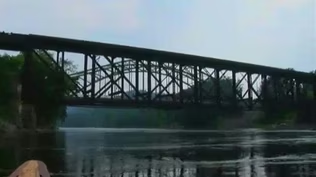
A short bridge from Guildhall crosses the river into Northumberland, New Hampshire.
We were there today to check out a new canoeing access being installed by volunteers with the Vermont River Conservancy.
The Conservancy's building a paddlers trail with tent sites, fire rings, privies and tables, and perching logs about every five miles the whole way down the river from the Canadian border to Massachusetts.
The little dock is a safe take out just above an old broken dam in Guildhall.
The river level’s up today thanks to some recent rain.
I took a walk out onto the bridge and decided if I were paddling through here today, I'd probably run the old dam with very few reservations.
There are about 12 of us.
I haven't got an exact count yet.
After visiting with the work crew, we set off to spend a couple of days on the river.
♪ [water spreading] It's been several decades since I last paddled this section of the river, and I'd quite forgotten the miles of beautiful rapids.
Unthreatening, but enough to keep us alert and dump a couple of gallons of water into one canoe.
I feel a little disoriented because I don't have either my usual septuagenarian canoe partners, Bob and Al.
For hundreds of miles, I've stared at one or the other of their broad backs, parkas, gray hair, and wide-brimmed hats.
But for this voyage, Steven, the organizer, paired me with Lydia, an ebullient, dark-haired nyad who really knows her stuff and whitewater.
But she approaches each drop with ecstatic Yahoos!
while behind her, I'm trying to look around her to spot hidden rocks.
[water flowing] We're moving right along here.
You know?
You look at the rocks at the bottom of the river, they're going by faster than you can jog.
[water lapping and spreading] Something in the water down there; it’s either ducks or geese or rocks.
I think it's geese or ducks.
Yeah.
Waterfowls.
[water flowing] Just two of us together ♪ we'll plan our honeymoon ♪ cruising down the river ♪ on a Sunday afternoon ♪ [Willem chuckling] Yeah.
Except it's Saturday.
Yeah.
Look at those trees up there.
You can see the underside of the leaves.
If the sky looked different, I'd say we're going to get rain, but it may not.
Look at here.
This is all grazed off isn’t it?
Well, it looks as though the current goes right up against that bank.
[water flowing] They seem to be going to river right.
River right.
As they call it.
You all buttoned in there, dear?
Yep!
Okay.
[water lapping] Pretty much everybody you meet on the river is pretty friendly.
Fishermen, paddlers, campers.
There was one little flotilla of kayaks with one guy on a paddleboard.
If I were to try that today, in my advanced state of decrepitation, I might as well just jump in and float down beside the board.
Be a lot safer.
[water flowing] Noah, the trip leader, warned us about the breached dam at Lyman Falls State Park, where we proposed to stop for the night.
Stay all the way to the left, he cautioned.
[water flowing] Which we did, and we shot right through just as slick as could be.
[water flowing] We are on the Connecticut River at the next campsite down from wherever we started, and we're going to set up tents here, cook a little supper.
And we've just discovered we brought a mouse with us, probably all the way from Montpelier, Vermont, in that canoe.
He just emerged half drowned in the bilge.
We're going to have to leave him here, poor soul.
We can't take him any farther.
I'm going to go up and find a place for my tent that's not too rough.
Hey ho, hey ho, it’s off to work we go ♪ we got to find a place to put the tent ♪ Hey ho, hey ho, hey ho, hey ho ♪ although we feeling low ♪ Hey ho, it’s off to work we go ♪ This is all very nice.
Here's the spot.
The campsite lies on the Vermont shores in the state park, on a grassy flat surrounded by scrubby second growth and lots of room for tents.
If there'd been a wind, it wouldn't have bothered us at all.
If there had been bugs, they would have.
Everybody picked his tent site and set up before supper.
The snorers set up way off on the edge of the clearing.
♪ We dined on potato salad, lots of sausages, and tabbouleh.
At least I think that's what it was.
I can't tell it from couscous or oatmeal.
♪ After supper, Steve Libby and I sat down for a few minutes to talk about the great day we just had on the river.
I wanted to find out more about the Vermont River Conservancy.
Steve, we made it.
We did.
Nobody got too wet.
Nobody tipped over.
Except we did bring a mouse with us down on the river somehow.
Yeah, and one of the canoes.
That was fantastic.
Maybe he wandered well, anyway, we're here.
We're here.
So what can you tell this is a great campsite.
This is one of yours?
Well, it was a project that we worked on with the state of Vermont where we orchestrated the acquisition of the parcel, and we purchased it and re-conveyed it to the state, and now it's, called Lyman Falls State Park.
This is a state park right here... It's a state park.
It’s a small-acreage one.
It's primarily for canoe access and although it does abut a state highway, but it's primarily for accessing from the Connecticut River.
And as we look around and see, it's, you know, primitive, but there's a fire ring in back of us and a few amenities.
But basically it's a great place for, you know, pretty large groups to be able to stop on their sojourns on the river.
Nice little campsite.
We are the Vermont River Conservancy.
Vermont River Conservancy.
Okay.
We're basically a conservation land trust that focuses on conserving lands along rivers, important put in and take out points.
We do a lot of swimming hole projects where a landowner may be interested in donating or selling us a swimming hole and we then conserve it and keep it open for public access.
We're trying to create an opportunity for folks who want to put in to the Connecticut as far north as Canaan to be able to, you know, take reasonable day trips down the river and have campsites or if you're just out for a day trip, you can start in any of the places and take out at another place 5 or 6 hours downstream.
So, we're trying to make it accessible for, a whole range of paddlers.
Public access to rivers and and other bodies of water is important because these rivers and lakes and ponds are our we are all owners of those.
I mean, they're the public trust resource.
And what we found and I think everybody's probably had a favorite swimming hole or fishing spot that they used to be able to go to all the time, and for whatever reason a landowner decided that public access was no longer in their best interest.
And these places have been posted.
So we like to work with landowners who are willing to permanently protect public access to these special places.
Access to water is a recreational opportunity that's available to everybody, no matter your economic means or your social status.
These are waters for everybody.
And, we feel like in this age where we may be getting warmer summers and swimming holes and being able to get into a place like the Connecticut River is only going to become more important.
And we want these places to be available to everybody.
Yeah, there's a strong kind of social justice aspect to this as well.
This has been lovely.
And tomorrow?
Tomorrow, after a delicious breakfast, we'll be heading downstream.
Who’s cooking breakfast?
I'm not.
It’ll be somebody else.
Okay.
Could be pretty good then.
[Willem chuckling] Could be pretty good, yeah.
We’ll be heading downstream to Maidstone Bridge crossing on the Connecticut; I think about a five hour paddle from here.
So, if the weather holds, which it looks like it will, we’ll be having a good day tomorrow as well.
More rapids coming up down below here?
Yeah.
Not anything like Lyman Falls, which we all successfully paddled through, but it'll be I think the water level’s nice.
It’ll be fairly easy.
Yeah.
The water's up and in pretty good shape.
The river meanders much more dramatically as we go further downstream.
Well that's great.
Thank you.
Yeah.
I will sleep very well tonight.
Well, good.
Well we're glad.
We hope you had a good dinner, and we'll look forward to s'mores over the fire.
I think I’ll go fishing in the morning before breakfast.
Ah, that'd be great.
Yeah, see if I can get some trout in here.
That would be nice.
♪ [background conversation] That fire’s nice.
The dew was kind of coming down tonight.
That’d be nice [Willem chuckling] Good sleep at night.
And mother is alone in the bedroom, I presume.
The nice thing about a campfire, though: you sit or stand around in a circle and you can see and hear everybody.
If the evening is cool, your backside gets chilly but it doesn't matter.
♪ Noah brought his guitar.
So, after supper, we sang around the fire and made s'mores.
♪ [conversation] Tom Slayton, the retired editor of Vermont Life magazine, knows a lot of old time songs, including one beauty named In Old Pawdogger Times.
... Paddle around on roller skates ♪ nor pine the piano fort ♪ they kept their men at a good arm's length ♪ and made them know their place ♪ and they played on washboards ♪ and kettles and brooms with amazing skill and grace ♪ They did-a-lay-a-bed till 11 A.M., got up in the morning ♪ betimes, and they didn't elope with the old man's coachman ♪ in old pawdogger times ♪ Folks didn't have delirium ♪ nor perpetrate horrible crimes ♪ for the cider was good and the rum was pure ♪ in old pawdogger times ♪ ♪ [laughter] When the dew begins to fall on the guitar, it's time to put it away.
We brushed our teeth and climbed into our tents for a cool, perfect sleeping night.
Well, we had a lovely day.
Beautiful weather.
The river was perfect, just as high as it needed to be, and not too much higher.
And, we're safe at a campsite.
Everybody's turned in.
Some people went to bed a little early because they were up early this morning.
But we're all set.
Got a brand new tent set up, and, as far as I know, my sleeping pad is working.
It is time to retire.
And we'll see you again in the morning.
Good night.
♪ [water flowing] When we got up, it was still quite early.
The sun was just above the trees and shining through a heavy mist over the river.
♪ [water flowing] This section of the river is regulated.
Artificial lures, barbless hooks and catch and release only.
I tried some fishing, but nobody down there seemed interested in what I was pitching.
♪ [birds calling] Pretty soon, I could smell coffee in the morning air.
Lydia cut up a few potatoes, put them in the frying pan, which Noah stirred faithfully.
[pan sizzling] [conversation] There's hard-boiled eggs.
There's granola with fruit, fresh apples, raisins, a conservative amount of milk, hot fried potatoes and ketchup.
And we always have peanut butter and jelly back up.
I can't survive... This is going to burn your little fingers pal.
We were in no great rush to get going.
We did a few maintenance jobs around the campsite, took the time to dry out some damp underclothes over the fire.
Some of the people in this outfit were going to get home smelling like smoked sausage.
[chuckling] It's pretty bad.
Somebody thought he'd heard a bear during the night, but the noise was coming from one of the tents around the perimeter and sounded suspiciously human.
Well, I heard something.
It sounded like a, I don't know what, it sounded like a lion biting something or... That was you.
[laughter] Yeah, that was you.
You want the old holes?
Yes.
Before we packed up the canoes to go this morning, Noah Pollock, Adam and I screwed the door back onto the privy.
Then I talked with Noah for a while to find out more about the Connecticut River Paddlers’ Trail.
Now Noah, we did a mighty work this morning putting that door back on the privy.
You think it will stay?
I sure hope so.
I mean, you're the one that put the screws in, so if it doesn’t we know whose fault it is.
That's why I’m not sure it's going to stay on.
Okay, well, this is more or less what you do you develop the campsites; you locate them or what?
Yeah.
For the last three years, with support from the Tillotson Foundation, I've been fortunate enough to have the job of helping coordinate the development of the Connecticut River Paddlers’ Trail.
And that involves both locating new access sites, locating new campsites, developing the sites, and setting up a program to ensure long-term stewardship from Canaan all the way down to the Massachusetts border and working to improve access to make sure it’s accessible for people of all ages and ability.
in the towns are into this too, The towns are into this too because it means extra business when paddlers go by.
Exactly.
It's amazing; once you improve a site from just an informal bank to a developed access, you start to see people come in from farther away to visit and staying in local bed and breakfasts and buying their groceries at the local general stores.
And up here in the North Country, tourism is, you know, basically the only industry that's growing.
And so what we're trying to do is develop the infrastructure that supports that growing industry up here.
All these campsites are free access; no fee and no reservations required.
Right?
Yeah.
Right now, it's a series of first come, first serve campsites.
Some of the campsites have donation boxes at the site, and we ask for about a $5 donation per person.
And that offsets the cost of stewardship.
But some of them are currently free.
Right now, there's no reservation needed.
In the future, if use becomes heavier, we may have to switch to a reservation system, but we're not having to do that right now.
And yeah, the idea is to provide, certainly, low cost, if not free, recreational opportunities for locals and visitors to come and enjoy the North Country.
And we're trying to have campsites every five miles to encourage, allow for flexibility in travel plans.
Most of the sites are fairly small.
Lyman Falls is one of the larger ones, but most of them, you know, they can really only handle about 12 people.
So by having campsites every five miles and ensure some flexibility in your your trip planning, the Connecticut River Paddlers’ Trail is managed by a collaborative of organizations.
Upper Valley Land Trust was instrumental back in the 1990s to establish a series of about seven campsites in the Upper Valley region.
The Vermont River Conservancy and other organizations like the Northern Forest Canoe Trail have taken the lead in developing the campsites and access points farther to the north and, with cooperation from hydro companies like Trans-Canada hydro, northeast and other town conservation commissions have all been involved in developing and helping to maintain these campsites and access points.
This is gonna be a beautiful day.
We’ve about a 14-mile paddle to the take out in Maidstone.
Now wait a minute, you said 11 miles.
11 miles to the campsite and then 14 miles to the take out if we make it all the way there.
Otherwise, we're hitchhiking back to the cars.
Oh, okay.
We'll make it.
Why don’t we do what we came here for... out here?
Oh, yes.
Any advice... All right, let's get it.
♪ [water flowing] Big rock on our right.
♪ [water flowing] The river dropped a bit during the night and it's bed also spread out.
So, Sunday morning was a bit bumpier.
The day before, but everybody got through just fine.
♪ [water flowing] We've got some sleepers coming up.
♪ [water flowing] I think we're stuck here Getting a little teetery, though.
Hard to relax.
Oh.
Shucks.
We got hung up on a sleeper.
Well, no harm done, I guess.
♪ [water flowing] I'm gonna get off this rock because it's pretty tippy.
There.
♪ [water flowing] ♪ [water flowing] Noah's looking out for us.
God bless him.
Either that or he's looking for some birds.
Well, I guess there's enough water to get through this section all right.
[paddling] Those of us who remember the good old days of paddling on the Connecticut River when, in the late afternoon, we often searched in vain for a place to pitch a tent to spend the night, think this long string of designated and maintained campsites is almost too good to be true.
We've got to remember that we'll continue to enjoy it only if we treat it kindly and practice good stewardship.
Personally, I try to carry out more than I brought in and leave each site the way I'd like to find it myself at the end of a long day on the river.
♪ [water flowing] Well, we have reached another campsite, as you can see.
This one's at the confluence of the Nulhegan River with the Connecticut.
We're stopping here for a few minutes, then we're going to continue on down to a takeout point another ten miles or so down the river.
But we're going to leave you here, and you can relax in comfort for the rest of this trip.
I'm Willem Lange, and I hope to see you again on Windows to the Wild.
♪ [paddling] ♪ [water flowing] ♪
Canoeing the Connecticut (Preview)
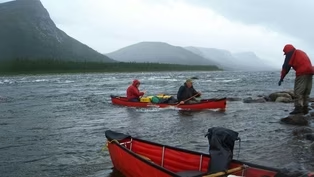
Preview: S8 Ep5 | 21s | Willem canoes the Connecticut River from Lemington to Guildhall, VT. (21s)
Providing Support for PBS.org
Learn Moreabout PBS online sponsorship New Episode
- News and Public Affairs

Top journalists deliver compelling original analysis of the hour's headlines.
 New Episode
 New Episode
 New Episode







 New Episode

Support for PBS provided by:
Windows to the Wild is a local public television program presented by NHPBS