
Steep Canyon Rangers
Season 2 Episode 1 | 24m 50sVideo has Closed Captions
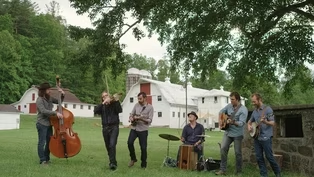
David visits a mountain farm where the Steep Canyon Rangers perform and share stories.
Join David on a visit to a Blue Ridge Mountain farm where the Steep Canyon Rangers perform and share stories about the band’s history and life on the road touring with comedian Steve Martin.
Problems playing video? | Closed Captioning Feedback
Problems playing video? | Closed Captioning Feedback
Steep Canyon Rangers
Season 2 Episode 1 | 24m 50sVideo has Closed Captions
Join David on a visit to a Blue Ridge Mountain farm where the Steep Canyon Rangers perform and share stories about the band’s history and life on the road touring with comedian Steve Martin.
Problems playing video? | Closed Captioning Feedback
How to Watch David Holt's State of Music
David Holt's State of Music is available to stream on pbs.org and the free PBS App, available on iPhone, Apple TV, Android TV, Android smartphones, Amazon Fire TV, Amazon Fire Tablet, Roku, Samsung Smart TV, and Vizio.
Providing Support for PBS.org
Learn Moreabout PBS online sponsorship(bright banjo music) ♪ ♪ (upbeat bluegrass music) - One of the most popular bands playing progressive bluegrass is Steep Canyon Rangers.
I met them in 1999, right after they got together.
Now, the fact that they're so well known now is due at least in part to their touring with comedian, actor, and musician Steve Martin.
Singer and guitarist Woody Platt is professional fishing guide.
By chance, Steve Martin's wife hired Woody for a fishing trip.
She introduced the band to Steve and they hit it off.
That exposure created a larger audience, and they've risen to meet the challenge writing great songs and performing exciting shows.
So how did the band get going?
- Oh, senior year in college Graham, our banjo player, and Charles, our bass player, and myself just ended up deciding to play some songs together.
We had known each other since our freshman year in Chapel Hill, but had never really played music together.
And then it just kinda happened spontaneously right towards the end of college, and one thing led to another.
- So were you already pretty good on the instruments or were you actually learning kind of at the time you were... - Oh we were awful.
We were awful.
(laughter) No, we were just gettin' started.
You know, Charles just got a bass, Graham was a soccer player and blew out his knee, and so he started playing the banjo kind of in his spare time, and I had a guitar and knew a few kind of traditional songs, so we were really starting from scratch.
And this band, the Rangers, is a real work-in-progress.
I mean we came from the very bottom.
We had some false confidence when we first started 'cause all of our friends showed up.
You know, we'd play in college and everybody'd show up at the gig, but we weren't very good.
- And Mike, you knew some of the fellas from growing up with them.
- Woody and Mike and myself are from Brevard so they were driving up and seeing how it worked on the home team.
And so we, you know, I kinda connected with the rest of the guys, I already knew Mike and Woody.
But, yeah, not long after they started, they kinda came back home and see how it would work in the mountains.
- Was it a band making a living at that point?
- Close.
Trying to be.
But you know, when you start a band at our age, right outta college, you don't need too much.
So the word living is kind of debatable.
(laughter) We just needed enough money to get to the next gig or pay rent, and so it was right on the edge.
- There was a time when you were going out with Steve Martin, a good bit right?
- [Woody] People say, you know, a band needs a break.
A break would help.
And that was one that was, it wasn't the kind of break we thought we might have.
It just came out of nowhere, but it was amazing.
And working with him, and Mike can speak to this too, I mean working with him night after night, and just getting the confidence in front of that size audience for us, you know, we went from playing in front of a few hundred people to five, six, seven thousand people.
Night after night after night, playing some huge festivals and places like The Hollywood Bowl where there's 18 thousand people, and have to do that three nights in a row, and go up there and sing, and be a part of his comedy routine, have to deliver jokes, and it just really helped our band grow, and as soon as we kind of started doing our own thing again, you could see it, we just absorbed a lot of that experience.
- So I've seen you guys play recently, and you're playing big festivals, and it's pretty loud.
It's not exactly like a little bluegrass festival or something like that.
- We spent years just playing traditional bluegrass festivals, and we loved it, it was a great experience for us to be accepted by that community and to focus on that particular thing.
But now that we've added the drums, and we're trying to play festivals where we might be the only string band or the only bluegrass band on the bill, we've had to learn how to use the space, stretch it out and fill up the stage, and have a show that's interactive and moves, and I think having Mike in the band and his, what he brings with the percussion and another voice has enabled us to do that.
You know, the drums can set this groove and do this thing that we couldn't do without him.
- I kinda feel like my job sometimes is to recreate what bluegrass is already doing so that a few key players can let go of that old pulse that they've been doing, you know, Mike and Charles and Graham and Woody and Nicky, all keeping this pulse, and now I've tried to come in and duplicate that for them, so that they can explore other areas.
- [David] Wow, does that change things a lot?
- I believe so, yeah.
I mean, absolutely.
When I first joined the band, I felt like I was just looking for things to latch on to, and not step on anybody, and now, I feel like, any one person will turn to me and will say, "Take this, so I can do something different."
(upbeat string music) ♪ It's the last train before they shut it down ♪ It's the last line going that way ♪ Last chance headin' out of town ♪ Thought I heard the driver say ♪ Packed my bags and all my things ♪ And left them all behind ♪ Red light flashing across that river bridge ♪ And I'm headin' down to Caroline ♪ Far away from my everyday ♪ 'Til every day ran dry ♪ Never stopped to look behind me ♪ Or turned to say goodbye ♪ So tell the ones I love this train's a runnin' late ♪ There ain't no end of the line ♪ The hardest part of heaven is makin' it wait ♪ But the Old 97's gonna make it this time ♪ Everything was made to break ♪ And the wheels are made of glass ♪ I can hear 'em groan and feel 'em shakin' ♪ 'Neath the weight of all our past ♪ So tell the ones I love this train's a runnin' late ♪ And there ain't no end of the line ♪ The hardest part of heaven is makin' it wait ♪ But the Old 97's gonna make it this time ♪ Close my eyes and feel the wind ♪ Lean back and let her roll ♪ And when that 97 hits a hundred and ten ♪ You can feel it in your soul ♪ Ooooooooooooh ♪ Ooooooh oooh oooooh ♪ Ooooooooooooh ♪ Ooooooh oooh oooooh ♪ (energetic bluegrass music) ♪ It's the last train before they shut it down ♪ The last line going that way ♪ Last chance headin' out of town ♪ Thought I heard the driver say ♪ Tell the ones I love this train's a runnin' late ♪ And there ain't no end of the line ♪ The hardest part of heaven is makin' it wait ♪ But the Old 97's gonna make it ♪ So tell the ones I love this train's a runnin' late ♪ And there ain't no end of the line ♪ The hardest part of heaven is makin' it wait ♪ The hardest part of heaven is makin' it wait ♪ The hardest part of heaven is makin' it wait ♪ But the Old 97's gonna make it this time - "Tell The Ones I Love" is, it's a train song, it's kind of a riff on the Old 97 and the "Wreck of the Old 97," that old song.
And the idea came from the bell, the replica of the bell in the depot in Greensboro, at the train museum down there.
It tells the story of that terrible wreck, but they don't all die in this version.
- [David] So you guys are the main songwriters for Steep Canyon Rangers.
You get most of your material just the two of you working together, do you work separately, how does that work?
- We mostly work independently, you know, to get the basic structure of the song, and then we bring it to the band, and everybody's got different strengths.
And you know, that's fun for a songwriter to have a band like this to work with, I think.
- It's like you're always honing your craft, you're always learning something new.
So it's always evolving, I think.
- Who are your favorite songwriters that you've listened to?
- Shawn Camp, Jim Lauderdale, some of the Americana guys like that, Guy Clark.
- [David] Oh yeah, yeah.
How about you, Graham?
- I been listenin' to a lot of Merle Haggard lately, just since he passed.
You know, to make a seemingly simple song like he has, but they're really intricate when you get down into them, you know.
- [David] Now of course you're just trying to write a good song, but are you thinking about the band and what it requires and what it can do?
- I think you have to play to your strengths, you know, as a band, whether it's, you know, voices, or the instruments, and just writing with the band in mind and, you know, giving everybody a place to shine within a song.
- To get a good song for Steep Canyon Rangers, it helps to do that, but sometimes I find you just have to write whatever's in the room that day, too.
- [David] That's right.
Whatever the inspiration is, you gotta go with that.
- Right.
And then, you know, a good song will eventually find a home.
- [Graham] The song "Radio" that we have on our last record is a song about growin' up, you know, in Greensboro, listenin' to music, kind of in your bedroom as a kid, and all the memories that kinda come together with that.
You know, I remember riding home from church in the back seat of the car, listenin' to the Top 40 Countdown on the radio, and just, you know, the songs that you kind of trace your life by.
- Radio was an important thing in those days.
- Still is.
- [David] Still is.
- One, two.
(bluegrass music) ♪ I really dug your double tape deck ♪ Pressin' dead flowers ♪ For hours with you ♪ Up in your bedroom ♪ Beneath that Waterloo sunset so fine ♪ Ridin' home from Sunday school ♪ Casey Kasem told me I'd find her one day ♪ And I believed, I believed ♪ Every word he said ♪ 'Cause I was born to the rhythm, rocked in the bosom ♪ Raised on the sound of the radio ♪ And when I want to get back ♪ I turn it up loud and I'm ready to go ♪ We never had to look around, look around ♪ The sound was everywhere, and you'd call me on the phone ♪ Sayin' look what I found ♪ A skeleton key, made just for you ♪ Songs were the dark sunglasses and the telescopes ♪ We were lookin' through ♪ And the open door that we stumbled through ♪ And we crawled, and we ran ♪ And we just, we just flew ♪ 'Cause I was born to the rhythm, rocked in the bosom ♪ Raised on the sound of the radio ♪ And when I want to get back ♪ I turn it up loud and I'm ready to go ♪ On the radio ♪ On the radio ♪ On the radio ♪ On the radio ♪ 'Cause I was born to the rhythm, rocked in the bosom ♪ Raised on the sound of the radio ♪ And when I want to get back ♪ I get back ♪ Born to the rhythm, rocked in the bosom ♪ Raised on the sound of the radio ♪ And when I want to get back ♪ I turn it up loud and I'm ready to go ♪ On the Radio - Nicky, you were trained as a classical violinist, and how has that affected or influenced your bluegrass playing?
- Well, I guess along with a lot of attention to intonation, my classical training might show through the most in my use of positions.
I will play sometimes as high up as fifth or seventh position while playing bluegrass.
- [David] Show us what you're talking about.
(violin music) Oh yeah, that's not easy to do.
- So, that's one way in which I think my classical training has rubbed off.
- And Mike, I know that you were interested in Italian music, being Italian yourself, and you learned to play some of that stuff.
Does that influence your bluegrass playing?
- It does.
I think that it influenced me mostly with the tremolo, with the style of tremolo.
I think a lot of the bluegrass players tend to have like a slower tremolo.
- [David] Show us.
- Well, like this.
(mandolin chords) And the Italian guys might do more like... (faster mandolin chords) Rather than... (mandolin chords) I dunno, I guess when I was trying to learn how to do tremolo on the mandolin, I think I learned more from the Italian players than from the bluegrass players.
- It's such evocative music.
It's just really great.
Now, both these instruments are from Italy, really, and have been incorporated in bluegrass.
Can you play us one of those Italian pieces?
- [Mike] Sure.
One, two, three, one, two.
(sweeping Italian folk music) - [David] Beautiful.
Your grandfather influenced you with the Italian music.
Was that just, is that why you got the mandolin in the first place?
- No, I actually got into the mandolin from a completely bluegrass and old-time angle.
I was into Bill Monroe and stuff like that.
And it wasn't 'til my grandfather, he actually played me a little melody, he was a violin player, and he played me a little melody one time we were playing together, and I was like, "Wow, what's that?"
And he said it's an Italian folk song, and I remember hearing these guys with mandolins and accordions and guitars playing this stuff down in Florida where he grew up in a little Italian neighborhood.
So I started doing some research and thought, wow, I'm an Italian-American kid playing a mandolin, which is the most Italian instrument, but I'd never thought about it from that angle.
- [David] Nicky, when did you join the band?
- I joined in 2004, about 12 years ago.
- [David] Was there a fiddler before you?
- There was, yeah.
I believe she went to Chapel Hill as well.
- She did.
- Lizzie Hamilton, now Lizzie Bonson, was the fiddle player for the first four years of this band's inception, and I took her place.
I'm glad that there was room for me.
But this has been, you know, my gig now for longer than I've had any other position.
- [David] How long do you think it'll last?
You guys have done really well.
Do you feel like this is a lifelong effort if you can make it?
- It feels like it.
I mean, there's really no definite end in sight.
But that's kind of the beauty of being in this profession.
You can retire and then you can have a reunion tour and then retire again and have another reunion tour.
- But most bands, you know, break up for just, they get irritated at each other.
You guys have been really good about that, having been together almost 17 years.
What's the key there?
- I think it's because we started as friends first.
You know, Woody and Graham and Charles were just friends in college, before any of them bought their instruments they were just friends, and then they all bought these bluegrass instruments and started learning.
And I grew up with Woody, I've known Woody since Kindergarten.
- [David] And you said Mike Ashworth too.
- [Mike] And then Mike, now, is one of my best friends in high school, and we played music together in high school, so it's not like these are a bunch of strangers that got together because they were good at their instruments, we were just friends that learned how to play our instruments together.
(melodic bluegrass music) ♪ Just one mistake that a man can make ♪ When he has the world tied down ♪ Is to let it ride on an easy lie ♪ And close his eyes ♪ And close his eyes ♪ Don't let me go down that road again ♪ I know where it leads and how it ends ♪ Right now I need the kind of friend ♪ Who won't let me go down that road again ♪ I set her free and called it love ♪ And I watched her slip away ♪ I let her go in a place so dark ♪ After all these days ♪ After all these days ♪ Don't let me go down that road again ♪ I know where it leads and how it ends ♪ Right now I need the kind of friend ♪ Who won't let me go down that road again (melodic bluegrass music) ♪ There is a man who looks just like me ♪ Who doesn't feel a single thing ♪ If you see him 'round ♪ Won't you stop and say ♪ It's not too late ♪ It's not too late ♪ Don't let me go down that road again ♪ I know where it leads and how it ends ♪ Right now I need the kind of friend ♪ Who won't let me go down that road again ♪ So don't let me go down that road again ♪ I know where it leads and how it ends ♪ Right now I need the kind of friend ♪ Who won't let me go down that road again ♪ So don't let me go down that road again ♪ - [Narrator] David Holt's State of Music is available on DVD.
Music from the program is available on CD.
To order, visit shoppbs.org or call 1-800-PLAY-PBS.
- Do you think you'll ever evolve into a rock 'n' roll band?
- Well... - [David] No.
(laughs) - We've always been rock 'n' roll.
(laughs) Right here.
[slide whistle and spring boing] ♪
Episode 1 Preview | Steep Canyon Rangers
Video has Closed Captions
Preview: S2 Ep1 | 30s | David visits a mountain farm where the Steep Canyon Rangers perform and share stories. (30s)
Providing Support for PBS.org
Learn Moreabout PBS online sponsorship







Support for PBS provided by: