
Italy Made with Love: Bologna Generations
9/9/2026 | 25m 8sVideo has Closed Captions
Intimate journeys into Bologna’s workshops and kitchens of the region’s most passionate artisans.
Follow artisans preserving centuries-old traditions. In Emilia-Romagna, shoemakers handcraft leather shoes over weeks, pasta makers shape tortellini from family recipes, and historic fabric printers use Renaissance-era techniques. Through rich storytelling and visuals, the episode celebrates Bologna’s devotion, skill, and living heritage through its people.
Problems playing video? | Closed Captioning Feedback
Problems playing video? | Closed Captioning Feedback
Support provided by:

Italy Made with Love: Bologna Generations
9/9/2026 | 25m 8sVideo has Closed Captions
Follow artisans preserving centuries-old traditions. In Emilia-Romagna, shoemakers handcraft leather shoes over weeks, pasta makers shape tortellini from family recipes, and historic fabric printers use Renaissance-era techniques. Through rich storytelling and visuals, the episode celebrates Bologna’s devotion, skill, and living heritage through its people.
Problems playing video? | Closed Captioning Feedback
Where to Watch Made With Love
Made With Love is available to stream on pbs.org and the PBS app.
Buy Now
Made With Love
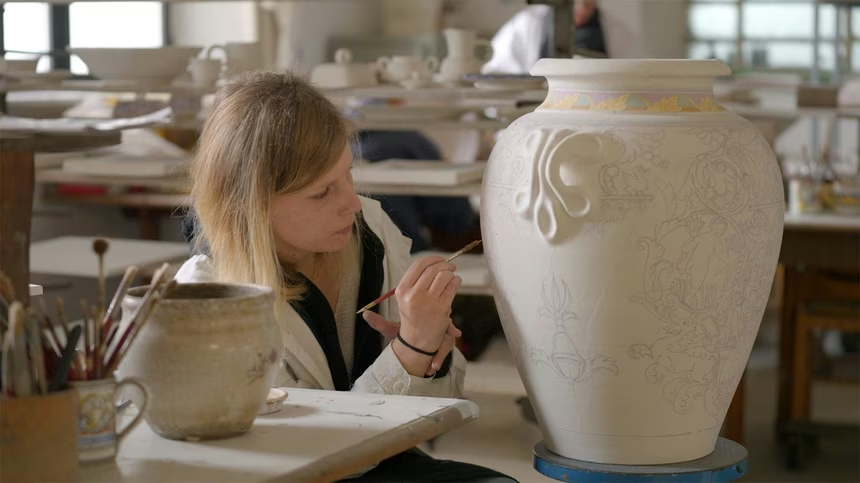
Made with Love celebrates the artisans keeping age-old traditions alive — an intimate journey into their workshops, kitchens, and the passionate hands behind extraordinary craft. Without them, a piece of our shared heritage would be lost.Providing Support for PBS.org
Learn Moreabout PBS online sponsorship♪ Narrator: Bologna, Italy.
Known as the red city.
It's shaped by endless porticos, iconic piazzas, and historic architecture.
But Bologna's true heartbeat isn't in its buildings.
It lives in its artisans.
Massimo: What we do here is keeping the tradition alive.
Narrator: Bologna is home to legendary creations, [Engines revving] and cuisines born right here.
Daniela: Special in the world.
Monica: Oh, la la.
Narrator: Discover the legacy of these master craftsmen and their timeless artistry.
[Wood creaking] in "Italy: Made with Love."
Narrator: To Enzo Bonife, the handmade luxury shoes that bear his name are more than footwear.
They are a promise fulfilled.
Man: My father was born in Bologna city center in old town in 1935.
Then when the war started, Bologna became a very dangerous place to be, so to escape the bomb, he moved to the mountains.
When he found himself there, he had to walk barefoot because his family was in a situation of extreme poverty.
He had pain, and his greatest dream was to have a pair of shoes.
And he promised himself to make the most beautiful shoes in the world.
Narrator: In the decade after the war, Enzo both enlisted in the air force and worked at a local footwear company.
There he found Guerrina, a young shoemaker who became his wife.
In 1963, they dared to make good on his dream, starting a line of handmade shoes.
[Enzo speaking Italian] Narrator: Today, these leather pieces of perfection are worn worldwide, with one pair even having found its way to American President Ronald Reagan.
But each is crafted here in Enzo's workshop.
It's a family business that includes son Massimo, wife Guerrina, Enzo, daughter Sylvia, and now granddaughter Benedetta.
[Enzo speaking Italian] Massimo: To create one pair of our shoes, normally we need from 300 to 350 different operations.
There are some big steps that we can sew.
Narrator: First Guerrina's skilled hands draw a model or pattern.
The difference between success and failure here is a matter of millimeters.
[Guerrina speaking Italian] Narrator: The pattern is then cut onto fine leather.
Massimo: We look for the best materials all over the world.
Woman: I start to work here 3 years ago.
I love working with my family.
[Enzo speaking Italian] Benedetta: I grew up here.
So I think this is my blood.
Narrator: For this shoe, the next step is a broguing, adding decorative perforations to the leather.
Massimo: So to make one pair of our shoes, we take about 4 weeks average.
Of course, it could be longer, depending on the construction requested by the customers and all the details requested to customize the shoe.
Narrator: The luxury leather is sewn together to create a flat seam.
The rest of the process uses a last, the molded form of a foot.
Leather is nestled around the last and secured in a special machine.
Small, strong nails tack the leather into place.
Then comes a different kind of hammering.
Enzo is one of only two people in the shop with the special skill to flatten the seams and strengthen the leather.
Massimo: This is not a job for him.
This is his passion.
Narrator: To sole the shoe, first a strip of leather is sewn around the bottom of the insole, an old-world process called welting.
The outsole is then secured to the welt.
Stitch by stitch, each shoe carries on Italy's reputation for producing fine footwear.
Massimo: Italian shoe culture is something that has very old roots.
In Bologna, there used to be a lot of good producers with a high level of quality.
Unfortunately, things changed during the end of the last century and many, many factory closed.
Narrator: Knowing they are torchbearers for their beloved craft brings purpose and care to their work each day.
Massimo: Now I'm doing the flattening of the sole to make it perfect for the next step.
A good indication if the sole is flat enough, it is that it has to change the color.
So be quite bright and clean.
And that's it.
Narrator: Its edges are milled to refine the appearance.
Then the sole and heel are prepared to be joined.
The surfaces are sanded to ensure a good connection with glue.
And finally, flame.
A small fudging wheel is heated to leave a decorative imprint.
As they are prepared for boxing, it's not only the shoes that shine, but also their makers.
Massimo: Of course, there are machines that can produce shoes, but we love to make shoes.
It's not over when the shoe is boxed.
It's over only when I receive the feedback of the customer.
Then we are really satisfied.
What we do here is keeping the tradition alive.
This is what my parents taught us.
It's the only way that we know to produce shoes.
So, our staff grow up by doing this techniques, and they don't know anything else.
So, we cannot change.
Venus, the mythical goddess of love, beauty, and desire.
So enchanting was this deity that local lore in Bologna says the mere sight of her navel prompted an innkeeper to recreate it from pasta.
The result, legend says, was tortellini.
Ok.
Narrator: Today in Bologna, a different kind of passion fuels those who handcraft this beloved stuffed pasta.
I'm Monica.
I'm Dani.
And we are sfogline in Bologna.
[Laughs] Narrator: Sfogline is a title these sisters wear with joy and pride.
Aw.
It marks them as master pasta makers, culinary artisans carrying on bologna's tradition of fresh pasta made with eggs.
Monica: We are having our 25th year inside the shop, 20 together.
Luckily, nothing terrible happened yet.
[Laughs] Narrator: So how did pasta become the culinary trademark of Italy?
It's thought the food arrived with the Arab invasion of Sicily in the 9th century.
But by the 1600s, it had spread far and wide thanks in part to simple machines that could make it.
Italians of all social classes recognized what everybody loves about pasta even now, it's delicious, affordable, and easy to store.
Today, the sisters are making tortellini and its larger cousin tortelloni.
Please, can you start with flour?
Double zero is a special flour.
Yes.
So this is very fine.
Narrator: This very fine flour is milled from an especially soft wheat grown in this region.
Mixing it with eggs in the signature style of Bologna makes it silky and flavorful.
Normally is 100 grams of flour and one eggs, medium eggs.
Egg.
Egg.
Ok.
Now we start with 3 eggs.
No.
4.
[Laughs] and the yolks is very yellow because chicken eat only corn.
Narrator: Rolling begins with a small pin.
It's a job Monica first learned from her grandmother at age 6.
Arms very strong.
Push over the dough and start like this.
So as you can see, thanks to my belly, I succeed in making this very thin, because the dough should be the envelope of what you see inside and you will taste after.
Narrator: But when you live and work with your sister, there's always a second set of eyes.
Uh... [Clicks tongue] not bad.
Every day I write a book.
Narrator: Each family in Bologna has its own recipe for the magic in this simple delight.
And these are the filling of tortelloni.
This is the filling of tortelloni.
Ok, sorry.
Made with ricotta cheese, parsley, parmigiano-reggiano, 36 months old.
Soften up like this.
Narrator: With a special cutting wheel, the gold dough starts to become tortelloni, a larger version of tortellini.
I am the best.
[Blows raspberry] because I am perfect.
No comment.
Narrator: The silky texture comes from the ricotta made with only cow's milk, not that of a goat or sheep.
Monica: This is very special because it's like a cream.
This is very important to us, having the water, because we need the elasticity of the dough.
Sometimes the dough could be just a little dry.
So we need water like this to keep it moist.
Narrator: Thin but strong, the pasta stretches over the filling into a triangle.
Dani: And pinch.
Like a little heart.
Ok.
Our tortelloni.
In Bologna, everything is heart.
Narrator: And the heart of Christmas is tortellini.
Served in broth, these small, savory bites are a central part of holiday dinner.
You have people come in here in July for booking tortellini for Christmas.
Because it is not Christmas in Bologna without tortellini.
In Italy.
But especially in Bologna.
Narrator: The meat filling is a mix of pork loin cooked in butter, mortadella, and prosciutto crudo, a type of dry, cured ham.
The meats are ground and mixed with other savory flavors.
Monica: Mix it with the parmigiano and salt, nutmeg, and eggs, but I mixed before.
And now we are goingh this wonderful thing.
[Speaking Italian] [Speaks Italian] the feeling is like essence of Bologna because the pork is fantastic, parmigiano-reggiano, fantastic, and eggs, special in the world.
Fantastic.
Special in the world.
Ooh, la la.
And inside the we put the filling.
Zzz!
Narrator: This is precision work.
When placed on a scale, each tiny bite should weigh 5 grams.
My tortellini are the best, more better than tortellini of my sister.
Because I am [Speaks Italian] The modesty is something.
Narrator: But why be modest when you have something so good?
Monica: Customers come from all over Italy.
And most of them, after Christmas, call us and send an email just to thank us to spend a fantastic Christmas with our tortellini.
Clap your hands, everybody.
And everybody, clap your hands.
Narrator: Maybe the joy in this kitchen finds its way into the food.
Monica: The importance of this job for Bologna, to me, is huge, because bologna must be remembered for a good food and to show the sweetness of the work like this.
To me, the best food in the world is from Bologna.
Narrator: It's 1633 in Italy.
Galileo is on trial in Rome.
The country is recovering from the plague.
And in Sant'Arcangelo di Romagna, a fabric printing shop opens its doors.
Today the stamperia is living history, a place that produces heirloom-quality printed cloth using centuries-old tools and techniques.
[Man speaking Italian] [Woman speaking Italian] Narrator: The Marchi family lives above its beloved shop.
[Alfonso speaking Italian] Narrator: Working with his son Gabriele and daughter Lara, Alfonso begins by spooling the fine fabric.
It must be prepared for printing.
That job is done with a machine that is the last of its kind on earth.
It's a mangle, or mangano in Italian.
The Marchis say that the origins of its design date back more than 2,000 years and appear in the writings of the Greek engineer Philo of Byzantium.
This nearly 500-year-old mangle was built after its design got an upgrade from one of the most famous minds in history.
[Lara speaking Italian] Narrator: It was set to be destroyed after World War II, until 12-year-old Alfonso stepped in and pleaded with his grandfather to keep it.
[Alfonso speaking Italian] Narrator: In the decades that followed, Alfonso's loyalty to this machine has never wavered.
All these years later, the Marchi family still powers it themselves.
The giant stone stretches and presses the fabric to prepare it for printing.
[Lara speaking Italian] Narrator: The result-- fabric as smooth as paper.
The family has more than 2,000 stamp designs, many hundreds of years old.
Those worn by time are painstakingly recreated using old world techniques.
[Gabriele speaking Italian] [Tapping] Narrator: As Alfonso's granddaughter looks on, the pressed cloth is cut before printing.
And finally, paint is spread and gathered on the stamp.
Then printing begins.
This paint the family uses is made from a secret recipe that dates back to the year 600 B.C.
Gabriele works in total silence.
It takes hours to print a large tablecloth.
A single mistake would mean starting over again on new linen.
[Gabriele speaking Italian] Narrator: After the fabric dries, the color is fixed, and the piece makes one more trip through the mangle.
[Lara speaking Italian] Narrator: Tablecloths like these are woven in rural homes because families cannot afford embroidery.
Printing was added for special occasions.
[Alfonso speaking Italian] Narrator: Today, cloth like this is popular throughout italy because it's strong enough to use every day and enduring enough to pass from generation to generation.
[Lara speaking Italian] Narrator: Bologna stands firmly in the modern world, built on an ancient foundation.
Through its artisans, the past remains alive today.
Massimo: This is what my parents taught us, it's the only way that we know to produce shoes.
Narrator: Their work is living history... As new generations are writing the next chapter in this proud heritage, infusing each creation with passion and love.
[Kissing] Narrator: "Made with Love" shares the stories of dedicated artisans from around the world.
[Fire burning] honoring their work, to help preserve these traditions for generations to come.
For more information, visit... [Exhaling] ♪















Support for PBS provided by: