
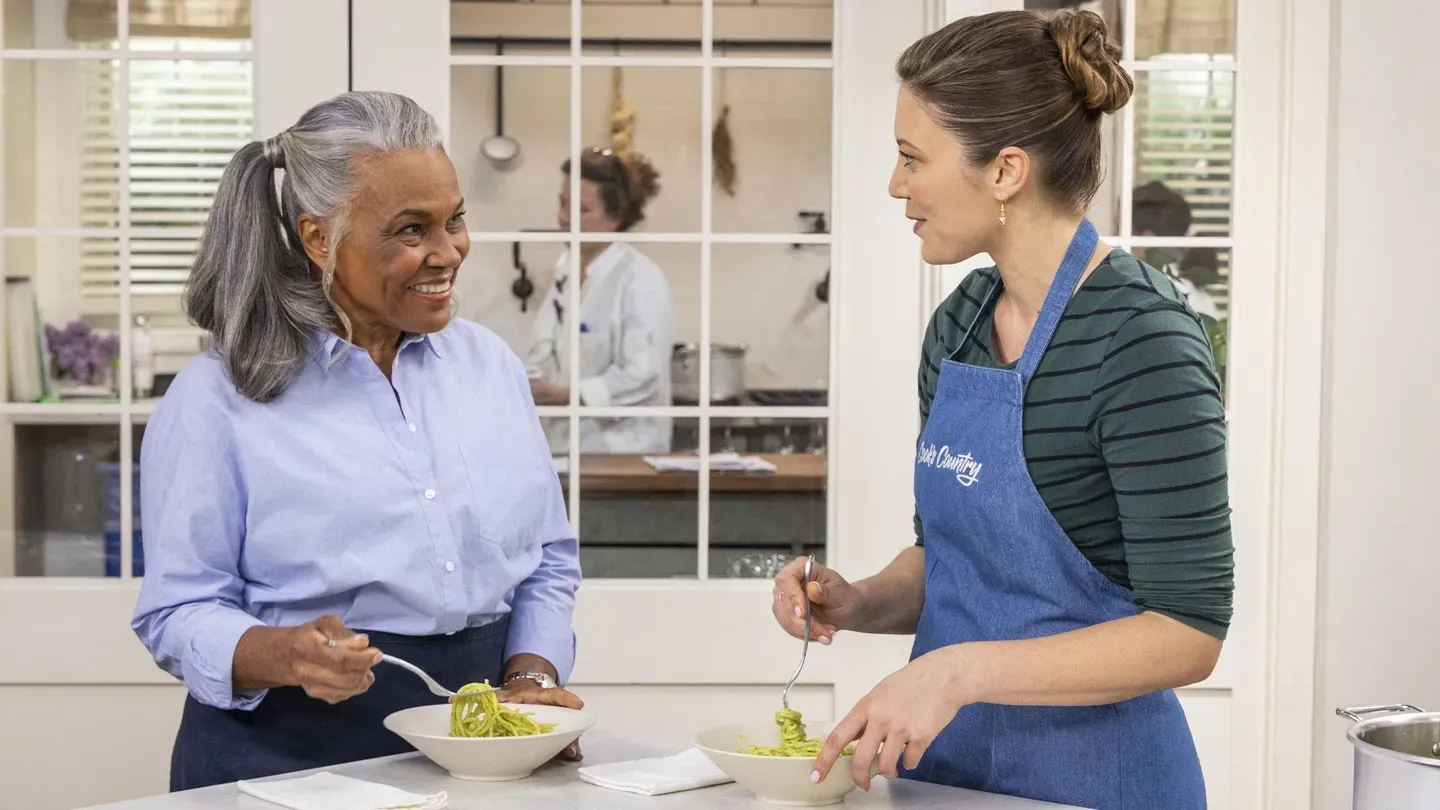
Cook's Country
Mesquite-Grilled Tacos Rasurados
Season 18 Episode 1822 | 27m 55sVideo has Closed Captions
Barbecued Chuck Roast, Tomatillo and Bibb Lettuce Salad with Tomatillo Ranch
Test cook Bryan Roof hits the road to Lockhart, Texas, where he explores its barbecuing traditions, and then cooks up some Barbecued Chuck Roast for host Bridget Lancaster. Toni Tipton-Martin shares the origins of ranch dressing. And test cook Kelly Song prepares a delightful Tomatillo and Bibb Lettuce Salad with Tomatillo Ranch for host Julia Collin Davison.
Problems playing video? | Closed Captioning Feedback
Problems playing video? | Closed Captioning Feedback
Cook's Country is presented by your local public television station.
Distributed nationally by American Public Television
Cook's Country
Mesquite-Grilled Tacos Rasurados
Season 18 Episode 1822 | 27m 55sVideo has Closed Captions
Test cook Bryan Roof hits the road to Lockhart, Texas, where he explores its barbecuing traditions, and then cooks up some Barbecued Chuck Roast for host Bridget Lancaster. Toni Tipton-Martin shares the origins of ranch dressing. And test cook Kelly Song prepares a delightful Tomatillo and Bibb Lettuce Salad with Tomatillo Ranch for host Julia Collin Davison.
Problems playing video? | Closed Captioning Feedback
Where to Watch Cook's Country
Cook's Country is available to stream on pbs.org and the PBS app.
Providing Support for PBS.org
Learn Moreabout PBS online sponsorship♪♪ -"Cook's Country" is about more than just getting dinner on the table.
We're also fascinated by the people and stories behind the dishes.
We go inside kitchens in every corner of the country to learn how real people cook, and we look back through time to see how history influences the way we eat today.
We bring that inspiration back to our test kitchen so we can share it with you.
This is "Cook's Country."
♪♪ Today on "Cook's Country," Bryan heads to the barbecue capital of Texas, Lockhart... then he makes his version of barbecued chuck roast... I share the history of ranch dressing... and Kelly makes a refreshing tomatillo and Bibb lettuce salad with tomatillo ranch dressing.
That's all right here on "Cook's Country."
♪♪ -Funding for this program has been provided by the following.
Monument Grills -- made for everyone, from the backyard master to the weekend host and the beginner just starting out.
Monument brings people together.
Monument Grills.
The everybody everywhere grill.
-Teakhaus.
Inspired by a passion for cooking and respect for our planet.
Each board is handcrafted from sustainably sourced wood designed for every step, from food prep to presentation.
Teakhaus.
♪♪ ♪♪ ♪♪ ♪♪ ♪♪ ♪♪ [ Cow moos ] -In a state that's well-known for its incredible barbecue, Lockhart, Texas, might just take top honors.
"The Bar-B-Que Capital of Texas," as it's officially known, is home to a few of the most celebrated barbecue joints in the country.
And today, I'm headed to an institution that's been in business for over a century: Kreuz Market.
Kreuz was opened in 1900.
It's an example of the classic German-style meat market that's common in this part of Central Texas, which was settled by German immigrants in the mid-1800s.
♪♪ -We've been doing it for over 100 years.
-Pitmaster Roy Perez has been the guardian of tradition at Kreuz since he took over the pits in 1987.
-I've been here for 37 years.
And in 37 years, I've taken maybe a week's vacation and, uh... Because I just love working here.
-At Kreuz, they do just about everything the old-fashioned way.
Their eight brick barbecue pits are fueled by smoldering hot coals... always shoveled over from the previous day.
-When I first started, I remember when the boss man... He said, "If I ever catch anybody here using paper to start the fires, they're gonna be fired."
-When Kreuz Market moved to a new building on their 99th anniversary, it was Perez who dragged a metal washtub filled with hot coals from the old restaurant pit to the new location up the street.
In a sense, the same fire's been burning in these pits for over a century.
As with most great barbecue, the key to Kreuz's success is all in the technique.
Roy shows me how to build a fire by stacking the logs to maximize airflow then carefully adding the hot coals to get the blaze started.
♪♪ Alright.
So does that look good?
-It's real good.
-Is that acceptable?
-Yes.
-Smoky enough?
-You're ready to put an apron on and get working.
-On any given day, Roy's cooking a variety of meats in these pits: sausage, beef ribs, even boneless turkey breast.
And while brisket is the undisputed king of Texas barbecue, Kreuz serves up another specialty that's less common on barbecue menus around here: beef shoulder clod.
The shoulder clod is a large boneless cut which, as the name suggests, comes from the shoulder.
It's big in flavor and size, often ranging from 13 to 21 pounds.
-It's a lean piece of meat, naturally tender.
Brisket, you have to cook it to where it gets tender.
This one, you don't have to worry about it.
You can sell this rare, medium rare, and it's always gonna be tender.
-The clods are seasoned simply the night before.
Just salt, pepper, and a little cayenne.
Then they go in the fire to cook for 4 to 5 hours.
But while the process may seem deceptively simple, that's only because it's second nature to Roy after all these years.
-Like I said, years of experience.
You know how to keep it.
You know if you need more wood.
And also, like, all the factors.
Is it humid outside or is it cold?
So do you need more wood on the fire or less?
You know, it's -- Just so many factors.
You don't just throw the meat in... -Right.
-...and forget about it.
-And while many barbecue joints pride themselves on low and slow cooking, at Kreuz, they turn that formula on its head.
They keep their pits at a scorching 400 to 500 degrees, nearly twice as hot as other places.
-I mean, we do it old-school.
-Yeah.
-We just put the raw meat on, get it done, sell it, and out the door.
-So it's hot and fast rather than low and slow.
-Yes, sir.
-Finally, the shoulder clod is ready to come off the pit and it's time for me to try it myself.
Roy, this is absolutely amazing.
I'm just like -- I'm getting this, uh -- this beef steamed facial here.
-There you go.
Let me know what you think.
-Alright.
Man, I cannot believe how good it is.
Like, there's a -- a smokiness to it.
-Mm-hmm.
-But it comes in, you know, second place to how beefy it is, you know?
It's just like you get that pure essence of beef.
Nice seasoning on the outside.
But it's just so well-balanced.
Not too tough, not too tender.
-Let me ask you a question.
-Yeah.
-Does it need barbecue sauce?
-Absolutely not.
-Exactly.
And later on, if you want to sit down and add barbecue sauce, help yourself, but at least give it a chance without before you cover it up with sauce.
-Yeah.
-We put so much hard work into it that we hate for you to cover it up.
-After seeing all the hot, smoky work that goes into creating truly incredible barbecue, any fantasies I had about opening my own barbecue joint someday are definitely out the window.
But I know that if I'm craving some of the best smoked meat in the country, all I have to do is book a trip to Lockhart, where I'll find my friend Roy Perez dutifully manning the pits.
So I'm gonna sit here by myself and eat this entire plate of barbecue.
Seriously, I am.
♪♪ ♪♪ -I have a question.
-Go ahead.
-I saw that big thing of barbecue, that huge platter of barbecue.
-Mm-hmm.
-How long did it take for you to finish that?
Did you?
-Uh, I actually did.
It took me a few minutes.
It took me a few minutes.
-[ Chuckles ] -I was full, for sure.
But no regrets.
-Yeah.
-In honor of Kreuz and Roy Perez, we are going to focus on a chuck roast.
So their shoulder clod, it's a big hunk of meat.
Obviously, we're not gonna do that.
We're using a chuck eye roast here.
And the great thing about the shoulder clod and the chuck eye roast is it's got an incredible amount of beef flavor.
You know, it's really rich.
There's a lot of intramuscular fat.
And using a 5-pound chuck eye roast here, we could easily fit it on our 22-inch kettle grill.
So we're going to start off by making our rub, and it's going to be a very simple rub.
So we have 1 and 1/2 tablespoons of kosher salt here.
To that, we're going to add 1 and 1/2 teaspoons of pepper and 1/4 teaspoon of cayenne.
And that is basically the Kreuz rub.
So we'll just mix this together.
So, typically you might find this cut with a nice fat cap on top, but today ours doesn't have any fat cap.
If you had a fat cap that was bigger than, say, a half-inch, you might want to trim it down to a quarter-inch, you know?
But a little bit of fat on this meat is pretty good.
But we do want to dry it off a little with some paper towels to make sure our rub is going to stick to it.
And now we're just going to sprinkle it all over with our seasoning mixture here.
And the great thing about seasoning it on plastic wrap is when we wrap it up in the plastic, all that seasoning is going to adhere to the meat and just come in close contact with it.
And we just wrap this up nice and tidy.
I like to make sure, as I start to fold it, I get all the seasoning back on the meat first... and then just wrap it in like that, wrap it in like that.
Okay, so, this is going to go into the refrigerator for at least 18 hours, but if you can do a full 24 hours, it'll be that much better.
And during that time, that salt's going to help penetrate the meat and really change the structure of the protein so they hold onto a lot more moisture as they cook.
-Great.
-Alright, Bridget, before we head out to the grill with our meat that's been curing for 24 hours, we want to make a wood-chip packet.
Now, these wood chips have been soaking in water for at least 15 minutes.
You can go for a little bit longer if you need to.
And these are post-oak chips.
-Perfect.
-Because it's Central Texas barbecue, we're using oak today.
So these 2 cups of chips have been soaking.
So we want to put all the chips right here in the middle of a piece of foil.
We're just going to fold it up.
We want to make a packet that's about 8 by 4 inches.
So we'll fold in the sides.
We found that this particular size, especially for our grill setups that we typically use and the 22-inch kettle grill, like, an 8x4-inch packet is enough to really get the chips smoking but not smother the coals beneath.
-Got it.
-So that's why it's important.
-Well, the smoke's an ingredient, so you got to get it right.
-Yeah.
You got to get it right.
Now we're going to cut two 2-inch slits into the packet.
And that'll be ample room for the smoke to come out and for the fire to breathe.
-Okay.
-So we'll grab our meat and we'll head out to the grill.
-Sounds good.
-Alright, Bridget.
We have 6 quarts of charcoal briquettes burning over here, and that's going to provide a really intense heat.
-Nice.
-So we're going to pour the coals into the grill.
And we're going to bank them steeply on one side of the grill.
-Okay.
-So that's going to give us that high heat, but it's going to be flowing right across the meat.
So I'm going to just dump these coals in there.
-Nice.
-You want to take the tongs and kind of bank them up a little bit more steeply.
-Right.
-Because you don't want any of the coals directly underneath the meat.
And them on top of that, we're going to throw our wood-chip packet.
Then we can put our grate on top.
And we're going to cover the grill up and let that go for about 5 minutes so the grate can heat up and those wood chips will begin to smoke.
I should mention, too, that both the bottom and the top grill vents are fully open, so we get a lot of nice air circulation.
-Okay.
-Alright.
So the grill's been heating up for 5 minutes.
You can see the chips are just beginning to smoke.
And that's because we soaked them.
So there's a little bit of delay before they ignite.
-Okay.
-We're going to clean the grill.
Wipe it down with a little bit of oil.
And now we can throw our chuck roast onto the grill.
We're going to keep it away from the fire.
All the way here on the cool side of the grill.
-Okay.
-So we're going to insert our temperature probe right into the middle of the meat.
Okay?
And tuck that in.
I'm going to cover the grill and let this go for about 1 and 3/4 to 2 and 1/4 hours until it hits 145 to 150 degrees.
So that's about medium well right there.
-Okay.
-It'll be mostly cooked on the outside, but right in the center it'll be just slightly pink.
And so when you slice it thin, it'll still retain a lot of that juiciness.
-Can't wait.
-Alright, Bridget, it's been a couple of hours.
We've hit 145 degrees here, so that means the meat is ready to come off.
-[ Gasps ] Ohh!
What a reveal!
-Isn't that gorgeous?
It's so gorgeous.
And you can smell that kind of wood smoke coming through.
It's so nice.
So we're going to just transfer this right to our cutting board.
-Or my mouth.
-[ Chuckles ] And we pull out the temperature probe, which is extremely hot, and set that aside.
And then we're just going to cover this with a little foil and let it rest for 20 minutes.
-Okay.
I'll race you inside.
-[ Chuckles ] Alright, Bridget, this roast has been resting for 20 minutes.
The goal here is we're going to slice it really, really thin, and so we're just going to lean in.
Just nice thin slices.
-Ohh!
-You can smell how smoky that is.
-Abso-- I can see it.
That huge smoke ring on there.
-That smoke ring is just phenomenal.
You know, there's so much intramuscular fat throughout that everything remains juicy.
So can I give you a little meat here?
-You can give me a lot of meat.
-Alright.
Perfect.
There you go.
-Mmm!
-And a little bit for myself.
Okay.
We're all set.
-And that was just salt, pepper, and cayenne, right?
-Salt, pepper, cayenne.
That's the trinity at Kreuz Market.
-Nice.
-Central Texas style.
Very simple rub.
-Right.
-Okay, so, now before us, we have white bread.
-Mm-hmm.
-Every order at Kreuz Market gets a stack of white bread like this.
-Yes.
-I never really eat it, but I feel like it's a symbolic gesture that needs to be on our table here.
A few pickles.
-I'll take some pickles.
-Okay.
You know, it's just got a little bit of pinkness to it.
It's still juicy, though.
-Beautiful.
Yeah.
You can see that in there.
-Mm-hmm.
Mmm!
-Beef, salt, smoke.
-That's all you need.
Maybe try with a little slice of pickle.
-Mmm!
Good idea.
-I should also say that we are breaking a cardinal rule at Kreuz Market.
There's a sign that says "No forks.
Forks are at the end of your arms."
[ Laughs ] -Even the very exterior.
-Mm-hmm.
-Still moist.
But, oh, my goodness.
That's the smoked bonanza right there.
-I love the little lines of intramuscular fat.
-Oh, yeah.
Just a gorgeous, luxurious cut for not a lot of money.
-Absolutely.
Like I said, it's just a ton of flavor.
It holds onto the smoke really well, and it just stays juicy.
-Stunning.
Thank you so much, Bryan.
This is blue ribbon.
-Oh, I'm so glad we could share it together.
-And you're a winner.
[ Chuckles ] If you want to make this great Texas barbecue, it starts with rubbing a chuck eye roast with salt, pepper, and cayenne and refrigerate for at least 18 hours.
Bank charcoal on one side of the grill and add the wood-chip packet onto the coals.
Smoke the roast on the cooler side of the grill for 2 hours.
So, from "Cook's Country" and a special shout-out to the folks in Lockhart, Texas, barbecued chuck roast.
-Are you doing -- Alright.
I was about to say.
Are you picking up your fork again?
-No.
No way.
I'm never using a fork again, Bryan.
♪♪ -Once upon a time, there was an iconic condiment that got its start, of all places, on a dude ranch in Santa Barbara, California.
In the 1950s, the Hidden Valley Ranch was a typical dude ranch, offering guests activities such as horseback riding, hiking, and fishing.
But its owners, Steve and Gayle Henson, also hosted banquets where they served their own house dressing made with buttermilk, herbs, and spices.
Guests loved the recipe so much that the Hensons started selling packets of the dry mix, along with instructions for adding buttermilk and mayonnaise.
It became so popular that they closed the ranch and turned it into a full-time factory.
They named their product Hidden Valley Ranch.
Today, the term "ranch dressing" is generic for this style of creamy dressing, and it's even served as a dip for pizza and chicken wings.
And here at "Cook's Country," we create our own spin on the classic ranch recipe to dress our tomatillo and Bibb lettuce salad.
♪♪ -Tomatillos are a husked nightshade fruit known for their firmness and their tart floral flavor.
Now, usually they're cooked, to soften the texture and tame the tartness, but today Kelly's got a recipe for us that uses them raw in a salad.
-That's right.
You wouldn't expect that, right?
-No.
-Well, before I developed this recipe, I had never had them raw before, but I'm fully converted now.
-Okay.
-They're just bright, punchy, and they make an amazing palate cleanser, especially when used in the form of a salad.
So that's what we'll make today.
-I can't wait to try it.
-Yeah?
So I like to start with the star of the show, which are tomatillos.
These gorgeous green gems.
-Aww!
-Here I have a pound and 3 ounces, so a heaping bowl.
And we're just going to start by taking their jackets off.
-I love that you called it their "jackets."
-Yeah.
A little coat check.
-[ Laughs ] -The jackets are called calyxes.
The way you know that they're ripe is actually when the calyx, or the jacket, is a little bit separated from the fruit.
So when you're at the grocery store, you really want to look for one where the jackets are starting to peel away.
-Okay.
-Now those are all off.
And I'm just going to give these a little rinse-off.
And I like to give each one a little bit of love.
-[ Chuckles ] -Nice rubdown.
And I'm just going to drop them on this paper towel-lined rimmed baking sheet just to absorb any excess liquid.
And now we're going to towel them dry.
So we're actually going to use these tomatillos in two different ways today: a little bit in the dressing and the rest for the salad itself.
-Oh, clever.
-Yeah.
So I'm just going to start by weighing them out.
These tomatillos are -- They're pretty dense, so this should only take 1 or 2 tomatillos.
-Looks good.
-It's about 3 ounces.
Right?
Now we're going to use this to make the dressing.
-Okay.
-So, today we're going to be making a spicy tomatillo ranch.
-Oh, very cool!
-Yeah.
It's super delicious.
So the base of the ranch is actually going to be the tomatillo itself, and it's going to add this pop of brightness and acidity almost like buttermilk would to ranch.
-Oh, that makes sense.
-Yeah.
So I'm just going to quarter these guys.
It's all going to be blended, so it doesn't need to be super precise.
And because we're making a ranch, of course we need pops of fresh herb.
-Mm-hmm.
-So I'm just going to chop the cilantro.
I'm looking for 2/3 of a cup.
And here I like to use both the stems and the leaves.
Just pack that right in.
And all of this will be built right in the blender.
-I love it.
Nice and easy.
-Yeah.
Super simple.
Great.
And we're also going to be adding some chives in.
That just adds an allium-y hit.
So I find that it adds a lot of complexity.
And I'm just looking for 2 tablespoons of minced chives.
Again, these will be blended, so... not too hard on myself with my knife skills.
I'm looking for about 2 tablespoons packed in.
When I think of ranch, I think of dill.
-Absolutely!
-That's what makes ranch... ranch.
-Yep.
-So for the dill, I like to just give them a rough chop, as well.
Just having fun with our herbs today.
I am looking for a tablespoon of this.
And into the blender again.
And like I mentioned before, this is a spicy ranch, so we're going to add a jalapeño in there.
-Mmm!
-We're going to keep the seeds in.
-Yeah, you are!
And the ribs!
-Everything in there.
I've just removed the stem and given this a rough chop.
And all of that goes in there.
Our goal today is to have a super creamy, luxurious, rich ranch, so to achieve that, I'm using 1/3 of a cup of mayonnaise.
And I'm also adding 1 teaspoon of granulated garlic... as well as 1/2 teaspoon of table salt... and 1/4 teaspoon of black pepper.
And like I mentioned before, the tomatillos can be pulpy, so I want to blend this for a whole 90 seconds.
[ Whirring ] Great.
So that was a whole 90 seconds.
Let's see if our patience paid off.
And now I'm just going to transfer it to a serving vessel.
So the dressing, we're reserve for later, and now we can move on to the salad itself.
So I had a remaining 1 pound of tomatillos, if you remember, and so for the remaining, I'm just going to slice them as thin as possible.
And I like to slice them with the stem side down just to anchor it a little bit.
It's flatter that way.
Why make life harder?
-[ Chuckles ] -And I start by slicing one half.
I like to give the tomatillo a little rotate and then start on the other half.
And I'm going as thin as possible.
You want to aim for about 1/8 of an inch to 1/4 of an inch.
And like I mentioned before, the tomatillos are actually quite tart, so I want to give them little extra love just to balance out their flavors.
So I'm going to do that by macerating them... -Okay.
-...which basically just means coating them in some sugar.
Here I have 1 teaspoon of granulated sugar... as well as 1/2 teaspoon of table salt.
And that salt and sugar is really going to do several things.
It's going to infuse with the pulp to add a sweet and savory balance to the fruit, but while it's doing that, it'll also draw out any excess moisture so that our salad isn't waterlogged.
And it'll also help to soften the skin slightly and just soften the fruit overall.
-So, how long do you have to let them sit?
-So, I'll let these rest for 10 minutes and just let the salt and sugar do its work.
-Okay.
-So, it's been 10 minutes, and let's see what the macerating did for us.
-Oh, look at all that liquid!
-Yeah.
That would have ended up in our salad.
And the flavor of the tomatillo is super concentrated, as well.
So I'm going to drain that out because I'm not looking for that to be in my salad.
And here I have the leaves separated from one 7-ounce head of butterhead lettuce, sometimes called Bibb or Boston variety.
I'm just going to add the tomatillos right on top of the lettuce.
And using my hands again, I find this just to be the most gentle way.
I'm just going to give these a toss together.
And now that these have mingled a little bit, I'm just going to start to platter them.
So you really want to find the biggest platter that you own for this salad.
And that really just helps all the leaves breathe and everything to have a lot of room to spread out.
-Mm-hmm.
-And I find that liquid can begin to pool along the bottom.
None of that is attractive, so we really want to let everything shine.
And now that we have everything nice and spread out, we have a big canvas for drizzling our dressing over it.
So this is the dressing we made before.
And I'm just going to drizzle 1/2 cup over the salad.
And the remaining dressing, you can pass on the side during dinner or you can save that in the fridge for up to four days.
-Oh, nice!
-Yeah.
Right on top of this, continuing the green on green on green... roasted salted pepitas, also known as pumpkin seeds.
And I'm adding about 2 tablespoons here.
This just adds another pop of color but also some crunch and a nice salty burst.
Ready to dig in?
-Yes!
-Great.
Give you some nice balance of leaves and tomatillos.
-Mmm!
I can't wait to try this.
Alright.
I'm going right in for a tomatillo with a whole bunch of dressing on it.
-Nice.
-Mmm!
You get the tartness of the tomatillo, but it's mellowed, it's rounded on the back end because of, I think, the macerating.
Oh, there was a little heat in the jalapeño.
Oh, but it's good!
It's good.
That's a really good ranch!
It's like a modern version of a ranch, right?
The acidity is there.
The creaminess from the mayonnaise.
But it tastes greener.
It tastes fresher.
-And I find that even though it's spicy and herbaceous, the sweetness of the tomatillos kind of acts as a balance.
-Yeah, and the butter lettuce is almost like a nice mild foil because you've got the spiciness of the dressing, you've got the tartness of the tomatillo, and then just the mild butter lettuce.
-How do you feel about raw tomatillos now?
-Mmm!
I love it!
Kelly, this is really eye-opening and delicious.
Thank you for showing me how to make it.
-Thank you for joining me.
-If you want to make this super-green tomatillo salad, start by blending the tomatillos with lots of fresh herbs and mayonnaise to make a punchy dressing.
Macerate the tomatillos and let them drain for 10 minutes.
Then assemble the salad on a wide platter.
From "Cook's Country," Kelly's very own tomatillo and Bibb lettuce salad with tomatillo ranch.
You can find this recipe and all the recipes from this season, along with our product reviews and select episodes, at our website, CooksCountry.com/TV.
You know, I didn't even mention the pepitas.
I love their little crunchy, salty bites.
-They really pop up in there.
-Mm-hmm.
Hm.
-Let us help with dinner tonight.
Visit our website anytime for the newest season's rigorously tested recipes, full episodes, ingredient advice, and equipment reviews.
CooksCountry.com/TV.
-"The Complete Cook's Country TV Show Cookbook" brings together every recipe, tasting, and test from 18 seasons of the beloved TV show.
With trusted equipment recommendations and insights from the entire cast, this book is your guide to the very best in regional cooking.
The cost is $24.99, $15 off the cover price of $40.
To order, head to our online shop at CooksCountry.com/book.
-Funding for this program has been provided by the following.
Monument Grills -- made for everyone, from the backyard master to the weekend host and the beginner just starting out.
Monument brings people together.
Monument Grills.
The everybody everywhere grill.
-Teakhaus.
Inspired by a passion for cooking and respect for our planet.
Each board is handcrafted from sustainably sourced wood designed for every step, from food prep to presentation.
Teakhaus.
♪♪ ♪♪ ♪♪ ♪♪ ♪♪ ♪♪ ♪♪ ♪♪ ♪♪ ♪♪
 New Episode
- Food
Christopher Kimball’s Milk Street Television
Transform home cooking with the editors of Christopher Kimball’s Milk Street Magazine.






Support for PBS provided by:
Cook's Country is presented by your local public television station.
Distributed nationally by American Public Television