
The Battle to Breathe: The Last 10%
Clip: Season 53 | 18m 6sVideo has Closed Captions
Inside the race to bring life-saving genetic therapies to every person living with cystic fibrosis.
Can progress outpace progression? For around 90% of people living with cystic fibrosis— a deadly genetic disease— new prescription drugs offer life-changing treatment. But for Emily Kramer-Golinkoff and the remaining 10%, the wait continues. Can modern breakthroughs like gene-editing offer a cure? Discover how relentless champions like Emily are fighting to ensure no person with CF is left behind.
Problems playing video? | Closed Captioning Feedback
Problems playing video? | Closed Captioning Feedback
National Corporate funding for NOVA is provided by Carlisle Companies. Major funding for NOVA is provided by the NOVA Science Trust and PBS viewers.
Support provided by:


The Battle to Breathe: The Last 10%
Clip: Season 53 | 18m 6sVideo has Closed Captions
Can progress outpace progression? For around 90% of people living with cystic fibrosis— a deadly genetic disease— new prescription drugs offer life-changing treatment. But for Emily Kramer-Golinkoff and the remaining 10%, the wait continues. Can modern breakthroughs like gene-editing offer a cure? Discover how relentless champions like Emily are fighting to ensure no person with CF is left behind.
Problems playing video? | Closed Captioning Feedback
Where to Watch NOVA
NOVA is available to stream on pbs.org and the PBS app.
NOVA Labs
NOVA Labs is a free digital platform that engages teens and lifelong learners in games and interactives that foster authentic scientific exploration. Participants take part in real-world investigations by visualizing, analyzing, and playing with the same data that scientists use.Providing Support for PBS.org
Learn Moreabout PBS online sponsorship- I spend a lot of my day hooked up to medical devices.
I inhale a whole variety of different medications.
I have an airway vest which vibrates my lungs.
There's not a minute of a day that goes by where CF is not on my mind.
I inhale a specific drug that helps thin the mucus and keep it from building up and leading to lung infections.
I've started using some supplemental oxygen.
Any respiratory virus can spur really life-threatening lung infections.
For me with such advanced stage disease, you know, after COVID, my family made the really difficult decision to remain in strict isolation.
There is this like constant ticker in my head monitoring every single bodily sensation, every pain I feel in my lungs, and it is exhausting.
Every single person deserves a breakthrough and we won't rest until we get there.
- In my early career, giving someone the diagnosis of cystic fibrosis was very traumatic for the family and honestly traumatic for the physicians because people were still dying quite young.
So people are born with this disease.
They have signs and symptoms early as toddlers, and over time the disease progresses.
There used to be very few options for how to treat people.
So it was basically a lot of physical therapy, chest beating to help them move the mucus out and IV antibiotics.
But still, people with CF, especially the children, were so resilient in spite of their very, very challenging daily life.
- I remember doing your chest beating outside.
- In public.
- Yeah.
I mean, I had to do it twice a day.
I just wanted to get it over with.
She starts growing and you, you get used to CF and you don't really understand how rough cystic fibrosis is until you experience it.
- It was incredibly disruptive to my, you know, life.
I spent the greater part of my freshman, sophomore years on IVs in the hospital, really sick.
And then after college, that's when I plunged into this new, much more advanced stage of the disease.
We saw this future of running out of treatments and needing more than was laid out before us.
And that was around the time that the modulators were being developed.
- Modulators really act like almost no other drugs that were ever discovered.
They target the basic problem in CF, that you have thick, sticky mucus because the protein called CFTR does not function properly.
The first modulator was called Kalydeco.
You have this CFTR protein that can't turn on.
And what that drug did was it bound to a spot on the protein to get it to work.
- These patients had lungs that were clogged with mucus, and this little pill, within a few hours of taking it, they would start coughing up this horrible, disgusting mucus.
And for the first time in their lives, they could start to breathe deeply.
- Trikafta.
- I can breathe in so much deeper.
- Trikafta works for 90% of CF patients.
Well, what about that 10% that have mutations that can't be fixed?
- On Sunday?
- Well, it can't be tomorrow.
- We were so happy for the incredible advances happening, but that's when we learned that I was not part of the group that was poised to benefit.
I have a mutation that is part of a group of mutations called nonsense mutations, and what differentiates our mutations from all the rest is that we don't even produce a protein.
This is a more profound defect, and therefore it's a lot more difficult to fix.
Of course, you think, well, what's coming down the pipe for us?
And then to realize that there was also nothing in place and no drugs in the pipeline that would help us.
It was like beyond what we could even understand.
So what are we going to do about it?
From day one, our singular goal was to raise money to accelerate life-saving research for those that don't benefit from existing modulators.
We had no experience, no knowledge of how to raise money, so we filmed this video telling our family's story and asking people for help.
- Her lungs are getting worse.
- CF is playing out its course despite all of her efforts.
She spends four hours a day doing airway clearance.
She's doing everything she can.
You can help.
- Help us help our sister.
- You spent hundreds and hundreds of hours on that video.
- [Speaker] Hundreds of hours.
It was a labor of love.
- We made a video that we were very proud of, and we sent it out to every single person we knew.
Within minutes, the first donations came in and they came in from people we didn't even know.
And in the first week, we raised over $40,000.
That was the start of Emily's Entourage.
We started with a bang.
We quickly realized for the outlying 10% that we urgently needed research attention.
And so we went on this massive campaign to try to understand the landscape and hear from the researchers how could we be helpful?
What do they need?
One of the things we realized is that there were no cell systems for our mutations for drug development.
And so I was like, "Well, that is something I can help with."
I started like a national tour of donating my cells to different research labs.
It felt like the greatest privilege in the world to get to connect with the frontline people that held the power of discoveries that could become treatments.
- Emily's putting her heart and soul into finding new technologies that potentially could help treat the 10% of people who don't respond to Trikafta.
What she and her family do so that other patients can benefit, there are no words.
It's just extraordinary.
- We are a community that is filled with both unbelievable progress and also urgent, desperate, continued need.
We are not going to rest until there are good solutions for 100% of the CF population.
- Every patient should have a therapy that gives benefit just like the modulators.
So we and the entire CF community are bringing in a whole new generation of scientists that will go back to the biology, back to the roots of a genetic disease.
So in the case of CF, you have a faulty gene.
The faulty gene gives rise to a faulty mRNA, and then that goes on and gives rise to a problem with a protein, either a mutated protein or no protein.
The modulator works on the protein.
So what about the other two steps?
There is a whole new area of medicine that needs to be developed, genetic-based therapies that work on the DNA and the RNA and trying to make a normal functional protein.
- With gene therapy, what they discovered is that getting a gene into the cells of a patient with cystic fibrosis is not an easy thing.
They couldn't get it past the mucus, and when they did, it was impossible to get the gene into their lungs without the immune system freaking out, and it was dangerous.
- There was very little experience in the field.
Now, there's a history.
Diseases that were absolutely devastating can now be cured with gene therapy.
So we want to take advantage of those advances and move forward four different types of genetic-based therapies.
Gene delivery, where you replace the gene, so you have a healthy RNA to make a healthy protein, mRNA therapy to replace the mRNA, ASOs to fix the RNA, and gene editing, where you're actually fixing the genetic defect.
The simplest approaches will probably come first, what we frequently refer to as ASOs.
These are little pieces of DNA or modified RNA that you can deliver to the cell.
Each finds its complimentary sequence and they form kind of a patch to go after very specific mutations.
There are studies going on right now and they're really promising.
- [Announcer] The first speaker, Professor Batsheva Kerem.
- Hi, good afternoon.
These are interim results.
This is the first evidence of potential clinical benefit.
This was really exciting and very well received by the audience.
So I'm very happy and proud and excited.
I hope that we can contribute to at least this group of patients that cannot at the moment benefit from the current available modulators and the results looks good.
- I am the national lead primary investigator on the study for 4DMT, which is a DNA gene therapy.
So we are doing that trial here as well as testing mRNA therapy.
Unlike the modulators which are actually working on the protein that isn't made correctly, if you use gene therapy or mRNA therapy, you're actually telling the cell to make the proper protein.
We're in the very early phases of doing all of these trials right now, but what's really exciting is that for our DNA trial, we were able to actually see that we got the corrected gene into the airway cells of CF patients that need to have that corrected protein.
The thing that's so amazing about these therapies is it wouldn't matter what mutation you have, if they work, they'll work for all people with CF.
- So gene editing is really the holy grail.
Instead of adding something to your cells, which will bypass the genetic defect, you're actually going to the DNA itself and you're fixing it.
That genetic mutation no longer exists, you no longer have cystic fibrosis.
It's going to be probably several years before gene editing is tested in people with CF.
But I will say there's never been a more exciting time.
There's never been more effort in this field, and watching this progress and move forward in CF has been just absolutely astounding.
- People ask me all the time which therapeutic approaches I'm most excited about.
Like I'm excited that we have multiple therapeutic approaches.
At Emily's Entourage, we don't play favorites.
Our favorite is the thing that gets us to the finish line.
We want to be at the very leading edge, helping to cultivate and support and celebrate the people that get us there.
- I am in the scientific board of Emily Entourage and their work is fantastic.
She's very strong and I hope for her that she will be available to benefit from either our approach, our drugs or others.
- There is a big part of me that knows that there's a good chance that all the work that we're doing won't come in time for me.
I feel my own disease progressing with every passing minute, and I'm just one of many people who need this yesterday, need this 10 years ago.
And so my desperation has not lessened, my focus on the end goal has not lessened.
It's intensified exponentially because the time we have to do this is running out.
It's like can the progress outpace the progression?
And that is always the race that we are fighting down, not on behalf of just me, but on behalf of our entire community and every single person that loves them.
And so that is my life's work, that is my dream, and that is how I am choosing to spend, you know, my remaining time.
 Now Playing
The Battle to Breathe: The Last 10%
Video has Closed Captions
Clip: S53 | 18m 6s | Inside the race to bring life-saving genetic therapies to every person living with cystic fibrosis. (18m 6s)
The Battle to Breathe: CF Before Birth
Video has Closed Captions
Clip: S53 | 15m 51s | Inside one mother's fight to ensure a healthy life for her child with cystic fibrosis. (15m 51s)
The Mind-Bending Physics of Origami
Video has Closed Captions
Clip: S53 | 5m 52s | A simple fold can completely change how a material behaves. (5m 52s)

Video has Closed Captions
Clip: S53 | 5m 48s | Modern physics and imaging techniques are finally solving the mystery. (5m 48s)
Why Earth’s Core Is Younger Than Its Surface
Video has Closed Captions
Clip: S53 | 6m | Time isn’t the same for everyone, according to Einstein. (6m)

The Truth about Quantum Computers
Video has Closed Captions
Clip: S53 | 6m 44s | Microsoft's breakthrough in quantum computing could have a huge impact on science, and our future. (6m 44s)
The Problem That Broke Physics (And Led to Chaos)
Video has Closed Captions
Clip: S53 | 6m 12s | The “butterfly effect” is often cited in pop culture, but it’s actually rooted in physics and chaos. (6m 12s)
The Ocean Wave Scientists Thought Was Impossible
Video has Closed Captions
Clip: S53 | 5m 46s | These massive walls of water may be far more common than we once believed. (5m 46s)
Is Electricity Instant? A Shocking Experiment from 1746
Video has Closed Captions
Clip: S53 | 5m 56s | It’s taken over 250 years of shocking experiments to understand how quickly electricity moves! (5m 56s)
Does Notre Dame Sound Different Now?
Video has Closed Captions
Clip: S53 | 6m 8s | Restoring Notre Dame wasn’t just about stone and stained glass. (6m 8s)
Evolution: Brain Power Preview
Video has Closed Captions
Preview: S53 Ep13 | 1m | The story of the dolphin reveals how intelligence evolved, step by step, over billions of years. (1m)
Video has Closed Captions
Preview: S53 Ep12 | 30s | Inside the escalating military struggle to control space and the satellites we rely on. (30s)
Video has Closed Captions
Preview: S53 Ep11 | 30s | Step into the stunning cave that’s reshaping our understanding of prehistoric art. (30s)
Video has Closed Captions
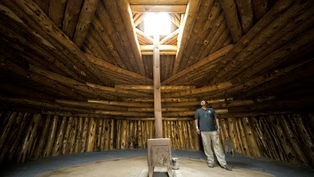
Preview: S53 Ep10 | 30s | Witness how Native North Americans have generated scientific knowledge over thousands of years. (30s)
Video has Closed Captions
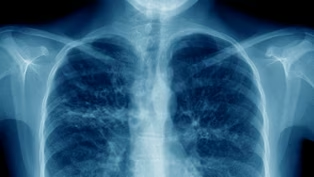
Preview: S53 Ep9 | 30s | Follow the relentless quest that led to a breakthrough treatment for a deadly disease. (30s)

Video has Closed Captions
Preview: S53 Ep7 | 30s | Follow the Artemis mission to bring humanity back to the Moon for the first time since Apollo. (30s)

Athens: Birth of Democracy Preview
Video has Closed Captions
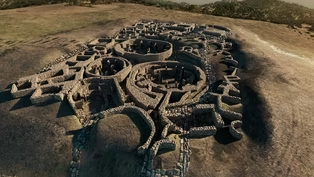
Preview: S53 Ep8 | 30s | Archaeologists investigate the dramatic origins of democracy in ancient Greece 2,500 years ago. (30s)
Stone Age Temple Mystery Preview
Video has Closed Captions
Preview: S53 Ep6 | 30s | Surprising evidence at the world’s oldest temple overturns our understanding of human history. (30s)
Video has Closed Captions
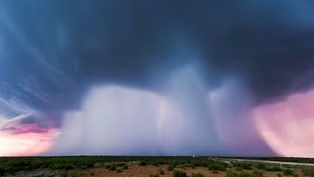
Preview: S53 Ep5 | 30s | A deadly—and growing—global weather phenomenon mystifies scientists. (30s)
Video has Closed Captions
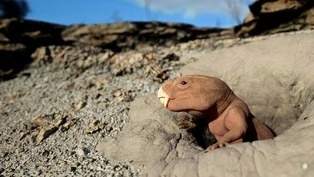
Preview: S53 Ep4 | 30s | Explore mammals’ surprising origins, long before the age of dinosaurs. (30s)

Video has Closed Captions
Preview: S53 Ep3 | 30s | Do speech buttons really allow dogs to talk to us? Scientists investigate. (30s)

Angkor: Hidden Jungle Empire Preview
Video has Closed Captions
Preview: S53 Ep2 | 30s | New evidence sheds light on the remarkable life—and mysterious collapse—of the ancient jungle city. (30s)

When Earth Was Bombarded by Asteroids
Video has Closed Captions
Clip: S53 Ep1 | 3m 41s | What studying the surface of the Moon revealed about Earth’s apocalyptic youth. (3m 41s)

Asteroids: Spark of Life? Preview
Video has Closed Captions
Preview: S53 Ep1 | 30s | What if violent asteroid impacts actually jump-started life on Earth? Explore a dramatic theory. (30s)
Providing Support for PBS.org
Learn Moreabout PBS online sponsorship














Support for PBS provided by:
National Corporate funding for NOVA is provided by Carlisle Companies. Major funding for NOVA is provided by the NOVA Science Trust and PBS viewers.