
Iran defiant as U.S. pushes to reopen Strait of Hormuz
Clip: 5/5/2026 | 4m 50sVideo has Closed Captions
Iran remains defiant as U.S. launches new effort to reopen Strait of Hormuz
Top U.S. officials said Tuesday that the ceasefire with Iran has not ended, despite exchanges of fire in the Strait of Hormuz. Both Rubio and Hegseth said the U.S. was in a new phase of operations designed to ensure safe passage for commercial vessels stuck in the Persian Gulf. But so far, very few ships appear to want to run the Iranian gauntlet in the strait. Nick Schifrin reports.
Problems playing video? | Closed Captioning Feedback
Problems playing video? | Closed Captioning Feedback
Major corporate funding for the PBS News Hour is provided by BDO, BNSF, Consumer Cellular, American Cruise Lines, and Raymond James. Funding for the PBS NewsHour Weekend is provided by...
Iran defiant as U.S. pushes to reopen Strait of Hormuz
Clip: 5/5/2026 | 4m 50sVideo has Closed Captions
Top U.S. officials said Tuesday that the ceasefire with Iran has not ended, despite exchanges of fire in the Strait of Hormuz. Both Rubio and Hegseth said the U.S. was in a new phase of operations designed to ensure safe passage for commercial vessels stuck in the Persian Gulf. But so far, very few ships appear to want to run the Iranian gauntlet in the strait. Nick Schifrin reports.
Problems playing video? | Closed Captioning Feedback
Where to Watch PBS News Hour
PBS News Hour is available to stream on pbs.org and the PBS app.
Providing Support for PBS.org
Learn Moreabout PBS online sponsorshipAMNA NAWAZ: Welcome to the "News Hour."
Top American officials said today the cease-fire with Iran had not ended, despite exchanges of fire in the Strait of Hormuz and Iranian attacks on U.S.
allies in the Gulf.
Both the secretaries of state and defense said the U.S.
was in a new phase of operations designed to ensure safe passage for commercial vessels stuck in the Persian Gulf.
But, so far, very few ships appear to want to run the Iranian gauntlet in the strait, and Iran remains defiant.
Nick Schifrin again begins our coverage.
NICK SCHIFRIN: On the streets of Tehran today, even the statues are wrapped in nationalism.
Newspapers sneer at the U.S.'
new Project Freedom.
Signs celebrate regime continuity, and posters proclaim Iran's stranglehold on the Strait of Hormuz.
Iran's public rhetoric remains defiant.
Today, the Islamic Revolutionary Guard Corps warned that ships crossing the Strait of Hormuz without coordinating with Iran would be -- quote -- "categorically dealt with."
And on X, Iran's chief negotiator and Parliament speaker, Mohammad Ghalibaf, today accused the U.S.
of a violation of the cease-fire and warned: "We have not even begun yet."
And for the second day in a row, the United Arab Emirates said it was attacked by Iranian missiles and drones that yesterday hit Fujairah, the UAE's only major port that bypasses the Strait of Hormuz.
Yesterday, Iran also launched small boats like these and missiles at U.S.
ships, actions that today President Trump downplayed.
QUESTION: What do they need to do to violate the cease-fire?
DONALD TRUMP, President of the United States: Well, you'll find out, because I'll let you know.
They know what to do and they know what to do.
We -- and they know what not to do, more importantly, actually.
And they fired them in little boats with peashooters.
You know what a peashooter is?
A little boat with little you know what, because they don't have any boats anymore.
PETE HEGSETH, U.S.
Defense Secretary: The cease-fire is not over.
NICK SCHIFRIN: At the Pentagon, Secretary Hegseth also dismissed Iran's attacks on U.S.
forces yesterday as what he called frothiness.
PETE HEGSETH: We expected there would be some churn at the beginning, which happened.
NICK SCHIFRIN: But Iran's defiance extends to the negotiating table, where President Trump has acknowledged they refuse to accept us demands.
Until those talks are fruitful, President Trump today made clear he does not want to increase pressure on Iran by resuming the war.
DONALD TRUMP: We don't want to go and kill people.
We really don't.
I don't want to.
I don't want to.
It's too tough.
NICK SCHIFRIN: Instead, the U.S.
says it will maintain economic pressure, including new threats today on Chinese banks facilitating Iranian oil exports, and a diplomatic push at the U.N.
to condemn Iran's strait choke hold.
MARCO RUBIO, U.S.
Secretary of State: They're not going to change their position out of the kindness of their heart.
There has to be a pressure point on them that causes them to realize they cannot continue to close the straits, or they face crushing economic consequences, but also global diplomatic isolation, which they have proven in the past to be susceptible to.
NICK SCHIFRIN: But Iran's choke hold over the strait, through which 20 percent of the world's oil and natural gas traveled before the war, has not only affected American gas prices.
It has led to higher prices around the world, leading to food and humanitarian aid shortages.
MATTHEW HOLLINGWORTH, Assistant Executive Director, World Food Program: A lot of people can't afford to eat the basic commodities, the basic foods that they rely on.
NICK SCHIFRIN: Matthew Hollingworth is an assistant executive director at the World Food Program.
He says, since the war began and the Strait of Hormuz largely closed, food prices across Central and Eastern Africa have increased by as much as 50 percent at a time when WFP already faced aid cuts.
MATTHEW HOLLINGWORTH: We are in a situation today already because of this war that, 1.5 million people, we simply cannot afford to help anymore.
We know, in the next three months if the price of oil stays above $100 a barrel, that figure will jump to nine million more people that we will not be able to help.
NICK SCHIFRIN: WFP predicts the number of people who are food-insecure will increase by 45 million by the summer if the Strait of Hormuz that is so vital to all shipping isn't open.
Humanitarian organizations have tried to create work-arounds to avoid the strait, but it is not sustainable, says Hollingworth.
MATTHEW HOLLINGWORTH: We can go on different routes, but it does add, again, weeks and it adds serious cost.
The easiest, fastest way to do it is a resolution in the Middle East that will reopen these supply chains that the world desperately needs.
NICK SCHIFRIN: But, today, the strait remains largely closed and diplomacy at an impasse.
For the "PBS News Hour," I'm Nick Schifrin.
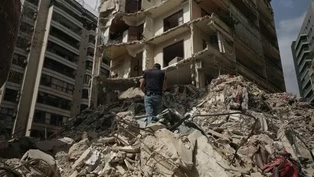
Families in Lebanon search for victims of Israeli strikes
Video has Closed Captions
Families in Lebanon still search rubble for loved ones killed in a day of Israeli strikes (8m 44s)

News Wrap: Senate GOP requests $1 billion for Trump ballroom
Video has Closed Captions
News Wrap: Senate GOP requests $1 billion in funding for Trump’s ballroom (5m 51s)
States scramble to redraw congressional maps before midterms
Video has Closed Captions
New wave of Southern states scramble to redraw congressional maps ahead of midterms (5m 2s)

Thousands of immigrant truckers lose CDLs in Trump crackdown
Video has Closed Captions
Thousands of immigrant truckers lose commercial licenses in Trump administration crackdown (8m 8s)
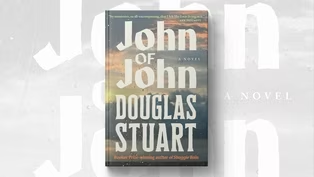
What inspired Douglas Stuart’s new novel ‘John of John’
Video has Closed Captions
How author Douglas Stuart’s journey to a remote Scottish island inspired ‘John of John’ (6m 46s)
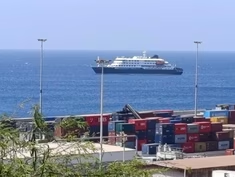
What to know about human-to-human hantavirus transmission
Video has Closed Captions
Can hantavirus spread between humans? What to know as WHO investigates ship outbreak (4m 54s)
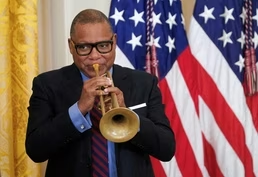
Wynton Marsalis on why jazz is democracy’s perfect metaphor
Video has Closed Captions
Why Wynton Marsalis thinks jazz is the perfect metaphor for democracy (7m 57s)
Providing Support for PBS.org
Learn Moreabout PBS online sponsorship New Episode
- News and Public Affairs

Today's top journalists discuss Washington's current political events and public affairs.

- News and Public Affairs

FRONTLINE is investigative journalism that questions, explains and changes our world.

 New Episode
 New Episode
 New Episode
 New Episode
 New Episode
 New Episode

 New Episode
 New Episode
Support for PBS provided by:
Major corporate funding for the PBS News Hour is provided by BDO, BNSF, Consumer Cellular, American Cruise Lines, and Raymond James. Funding for the PBS NewsHour Weekend is provided by...