
Windows to the Wild
YouTube Outdoors Guide
Season 9 Episode 10 | 26m 46sVideo has Closed Captions
Scott Ellis hikes, camps and paddles around New England all year round.
Scott Ellis hikes, camps and paddles around New England all year round, and films his adventures to share on YouTube. Host Willem Lange hikes Cardigan Mountain with Scott to learn how he uses technology to relive his experiences in nature.
Problems playing video? | Closed Captioning Feedback
Problems playing video? | Closed Captioning Feedback
Windows to the Wild is a local public television program presented by NHPBS
Windows to the Wild
YouTube Outdoors Guide
Season 9 Episode 10 | 26m 46sVideo has Closed Captions
Scott Ellis hikes, camps and paddles around New England all year round, and films his adventures to share on YouTube. Host Willem Lange hikes Cardigan Mountain with Scott to learn how he uses technology to relive his experiences in nature.
Problems playing video? | Closed Captioning Feedback
Where to Watch Windows to the Wild
Windows to the Wild is available to stream on pbs.org and the PBS app.
Providing Support for PBS.org
Learn Moreabout PBS online sponsorshipWILLEM: Recently, I met a guy who I think would like my job.
They like to think I might entertain a reasonable offer, but he's kind of interesting, so I hope you'll stick around to meet him.
♪ Welcome to Windows to the Wild.
I'm Willem Lange.
Today, I'm standing at the foot of Spruce Mountain in Plainville, Vermont, with Scott Ellis, who is kind of a child of nature, would you say?
SCOTT: You could say that.
You could definitely say that.
I like nature.
WILLEM: Okay.
Now, we met recently at a Wilderness Paddlers gathering over in Fairlee, Vermont, and I was very impressed with your enthusiasm.
And your films were fantastic.
I thought, We've got to get this guy up to show us how to do this sort of thing.
SCOTT: Yeah, they're pretty fun to make, too, those videos, so I'm glad you enjoyed them.
WILLEM: Yeah.
Yeah.
Of course, you know, when things are really bad, you don't shoot much, right?
So, it always looks like fun.
SCOTT: It always looks like it's beautiful weather in the video, right?
WILLEM: Your films are that kind of a mixture of entertainment, you know, just being out in the woods and a little bit of instruction also on how to do it yourself.
SCOTT: Yeah, yeah, that's kind of the idea we want to guide people to the outdoors.
So, you want to show them that it's fun and you got to give them the right skills to go out.
I just picked up an inexpensive painter's clear plastic tarp.
I went cheap and hopefully that was a good choice.
And I cut it into a half circle.
I do that by using a pen on a string to go all the way around and make a half circle and cut that out.
Now, when you bring that together, it should create a perfect cone.
WILLEM: Now, on our way up the mountain, we'll play you a few clips of Scott's films.
And we'll also talk more about how he does what he does.
So, I suppose we might as well if we're going to show them how to climb the mountain.
SCOTT: Yeah.
You want to go for a walk?
WILLEM: Not much, [laughing] but we’ll do it.
Okay!
♪ SCOTT: I lose track of which hikes I've done.
Sometimes every mountain kind of blurs into one.
And I thought I had done this one, but it turns out I've never been here before.
WILLEM: Spruce Mountain sits south of Plainfield, Vermont.
The trail to it lies mostly with in the L.R.
Jones State Park, Vermont's first state forest.
♪ Today's hike is about a 4.4-mile round trip, and it's classified moderately difficult.
Well, how about this water running right down the trail.
Dogs are permitted on the trail, so Scott brought along Wilhelmina and Baxter.
SCOTT: Baxter.
Baxter!
What's this?
Oh, yeah.
What's this?
Now, you forget about that.
Now, you forget about that.
Oh, yeah.
♪ Oh, Baxter.
Yes.
Good boy, Baxter.
Good boy!
WILLEM: The weather is a bit fickle, teetering between winter and spring.
[ice puncturing] This looks wet, my friend.
SCOTT: You want a hand, Willem, or you got it?
WILLEM: Nope.
It ain't slippery.
SCOTT: Hahahahaha.
That is some interesting spring hiking right there.
[chuckling] Just gotta go right through it.
WILLEM: Scott teaches at a school about an hour away.
When he's not in the classroom, he's out here.
When did you discover the outdoors?
SCOTT: The outdoors has always been there, you know?
It's been a big part of my life, I think.
You know, growing up in Deerfield, I grew up going off rope swings and playing around in the woods.
And, you know, summer camp has always been a big part for me as well.
Every summer, I make that pilgrimage to camp, and that's a great experience for all the youth to go out.
WILLEM: What camp do you go to?
SCOTT: I used to go to a camp called Wildwood, which was a Mass Audubon camp.
And more recently, I've been affiliated with the Aloha Foundation in Fairlee, Vermont, which is a great program.
I’ve done a lot of good stuff with them as well.
WILLEM: It might be the teacher in Scott that brings out the filmmaker in him.
SCOTT: Welcome to this segment on portaging.
WILLEM: Buried within each of his adventures, there's a lesson waiting for an audience.
SCOTT: Boat’s ready to go.
So, it's time to pick it up and carry it, right?
Like to take it up to my lap, reach across, up high, my right hand underneath the boat.
One, two, three.
Snap.
She's up.
One thing I found with a camera is if you don't have it out, you're not going to use it.
And so I carved up I make my own canoe paddles and I had an extra piece of wood, and I carved up this extra nice piece of cedar here, and I made a walking stick that I can put the GoPro right on the end.
Now, a lot of times when I'm out there, I don't have a camera crew like you, Will.
I got to do everything myself.
We're low-budget, guerrilla-style shooting, so I got to video myself, too, which the stick makes really cool.
I can just kind of hold it out.
And there you go.
I am my own camera man.
WILLEM: This is a selfie stick!
SCOTT: Yes!
A selfie stick!
That is what I’m to call it from now on.
This is my selfie stick.
WILLEM: I love it.
SCOTT: But you can get cool angles, like you hold it up on someone, you can get a shot like that.
One really fun way is I'll put it on the canoe.
If you stick it off the edge of the canoe, and the canoe is here, the canoe will move with you.
So when I lean, it will go into the water, and then when I lean back up, it will come back out.
And it’s waterproof, this little guy.
So, really cool camera.
And what sold me originally was that it’s waterproof and indestructible.
And I said, That's my style right there.
I need something like that.
And got one and said, Hey, this could be a really fun little tool for wilderness trips that I go on to make my slideshows a little cooler.
Come on, get it out of there!
Oh, no shoe!
I see it.
I see the shoe down there!
Don't lose it.
GIRL: I feel like I'm birthing a shoe.
SCOTT: Ahhhh!
Look at that shoe.
You talk of a window to the wild, well, I'm carrying my window right here, and it's a little mini window that we can bring and let the viewers see what we're seeing as we go on our walks in the woods.
When you go camping, the equipment and gear you bring can make the difference between a great, comfortable experience and a miserable one.
On this trip, I made a conscious effort to bring primitive, simple clothing and equipment.
WILLEM: Now, your films, I've seen several of them.
Quite a broad range of topics.
You know, everything from how to poop in the woods to portaging canoes?
SCOTT: Yeah.
Yeah.
WILLEM: So you just try to cover the whole outdoor experience?
SCOTT: There's a lot to do in the outdoors, Willem.
You know, there's hiking and canoeing kind of the basics, but even when you are hiking and canoeing, there's different ways to go about that.
You could go for a day hike or you could hike the whole Appalachian Trail.
You could go paddle on your neighborhood pond or you could go up to Quebec and get lost for a month when you canoe.
And then, when you're out there, there's a lot of pieces that come too.
I think a lot of people don't go on trips into the wilderness because they might be afraid that they don't have the right piece of gear or they don't know what to do in a certain situation.
And I like to try and let people know that they can figure that out.
It’s not that intimidating.
And it's really where we come from.
People actually came from nature.
We forget that sometimes; we see it as this foreign place where you need to stay away from, but I think it's the place where we're really safe in nature.
And, it helps me kind of see myself in a way.
♪ [snow crunching underfoot] So, the first thing I kind of want to do before I even build the whole cave or snow shelter is I want to pack out the initial spot where I'm going to build it from.
WILLEM: If you'd like to know what it's like to sleep in a mound of snow, Scott’s made a film about that too.
♪ SCOTT: I used to work for the Boy Scouts and we would do an overnight trip.
These kids would come up and we'd help guide them to do a trip and we would build these quinzhees and we would do it every weekend for a while.
And so by the end of the winter, we had like a quinzhee village, you know, we had like 20 of these things all over the place because each group would make one.
And it’d sleep 2 or 3 kids in it.
One night, we're up there and it’s so quiet in the quinzhee; you can't hear anything I would get up every few hours, just poke my head out, make sure everybody's okay, and there's nobody out crying or anything.
So I get out and I dress up, and I poke my head out, and I hear a snowmobile.
And I’m like, Oh my God, I've never seen a snowmobile up here.
And he must have followed our tracks up.
And he came along at night with his lights on, and he saw one of the quinzhees and he thought, This is the greatest jump I've ever seen!
Who built this awesome jump out here?
And there's kids sleeping in it.
And so the guy vroom vroom and sure enough, he launches off the quinzhee.
It totally holds.
It doesn't collapse at all.
It stays strong.
And the kids come running out in their boxer shorts in the middle of winter cause they're like, What was that!
And the guy sees people, like two little kids, run out of his awesome jump he just went off and he just hightails it out of there.
I'm running after him.
But what a little experience those kids had!
WILLEM: Well, they cut that tree out just below the parking lot.
SCOTT: So, Willem, what is it that gets you inspired to go outside?
Like, you love the outdoors, right?
People always ask me that.
I'm interested in someone like myself that's been out for a while.
Why do you go outside?
WILLEM: I don't hike as much as I used to.
SCOTT: Yeah.
WILLEM: I love to get the boats out.
You know, a local pond or reservoir.
SCOTT: Yeah, canoeing is more of a thing now.
WILLEM: Kayaking all of a sudden!
SCOTT: Really?
WILLEM: You're alone.
You know, it’s not like a canoe where you jump in and out.
But then I tried it.
It's nice!
[snow crunching underfoot] SCOTT: The more we get people outside, the better it's going to be.
I think getting people outside also really heals them.
It has a healing kind of aspect for the individual.
So, the more we get them outside, it’s good for them as well as for nature.
[footsteps in stream] WILLEM: As we trudge through the snow and ice near a swamp, Scott spotted an old birch tree and suggested, what else?
A tea break!
SCOTT: So, Willem, right here, this is chaga fungus that grows on birch trees, which is a really cool fungus because Native Americans and in Russia as well they've always used it as a tea.
Tastes a little like coffee; wakes you up a little bit and has some good medicinal values that go with it.
Would you like to try some chaga tea?
WILLEM: No... [laughing] SCOTT: No!
WILLEM: If it happens to come along I might try it.
Yeah, but I wouldn't go across the street to do it.
SCOTT: Here we are, Willem.
WILLEM: Thank you.
I hate to act like King George, but could you take a sip first?
SCOTT: Yeah!
I'll take some from right here.
It is not poisonous.
I gave you the nice cup.
WILLEM: Oh, God bless you.
Okay, here's your health.
Now, what's it do for you?
SCOTT: All sorts of good things.
It helps boost your immune system is the short answer.
WILLEM: Okay.
SCOTT: So, if you're feeling a little sick, you can take some of this and you won't catch that cold.
It's also proven to show people who are taking chemotherapy treatments that it helps cure some of the symptoms.
WILLEM: Is that right?
That's interesting.
SCOTT: Here we go!
I recommend that unless you really know what's edible in nature and what's not, you bring along a few of your own tea bags.
SCOTT: Rock climbing is another passion of mine.
You can't take any unnecessary risks... WILLEM: Most of Scott’s other films show things just about anyone can do.
SCOTT: It's also fun to take the quick way down when you get to the top.
Once again, safety is important, so always check the water before you jump.
♪ ♪ [splash] WILLEM: So, you're trying to get people (1) excited about the outdoors and (2) know a little bit about what they're doing when they get out there.
SCOTT: Indeed, indeed.
WILLEM: But without focusing on the need to know everything before you get there.
SCOTT: You want them to feel like they can do it.
WILLEM: Yeah.
Right.
SCOTT: They can have the right things and the right knowledge to be able to go out into the wilderness and feel safe.
I think that's important.
If people feel safe and they're ready to go out there.
Now, there's some things that they're on their own when they're out there, you know, people have to make their own choices.
But the wilderness is a far safer place than a city in many ways, and people don't realize that.
They’re all, Oh, aren’t there bears?
You gonna carry a gun when you’re out there?
No, you don't need a gun.
You might need a gun if you're walking down the street in New York City, but you don't need one on top of Spruce Mountain.
We'll be fine right here.
Around the next turn, you're in a tiny pond, choked with lily pads and snake grass.
It's all part of the adventure, and it keeps you wondering what will be around the next bend.
WILLEM: We were talking earlier; you said you think that the GoPro is the modern equivalent of the old-fashion journal SCOTT: Yeah, yeah!
WILLEM: that ancient mariners used to write in with the stub of a pencil every night as they lay dying.
So, this is how you record what you do?
SCOTT: Yeah.
And I think, you know, your show is a great idea of, you know, the window to the wild.
And I kind of came up with a similar idea with a friend one night around a campfire where we said, Hey, we love going to the outdoors.
We want to inspire people to go to the outdoors.
And we also like playing around with video cameras.
Can we do both?
Can these things work together a little bit?
And so we started making videos with the intent of inspiring people to go out, but also, as you said, kind of like a journal.
And it's for me as well to look back and remember, and maybe my future children to look back and see what their dad did when he was young, going off into the wilderness and how to portage a canoe or maybe it is how to poop in the wilderness because there are certain tricks that work better than others!
WILLEM: There are!
SCOTT: This is looking really nice and comfortable, actually.
Yeah.
And you know what?
A lot of this people always think this one's crazy, but you get out in the woods and you forgot your toilet paper, right?
WILLEM: I did that once on a canoe trip!
SCOTT: One of the best natural toilet papers is right here.
This stuff it’s like a bidet.
Let’s go.
Go for a walk?
Go for a walk?
Oh, that'll be fun.
Yep.
So Willem, you like this trail?
What do you think of this trail?
It's a beautiful one.
It’s like a Sunday afternoon trail because it's, you know, starts out as a road, which we're still on, and then finally turns right and goes up the hill.
It's very nice.
Toward the top, it gets to be more of a mountain trail, you know?
SCOTT: But we haven't gotten there yet.
WILLEM: No.
We're assuming we will, of course.
SCOTT: And it seems to be a really good trail for dogs, too.
It's been listed as one of the top 50 hikes for dogs in Vermont and New Hampshire.
WILLEM: Is that right?
Is there a book that says that?
There’s a book that says that.
Yeah, they claim that to be the truth, so... [laughter] WILLEM: So far, these dogs are endorsing it.
SCOTT: Yeah, they like it.
WILLEM: Wilhelmina’s starting to exercise a little intelligence there.
SCOTT: Yeah.
Not just running the whole way up and down.
The younger one still.
WILLEM: He’ll [inaudible] himself to a stub.
SCOTT: Shall we walk on?
WILLEM: Oh, yeah.
SCOTT: All right.
WILLEM: Let's go.
[Willem grunts] Alright Willa, you wanna keep walking?
Yes, please!
Yeah, here we go.
♪ WILLEM: Wow.
SCOTT: What do you think?
Can you see in there, Willem?
[chuckling] WILLEM: Well, yeah.
A couple of chockstones up there.
SCOTT: Oh, yeah.
WILLEM: And, just where this thing slumped away from the cliff.
SCOTT: Yeah.
Nice little fracture right off there.
WILLEM: Yep.
SCOTT: Cover it up.
Hop on top.
WILLEM: Yeah.
SCOTT: That's a cool little feature.
You wanna go in WILLEM: Yeah.
SCOTT: and check it out?
WILLEM: Any predictions of earthquakes?
SCOTT: No, I don't think so.
The dogs have already tested it.
WILEM: Yeah, that's right.
They’d know, wouldn't they?
SCOTT: What do you think yellow icicles tastes like?
[Scott laughing] WILLEM: Not so good.
Like sphagnum moss.
SCOTT: Sphagnum moss?
WILLEM: Probably.
Look at that!
SCOTT: Cool!
Cool little cave.
That’s a fun little treat.
WILLEM: Some feldspar.
SCOTT: Oh, yeah.
Feldspar.
Some quartz.
Potassium feldspar, it looks like.
WILLEM: Tis.
SCOTT: Yeah.
And a little bit of mica in there.
WILLEM: Oh, yeah.
SCOTT: And then, the black stuff... WILLEM: Biotite?
SCOTT: Biotite maybe.
Yeah, that's probably a good guess.
♪ WILLEM: Now, I got to get back down this declivity.
♪ [snow compressing] [Willem sighs laboriously] K-A-N-G-I-Q-S-U- A-L-U-J-J-U-A-Q... Kangiqsualujjuag.
[Willem sighs laboriously] Long as I can spell that, I haven't lost my mind completely.
[laughing] Oh, dear.
If you hike, especially alone, you might understand what Scott means when he talks about feeling the spirit of nature.
We were talking a little bit about, the spiritual aspect of being out here.
What's that to you?
SCOTT: Yeah, well, you know, nature is healing to me.
When I come out here you know, the world that we live in today is just so full of distractions that you're bombarded with messages and people calling you, and you got to do this and that, and you got to take care of things at home.
When I get out in nature, especially on a longer trip, you know, all those worries go away.
Immerse yourself in nature.
Quietly listen, smell, watch, taste, touch, nurture your conscious.
Protect nature, defend the garden of your spirit.
The only worry is, Hey, am I warm?
Do I got a place to sleep tonight?
And do I have enough food?
And that's what you focus on.
Or maybe, How many miles am I going to do today?
And that for me is really cleansing to just focus on these pure things that are just about the day to day of being in the woods.
And I think that's what I really find healing.
And I want to share that with the world.
I want other people to know that feeling to know what it's like to take away all those distractions that are out there and really just clean yourself for a second.
And nature can be that shower, in a way, to clean us.
Having fun when you're out on a trip should never be a problem.
There are so many great things to do to fill your days.
Let me show you some of my favorite fun activities out there.
WILLEM: Part of the appeal of Scott’s films is that he tries to keep them fun.
I think one of the things that we try to do, you and I both, is to make it seem like fun SCOTT: Oh, yeah.
WILLEM: even if it isn't always.
you know, like with a little joke or irony.
That seems to run through your films as well.
SCOTT: Indeed.
And, Will, it can always be fun.
It can always be fun, you know?
WILLEM: Get out.
Come on!
[Willem chuckling] SCOTT: And humor is important.
You want to draw people in.
And I think there's lots of cool activities that you can do in the woods.
And maybe sometimes people think they can't go because it's going to be boring, but there's lots of cool things.
You know, fly a kite on top of a mountain, right?
Jump off a cliff into a deep pool of water, if you can.
Right?
WILLEM: Yeah and send someone else first.
SCOTT: Check the water check first!
But there's there's a lot of great, fun things to do in the wilderness and in nature.
And I think that's a really important thing for people to know as well that this is a great time.
You can have an awesome time out here and you can do all sorts of great things.
This one can really test your limits of what's possible with excellent teamwork.
If the boat ends up capsizing, then no problem.
Just swim underneath and hang out under the upside-down boat.
It's one of those things everyone should do at least once in their life.
WILLEM: You suppose you'll probably keep this up at least as long as I have, probably.
SCOTT: Oh, I hope so.
I mean, you're a role model in many ways, Willem.
You still get out here and do these great hikes, and I sure hope I'm still hiking when I'm at your age up here.
WILLEM: Well, I hope you do.
You're only 34 now?
SCOTT: 34.
Yep.
WILEM: You got 50 years ahead of you at least.
I hope so.
Maybe more even, right?
WILLEM: Now, wait a minute.
Don't get carried away.
You’ll be 84.
Yeah, you know, you will.
SCOTT: There's 84 year olds that are still hiking mountains and going out paddling.
♪ WILLEM: Oh, look at here.
SCOTT: Look at this.
WILLEM: Do you see poured concrete?
SCOTT: I think it's pretty obvious that we've made it to the top.
WILLEM: Dare I look up?
Holy Toledo!
[chuckling] SCOTT: All right, Willem.
Well, we made it to the top of the mountain.
What do you say?
WILLEM: Give me five.
SCOTT: Yeah.
WILLEM: Well, let's have a bite to eat.
What do you say?
SCOTT: Sounds great!
See if we can find a place to sit down.
SCOTT: Oh, the old tower climb.
WILLEM: On second thought, I'm going to have a little lunch while Scott takes you up the abandoned fire tower.
SCOTT: These towers can be scary WILLEM: Been there, done that.
[wind rippling] [wind rippling] SCOTT: Wooh!
Yeah!
Super nice, clear day up here.
It is very cold.
You come up this fire tower, and there's a level where the wind picks up and you can see all the frost up here.
And it is very chilly, but worth it for the views.
You can see Mount Moosilauke out in this general direction out there.
It’s snowy peak makes it stand out.
And then, if you look around this way, you can actually see the ski slopes of Killington, which is another great mountain of Vermont.
And the ski slopes really define that one as it's mountain out there.
And if you look out west, you can see out into the Adirondacks.
And I'm not sure which mountains those are, but there's some nice big ones out there too.
Beautiful 360-degree view from up here.
The fire tower allows you to get above the trees and... And I'm cold.
Even my cheeks are cold.
It's hard to talk even in this wind, so enjoy it for a moment.
A mental picture, a video picture, and we're ready to go back down.
[wind rippling] [Scott in distance] Cold up there!
[wind rippling] WILLEM: We made it!
Just barely.
But we're here at the top of Spruce Mountain.
SCOTT: Yeah.
WILLEM: Beautiful view.
What a day.
And not too hot.
[chuckling] SCOTT: Not too hot.
Especially for April, yeah.
WILLEM: You know how it is with an April day, when the sun is out and the wind is still, you’re one month on in the middle of May.
But if you so much as dare to speak, a cloud comes over the sunlit arch, a wind comes off a frozen peak, and you're two months back in the middle of March.
Who wrote that?
SCOTT: I don't know.
Who wrote that?
WILLEM: Come on!
Who else could write it?
Robert Frost.
SCOTT: Ah, classic.
WILLEM: Two Tramps in Mud Time.
Anyway, we made it.
And now, we will commence the perilous descente.
SCOTT: Yes.
We'll take our time going down.
WILLEM: Yes, that's for sure.
I hope we will.
And... which means we have to bring this to a close.
I hate this part of the show, but we do.
Thank you so much pardon my glove for joining us.
It's just been terrific.
SCOTT: Thank you for having me.
I think I feel like I'm the honored one here.
We'll do it again somewhere someday.
SCOTT: Sounds like a great deal.
WILLEM: So, we have to say goodbye, which I shall.
Goodbye.
I'm Willem Lange, and I hope to see you again on Windows to the Wild.
All right, let's take a hike.
♪ Support for the production of Windows to the Wild has been provided by: the Alice J. Reen Charitable Trust; the Fuller Foundation; the Mount Washington Cog Railway; and from Viewers Like You.
Thank you!
♪
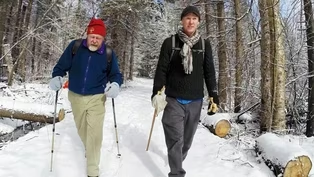
YouTube Outdoors Guide (Preview)
Preview: S9 Ep10 | 22s | Scott Ellis hikes, camps and paddles around New England all year round. (22s)
Providing Support for PBS.org
Learn Moreabout PBS online sponsorship New Episode
 New Episode
- Drama

Lesley Manville and Tim McMullan return in the final installment of the Susan Ryeland mysteries.
 New Episode



 New Episode
 New Episode

Support for PBS provided by:
Windows to the Wild is a local public television program presented by NHPBS