
Henry David Thoreau Asks Us to Live in the Present
Clip: Episode 3 | 8m 19sVideo has Closed Captions
Henry David Thoreau dies at 44, but his message lives on and encourages us to read.
On May 6th, 1862, Henry David Thoreau passes away peacefully at age 44 from tuberculosis. His work continues to inspire generations to live in the present, experiment, and get excited about the experiment of being alive. Thoreau offers us these messages, but it's up to us to open the book and read.
From
Problems playing video? | Closed Captioning Feedback
Problems playing video? | Closed Captioning Feedback
Episodes presented in 4K UHD on supported devices. Major funding for HENRY DAVID THOREAU was provided by The Better Angels Society and its members: The Keith Campbell Foundation for the...
Henry David Thoreau Asks Us to Live in the Present
Clip: Episode 3 | 8m 19sVideo has Closed Captions
On May 6th, 1862, Henry David Thoreau passes away peacefully at age 44 from tuberculosis. His work continues to inspire generations to live in the present, experiment, and get excited about the experiment of being alive. Thoreau offers us these messages, but it's up to us to open the book and read.
From
Problems playing video? | Closed Captioning Feedback
How to Watch Henry David Thoreau
Henry David Thoreau is available to stream on pbs.org and the free PBS App, available on iPhone, Apple TV, Android TV, Android smartphones, Amazon Fire TV, Amazon Fire Tablet, Roku, Samsung Smart TV, and Vizio.
Henry David Thoreau: It is pleasant to walk over the beds of these fresh, crisp, and rustling leaves.
They that soared so loftily and are laid low, resigned to lie and decay at the foot of the tree, and afford nourishment to new generations of their kind, as well as to flutter on high!
They teach us how to die.
Narrator: Surrounded by his family, Henry David Thoreau died at 9:00 in the morning on May 6, 1862.
He was just 44 years old.
His passing was so peaceful that Sophia wrote, "I feel as if something very beautiful has happened."
Some say the last words of the naturalist, who had so many transcendent experiences, were simply, "Moose.
Indian."
Sophia, who was reading to him about his river trip with John, said that his last words were: "Now comes good sailing."
♪ Henry David Thoreau: We found our boat in the dawn just as we had left it-- as if waiting for us, there on the shore, all cool and dripping with dew... We two, brothers, and natives of Concord, with a vigorous shove, we launched our boat from the bank and dropped silently down the stream.
We bade adieu to familiar outlines, and addressed ourselves to new scenes and adventures.
Naught was familiar but the heavens... [Horses clopping, bell ringing] Narrator: Three days later, after the church bell tolled 44 times, Concord gathered for his funeral.
School had been dismissed early so that the students--more than 300 in all--could attend.
Ralph Waldo Emerson delivered the eulogy.
♪ Ralph Waldo Emerson: He was bred to no profession; he never married; he lived alone; He chose, wisely no doubt for himself, to be the bachelor of thought and Nature.
Mr.
Thoreau dedicated his genius with such entire love to the fields, hills, and waters of his native town.
He knew the country like a fox or a bird, and passed through it as freely by paths of his own.
I cannot help counting it a fault in him that he had no ambition.
Wanting this, instead of engineering for all America, he was the captain of a huckleberry party.
But these foibles, real or apparent, were fast vanishing in the incessant growth of a spirit so robust and wise, so noble a soul that he should depart out of Nature before yet he has been really shown to his peers for what he is.
But he, at least, is content.
Clay Jenkinson: The last sentence in Walden is "The sun is but a morning star."
What does he mean?
It means "you've just begun to think "through the meaning and the significance of what I've produced here."
♪ [Cricket chirping] [Airplane whooshing] [Vehicle horns honking] Sandra Harbert Petrulionis: As Thoreau said, "Don't, when you come to die, discover that you have not lived."
He died young, but he didn't end his life realizing he had not lived.
Clay Jenkinson: It happens to millions of people today and then to realize: "I just existed.
I just lived.
I don't know what it meant.
I never really figured it out."
Michael Pollan: He was arguing for being aware at all times, to waking up to the facts of your life, to being conscious, being aware, being present.
♪ Henry David Thoreau: The mass of men lead lives of quiet desperation.
They honestly think there is no choice left.
Most of the luxuries, and many of the so-called comforts of life, are not only not indispensable, but positive hindrances to the elevation of mankind.
Bill McKibben: We built the world that Thoreau feared, a world that's so noisy and crowded that we don't have any time to think for ourselves anymore.
Douglas Brinkley: Most people are hostage to their upbringing, their economic status, and they don't get excited about the adventure of being alive.
And it's like watching an incredible birthright being extinguished because we're muddling through life.
And that's the death of freedom.
[Typing on keyboard, cellphone ringing] Henrik Otterberg: Many of the decisions that pertain to our lives have been made by others, have been made by circumstances that have been beyond our control.
Bill McKibben: A very human-centered view of the world has now raised the temperature to the point where our great forests catch on fire, where already hundreds of millions of people can no longer live in the places where they were born.
Thoreau intuits that if we're going to make it, we're going to have to turn to the natural world for help.
In wildness is the preservation of the world.
Robin Wall Kimmerer: It feels as if the whole living world is calling out to us to pay attention.
Lois Brown: But he says, you know, "Even in the muck of all this, "I encountered a white water lily, "and lilies like that grow in slime, and grow in spite of it."
He was open always to accepting signs from nature that all was not lost.
Thoreau was saying, if you're beginning to die within, take measures right now.
There must be some cabin in the woods within you.
There must be some space where you can regenerate yourself and remember what is most essential to you.
J. Drew Lanham: I think Thoreau gives us the bridge to do that.
If we would just open up our heads and hearts to those lessons, I think it can take us a long way on that path.
And here he is still offering these messages.
It's up to us to open the book and read.
♪ Henry David Thoreau: There is a season for everything.
You must live in the present, launch yourself on every wave, find your eternity in each moment.
Fools stand on their island of opportunities and look toward another land.
There is no other land; there is no other life but this.
Henry David Thoreau.
 New
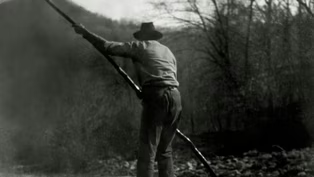
NewJoe Polis Teaches Thoreau the Penobscot View of Nature
Video has Closed Captions
Clip: Ep3 | 9m 45s | On an excursion, a Penobscot leader teaches Thoreau about the Penobscot culture and language. (9m 45s)
 New
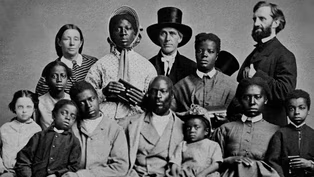
NewThoreau Begins to Work with the Underground Railroad
Video has Closed Captions
Clip: Ep3 | 5m 3s | Thoreau participates in the Underground Railroad and gives a speech on what it means to be free. (5m 3s)
Providing Support for PBS.org
Learn Moreabout PBS online sponsorship









Support for PBS provided by:
Episodes presented in 4K UHD on supported devices. Major funding for HENRY DAVID THOREAU was provided by The Better Angels Society and its members: The Keith Campbell Foundation for the...