
Joe Polis Teaches Thoreau the Penobscot View of Nature
Clip: Episode 3 | 9m 45sVideo has Closed Captions
On an excursion, a Penobscot leader teaches Thoreau about the Penobscot culture and language.
Throughout his life, Thoreau had been fascinated by Indigenous culture. As he and a friend set out on another excursion to Maine, he hires Joe Polis as a guide. Polis is a Penobscot leader, and throughout the trip, he teaches Thoreau about the Penobscot culture, language and way of life. Thoreau leaves Maine with a deeper appreciation for what it means to live in your native ground.
From
Problems playing video? | Closed Captioning Feedback
Problems playing video? | Closed Captioning Feedback
Episodes presented in 4K UHD on supported devices. Major funding for HENRY DAVID THOREAU was provided by The Better Angels Society and its members: The Keith Campbell Foundation for the...
Joe Polis Teaches Thoreau the Penobscot View of Nature
Clip: Episode 3 | 9m 45sVideo has Closed Captions
Throughout his life, Thoreau had been fascinated by Indigenous culture. As he and a friend set out on another excursion to Maine, he hires Joe Polis as a guide. Polis is a Penobscot leader, and throughout the trip, he teaches Thoreau about the Penobscot culture, language and way of life. Thoreau leaves Maine with a deeper appreciation for what it means to live in your native ground.
From
Problems playing video? | Closed Captioning Feedback
How to Watch Henry David Thoreau
Henry David Thoreau is available to stream on pbs.org and the free PBS App, available on iPhone, Apple TV, Android TV, Android smartphones, Amazon Fire TV, Amazon Fire Tablet, Roku, Samsung Smart TV, and Vizio.
In July of 1857, he left on his third and most ambitious trip to Maine, this time with his friend Edward Hoar.
[Oars splashing] The first stop--once again-- was on Indian Island to find a guide.
John J. Kucich: So in his third journey, the Indian guide becomes the whole point.
I think there's a very clear sense that he wants to find someone who can bring to life and test what he's been reading about all these years in Indian notebooks.
James Eric Francis Senior: And I think he really wanted to have a more immersive experience and really get to know what it means to be in this nature.
Narrator: They hired Joe Polis, a Penobscot spiritual and political leader.
James Eric Francis Senior: Polis is in his yard.
He's skinning a deer hide against a slanted log, but he's amongst these manicured gardens.
There's some sophistication to Polis.
He's articulate.
He's very knowledgeable, but he also is very Indigenous.
And Thoreau's trying to grapple with those two pieces of Polis.
♪ Narrator: Together, they would travel more than 300 miles up the Allagash Lakes, and then down the east branch of the Penobscot River by canoe and on foot, including portages around waterfalls and river rapids.
They carried the canoe and their supplies-- hundreds of pounds in all-- through mosquito-infested, muddy swamps and dense forests.
The trip gave Henry another opportunity to learn about how Natives negotiated the Maine wilderness.
♪ John J. Kucich: Thoreau is watching a Penobscot person living with incredibly intricate knowledge of the land as part of who they are.
Carol Dana: When we say "gu-dowl-nuh-bem-na-wuk," all our relations, we mean everything.
Minerals, trees, rocks.
Those are our relations.
Because without them, we know we'd be nothing, right?
James Eric Francis Senior: Thoreau thinks, "I can never have that other half of what Polis has, that Indigenous half."
Narrator: Polis taught Henry the words his people used for plants and herbs, leaves and roots.
Carol Dana: It's a dynamic, verb-oriented language.
A "je-sah-ti-gwah" is one who's painted many colors.
That's a dragonfly.
James Eric Francis Senior: The word for a birch bark canoe is "aw-gwee-den."
And it means "that which floats lightly."
You get this characteristic that is embedded within the meaning of that word.
The more he asks Polis about what each word is, the closer he is getting to understand that Indigenous worldview of the nature around him.
And what a gift!
John J. Kucich: Thoreau instantly grasps that mainstream American white culture has a lot to learn from Native people-- a very different way of being in the world, and language is one of the key entry points into it.
James Eric Francis Senior: For Thoreau, going from calling the tribe on its way to extinction to a point where Polis is a person who he admires the most.
He sees these men beyond the color of their skin, and he grows as a human being in relationship to this Indigenous culture.
But his goal is never really to use that to politically help Native communities.
[Horse neighs, horses clopping] His goal was really to reform white society to make it more responsive to the environment, to make it less immersed in this really rapacious, capitalist world he can see coming.
And he comes back from Maine with a deeper appreciation for what it means to live in your native ground.
And he eventually starts to go over his journals and gather the notes of his own place and to track much more carefully the phenomenon of Concord that will become the Kalendar project-- his great final project, which is this grand account of the Concord ecosystem.
[Bird chirps] Henry David Thoreau: Why should just these sights and sounds accompany our life?
I would fain explore the mysterious relation between myself and these things.
Make a chart of our life, know how its shores trend-- that butterflies reappear... and when-- know why just this circle of creatures completes the world.
Kristen Case: The depth of what he included in his records is pretty unique.
He cared enough about it to want to be present at the opening of every wild flower in the spring.
♪ The Kalendar charts are the study of the climate as it changes through the seasons.
And he always was moving toward this kind of greater and greater fullness of vision-- to bring many perspectives, many temporal points together into a kind of symphony.
Narrator: Thoreau pored through decades of his seasonal observations, and combined them with new ones, creating records so precise, they have proven to be invaluable for scientists measuring the effects of climate change almost 200 years later.
Robert Thorson: You can't see climate.
But you can see the manifestation of a climate change in the phenomenon around you.
So if you can have measurements from the 1850s, people can really understand things have changed.
Beth Witherell: He wrote, "Don't underrate the value of a fact.
One day, a fact will flower into a truth."
Narrator: In his essay "Civil Disobedience," Thoreau had asserted that each citizen should resist a government that supported slavery.
A militant abolitionist named John Brown had a more aggressive strategy: armed resistance.
Back in 1856, after a series of clashes between pro- and anti-slavery militia, Brown had killed five unarmed pro-slavery settlers in Kansas.
Brown traveled to Concord in 1857, looking for support for his cause, and went there again in May of 1859.
During that visit, Henry met with Brown, and would later describe him as a meteor "flashing through the darkness in which we live."
That fall, John Brown and his men raided the federal armory at Harpers Ferry, Virginia, hoping to arm a slave uprising with the weapons there.
[Rifles firing] They failed, and Brown was captured.
Douglas Brinkley: John Brown is a conundrum.
You can look at him very clearly and make an argument that he is a terrorist, and you can also call him a liberator.
But it became a tipping point, John Brown.
He became a symbol for anti-slavery.
Henry David Thoreau: It galls me to listen to the remarks of craven-hearted neighbors, who speak disparagingly of Brown because he resorted to violence, resisted the government, threw his life away!
What way have they thrown their lives, pray?
Such minds are not equal to the occasion.
Beth Witherell: He sits down and he writes and he writes and he writes, assuming that Brown will be executed.
He wants to get the word out before a judgment is made.
Narrator: On October 30th, Thoreau gave a fiery speech in Concord, the first person to publicly defend Brown's actions.
"I do not wish to kill or be killed," he asserted, "but I can foresee circumstances in which both these things would be by me unavoidable."
Douglas Brinkley: He's saying forget the law, forget what the federal government says.
You know what's right and wrong.
And if people have to die to do away with slavery, we have an obligation to do it.
Narrator: John Brown was hanged on December 2nd.
Thoreau wrote a new speech called "The Last Days of John Brown."
It was read aloud six months later at Brown's gravesite.
"He is the clearest light that shines on this land," he wrote.
"He is an Angel of Light."
Lois Brown: What is it about John Brown that so shifts?
Like, it's a seismic shift in Henry David's life.
He realized what it takes to achieve change.
Narrator: The issue of slavery would be decided on the battlefield.
[Fife and drum music]
 New
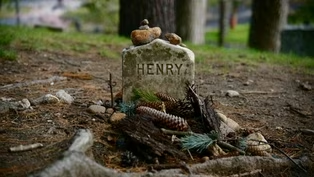
NewHenry David Thoreau Asks Us to Live in the Present
Video has Closed Captions
Clip: Ep3 | 8m 19s | Henry David Thoreau dies at 44, but his message lives on and encourages us to read. (8m 19s)
 New
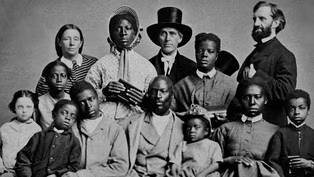
NewThoreau Begins to Work with the Underground Railroad
Video has Closed Captions
Clip: Ep3 | 5m 3s | Thoreau participates in the Underground Railroad and gives a speech on what it means to be free. (5m 3s)
Providing Support for PBS.org
Learn Moreabout PBS online sponsorship







Support for PBS provided by:
Episodes presented in 4K UHD on supported devices. Major funding for HENRY DAVID THOREAU was provided by The Better Angels Society and its members: The Keith Campbell Foundation for the...