
Cats Accidentally Solved a Physics Mystery
Clip: Season 53 | 6m 17sVideo has Closed Captions
Falling cats seem to break the rules of motion, but the real explanation is stranger than it looks.
For centuries, scientists have been baffled by how cats land on their feet. Figuring it out took several theories, calculations, and dropped cats. But it’s helped us understand everything from how to move in zero gravity to building better robots.
Problems playing video? | Closed Captioning Feedback
Problems playing video? | Closed Captioning Feedback
National Corporate funding for NOVA is provided by Carlisle Companies. Major funding for NOVA is provided by the NOVA Science Trust and PBS viewers.
Support provided by:


Cats Accidentally Solved a Physics Mystery
Clip: Season 53 | 6m 17sVideo has Closed Captions
For centuries, scientists have been baffled by how cats land on their feet. Figuring it out took several theories, calculations, and dropped cats. But it’s helped us understand everything from how to move in zero gravity to building better robots.
Problems playing video? | Closed Captioning Feedback
Where to Watch NOVA
NOVA is available to stream on pbs.org and the PBS app.

NOVA Labs
NOVA Labs is a free digital platform that engages teens and lifelong learners in games and interactives that foster authentic scientific exploration. Participants take part in real-world investigations by visualizing, analyzing, and playing with the same data that scientists use.Providing Support for PBS.org
Learn Moreabout PBS online sponsorshipthe ultimate physicists?
Well, they don't defy physics so much as they teach us about it.
Picture this.
Its the 1960s.
Bell bottoms, peace signs and a nasty cold war between the U.S.
and the Soviet Union.
Suddenly, the president of the United States goes rogue and announces we are going to the moon!
“What the Physics?
The Moon?
!” Says NASA.
“We have some questions about that.” See, NASA had already learned from early space flight that moving around when youre weightless isnt easy.
They wanted to know the best way to get from point A to point B without the help of gravity.
So they did what anyone in their position would do.
They turned to cats.
More precisely, they turned to Stanford University engineer Thomas Kane.
And he turned to cats.
Because as everyone knows cats are special.
They do all kinds of matrix-level stuff like seeming to defy the laws of physics Before I go any further I have to ask that you please dont test any of this out on Mr.
Whiskers.
Okay, the basic idea is that if you drop a cat belly up, it will reorient itself in midair without pushing off anything for leverage and land on its feet.
And according to the laws of motion, it doesnt seem like that should be able to happen.
We even have a name for why.
Its called the law of conservation of angular momentum.
Or as I like to call it: spinniness.
It just means that something thats spinning will keep spinning until its stopped.
It also means and this is the spooky cat part nothing thats not already spinning can just spontaneously start spinning.
Its easy to see that in action with something thats not a cat, like a spinny office chair.
You can sit down on a spinny chair, but it wont start spinning unless someone gives it a push.
Orits haunted.
And once its spinning it will keep spinning unless something interferes with it, like resistance from the air or friction.
So, you need another force to change an objects angular momentum.
Otherwise, it stays the same.
But a falling cat seemingly changes its angular momentum without any outside force.
And its taken a bunch of different scientists a lot of time and research to figure out how they do it.
For a while, the theory was that our feline friends must be doing some work.
Like maybe they push off from a surface at the last second, to give themselves initial rotation as they begin to fall.
But in 1894, a physiologist named Marey took a series of high-resolution photographs of a cat falling.
Actually, that poor cat got dropped.
Again, please dont try this.
Heres what the photos show: First: The cat started out fully upside down.
Second: It didnt push off from anything.
And finally: The cat still turned in mid air and landed on its feet!
Like I said matrix-level!
What scientists at the time werent thinking about is that cats are a lot more flexible than, say, a spinny chair.
And they have better instincts well, usually.
So when scientists finally considered that cats can move all on their own, they came up with all kinds of ideas about how cats twist and contort their bodies to turn in midair.
Marey concluded that the cat in the photos used a “tuck and turn” method.
First, it tucked in its front legs and stretched out its back legs while turning the front of its body.
Then it tucked its back legs and stretched out its front legs to turn the back.
This method would be kind of like moving your arms while spinning on that office chair.
Pull your arms in, and youll spin faster.
Stretch them out, and youll slow back down.
That works because when you move your arms, youre changing your moment of inertia, so your velocity changes to maintain angular momentum.
In cat terms, the idea was that a cat tucked its front legs, making the front half of its body spin faster than the back.
Then it tucked its back legs to allow the rest of its body to catch up.
But a few decades later, two Dutch physiologists studied the problem again.
And they argued for a different method, which is now known as the “bend and twist” model.
Not to be confused with the bend and snap...very different outcome.
[Elle Woods] So you bend and snap.
[Athena Brensberger] They suggested that the halves of a cats body are like two cylinders that can twist in opposite directions.
Each half puts an equal and opposite force on the other.
That allows them to rotate and cancels out their angular momenta.
Then, when the cat straightens out, its flipped over.
In the 1960s, Kane, the Stanford engineer who attracted NASAs attention, built on both of those models.
He also came up with equations and computer models to simulate a cats movement in the air.
And Kane determined that cats super flexible spines are moving around a lot when they fall.
But theyre mostly bending, not twisting.
Or snapping.
As it falls, the cat bends forward, to the side, back, to the other side, and forward again.
And when the front part of the cat moves around, the rest of its body rotates in the opposite direction.
That allows the cat to flip and land on its feet.
In reality, cats are probably using a combination of movements to eventually land upright.
But what theyre not doing is defying the laws of physics.
And weve been able to take that information and apply it to all sorts of things.
Like Kanes research did help NASA.
He determined that any object could rotate without an outside force.
To demonstrate the method to astronauts, he took pictures of a trampoline athlete who wore a spacesuit while performing cat-like twists.
To this day, astronauts are trained to mimic cats when they turn around in space.
Similar ideas informed the Hubble Space telescope, which relies on spinning wheels called gyroscopes to generate angular momentum.
And in robotics, cats are inspiring new designs to help robots fall and land without breaking.
So cats are the ultimate physicists.
They dont defy physics so much as they teach us about it.
And the more we learn from cats, preferably without dropping any more of them, the more mind- (and body-) bending stuff we can do, both here on Earth and way out in space.
 New
NewWould a Penny Dropped from the Empire State Building Kill You?
Video has Closed Captions
Clip: S53 | 5m 52s | Falling is more complicated than you might think. (5m 52s)
 New
NewIs There a Center of the Universe?
Video has Closed Captions
Clip: S53 | 5m 56s | Physics says the universe is centerless, but a cosmic alignment has scientists asking questions. (5m 56s)
 Now Playing
Cats Accidentally Solved a Physics Mystery
Video has Closed Captions
Clip: S53 | 6m 17s | Falling cats seem to break the rules of motion, but the real explanation is stranger than it looks. (6m 17s)
 New
NewThe (Persistent) Illusion of Centrifugal Force
Video has Closed Captions
Clip: S53 | 5m 55s | Here’s why centrifugal force is considered a “fictitious” force. (5m 55s)

The Battle to Breathe: The Last 10%
Video has Closed Captions
Clip: S53 | 18m 6s | Inside the race to bring life-saving genetic therapies to every person living with cystic fibrosis. (18m 6s)
The Battle to Breathe: CF Before Birth
Video has Closed Captions
Clip: S53 | 15m 51s | Inside one mother's fight to ensure a healthy life for her child with cystic fibrosis. (15m 51s)
The Mind-Bending Physics of Origami
Video has Closed Captions
Clip: S53 | 5m 52s | A simple fold can completely change how a material behaves. (5m 52s)
Video has Closed Captions
Clip: S53 | 5m 49s | Modern physics and imaging techniques are finally solving the mystery. (5m 49s)
Why Earth’s Core Is Younger Than Its Surface
Video has Closed Captions
Clip: S53 | 6m | Time isn’t the same for everyone, according to Einstein. (6m)

The Truth about Quantum Computers
Video has Closed Captions
Clip: S53 | 6m 44s | Microsoft's breakthrough in quantum computing could have a huge impact on science, and our future. (6m 44s)
The Problem That Broke Physics (And Led to Chaos)
Video has Closed Captions
Clip: S53 | 6m 12s | The “butterfly effect” is often cited in pop culture, but it’s actually rooted in physics and chaos. (6m 12s)
The Ocean Wave Scientists Thought Was Impossible
Video has Closed Captions
Clip: S53 | 5m 46s | These massive walls of water may be far more common than we once believed. (5m 46s)
Is Electricity Instant? A Shocking Experiment from 1746
Video has Closed Captions
Clip: S53 | 5m 56s | It’s taken over 250 years of shocking experiments to understand how quickly electricity moves! (5m 56s)

Does Notre Dame Sound Different Now?
Video has Closed Captions
Clip: S53 | 6m 8s | Restoring Notre Dame wasn’t just about stone and stained glass. (6m 8s)

Evolution: Brain Power Preview
Video has Closed Captions
Preview: S53 Ep13 | 1m | The story of the dolphin reveals how intelligence evolved, step by step, over billions of years. (1m)
Video has Closed Captions
Preview: S53 Ep12 | 30s | Inside the escalating military struggle to control space and the satellites we rely on. (30s)
Video has Closed Captions
Preview: S53 Ep11 | 30s | Step into the stunning cave that’s reshaping our understanding of prehistoric art. (30s)
Video has Closed Captions
Preview: S53 Ep10 | 30s | Witness how Native North Americans have generated scientific knowledge over thousands of years. (30s)

Video has Closed Captions
Preview: S53 Ep9 | 30s | Follow the relentless quest that led to a breakthrough treatment for a deadly disease. (30s)
Video has Closed Captions
Preview: S53 Ep7 | 30s | Follow the Artemis mission to bring humanity back to the Moon for the first time since Apollo. (30s)

Athens: Birth of Democracy Preview
Video has Closed Captions
Preview: S53 Ep8 | 30s | Archaeologists investigate the dramatic origins of democracy in ancient Greece 2,500 years ago. (30s)
Stone Age Temple Mystery Preview
Video has Closed Captions
Preview: S53 Ep6 | 30s | Surprising evidence at the world’s oldest temple overturns our understanding of human history. (30s)

Video has Closed Captions
Preview: S53 Ep5 | 30s | A deadly—and growing—global weather phenomenon mystifies scientists. (30s)
Video has Closed Captions
Preview: S53 Ep4 | 30s | Explore mammals’ surprising origins, long before the age of dinosaurs. (30s)

Video has Closed Captions
Preview: S53 Ep3 | 30s | Do speech buttons really allow dogs to talk to us? Scientists investigate. (30s)

Angkor: Hidden Jungle Empire Preview
Video has Closed Captions
Preview: S53 Ep2 | 30s | New evidence sheds light on the remarkable life—and mysterious collapse—of the ancient jungle city. (30s)
When Earth Was Bombarded by Asteroids
Video has Closed Captions
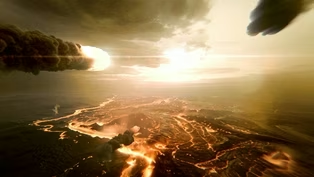
Clip: S53 Ep1 | 3m 41s | What studying the surface of the Moon revealed about Earth’s apocalyptic youth. (3m 41s)
Asteroids: Spark of Life? Preview
Video has Closed Captions
Preview: S53 Ep1 | 30s | What if violent asteroid impacts actually jump-started life on Earth? Explore a dramatic theory. (30s)
Providing Support for PBS.org
Learn Moreabout PBS online sponsorship
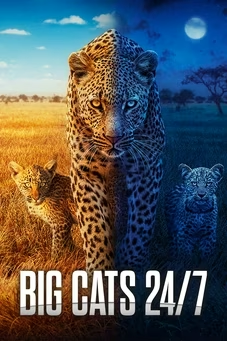
- Science and Nature

Follow lions, leopards and cheetahs day and night In Botswana’s wild Okavango Delta.
 New Season








Support for PBS provided by:
National Corporate funding for NOVA is provided by Carlisle Companies. Major funding for NOVA is provided by the NOVA Science Trust and PBS viewers.