
Is There a Center of the Universe?
Clip: Season 53 | 5m 56sVideo has Closed Captions
Physics says the universe is centerless, but a cosmic alignment has scientists asking questions.
Is Earth the center of the universe? Is there a center of the universe at all? Physics relies on the idea that there isn’t – but some strange evidence that suggests our place in the cosmos may not be as ordinary as we thought.
Problems playing video? | Closed Captioning Feedback
Problems playing video? | Closed Captioning Feedback
National Corporate funding for NOVA is provided by Carlisle Companies. Major funding for NOVA is provided by the NOVA Science Trust and PBS viewers.
Support provided by:


Is There a Center of the Universe?
Clip: Season 53 | 5m 56sVideo has Closed Captions
Is Earth the center of the universe? Is there a center of the universe at all? Physics relies on the idea that there isn’t – but some strange evidence that suggests our place in the cosmos may not be as ordinary as we thought.
Problems playing video? | Closed Captioning Feedback
Where to Watch NOVA
NOVA is available to stream on pbs.org and the PBS app.
NOVA Labs
NOVA Labs is a free digital platform that engages teens and lifelong learners in games and interactives that foster authentic scientific exploration. Participants take part in real-world investigations by visualizing, analyzing, and playing with the same data that scientists use.Providing Support for PBS.org
Learn Moreabout PBS online sponsorshipEver since I discovered that I am not, in fact, the center of the universe Ive been obsessed.
If not me then where?
Well, Ive done some research and there are actually several places right here on Earth trying to claim the title.
Times Square.
Wallace, Idaho.
A weird concrete circle in Tulsa, Oklahoma.
Even NASAS Jet Propulsion Lab.
Okay, but technically, theyre all correct.
If the universe is expanding in every direction, then the center of the universe nowhere and everywhere all at once.
Thats pretty much been the accepted answer, but weve been wrong about the universe and our place in it before, and, well, we just might be wrong again.
Back in the 2nd century CE, an astronomer made a model of the univers where the Sun and other planets revolved around the Earth.
And people subscribed to tha geocentric model for centuries.
But as we observed more and more about the motion of our moon, other planets, and stars, that model just didnt explain what we were seeing.
So by the 16th century, some people thought we needed a new model where everything didnt revolve around Earth.
Copernicus wasnt the first one to have the idea that the planets actually revolved around the sun, but he does usually get the credit.
And his heliocentric model did a much better job of explaining what we observed about the night sky.
It also marked a huge change in the way humans thought about the universe, and our place in it.
Copernicus “sun-in-the-middle” theory led to a broader idea in physics, called the Copernican Principle.
That idea says that nothing Earth, or anything else is all that central to the universe.
And there are no “special observers.” None of us are more uniqu than anyone, or anything else.
Sit with that for a second its okay.
Later on, that idea was expanded and generalized to become the Cosmological Principle.
It says that at large scales, the universe is generally made up of the same mixes of celestial stuff: its homogeneous.
And no matter where you look, things in the universe will generall look the same: its isotropic.
So just like the Copernican principle says that there are no special observers, the Cosmological Principle says there are no special places and no preferred direction in the universe.
Heres another way to think of i The universe is kind of like a bowl of chili.
That chili has lots of stuff i itbeans and meat and tomatoes.
But its a homogeneous mixture: no bean is more important or central to that chili than any other.
Its all chili.
The mixture is also isotropic: no matter where you look in the bowl, the chili looks pretty much the same.
That idea became pretty crucial to a lot of physics.
It let us apply the physical laws we observe from here on Eart to everywhere in the universe.
And its critical to some of our best ideas about how the universe started and how it works.
Like the Big Bang, when the tiny, dense universe began expanding in all directions.
But it wasnt until the 1960s that we could really test out the Cosmological Principle.
Thats when we discovered the cosmic microwave background, or CMB.
The CMB is leftover radiation from the very early universe that has been traveling through the cosmos for billions of years.
Its no longer visible light but microwave radiation that permeates the sky.
And when we measured it we found that the CMB is mostly pretty uniform.
But there are little fluctuations in temperature and density across it.
Scientists thought they could study the distribution of those fluctuations to figure out if the universe really looks the same in every direction.
So they divided the sk into segments and compared them.
They started with the whole thing, then divided it into two, then four, and so on, all the way up to 4,000 segments.
The idea was that comparing all these segments would allow them to see how the fluctuations in temperature and density were distributed across the sky.
And if the universe is the same in every direction, the fluctuations should be completely random.
Or if we look back at our bowl of chili, lets say we divide it and map out all the ingredients in every bowl.
First we do it with two bowls, then four, then eight.
No matter how many ways we divide the chili, the placement of the meat and beans should always be completely random.
The maps should all look different.
And mostly, the maps of the CMB did look different.
Except for a couple things.
The details get complicated but basically, when scientists compare the fourt and eighth divisions of the CMB, the differences in temperature and density do match up.
And they dont just match up.
They also seem to line up along a particular axis.
And one more weird thing the planets of our solar system generally orbi the Sun on sort of a flat plane.
Above that plane, its slightly cooler than it is below.
And the plane of our solar system also lines up with that same axis.
Some scientists argue that these findings could have just been errors bad statistics, or bad measurements, or just a random fluke.
But in 2005, two physicist published a paper calling this discovery “The Axis of Evil.” Their thinking was that if things do line up this way we might have a lot to rethink about our existing models of the universe.
Because maybe things arent the same in every direction after all.
Maybe certain places in th universe, like our solar system, are more centra than other parts of the cosmos.
And maybe a bunch of our assumptions about physics, the universe, and our place inside it arent actually true.
So far, the evidence isnt strong enough to say anything for sure.
But it is odd.
If there really is nothin special about our solar system, why would things line up here?
We dont know.
But we humans are the ones observing this stuff.
And we have a long history of measuring, theorizing, being wrong, and trying again to inch closer and closer to figuring things out.
So maybe there is something special about us and our part of the universe after all.
 New
NewWould a Penny Dropped from the Empire State Building Kill You?
Video has Closed Captions
Clip: S53 | 5m 52s | Falling is more complicated than you might think. (5m 52s)
 Now Playing
Is There a Center of the Universe?
Video has Closed Captions
Clip: S53 | 5m 56s | Physics says the universe is centerless, but a cosmic alignment has scientists asking questions. (5m 56s)
 New
NewCats Accidentally Solved a Physics Mystery
Video has Closed Captions
Clip: S53 | 6m 17s | Falling cats seem to break the rules of motion, but the real explanation is stranger than it looks. (6m 17s)
 New
NewThe (Persistent) Illusion of Centrifugal Force
Video has Closed Captions
Clip: S53 | 5m 55s | Here’s why centrifugal force is considered a “fictitious” force. (5m 55s)

The Battle to Breathe: The Last 10%
Video has Closed Captions
Clip: S53 | 18m 6s | Inside the race to bring life-saving genetic therapies to every person living with cystic fibrosis. (18m 6s)
The Battle to Breathe: CF Before Birth
Video has Closed Captions
Clip: S53 | 15m 51s | Inside one mother's fight to ensure a healthy life for her child with cystic fibrosis. (15m 51s)
The Mind-Bending Physics of Origami
Video has Closed Captions
Clip: S53 | 5m 52s | A simple fold can completely change how a material behaves. (5m 52s)
Video has Closed Captions
Clip: S53 | 5m 49s | Modern physics and imaging techniques are finally solving the mystery. (5m 49s)
Why Earth’s Core Is Younger Than Its Surface
Video has Closed Captions
Clip: S53 | 6m | Time isn’t the same for everyone, according to Einstein. (6m)
The Truth about Quantum Computers
Video has Closed Captions
Clip: S53 | 6m 44s | Microsoft's breakthrough in quantum computing could have a huge impact on science, and our future. (6m 44s)
The Problem That Broke Physics (And Led to Chaos)
Video has Closed Captions
Clip: S53 | 6m 12s | The “butterfly effect” is often cited in pop culture, but it’s actually rooted in physics and chaos. (6m 12s)
The Ocean Wave Scientists Thought Was Impossible
Video has Closed Captions
Clip: S53 | 5m 46s | These massive walls of water may be far more common than we once believed. (5m 46s)
Is Electricity Instant? A Shocking Experiment from 1746
Video has Closed Captions
Clip: S53 | 5m 56s | It’s taken over 250 years of shocking experiments to understand how quickly electricity moves! (5m 56s)
Does Notre Dame Sound Different Now?
Video has Closed Captions
Clip: S53 | 6m 8s | Restoring Notre Dame wasn’t just about stone and stained glass. (6m 8s)

Evolution: Brain Power Preview
Video has Closed Captions
Preview: S53 Ep13 | 1m | The story of the dolphin reveals how intelligence evolved, step by step, over billions of years. (1m)
Video has Closed Captions
Preview: S53 Ep12 | 30s | Inside the escalating military struggle to control space and the satellites we rely on. (30s)
Video has Closed Captions
Preview: S53 Ep11 | 30s | Step into the stunning cave that’s reshaping our understanding of prehistoric art. (30s)
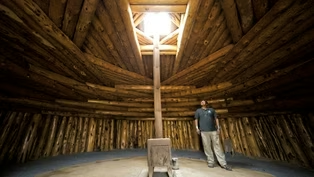
Video has Closed Captions
Preview: S53 Ep10 | 30s | Witness how Native North Americans have generated scientific knowledge over thousands of years. (30s)

Video has Closed Captions
Preview: S53 Ep9 | 30s | Follow the relentless quest that led to a breakthrough treatment for a deadly disease. (30s)
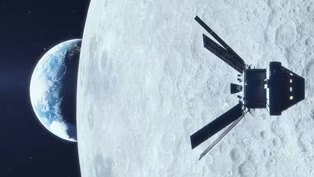
Video has Closed Captions
Preview: S53 Ep7 | 30s | Follow the Artemis mission to bring humanity back to the Moon for the first time since Apollo. (30s)
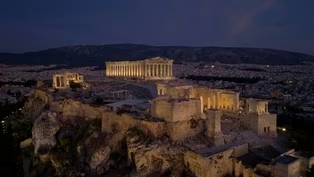
Athens: Birth of Democracy Preview
Video has Closed Captions
Preview: S53 Ep8 | 30s | Archaeologists investigate the dramatic origins of democracy in ancient Greece 2,500 years ago. (30s)
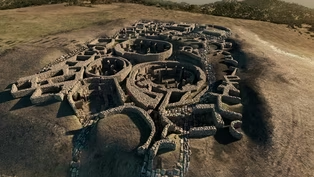
Stone Age Temple Mystery Preview
Video has Closed Captions
Preview: S53 Ep6 | 30s | Surprising evidence at the world’s oldest temple overturns our understanding of human history. (30s)
Video has Closed Captions
Preview: S53 Ep5 | 30s | A deadly—and growing—global weather phenomenon mystifies scientists. (30s)
Video has Closed Captions
Preview: S53 Ep4 | 30s | Explore mammals’ surprising origins, long before the age of dinosaurs. (30s)

Video has Closed Captions
Preview: S53 Ep3 | 30s | Do speech buttons really allow dogs to talk to us? Scientists investigate. (30s)
Angkor: Hidden Jungle Empire Preview
Video has Closed Captions
Preview: S53 Ep2 | 30s | New evidence sheds light on the remarkable life—and mysterious collapse—of the ancient jungle city. (30s)
When Earth Was Bombarded by Asteroids
Video has Closed Captions
Clip: S53 Ep1 | 3m 41s | What studying the surface of the Moon revealed about Earth’s apocalyptic youth. (3m 41s)
Asteroids: Spark of Life? Preview
Video has Closed Captions
Preview: S53 Ep1 | 30s | What if violent asteroid impacts actually jump-started life on Earth? Explore a dramatic theory. (30s)
Providing Support for PBS.org
Learn Moreabout PBS online sponsorship
- Science and Nature

Follow lions, leopards and cheetahs day and night In Botswana’s wild Okavango Delta.
 New Season




Support for PBS provided by:
National Corporate funding for NOVA is provided by Carlisle Companies. Major funding for NOVA is provided by the NOVA Science Trust and PBS viewers.