
Extended Series Preview
Preview: Season 2026 | 1m 27sVideo has Closed Captions
Discover epic science in the most extreme places on Earth.
A story of scientific daring and discovery, grit, and human endeavor, where unlocking the mysteries of our icy worlds is key to unlocking the forces that drive our planet.
Problems playing video? | Closed Captioning Feedback
Problems playing video? | Closed Captioning Feedback
Extended Series Preview
Preview: Season 2026 | 1m 27sVideo has Closed Captions
A story of scientific daring and discovery, grit, and human endeavor, where unlocking the mysteries of our icy worlds is key to unlocking the forces that drive our planet.
Problems playing video? | Closed Captioning Feedback
Where to Watch Ages of Ice
Ages of Ice is available to stream on pbs.org and the PBS app.
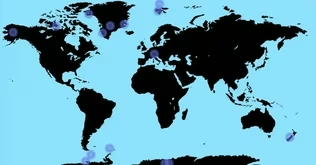
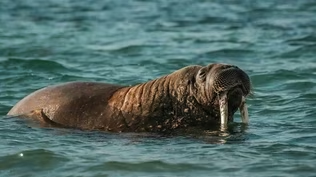
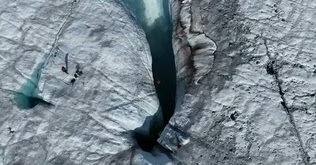
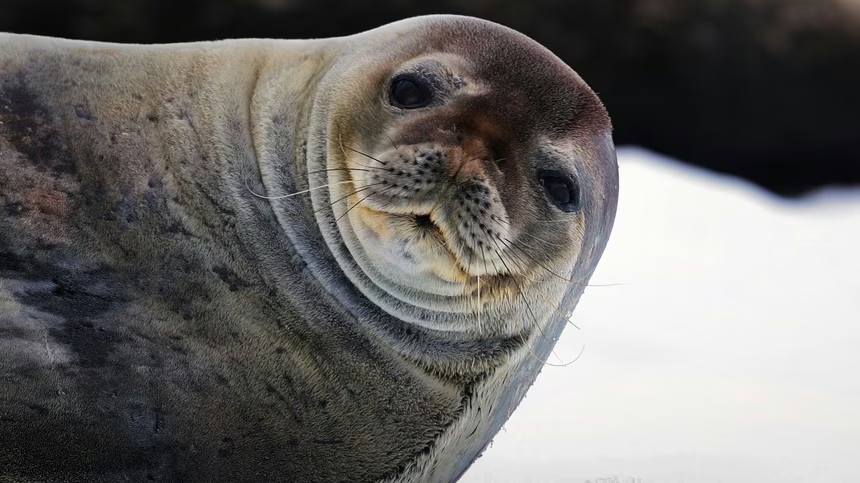
Share Inspiring Moments From The Film
Explore the PBS Giphy collection for Ages of Ice.Providing Support for PBS.org
Learn Moreabout PBS online sponsorship♪ Throughout Earth's time, there have been multiple ice ages and were called these interglacial warm periods.
In the stage we are in the orbit around our sun, we should actually be entering a phase of cooling.
And it's not.
You see this rapid rise, that is definitely the human fingerprint.
And never in geologic history have we seen such a rise in such a short amount of time.
There's nothing quite like the Arctic to humble you, right?
You will suffer.
You'll get cold toes and feet, you'll get hungry.
You'll get thirsty.
You might be inherently cold all the time.
This kind of terrain has these hidden dangers as much as it has these hidden stories.
We're laying the groundwork for incredible research that will continue beyond our lifetimes.
The polar regions can give us the pulse of the planet.
What is happening?
You're gathering intimate scientific data on the surface, beneath the surface, above the surface.
And unless we're here, we don't understand how the planet is faring or what's its health into the future.
Its this storminess, this activity, all this energy is just driving everything else that the oceans are doing.
There hasn't been a time where humans have lived, where it's been ice free.
And that's the experiment.
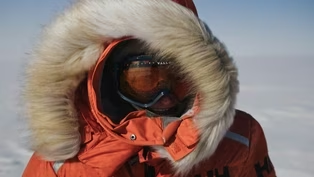
Why Scientists Brave the Poles
Video has Closed Captions
Preview: S2026 | 3m 59s | At -40°, your eyelashes freeze with every blink. So why do these scientists keep coming back? (3m 59s)
Video has Closed Captions
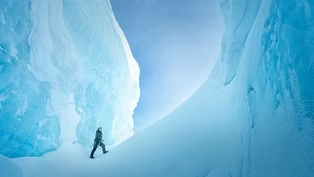
Preview: S2026 | 30s | Discover epic science in the most extreme places on Earth. (30s)
Video has Closed Captions
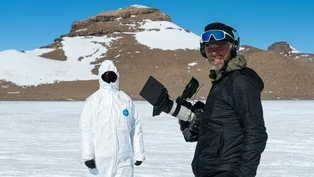
Preview: S2026 | 4m 54s | Go behind the scenes of the epic three-year journey to film “Ages of Ice.” (4m 54s)
 Now Playing
Video has Closed Captions
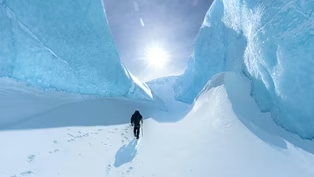
Preview: S2026 | 1m 27s | Discover epic science in the most extreme places on Earth. (1m 27s)
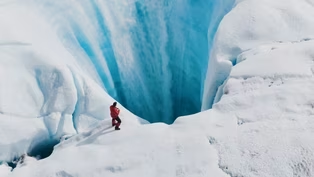
Video has Closed Captions
Clip: S2026 | 2m 22s | Glaciologist Alun Hubbard stands at the edge of a perilous moulin on the Greenland ice sheet. (2m 22s)
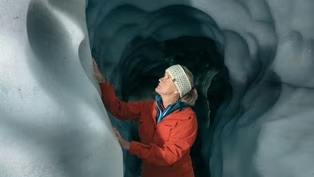
Video has Closed Captions
Clip: Ep3 | 3m 39s | Could life beyond Earth hide in ice? Dr. Birgit Sattler finds tardigrades thriving inside a glacier. (3m 39s)
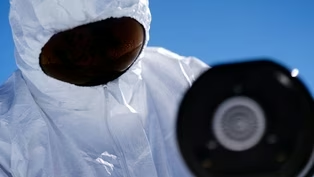
Antarctica's Air-Eating Microbes
Video has Closed Captions
Clip: Ep3 | 3m 54s | No sunlight, no soil to eat. In Antarctica, Dr. Ry Holland finds microbes surviving on thin air. (3m 54s)
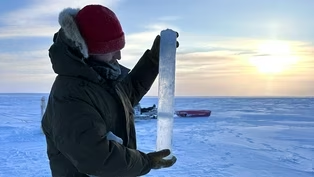
Video has Closed Captions
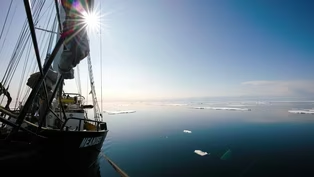
Clip: Ep2 | 3m 58s | Pumping seawater onto frozen ocean, Real Ice and Inuit guides test whether sea ice can grow thicker. (3m 58s)
Video has Closed Captions
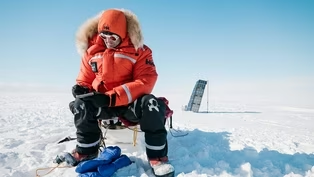
Clip: Ep2 | 2m 18s | Dr. Melanie Lancaster is a marine mammal specialist and advocate for quiet Arctic oceans. (2m 18s)
Video has Closed Captions
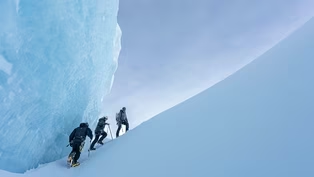
Clip: Ep1 | 4m 48s | Five strangers, 220-pound sleds, 30 days on Greenland's ice, all to map what lies beneath. (4m 48s)
Video has Closed Captions
Clip: Ep1 | 4m 58s | Is Greenland's ice leaking methane? Glaciologist Alun Hubbard descends into a moulin to find out. (4m 58s)
Providing Support for PBS.org
Learn Moreabout PBS online sponsorship New Episode
- Science and Nature

Explore scientific discoveries on television's most acclaimed science documentary series.

 New Episode
 New Episode









Support for PBS provided by: