
The Making of “Ages of Ice”
Preview: Season 2026 | 4m 54sVideo has Closed Captions
Go behind the scenes of the epic three-year journey to film “Ages of Ice.”
Learn how crew and scientists travelled to some of the most unforgiving places on the planet to film “Ages of Ice.” Battling blizzards, crossing ice sheets, and adapting to the unpredictability of polar fieldwork, watch the extraordinary effort behind every moment on screen and the shared curiosity driving filmmakers and scientists to the ends of the Earth.
Problems playing video? | Closed Captioning Feedback
Problems playing video? | Closed Captioning Feedback
The Making of “Ages of Ice”
Preview: Season 2026 | 4m 54sVideo has Closed Captions
Learn how crew and scientists travelled to some of the most unforgiving places on the planet to film “Ages of Ice.” Battling blizzards, crossing ice sheets, and adapting to the unpredictability of polar fieldwork, watch the extraordinary effort behind every moment on screen and the shared curiosity driving filmmakers and scientists to the ends of the Earth.
Problems playing video? | Closed Captioning Feedback
Where to Watch Ages of Ice
Ages of Ice is available to stream on pbs.org and the PBS app.
Share Inspiring Moments From The Film
Explore the PBS Giphy collection for Ages of Ice.Providing Support for PBS.org
Learn Moreabout PBS online sponsorship♪ Making a series about the polar regions requires doing some hard yards.
For the past three years, cameras have followed scientists into some of the most remote, hostile, and extraordinary environments on the planet.
Across the ice sheet of Greenland, into the heart of Antarctica, and through the storm battered scenes that surround them.
Spray coming over here, be careful.
To tell the story required crossing crevasse fields, enduring temperatures below -40 degrees, and working in places where help could be days away.
Here it comes.
But it also meant witnessing things few people ever see.
And scientists making remarkable discoveries on the front line of a changing planet.
Oh my goodness.
Every moment of wonder on screen has a story of its own.
Leading that journey was director Karina Holden.
After two and a half years of filming, this is it.
Coldest we've been.
It's like a dry cold.
It really bites at you.
The most bitter cold, though, was in the Canadian Arctic when we were on the sea ice.
And it was a wet, cold.
And that got to, you know, -40.
And then the wind picked up, so you going into the -50°C.
And it feels like you're on fire when it's that cold.
All of our batteries are now toast.
So we are calling it a day.
We're out here, and were camping.
So having to sleep on that, it's it's brutal.
It's ******* windy.
You know, that's what the story is all about understanding these places.
So we've got to be out here to experience it.
Three, Two, One.
So I think what makes Ages of Ice different to a lot of other shows that have looked at our polar regions before, is it's really about scientific endeavor.
Yeah, thatll work.
And one of the things that we really have strived to do is make it a very immersive experience.
Schoolboys and explosions, right?
To take viewers into places where the scientists are really, you know, they're explorers.
We come out here with sort of a sense of the science that we want to do, but science in itself is a creative process.
Both scientists and filmmakers, you know, were coming at things with a set of problems we're trying to solve and using our creativity to say, well, how can we work best with the story that's in front of us?
And certainly that's been the case here.
It's been glorious to be out in these places.
There is something humbling about being in a part of the planet that's so expansive and so vast.
We're at 80 degrees north now, and we've just come into the ice pack, and it is one of these unbelievably beautiful Arctic days.
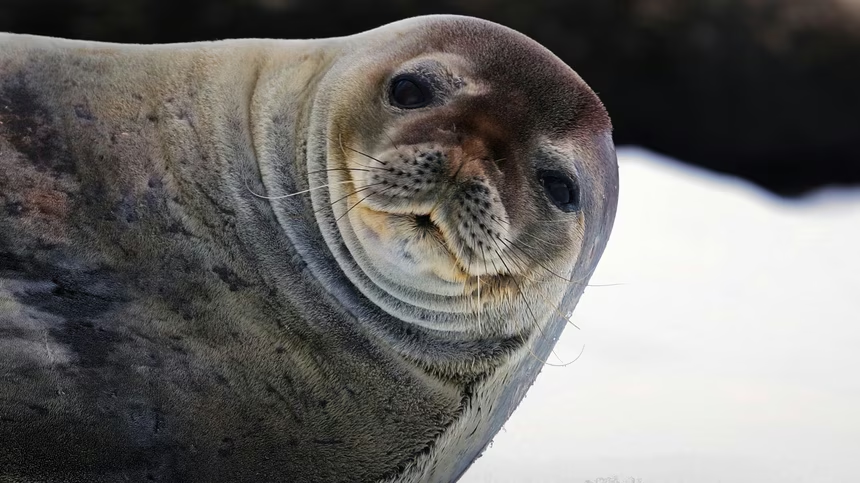
Oh, we've got a seal.
This is a gorgeous bearded seal.
These are actually some of my favorites.
It feels magical.
It really does.
And I think that what really gives me hope is just seeing scientists at work.
And that quest for for knowledge has really inspired me throughout the project.
We travel to the ends of the Earth to understand them, only to discover they were never really the end of the story.
Because what happens in these remote frozen worlds doesn't stay there.
It flows through oceans.
Through atmospheres, through ecosystems, and till it touches every one of us, reminding us that on a planet as connected as ours, there is no such thing as far away.
Why Scientists Brave the Poles
Video has Closed Captions
Preview: S2026 | 3m 59s | At -40°, your eyelashes freeze with every blink. So why do these scientists keep coming back? (3m 59s)
Video has Closed Captions
Preview: S2026 | 30s | Discover epic science in the most extreme places on Earth. (30s)
 Now Playing
Video has Closed Captions
Preview: S2026 | 4m 54s | Go behind the scenes of the epic three-year journey to film “Ages of Ice.” (4m 54s)
Video has Closed Captions
Preview: S2026 | 1m 27s | Discover epic science in the most extreme places on Earth. (1m 27s)
Video has Closed Captions
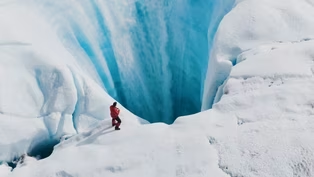
Clip: S2026 | 2m 22s | Glaciologist Alun Hubbard stands at the edge of a perilous moulin on the Greenland ice sheet. (2m 22s)
Video has Closed Captions
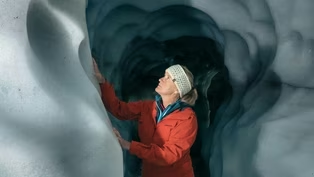
Clip: Ep3 | 3m 39s | Could life beyond Earth hide in ice? Dr. Birgit Sattler finds tardigrades thriving inside a glacier. (3m 39s)
Antarctica's Air-Eating Microbes
Video has Closed Captions
Clip: Ep3 | 3m 54s | No sunlight, no soil to eat. In Antarctica, Dr. Ry Holland finds microbes surviving on thin air. (3m 54s)
Video has Closed Captions
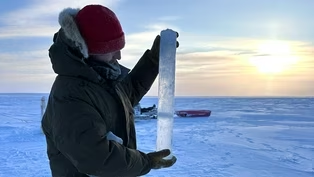
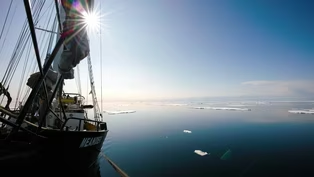
Clip: Ep2 | 3m 58s | Pumping seawater onto frozen ocean, Real Ice and Inuit guides test whether sea ice can grow thicker. (3m 58s)
Video has Closed Captions
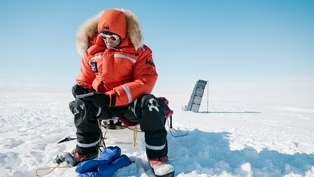
Clip: Ep2 | 2m 18s | Dr. Melanie Lancaster is a marine mammal specialist and advocate for quiet Arctic oceans. (2m 18s)
Video has Closed Captions
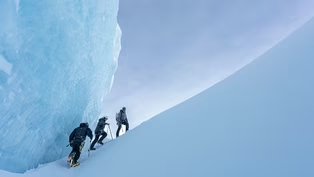
Clip: Ep1 | 4m 48s | Five strangers, 220-pound sleds, 30 days on Greenland's ice, all to map what lies beneath. (4m 48s)
Video has Closed Captions
Clip: Ep1 | 4m 58s | Is Greenland's ice leaking methane? Glaciologist Alun Hubbard descends into a moulin to find out. (4m 58s)
Providing Support for PBS.org
Learn Moreabout PBS online sponsorship New Episode
- Science and Nature

Explore scientific discoveries on television's most acclaimed science documentary series.
 New Episode
- Science and Nature

Capturing the splendor of the natural world, from the African plains to the Antarctic ice.

 New Episode







Support for PBS provided by: