Our Hometown
Exeter | The Folsom Tavern
Clip | 5m 57sVideo has Closed Captions
Rebeccah tells us about the beautiful architecture & rich history of the Folsom Tavern.
Rebeccah tells us about the beautiful architecture & rich history of the Folsom Tavern. It has great significance to Exeter and to the Revolutionary War, as a meeting house and Tavern.
Problems playing video? | Closed Captioning Feedback
Problems playing video? | Closed Captioning Feedback
Our Hometown is a local public television program presented by NHPBS
Our Hometown
Exeter | The Folsom Tavern
Clip | 5m 57sVideo has Closed Captions
Rebeccah tells us about the beautiful architecture & rich history of the Folsom Tavern. It has great significance to Exeter and to the Revolutionary War, as a meeting house and Tavern.
Problems playing video? | Closed Captioning Feedback
How to Watch Our Hometown
Our Hometown is available to stream on pbs.org and the free PBS App, available on iPhone, Apple TV, Android TV, Android smartphones, Amazon Fire TV, Amazon Fire Tablet, Roku, Samsung Smart TV, and Vizio.
We are, sitting in the Folsom Tavern, which is part of the American Independence Museum here on our campus.
It was built to impress, and it is a very impressive building.
It was started 1773, finished in 1775, just a few months before Exeter became the capital of New Hampshire during the Revolutionary War.
It was built by Colonel Samuel Folsom.
He fought in the French and Indian War, but he did not fight during the Revolutionary War.
But he was a very significant influence during that war.
It was located right in the center of town.
So when you came in, it was the first thing you saw.
It has a, a New England Georgian townhouse facade on it.
And it has, a hip roof, which is very rare for the north actually meant you see it much more in the south.
It also was built as what they called a double house, which means that it has, a center hallway, a center stair stairwell in it, and, and two chimneys.
It was Samuel's grandfather who had a tavern that was located around the corner, actually, on Water Street.
The burned in, 1768.
So, there's a family history to that, which I thought was interesting, and it had the most beautiful view, also of the Swampscott River, because none of the buildings were down, on Water Street.
And so that was where the, the harbor was, and it was it was, a beautiful setting.
So 1783 the society, of Cincinnati was, actually formed and organized here.
It was chosen for that.
And again, because it was also, an upper class location, the same retired or many retired officers from the Revolutionary War that wanted to, be remembered, for their, participation in our independence and liberty.
1789 George Washington, came through town.
It was, quite a much shorter visit than the community was anticipating.
But he did have breakfast here, and he did have breakfast in the front parlor, which has been documented.
And, they wanted him to stay for dinner and a little bit more celebration, but he had to to go on.
But there's an interesting aside to when he left to.
And this was witnessed by, one of the gentlemen that, accompanied him to Washington from town, out of town, as his carriage was leaving.
And, apparently they reached the top of High Hill and, he asked the carriage driver to stop, and, he looked back at Exeter and thought that it was quite a lovely, landscape.
He commented on that, which I think is very interesting.
And he did comment in his diaries, too, on his, different places that he stayed, including Exeter.
The tavern has been moved three times, which again makes it extremely interesting and also amazing that we have that we have ended up with this really beautiful, building in 1860.
They wanted to well, they wanted to, Front Street was expanded.
So when they did that, they just had to move the tavern a little bit back a little bit to the side.
So which is what they did, but they elevated it also.
And at that point they built, underneath, of the tavern, there was a restaurant and, there you could buy tickets for the, the train, etc., etc.. So it was there until 1929 when Standard Oil made an offer for the land, not the building.
And so the building at that point was sold to the Society of Cincinnati.
Keeping in mind the fact that this is where they were founded and it was moved, just a couple of streets over to Spring Street, which is, right now the west side of where we're sitting.
And so then in 2004, it was determined that it, it, it should be relocated to, to a point or a place on Water Street of prominence, which is what it had before, which is around the corner from Spring Street.
So it wasn't a major move, but again, it was significant.
And then from that move it was restored.
And by 2007, beautifully restored, I have to say.
And by 2007, it was open again, as a tavern.
So the society, has had a definitely an association with this whole property while, they were they did continue to actually acquire property, which made it possible when they did move the tavern in 2004 to have this wonderful location on Water Street.
And yes, they do continue to have an annual meeting here.
Very significant to them.
They really are committed to the integrity of the tavern and also to sharing it with the community, and certainly with the state, given its incredible historic value to the American Revolution.
Exeter | The Society of Cincinnati
Video has Closed Captions
Clip | 6m 13s | Dana tells us about the genesis of the Society of Cincinnati in New Hampshire. (6m 13s)
 Now Playing
Video has Closed Captions
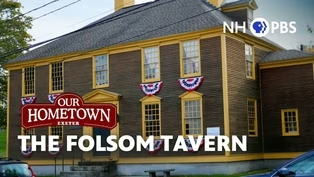
Clip | 5m 57s | Rebeccah tells us about the beautiful architecture & rich history of the Folsom Tavern. (5m 57s)
Video has Closed Captions
Clip | 4m 11s | Alexis Cargill speaks about the Community Fridge; a self-serve food clearinghouse. (4m 11s)
Exeter | Living in a Vibrant Community
Video has Closed Captions
Clip | 3m 30s | Cathleen Toomey talks about moving to, and living in such a diverse, thriving community. (3m 30s)
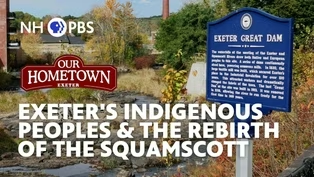
Exeter | Indigenous Peoples & the Rebirth of the Squamscott
Video has Closed Captions
Clip | 6m 28s | Denise and Paul Pouliot tell us about the indigenous roots of many of the area names. (6m 28s)
Video has Closed Captions
Clip | 5m 21s | Bob Glowacky tells us about the many things that Exeter TV is doing to connect & build community. (5m 21s)
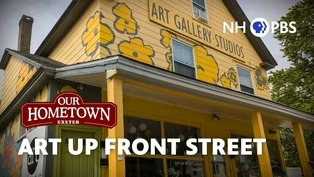
Video has Closed Captions
Clip | 4m 39s | Rose talks about the vibrant art community in Exeter, and how she started her studio & gallery. (4m 39s)
Warner | Woodworking in Warner
Video has Closed Captions
Clip | 2m 10s | Jim McLaughlin shares how woodworking deepened his bond with Warner. (2m 10s)
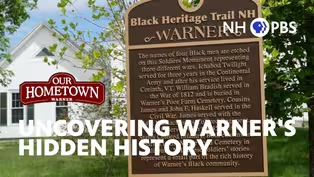
Warner | Uncovering Warner's Hidden History
Video has Closed Captions
Clip | 5m 7s | Discover Warner’s untold Black history with local historian Rebecca Courser. (5m 7s)
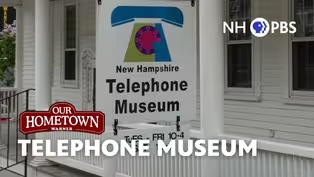
Video has Closed Captions
Clip | 6m 22s | Graham Gifford shares how Warner’s telephone museum came to life—surprising all. (6m 22s)
Video has Closed Captions
Clip | 2m 53s | Ian Rogers shares how travel and Warner’s community shaped his independent spirit. (2m 53s)
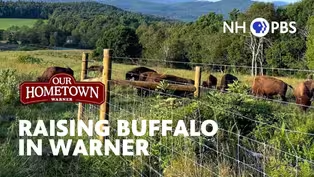
Warner | Raising Buffalo in Warner
Video has Closed Captions
Clip | 4m 47s | Brian & Kira Farmer share why they moved to Warner and raise buffalo on their farm. (4m 47s)
Warner | Painting Warner's Landscapes and Legacy
Video has Closed Captions
Clip | 2m 17s | Artist Mimi Wiggin paints her family’s legacy and Warner’s landscapes and traditions. (2m 17s)

Video has Closed Captions
Clip | 7m 57s | Neil Nevins tells about their non-profit, "Main Street Warner". (7m 57s)
Warner | From Train Station to Print Shop
Video has Closed Captions
Clip | 5m 56s | Jeremy reflects on the vibrant life surrounding Warner’s beloved train station. (5m 56s)
Video has Closed Captions
Clip | 2m 24s | Nancy Martin shares funny, fishy memories from Warner’s kids’ derby. (2m 24s)
Video has Closed Captions
Clip | 5m 1s | The rich history of Warner's fire department. (5m 1s)
Warner | Fall Foliage Festival
Video has Closed Captions
Clip | 2m | Ray Martin reflects on decades organizing the Warner Fall Foliage Festival and service. (2m)
Video has Closed Captions
Clip | 3m 52s | Tim Blagden shares how Warner’s abandoned rails became a community trail vision. (3m 52s)

Video has Closed Captions
Clip | 7m | Apryl Blood and Patty Anderson discussing their roles in the community. (7m)
Warner | Cheddah?,... No, Feta
Video has Closed Captions
Clip | 4m 34s | Author David Elliott speaks about moving to Warner. (4m 34s)
Warner | A Creative Welcoming Community
Video has Closed Captions
Clip | 4m 7s | As a radio guy and author, Matt Esenwine talks about coming to Warner. (4m 7s)
Warner | 4-H Leadership and Community Teaching
Video has Closed Captions
Clip | 5m 41s | Susan Jenna and Abigail R. reflect on decades of 4-H leadership and community teaching. (5m 41s)

Video has Closed Captions
Clip | 3m 15s | Dan Salzer and Jonathon Picard talk about Pemi Baker TV. (3m 15s)
Video has Closed Captions
Clip | 3m | Maryann Barnsley tells us about a childhood dream. (3m)
Video has Closed Captions
Clip | 2m 1s | Katharina Kelsey and her husband made a list, Plymouth checked all the boxes, and so much more. (2m 1s)

Plymouth | The Happiness Quest
Video has Closed Captions
Clip | 2m 34s | Dr. Marie Sanders relates what can happen when an entire town works together to discover happiness. (2m 34s)

Plymouth | Memories, Stories and Cake
Video has Closed Captions
Clip | 5m 41s | Patricia Hoyt came to Plymouth for college, launched her career here. (5m 41s)
Plymouth | Memories of Plymouth
Video has Closed Captions
Clip | 1m 55s | Louise McCormick is a townie. She grew up in Plymouth, and has spent most of her life here. (1m 55s)
Plymouth | Local Foods Plymouth
Video has Closed Captions
Clip | 3m 23s | Marianna Evans talks about Local Foods Plymouth, and how the pandemic helped to create a model. (3m 23s)
Video has Closed Captions
Clip | 2m 21s | Carol Dunn tells about how this amazing town bonded together to save her business on Main Street. (2m 21s)
Plymouth | From Minsk to Plymouth
Video has Closed Captions
Clip | 3m 41s | Jim Lurie tells us how in 1917, his grandfather travelled from Minsk, Russia, across Siberia. (3m 41s)
Video has Closed Captions
Clip | 1m 34s | Bob Gannett speaks about an interesting story unfolding as he was on the radio. (1m 34s)
Video has Closed Captions
Clip | 4m | Terry Fifield has lived in a lot of places, but found that the Plymouth area to be the best. (4m)
Plymouth | Community... on Wheels
Video has Closed Captions
Clip | 6m 14s | Mike Currier talks about the roots of the Plymouth Skate Park. (6m 14s)
Video has Closed Captions
Clip | 1m 45s | Bill Clark talks about, even with growth and progress, Plymouth is a special town. (1m 45s)
Video has Closed Captions
Clip | 4m 19s | Suzan Gannett talks about Artistic Roots, and the programs and passions that it has inspired. (4m 19s)
Video has Closed Captions
Clip | 2m 31s | John Scheinman shares how the skills needed in successfully coaching can be used. (2m 31s)
Plymouth | A Commitment of Caring
Video has Closed Captions
Clip | 5m 1s | Jessica Dutille talks about re-building community, after the pandemic changed the world. (5m 1s)
Video has Closed Captions
Clip | 4m 16s | Yvonne recalls growing up in Berlin, and speaking two languages in school. (4m 16s)
Video has Closed Captions
Clip | 6m 41s | Andre speaks to us about growing up in Berlin. (6m 41s)
Video has Closed Captions
Clip | 12m 40s | Walter tells us about Berlin's Skier/Soldier, Paul Petersen, and a love story. (12m 40s)
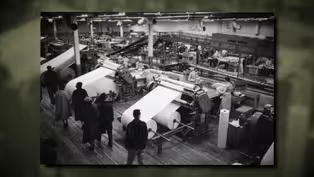
Video has Closed Captions
Clip | 3m 36s | Roland talks about working in every aspect of the paper industry, over 4+ decades. (3m 36s)
Video has Closed Captions
Clip | 4m 19s | Renney tells a couple of great stories about growing up in Berlin. (4m 19s)
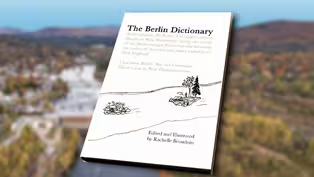
Video has Closed Captions
Clip | 5m 37s | Berlin has a language all its own, and Rachelle decided to compile a dictionary of words. (5m 37s)
Video has Closed Captions
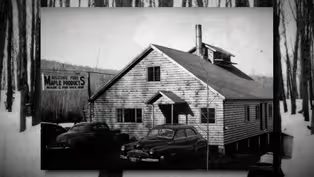
Clip | 4m 24s | Olive speaks about growing up in Berlin, in a family that owned Bisson's Sugar House. (4m 24s)
Video has Closed Captions
Clip | 3m 5s | Lorna recalls heading into Berlin on Friday nights, for shopping & meeting up with friends (3m 5s)
Video has Closed Captions
Clip | 3m 54s | Moving to Berlin was a dream come true for Haven, as he loved working in the woods. (3m 54s)
Video has Closed Captions
Clip | 2m 43s | Diane talks about going from a 45 year career in the banking industry. (2m 43s)
Video has Closed Captions
Clip | 6m 40s | Dennis tells the story of the history of boy scouts in Berlin, NH. (6m 40s)
Providing Support for PBS.org
Learn Moreabout PBS online sponsorship















Support for PBS provided by:
Our Hometown is a local public television program presented by NHPBS